
How Long Between Marathons? How Many Can You Run a Year?
Marathon muscle damage takes 3 to 4 weeks to repair. Find out how long to wait between marathons, how many to run a year and how to plan your next race.





Marathon muscle damage takes 3 to 4 weeks to repair. Find out how long to wait between marathons, how many to run a year and how to plan your next race.
Runners who swapped half their sessions for rides gained as much VO2max as those who only ran. See how much cycling helps marathon training and when to stop.
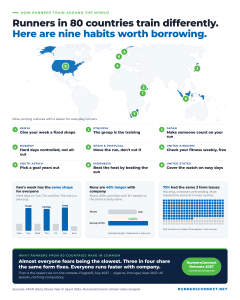
Over the last few years, about 240 runners from our coaching community in more than 20 countries came to our running retreats. They came from


Hot packs warmed deep hamstring muscle just 0.4°C (0.7°F). Learn when heating pads, hot baths and Icy Hot help before a run, and when you should skip them.

Aerobic running means running easy enough to fuel your muscles with oxygen. Even a 1,500 m race is about 80% aerobic. Learn how to check your aerobic pace.

A slow jog warms you up for easy runs. Before workouts and races, add drills and strides. Get the routine, the stretching research and how long to warm up.
Over the last few years, about 240 runners from our coaching community in more than 20 countries came to our running retreats. They came from
Hot packs warmed deep hamstring muscle just 0.4°C (0.7°F). Learn when heating pads, hot baths and Icy Hot help before a run, and when you should skip them.
Aerobic running means running easy enough to fuel your muscles with oxygen. Even a 1,500 m race is about 80% aerobic. Learn how to check your aerobic pace.
A slow jog warms you up for easy runs. Before workouts and races, add drills and strides. Get the routine, the stretching research and how long to warm up.


A short, easy run the day before a race beats a full rest day. Here is how far to run before a 5K, 10K, half marathon or marathon, and when to skip it.

Blood lactate can hit 15 to 25 mmol/L after a sprint. See why lactic acid burns when running, whether it makes you sore, and how to clear it. Learn more.

Should you take Imodium before a marathon? See when it peaks, the 8 mg daily limit and the gut training plan that cut runner’s gut symptoms by 60%. Learn more.


Every athlete with intestinal cramps in one race survey had eaten a fiber-rich pre-race meal. See how much fiber runners need and when to cut it. Learn more.
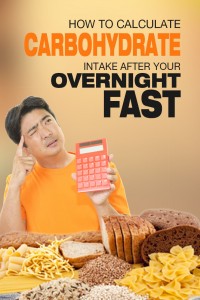
A 150-pound runner burns about 245 grams of carbs on a rest day and 16 to 22 grams per mile. See how many carbs you burn asleep and on the run. Learn more.

Missed periods and low testosterone are linked to 4.5 times more bone injuries. Learn the 7 warning signs of underfueling and how much to eat. Find out more.

Runners lose about 1.3 liters of sweat per hour on average. Learn how to calculate your own sweat rate and turn it into a safe drinking plan. Find out how.

Coffee before running can make you 2% faster in endurance races. Learn how much caffeine to take for your weight and how long before a run to drink it.

Taller runners take about 12 fewer steps per minute for every 4 inches of height. See the stride length your pace needs and when to raise cadence. Learn more.
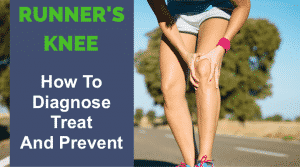
Runner’s knee is the most common running injury. See how long it lasts, how to tell it from a meniscus tear and the exercises that ease the pain. Learn more.

A narrow stride width raises IT band strain and shin bone stress. See how wide a normal running step is, test yours in 2 minutes, and learn how to fix it.

Raising your stride frequency 10% cut hip and knee loading in a 45-runner study. See how stride length and frequency set your pace and how to change yours.

Distance runners get asthma 5 times as often as non-runners. See the best time to run in pollen season and which allergy relief works for runners. Learn more.
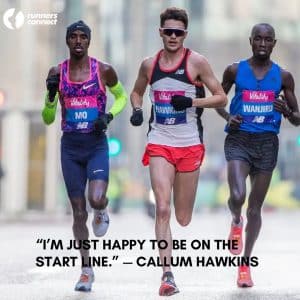
20 to 70% of runners reinjure on the way back. A criteria-based return-to-running protocol and readiness checklist to make your comeback the last one.

How many days a week should older runners run? Most runners 60 and up do best on 4 to 5 days, with smart spacing between hard sessions. See the weekly plan.


Struggling with slower recovery and slipping times after 40? These 5 evidence-based masters running tips address the exact physiology that changes with age. Learn more.

A typical 40-year-old runs a 55-minute 10K. By 70, that slips to 64 minutes. See decade-by-decade benchmarks and the 4 levers that slow the rate.

As all masters runners know and understand, things change as we age. We’ve already covered the need for More focused strength training More recovery, and

Last week I wrote an article on how to re-think your perception of training theory or workout ideas when you think you’re too slow for

The term masters has a bad connotation. I mean it sounds old. Especially for those “younger masters.” I remember racing the Masters Track and Field

Clip on the safety key, press Quick Start and pick a speed you can still talk at. Here’s how to use a treadmill, plus the 1% incline rule. Learn more.
Runners lose about 1.3 liters of sweat per hour on average. Learn how to calculate your own sweat rate and turn it into a safe drinking plan. Find out how.

Flow state running feels effortless, but it is a real, measurable brain state. Learn how it differs from a runner’s high and how to reach it on your next run.

Needing to poop while running? Learn the blood-flow cause, the foods that trigger runner’s trots, and how to time runs, hydrate, and prep for race day.

The best BPM for running is 125 to 140 beats per minute. See what the research says about tempo, syncing your cadence, and building a playlist that works.
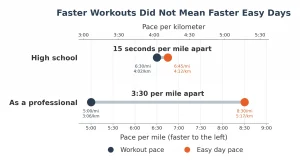
Your easy pace often stalls or slows deep in a training block, and research shows muscle damage cuts running economy 3-7%. See what to judge instead. Find out.


"I have come across many coaches, scientists, and physicians associated with running in my lifetime. No one connects all the dots with history, science, and practical application like RunnersConnect does. I look forward to their frequent posts, which are referenced with science and applicable to all the current trends and debates in running. "
Dr. Mark Cucuzzella
"Understanding the science behind the workouts and the plan helps me to trust the training when I know why I'm doing a particular workout and what the result of it should be."
Kara Schmidt

"As a master's runner and journalist specializing in running, I find the well researched information presented on Runner's Connect incredibly useful. You won't find a better clearing house of running knowledge on the Internet! "
Amanda Loudin

"I love your emails! You cover all the important injury prevention and topics related to running performance. As a competitive runner, I'm always learning more from Runners Connect! "
Barbara Broad

"RC helped me smash my stretch goal and I couldn't be happier. In all my races so far I've been simply amazed at what a great feeling it is being well trained and well prepared for the task at hand."
Dean Roberts

"As usual, Jeff and the RunnersConnect team goes beyond all the simplistic advice you normally find in magazines and backs up all theories with research and pratical examples."
Brian Connors