

Runners slow down after 40.
Large-scale race data puts the average decline at about 0.2% per year for moderate distances and 1 to 1.4% per year for the marathon.
That’s 1 to 6 seconds per mile per year, depending on how far you race.
The physiological systems driving that number are largely ones you can train against.
- How fast runners actually slow down after 40, and why the marathon takes a bigger hit than shorter races
- Decade-by-decade pace benchmarks from 10K to marathon
- The 4 physiological changes behind age-related decline, and what to do about each
A good 10K time for a 40-year-old runner is around 55:00 (8:51/mi, 5:30/km), rising to roughly 60:45 (9:46/mi, 6:04/km) by age 60 for runners who stay consistent.
How Fast Do Runners Slow Down After 40?
The decline is real, but the numbers are smaller than most runners expect.
A 2010 study of nearly 200,000 runners in a 15K road race found that for each year over 40, performance dropped by just 0.2%.
That’s roughly 1 second per mile per year.
As runners age, the performance gap between men and women shrinks significantly.
By age 60, women close about 5 of the 15% gap that separates the genders at age 40.
Men’s performance drops more sharply after 60, while women continue declining at a steadier, more linear rate.
The same study also separated runners into trained and untrained categories.
Trained runners were nearly 16% faster across all age groups.
A trained woman over 40 can edge out an untrained man of the same age.
Research on NYC Marathon finishers found that runners over 40 slowed by 1 to 1.4% per year, which works out to 4 to 6 seconds per mile per year for a 3-hour marathoner.

That’s a steeper decline than the 15K data, which points to a real distance effect.
The marathon punishes aging more than shorter races.
A 2003 study of highly trained male runners with 10K times between 31 and 40 minutes found performance declined at about 0.5% per year, or just under 2 seconds per mile per year.
Shorter distances are kinder to aging runners, and staying fit matters.
What Is a Good 10K, Half Marathon, or Marathon Time by Age?
The decline rates from those studies turn into concrete benchmarks once applied to the race times most runners actually run.
Global aggregate data from millions of race results puts the average 40-year-old recreational runner near 55:00 for the 10K, 2:05 for the half marathon, and 4:30 for the full marathon.
Apply the 0.5% annual decline at the 10K, roughly 0.6% at the half, and 1.2% at the marathon, and you get a realistic picture of how those times drift across three decades.
| Age | 10K (pace) | Half Marathon (pace) | Marathon (pace) |
|---|---|---|---|
| 40 | 55:00 (8:51/mi, 5:30/km) | 2:05:00 (9:32/mi, 5:55/km) | 4:30:00 (10:19/mi, 6:24/km) |
| 50 | 57:50 (9:18/mi, 5:47/km) | 2:12:30 (10:06/mi, 6:17/km) | 5:04:00 (11:36/mi, 7:12/km) |
| 60 | 60:45 (9:46/mi, 6:04/km) | 2:20:30 (10:43/mi, 6:39/km) | 5:43:00 (13:05/mi, 8:07/km) |
| 70 | 63:50 (10:16/mi, 6:23/km) | 2:29:00 (11:22/mi, 7:04/km) | 6:26:00 (14:44/mi, 9:09/km) |
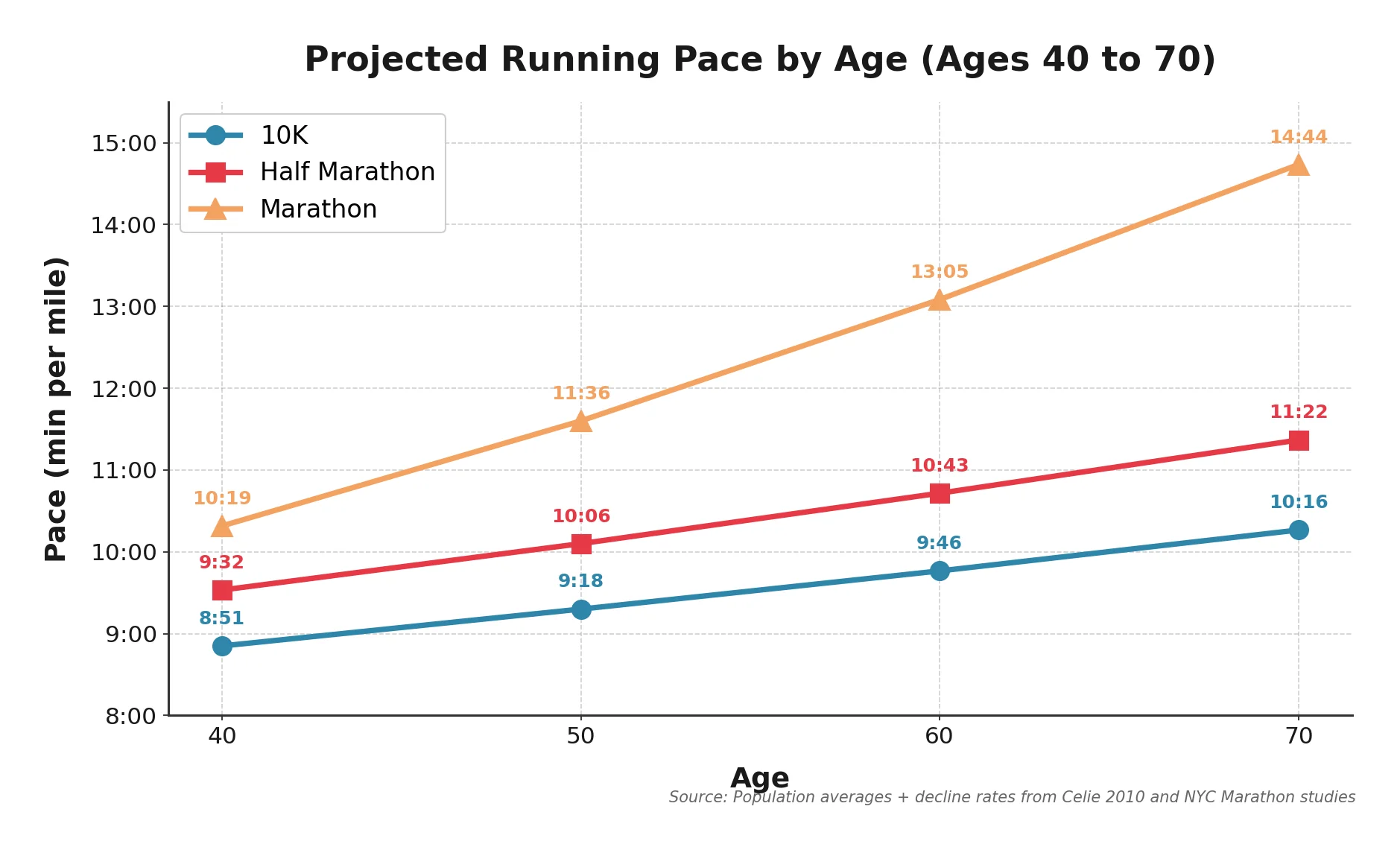
A typical 60-year-old recreational runner loses about 6 minutes off a 10K, 15 minutes off a half marathon, and more than an hour off a marathon compared to their 40-year-old benchmark.
These are population averages, not destiny.
A trained runner who keeps up interval work and strength training routinely beats these benchmarks by several minutes at the 10K and double-digit minutes at the marathon.
Most large data sets show the curve steepens after about age 60 for men, while women decline on a straighter line but from a slightly smaller gender gap than at age 40.
If you want to run your own projection against a different baseline, our race time calculator lets you plug in a current time at one distance and see what an honest goal looks like at another.
RunnersConnect Bonus
Download your FREE Age Grading Performance Calculator now.
It makes it easy to calculate your age graded performance to compare yourself against those young guns or your former self.
What Causes the Decline in Running Performance After 40?
Several physiological systems change as you get older, and most of them are connected.
VO2 max, your body’s ceiling for oxygen processing, drops steadily after 40.
This is the single biggest contributor to slowing race times.
Maximum heart rate falls too, which limits how hard your cardiovascular system can work at peak effort.
Muscular strength, explosive power, and flexibility all decline with age.
The strength losses are particularly damaging because they affect your ability to generate the propulsive force that keeps your stride efficient at faster paces.
Running economy, how efficiently you use oxygen at a given pace, barely declines in trained runners, even into your 60s.
The engine gets smaller, but the transmission stays efficient.
Research has shown that NAD+ levels drop with age, reducing the efficiency of mitochondrial energy production.
Mitochondria are the structures inside your cells that convert fuel into usable energy.
When NAD+ declines, the entire recovery and adaptation cycle slows down.
For masters runners, this often shows up as slower recovery between sessions, a widening gap between training effort and expected adaptation, and declining aerobic capacity despite consistent work.
One approach gaining traction is supplementing with NAD+ precursors (NMN or NR) at 1,000 to 1,200 milligrams daily for 4 to 12 weeks.
The research is still developing, but early findings point to improved mitochondrial efficiency and cellular repair capacity in aging athletes.
Addressing that decline at the source is what NAD+ supplementation targets. MAS NAD+ is targeted specifically at masters athletes who want to address the cellular decline before it becomes performance-limiting.
How Does Running Form Change With Age?
Your running mechanics shift as the years accumulate, and those changes carry their own efficiency costs.
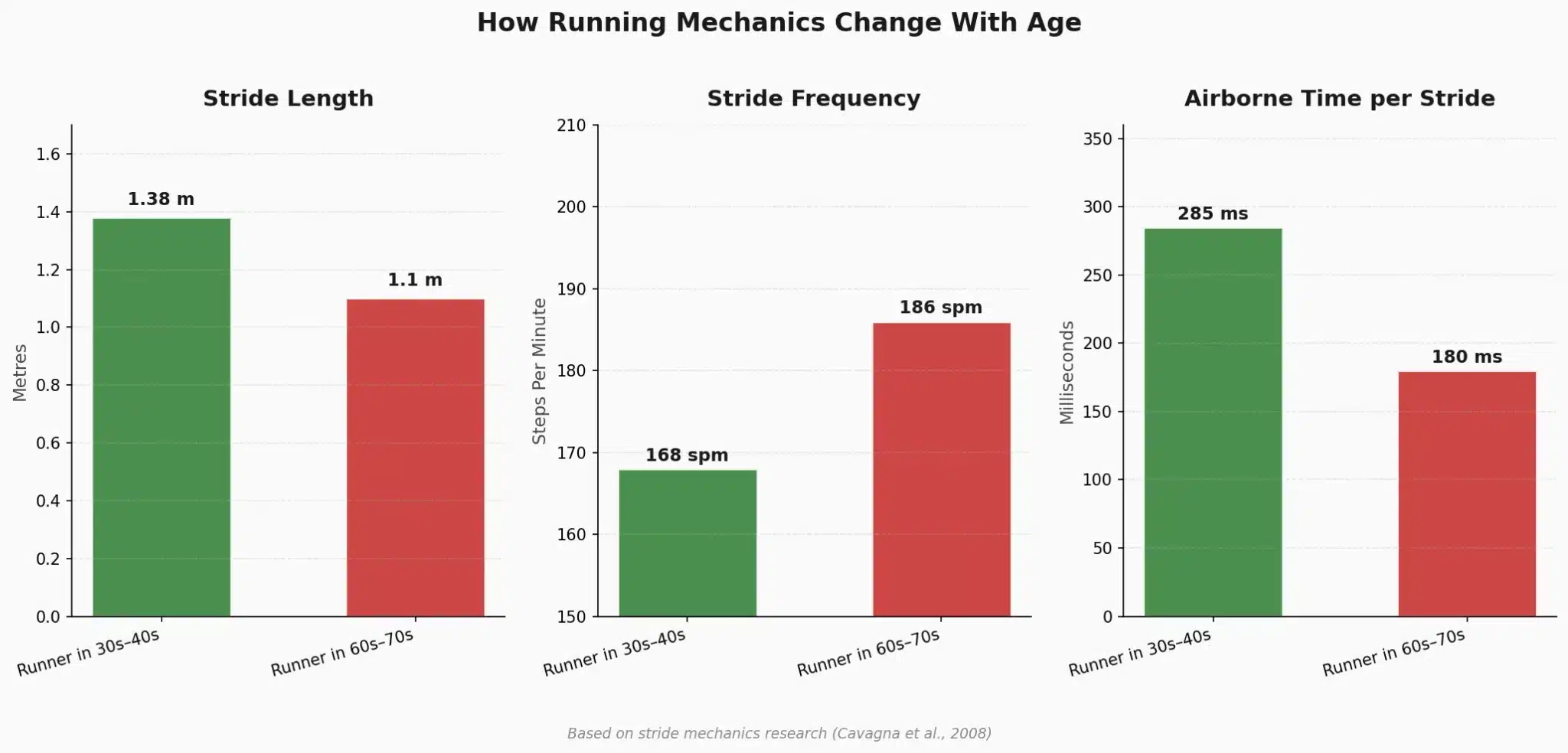
Research by Cavagna and colleagues compared the running mechanics of men in their late 60s and 70s to college-aged men across a wide range of speeds.
Younger runners generated 75% more peak vertical acceleration at high speeds compared to the older runners.
That vertical push is what allows a longer, loping stride that spends more time in the air than on the ground.
Without it, older runners compensate by increasing stride frequency, taking more steps per minute to maintain speed.
This is the biomechanical reality behind the “old man shuffle,” a direct consequence of reduced muscular power.
The efficiency penalty gets worse at faster paces.
A 2022 study confirmed that above roughly 8:45 per mile (5:26/km), the most efficient stride pattern shifts to a floating, asymmetric gait that requires significant vertical power.
Older runners who can’t generate that power become disproportionately less efficient at faster speeds.
With less time in the air per stride, there’s also less time to swing the legs forward, which forces a quicker and more energy-costly turnover.
Can You Slow Age-Related Performance Decline?
You can’t stop the clock, but you can target the specific systems that drive the decline.
Interval Training
Higher intensity workouts are the primary driver of aerobic capacity.
If you built your fitness on mileage as a younger runner, shifting toward more quality sessions is often the better trade-off as a masters runner.
Shorter races like 5Ks, 10Ks, and 10-milers push the aerobic ceiling in ways that marathon-pace training doesn’t.
Strength Training
This is the most direct way to address the biomechanical changes described above.
Focus on the major propulsion muscles: glutes, hamstrings, and calves.
These are the muscles responsible for generating power during your running stride.
If you’re over 50 and not lifting 1 to 2 times per week, this is the single biggest change you can make.
Easy Mileage
Running economy is one area where age barely touches trained runners, so investing in it pays compound returns.
If you didn’t run high mileage when you were younger, gradually building your easy miles can still improve your economy.
Flexibility and Mobility
Dynamic stretching and foam rolling won’t reverse aging, but they help maintain the range of motion your stride needs to stay efficient.
NAD+ Supplementation
The goal is to address cellular energy production at the mitochondrial level.
The research is still emerging, but the mechanism is clear: support the declining NAD+ pathway and you support the recovery and adaptation processes that underpin all the training above.
There’s a silver lining in the biomechanical changes: a higher stride frequency means less impact force per step, which may explain why older runners tend to have a lower incidence of many common running injuries.
Do Longer Races Get Harder Faster as You Age?
The data consistently shows that longer races take a bigger hit from aging.
At 15K, the decline is about 0.2% per year, or 1 second per mile (0.6 sec/km).
At the marathon, it’s 1 to 1.4% per year, or 4 to 6 seconds per mile (2.5 to 3.7 sec/km).
Highly trained 10K runners fall somewhere in between at about 0.5% per year.
The likely explanation is that the marathon places greater demands on the physiological systems that decline most with age: sustained aerobic output, muscular endurance over hours, and glycogen management.
Shorter races rely more on running economy and anaerobic capacity, both of which hold up better.
If you’re a masters runner watching your marathon times slip, racing shorter distances more often isn’t just a consolation prize.
Shorter races keep your VO2 max sharper and give you events where the aging penalty is smaller.
| Factor | What Happens | What To Do |
|---|---|---|
| VO2 max | Declines steadily after 40 | Interval training, shorter races |
| Muscular power | Drops, reducing vertical push and stride length | Strength training 1-2x/week, focus on glutes/hamstrings/calves |
| Running economy | Barely changes in trained runners | Maintain with consistent easy mileage |
| NAD+ levels | Decline, reducing mitochondrial efficiency | NAD+ supplementation (1,000-1,200mg daily) |
| Stride mechanics | Higher frequency, less air time, less efficient at speed | Strength training to preserve propulsive power |
| Flexibility | Decreases with age | Dynamic stretching, foam rolling |




30 Responses
Great news for those of us over 40! Even better is the advice on what areas to focus on, thanks for a very informative article.
I am glad you enjoyed the article, Kris! We really try to focus not just on the science, but how you can implement what the research suggests. It’s not always as clear-cut as this, but always something to think about. Good luck with your training!
I realize that I am a little behind in this discussion, but I just found it. I am 64 and I have been running for over 35 years. I noticed a huge reduction in my ability to sustain my normal run of 6 miles every other day in my late 50’s. At 64 I can no longer run 5 miles without stopping occasionally and walking. My recovery time is huge as well. I used to sprint through 6 miles, now I feel like I have lead feet doing just 5 every other day. No comparison to when I was in my 40’s.
Its an heavy emotional blow to experience this loss as well. I begin to question why I continue to run. Its very discouraging. I don’t care what this survey says about mice, or humans.
Hi Ray, little as I like to affirm somewhat unhappy comments, I tend to believe you are correct. While there are plenty of examples of persons who run quite well into their late 50’s, they are not the norm. Most of us – including those of us who continue to run seriously – find that we are dropping off rather rapidly after hitting mid 40’s. The numbers I see in age-graded calcultors are 2.5 seconds per mile per year. But the reality seems to be closer to twice that amount.
It’s great to hear about folk of all ages still out there. In regard to times and ages I can say that it hit me in late 40’s. I never was much good. Despite years of training and being a grad in sports science I never could break 40 min for the 10 k’s. Genes are a big part.
In my ex sic class there were 2 blokes that would win all the fun runs and only trained in the bar drinking beer. On VO 2 max tests they showed high readings – relatively untrained. Thats genetics.
I keep running but at 51 I’m slow. The only thing I can add is if you find yourself stopping during the distance your going too quick, Build your runs and pace yourself so stopping doesn’t need to happen.
Thanks for sharing Phillip. You are still doing it, which is what matters the most, and your advice is right on. We have lots more articles on running as a master, including this post https://runnersconnect.net/masters-running/mastering-being-a-master/ and this https://runnersconnect.net/masters-running/change-progress-masters/
we have many more, but based on your comment, you will enjoy these the most. Keep up the good work!
Hey, I get in a whole new age bracket in less than two months and will leave those pesky fast kids in my current age bracket under 60 behind. I’m loving it. I can’t think of anything better than getting old, although many years ago I would have thought it would seriously suck.
We live in a time where diabetes and obesity is seriously epidemic, so there’s not much better than trying to be a role model for your friends and peers than someone as old as them who goes out and hits it hard almost every day, even with all the congestion and chaos we face at work and home. I absolutely love to race, but if I can get a close overweight friend thru a first 5K this summer that would be as good as PRing the whole rest of the year (which I intend to do anyway)
We’ll said Michael! I love the enthusiam in your post 😉 Be the change 🙂 Keep up being a amazing role model for your family & friends.
Love the attitude, Michael!
I totally agree with the mindset of being able to help others through your running. If we could all inspire just a few people to pick up running as much as we do, the US would be a much healthier place to live. While it’s slightly different, seeing the joy someone gets when they hit a PR is just as good as when I ran my best.
Yes thanks for the article, as a 53 year old runner, I was very interested to understand more about how aging effects my running. But at the end of the day, my focus each day is on what I can do to stay healthy and run my best. At 53 this past year, I ran within one minute of my marathon PR which I set at age 39. I’m getting ready to break my PR and 3 hours next month in Boston. I am so glad that I didn’t let being 53 keep me from chasing my desire to break 3 hours, which I feel that I’m ready to do. This past year has been amazing, I ran a 3:04 and 3:01, my 2nd and 3rd best marathon times of my life and I have ran since high school. I’m running with so much strength and confidence and I thank Coach Jeff for helping me get to this point. Each day I complete a really tough workout and all my parts are still in working order I appreciate it. As long as there’s one Ed Whitlock out there breaking boundries, I can ask why not me? As they say you know you’re over the hill when your mind makes a promise that your body can’t fill. I’ll let you know which side of the hill I’m on April 16.
Awesome comment, Dannis. That’s one of the first things I remember when you contacted me. I saw the potential and I was really excited to help you change your perspective on what was possible at your age. To me, that shift in mindset about what is possible and impossible is what makes running truly great. Whether you’re a 53 year-old runner wondering if you can break a 14 year-old PR or a new runner wondering if running 13 miles is even possible, it’s an awesome experience when you accomplish goals you weren’t sure were possible.
Boston is going to go great, you’ve put in the work!
Hi Coach Jeff
Please could you send me the plan you gave to Dannis (above), I am a 51 year old marathoner and looking to improve my race times. This year I ran a 3:10 (PB) and 3:13 and would like to see if I can improve further. I very much look forward to hearing from you.
Here’s the plan we gave Dannis: https://runnersconnect.net/training-plans/
I just started working with Nate, and stumbled across this note. I fall into that third control group and have found similar age/impact progression. My question is when should an athlete work on strength training within the context of a weekly training cycle? Consider Monday/Friday runs are generally relaxed, Tuesday/Thurs runs are tempo/track day, Wednesday medium long, etc. what two to three days would a one hourish weight session best fit? Consider hill sprints are part of the schedule, what would a session look like? I’m thinking a session of bench press, military press, dips, curls, fly, lumberjacks, then squats, lunge, ham curl, leg curl, adductor, abductor press, then planks and bridges. Thoughts?
That’s a great question, Erik. There are two schools of thought when it comes to incorporating strength work into the schedule: (1) hard days hard and easy days easy; and (2) balancing workload.
Personally, I believe in the hard days hard theory, which simply means that your weight training should be done on the hard days of training so that you can maximize recovery on the easy days. Given your schedule, I would include the strength training Tues and Thur AFTER your workout and perhaps on Saturday and Sunday.
As for a specific routine, we’re actually developing a series of routines now, but my suggestion for general strength would be something like:
Lat pull downs
Upright rows
Shoulder shrugs
Shoulder lateral raises
Triceps overhead
Dips
arm action running
Single leg squats
Box step ups
Hip flexor cable/machine
Pawback hamstring
Calf raises
Leg raises
This obviously doesn’t include core work, which I think is more beneficial. Personally, I would do one day of general strength as described above and two days of this core routine:
Prone
Side/lateral holds
Supine
Prone knee bent
Hip thrusts
Donkey kicks
Fire hydrant
Hurdles
Low back extensions
Opposite arm/leg
Double eagles
I hope that helps!
At 55 I set my pr at the Disney Marathon…3:02:11, placing 1st in age and 77 over all….It can be done…As in the other runners comment, the gym and its diversity paid off…I also ran a race, 5, 10 15k and a couple of halfs on the average of about every 3 weeks for six months prior to the marathon…the gym gave me strength I never had to this degree, and the races every couple of weeks or so gave me constant tempo push I could never get on my own…in 2010 I broke my previous Boston pr by 5 minutes………..Lots of miles left here………..
Should the title read ‘affect’ instead of ‘effect’?
Wow, good catch. Thanks!
The World Masters Athletics Association (WMA) recently lowered the masters age from 40 to 35.
Is there any evidence that Road runners generally runner slower after age 35.
I see many road runner running personal bests between 35 and 39.
The road running Community in general still recognize the masters age as 40 and not 35.
I see world road race records being broken by runners between 35 & 39 but do not see this in Track.
Everyone is different .. but the World Master at least hit ME dead on. 35 years old was precisely where I had a big dip in performance. The other big dips (so far -i’m 47) happened @ 42 and @ 44.
I can confirm that it is not all downhill after 40 for everyone. In fact some people get a lot better well after 40. Some people age much more slowly. In regards to aging there was a study done in recent years where mice were made to age quickly. One set of mice ran on a wheel for 50 minutes three times a week and another set did not. The mice did that did not run showed all the signs of aging, both inside and out. The mice that did run showed little signs of aging. Whether or not this applies to humans I can not say for sure but if I had to guess I would say it does to a great extent.
Wow. I’m really inspired by the posts here! I’ve been a recreational runner for years and just started to race two years ago. I finished my first half, the route 66 marathon, in 20 degree weather (I hate the cold) in 2:24 at age 46. May not sound like much to you speedier folks but, I was shooting for 2:30. Might have gone a little faster if asthma hadn’t made me struggle through the last two miles. Was wondering if I could speed up a little and when I read your posts I think definitely. Thanks for the inspiration I’m going to set a new goal for my spring training!
This is great. Being 33 now, I know what I need to do to remain competitive in the coming years and that my speed is on borrowed time. The focus on aspect was most helpful! Thanks!
Ran the Corporate Challenge 1/2 Marathon this morning in a time of 1:39.2 at 73 years of age and very happy with that run. My concern is that I would like to improve on that but how much training should I be doing at my age and what should it consist of. I am 6′ tall and 65 kg so there is nothing much of me. Have been running most of my life
I read a study from a few years ago that showed that mice who ran 50 minutes a day, three times per week on wheel showed no signs of typical aging where the mice that did not run were grey and frail. I think this may very well carry over, at least to some degree, to humans
I have been running since 1977, and I get a little slower every year, but, at almost 60 years old, I still logged 550 miles for last year. A few years ago I stopped running, because my dog running buddy got too old to run. Then I had to build it all up again from zero. I doubted that I could do it, but I did and you can too. Be nice to your tendons and rest a little more, but keep a slow and steady program. If you have a tired day, cut yourself a little slack. Everybody has different goals, but you can work toward them at any age. Keep running!
Hi Barbara, thanks for sharing. That is a wonderful comment for others to learn from. Have you listened to our most recent podcast with Margaret Webb? You will probably enjoy it a lot. Here is the link: https://runnersconnect.net/running-interviews/margaret-webb/ Keep up the good work!
I am a 60 year-old jogger, who does the best he can. I have had various injuries and surgeries, as well as breaking both arms awhile back, with the right one still not healed properly. In addition, shoulder and back problems requiring cortisone shots, arthritis, etc. I jog about 6 miles anywhere from once to 3 times a week. But I can only go very slowly the first two miles, and even then am not fast. The other day somebody said to “have a nice walk” and that was dispiriting. But I guess if you call “run” only fast running, then steady jogging between 4-6 mph is closer to a “walk” although frankly I still think of it as running because I’ll do repetitions during the jog when I do 50 & 100 yard dashes at a fast clip, etc. What I don’t understand is the sneering at jogging steadily–I would like to see how the person who made that “have a nice walk” comment would do with the same surgical problems and injuries. But whereas there is a lot of talk about it being better to do something than nothing, in fact there is a lot of nastiness out there too when one tries to do it.
Hi Alan, thanks for sharing your thoughts, sorry to hear about the frustrations of others being rude. It is great that you do not let this bother you, as long as you are getting out there and doing something, you are lapping many people who do not get off the couch! Keep leading the way with your actions, and let us know if we can help. We know older runners are an inspiration. You should check out some of our podcasts, you would probably enjoy them, especially this one with Margaret Webb: https://runnersconnect.net/running-interviews/margaret-webb/