

You’ve probably asked yourself: if I run a marathon, how long will it take?
The answer depends on who you are, how you’ve trained, and what you’re aiming for.
Research on hundreds of thousands of marathon finishers reveals clear patterns that let you estimate your own finish time before you ever stand on the start line.
So, in this article you’re going to learn the research-backed practical advice on your marathon finishing time:
- Why the marathon distance is exactly 26.2 miles and what that works out to in kilometers
- The average marathon time for everyday runners, broken down by age and gender
- What factors actually predict whether you’ll finish in 3:30 or 5:30
- How to set a realistic goal time for your own race
- How to predict your finish time from existing race PRs
- What cutoff time limits most marathons enforce
- How threshold training speeds up your marathon pace
- What to expect in the weeks after crossing the finish line
How Long Is a Marathon in Miles and Kilometers?
A marathon is 26.2 miles, or 42.195 kilometers.
That oddly specific distance comes from the 1908 London Olympics, when race organizers extended the course by 385 yards so the finish line would sit directly in front of the royal family’s viewing box.
The arbitrary decision stuck, and every certified marathon on earth has measured 26.2 miles ever since.
Every standard marathon is exactly 26.2 miles (42.195 km), regardless of country, terrain, or organizer.
At a 9:00 min/mile pace (5:36 min/km) that works out to roughly 3 hours 56 minutes of continuous running.
At a 12:00 min/mile pace (7:27 min/km) the same distance takes just over 5 hours and 15 minutes.
What Is the Average Time to Run a Marathon?
The average marathon finishing time for everyday runners in the United States sits between 4:30 and 4:45, depending on the year and the race.
Global averages tend to run slightly slower because of differences in course terrain, weather, and fitness levels of non-U.S. participants.
A 2025 machine-learning analysis of more than 117,000 race records found that gender was the single strongest predictor of finishing time, followed by country of origin, age, and race location.
Men finish marathons faster than women on average, with typical male finish times in the 4:15–4:35 range and female averages in the 4:45–5:15 range.
If you finish under 4 hours, you’re in roughly the top 10% of all everyday marathoners.
Under 3:30 puts you in the top 5%, and a sub-3:00 marathon puts you in the top 1% of non-elite runners.
These averages don’t include the professional field, which tends to finish in the 2:05–2:25 range for men and 2:15–2:45 for women.
What Is the Average Marathon Pace Per Mile and Kilometer?
Finish times tell you how long a marathon takes.
Pace tells you how fast you need to run each mile to hit that number.
The average everyday marathoner holds roughly 10:18/mi (6:24/km) to 10:53/mi (6:45/km) across all 26.2 miles.
Men running at everyday average speed fall in the 9:44/mi (6:03/km) to 10:30/mi (6:31/km) range.
Women at the same everyday average fall in the 10:53/mi (6:45/km) to 12:01/mi (7:28/km) range.
The table below converts common finish time goals directly to per-mile and per-kilometer pace.
| Finish Time | Pace per Mile | Pace per Km |
|---|---|---|
| 3:30 | 8:01/mi | 4:59/km |
| 3:45 | 8:35/mi | 5:20/km |
| 4:00 | 9:10/mi | 5:41/km |
| 4:15 | 9:44/mi | 6:03/km |
| 4:30 | 10:18/mi | 6:24/km |
| 4:45 | 10:53/mi | 6:45/km |
| 5:00 | 11:27/mi | 7:07/km |
| 5:15 | 12:01/mi | 7:28/km |
| 5:30 | 12:36/mi | 7:49/km |
Your long runs should be run 60-90 seconds per mile (37-56 seconds per km) slower than your goal marathon pace.
That slower effort builds aerobic capacity without accumulating the fatigue that would blunt hard workout quality later in the week.
Threshold workouts, by contrast, should land 20-30 seconds per mile (12-19 seconds per km) faster than marathon pace to push your lactate ceiling higher.
Ready For More?
Get Our FREE Race Day Strategy Calculator!
You’ll learn how to calculate your exact splits for the marathon in both KM and miles.
How Does Marathon Time Vary by Age?
Age is one of the strongest predictors of marathon finishing time, but the relationship isn’t linear.
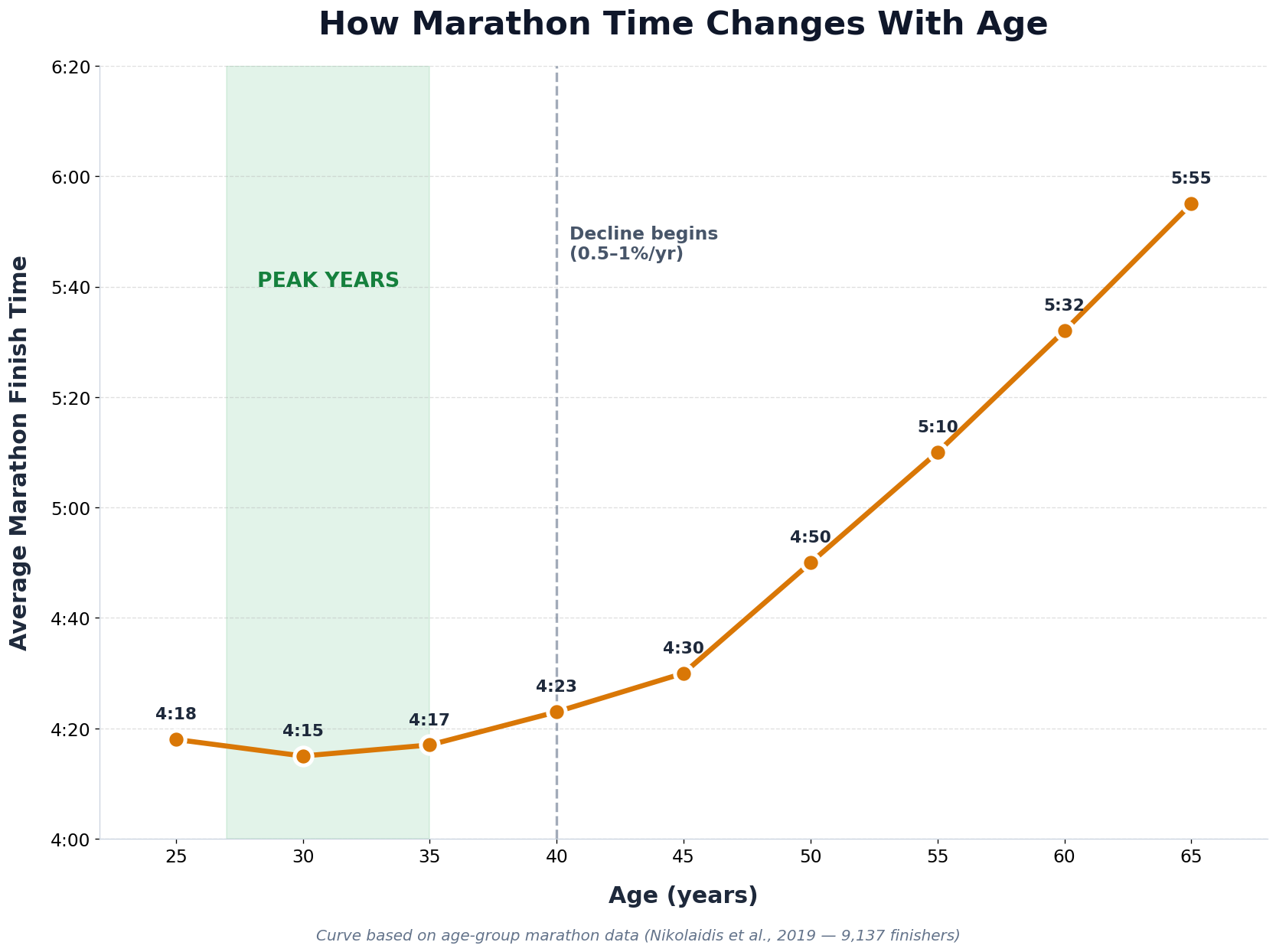
Most runners hit their peak marathon speed in their late 20s and early 30s, when VO2 max is highest and recovery from training is fastest.
Research on more than 9,000 marathon and half-marathon finishers confirmed that runners under 25 posted the fastest times and those over 54 posted the slowest, with a steady decline across each five-year age band in between.
Performance stays relatively flat through the late 30s, then begins dropping at roughly 0.5–1% per year starting around age 40.
In practical terms, runners in their 40s typically finish 10–15 minutes slower than they did in their 30s, all else equal.
By age 50, most everyday runners finish 30–45 minutes slower than their peak in their 30s.
The decline isn’t fixed: runners who hold training volume and intensity steady into their 40s and 50s slow far less than age alone would predict.
Masters runners over 60 face the steepest drops, but many still complete marathons under 5 hours with consistent preparation.
How Does Marathon Time Differ Between Men and Women?
On average, men finish marathons 20–30 minutes faster than women at the same age and fitness level.
The gap exists because men typically have higher absolute VO2 max capacity, greater muscle mass relative to body weight, and a slightly higher capacity to deliver oxygen to working muscles over long distances.
The finish-time gap is also narrowing over time, with female participation and performance improving faster than male performance over the past decade.
Women’s average marathon times now sit roughly 10–15% slower than men’s, compared with a gap closer to 20% a decade ago.
At the elite level, the current world-record gap between men and women is under 12 minutes, the smallest it has ever been.
What Factors Actually Determine Your Marathon Time?
Age and gender set a baseline, but they’re not destiny.
Training volume is the single strongest controllable predictor. Runners who log 40+ miles per week finish significantly faster than those running 20–25 miles per week, even at the same age and experience level.
Weekly consistency matters more than peak mileage.
A runner who logs steady 35-mile weeks usually beats a runner with sporadic 50-mile peaks broken up by missed weeks.
Pacing strategy determines whether you hit the wall. Starting too fast burns through glycogen reserves, and most runners who do it slow dramatically between miles 18 and 20.
A landmark 2010 analysis of marathon metabolism found that more than 40% of marathoners experience severe glycogen depletion during the race, and 1–2% drop out before reaching the finish line.
Running an even or very slightly negative split, where the second half is the same pace or marginally faster than the first, is associated with better finish times in amateurs and elites alike.
Body composition affects your pace. Runners who reduce body weight primarily through fat loss, rather than muscle loss, typically improve their marathon time by 3–5 minutes per 5 pounds lost.
Nutrition and race-day fueling matter just as much.
Runners who practice their fueling strategy in training rarely hit the wall, while those who wing it often suffer severe slowdowns after mile 20.
Experience compounds. Your first marathon is typically 20–30 minutes slower than your third, even with identical training, because pacing judgment improves only with repetition over the full distance.
What’s a Realistic Marathon Time for Your First Race?
Most first-time marathoners finish somewhere between 4:30 and 5:15, regardless of their 5K or half-marathon times.
The distance is long enough that small mistakes compound, and most first-timers lose more time in the last 10K than they expected.
If you’ve run a sub-2:00 half-marathon, you’re likely targeting a 4:00–4:30 marathon.
If your half-marathon PR sits in the 2:15–2:30 range, expect a first-marathon time closer to 4:45–5:15.
The most common first-marathon mistake is running the first 5 miles too fast and paying for it in miles 18–20.
First-timers who run the opening 10 miles at goal pace or slightly slower finish stronger and are far less likely to DNF or blow up in the final stretch.
A useful benchmark is to add 8–12% to your half-marathon time to estimate a conservative first-marathon target, then adjust based on training consistency and experience.
How Do You Predict Your Marathon Finish Time?
Your existing race PRs give you the most reliable estimate of your marathon time before you have ever run the distance.
In practice, multiply your half marathon finish time in minutes by 2.09 to get a conservative marathon projection.
| Half Marathon PR | Projected Marathon |
|---|---|
| 1:45 | 3:39 |
| 1:50 | 3:50 |
| 1:55 | 4:00 |
| 2:00 | 4:11 |
| 2:10 | 4:32 |
| 2:20 | 4:53 |
| 2:30 | 5:14 |
From a 5K, multiply your finish time in minutes by approximately 9.27 to project your marathon time.
A 25:00 5K runner projects to roughly 3:52 for the full marathon.
A 30:00 5K runner projects to roughly 4:38.
RC’s race calculators handle these conversions instantly and let you input your exact time for a personalized estimate.
How Long Do You Have to Finish a Marathon?
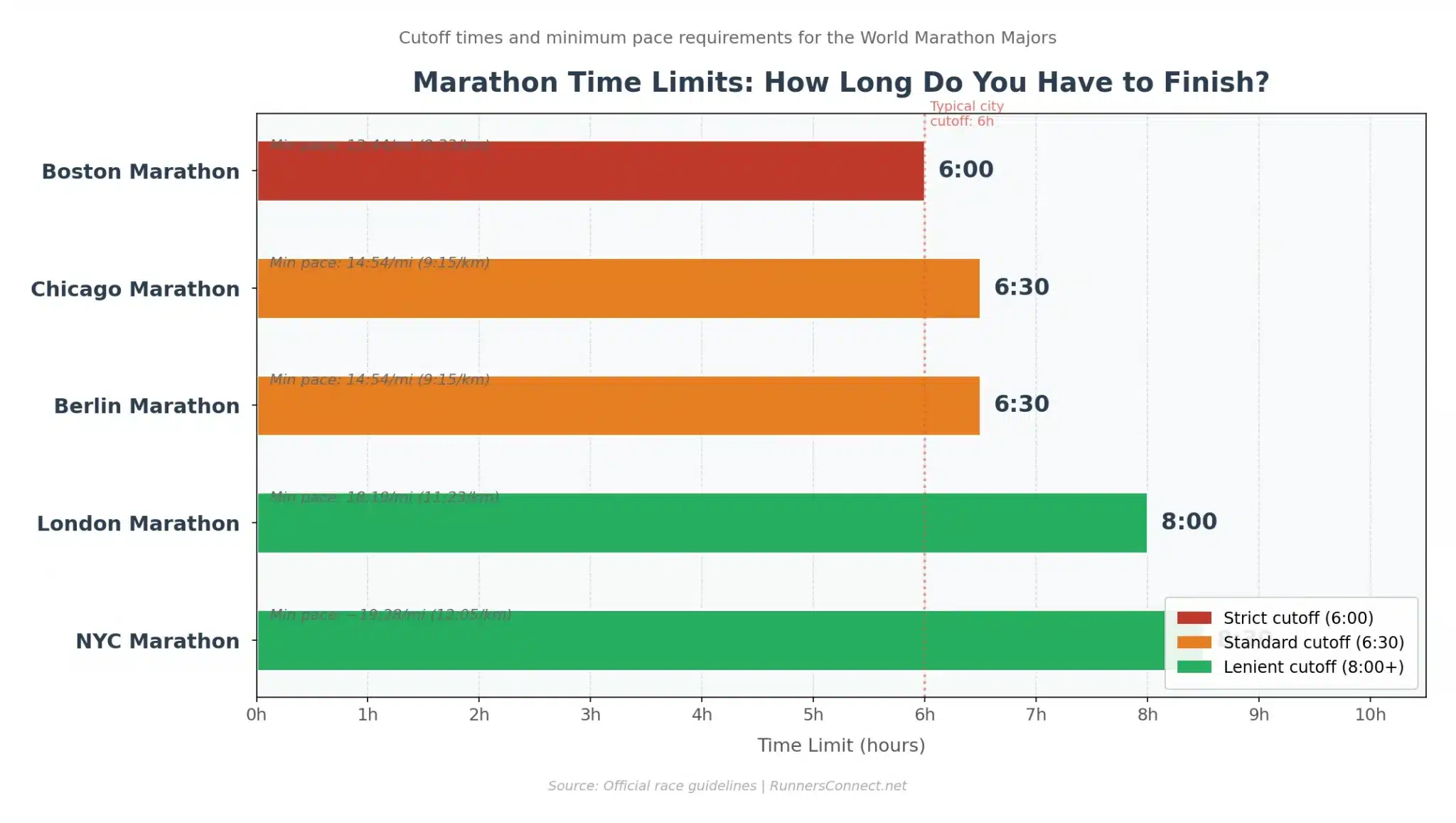
Most marathons enforce a time limit of 6 to 7 hours, after which course support is withdrawn and finishers must complete the remaining miles on open roads.
- Boston Marathon: 6 hours (13:44/mi, 8:32/km)
- Chicago Marathon: 6 hours 30 minutes (14:54/mi, 9:15/km)
- Berlin Marathon: 6 hours 30 minutes (14:54/mi, 9:15/km)
- London Marathon: 8 hours (18:19/mi, 11:22/km)
- New York City Marathon: approximately 8 hours 30 minutes (19:28/mi, 12:05/km)
If you are targeting a finish time near the cutoff, building a marathon pacing strategy around conservative early miles is especially important.
How Long Should You Train to Run a Marathon?
Most runners need 16–20 weeks of dedicated marathon training to be fully prepared.
If you’re newer to running, aim for 20 weeks or more, with a solid aerobic base built before the formal plan starts.
If you’ve completed 3+ marathons, 14–16 weeks is usually enough to peak for a new race.
Training for less than 12 weeks carries significant injury and bonk risk, even for experienced runners.
Build an aerobic base of at least 2–3 months of consistent running before starting a formal marathon training plan.
Your long run should progress to at least 18–22 miles (29–35 km) by 3 weeks out, with the final 2 weeks reserved for a proper taper.
Do Threshold Workouts Help You Run a Faster Marathon?
Yes, significantly.
Lactate threshold training improves your body’s ability to clear lactate at higher running speeds, which directly translates to holding a faster marathon pace without fading.
Runners who accumulate regular work at threshold pace show markedly greater improvements in marathon performance over 16–20 weeks compared with those training exclusively in easy zones.
A typical threshold workout looks like 3–4 × 8 minutes at 88–92% of max heart rate, with 2 minutes of easy jogging between reps.
Runners who add 1–2 threshold sessions per week during marathon training consistently improve their marathon time compared to easy-zone-only training.
How Long Does It Take to Recover After a Marathon?
Runners consistently underestimate how long a marathon takes to recover from.
The finish line is the visible end point, but the biological repair process runs well past the medal ceremony.
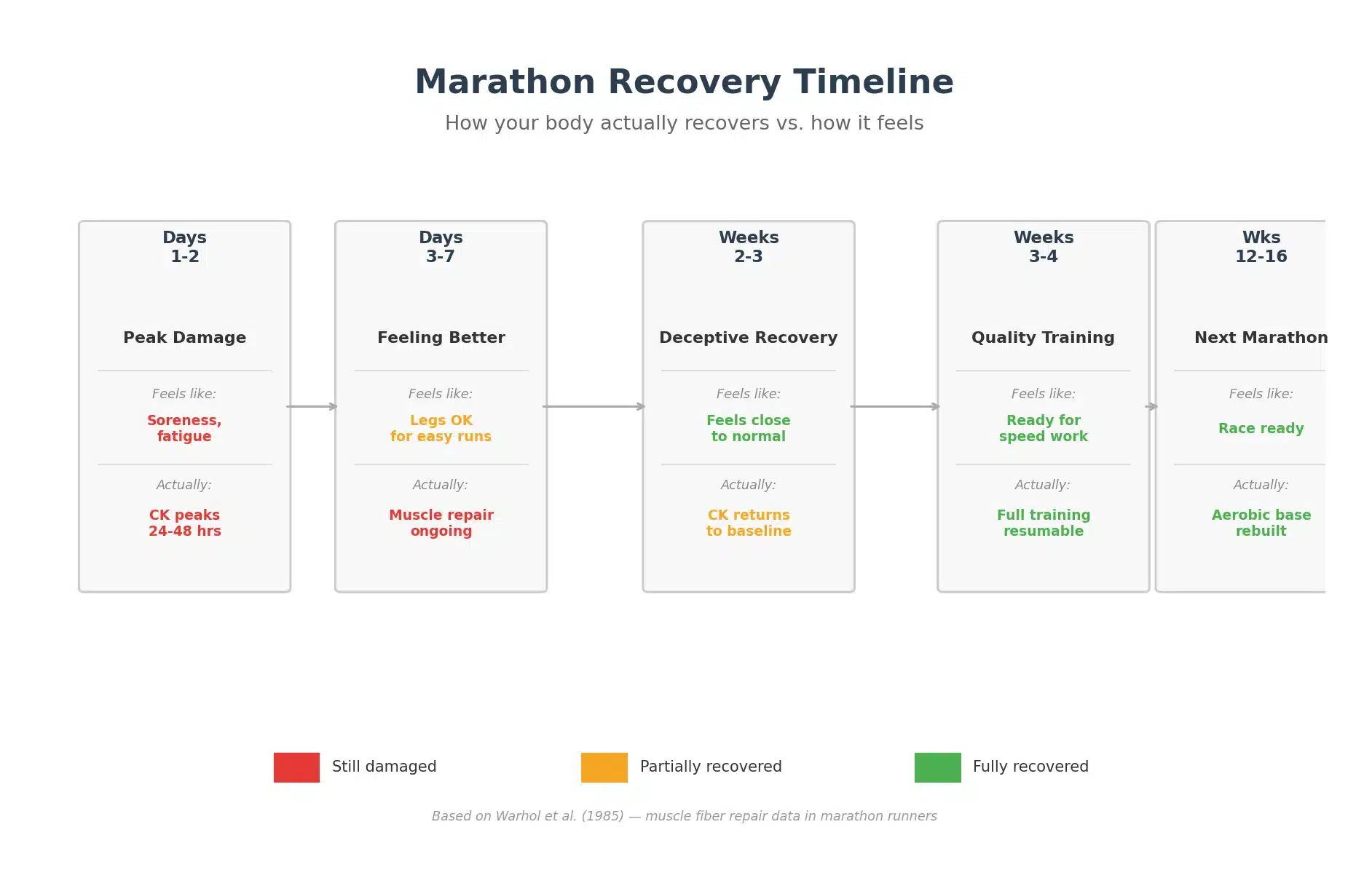
Blood markers of muscle breakdown, particularly creatine kinase, typically peak within 24 to 48 hours of finishing and take 2 to 3 weeks to return to pre-race baseline.
In practical terms, that means your legs may feel fine after 4 or 5 days, but the underlying tissue repair is still running.
A widely used coaching guideline puts the minimum easy-day recovery at one day per mile raced.
For a full marathon, that works out to roughly 26 days of easy running or rest before resuming hard training.
The first quality workout is typically resumable 3 to 4 weeks after a marathon.
Return-to-race timelines depend on what you’re targeting.
A 5K or 10K race 4 to 6 weeks post-marathon is realistic if training resumes normally in week 3.
Another marathon takes longer: 12 to 16 weeks gives the body enough time to rebuild aerobic base before starting a new training block.
Psychological recovery follows its own clock.
Feeling flat or unmotivated for 2 to 4 weeks after a marathon is normal, even when legs feel fine.
That’s a standard hormonal and neurological response to prolonged maximal effort, and it typically resolves on its own without forcing training.
RunnersConnect Bonus
Download your FREE Marathon Recovery Schedule for Runners.
It’s a PDF showing how to recover correctly in the 3 weeks post marathon, plus our cross training guide with over 20 sample workouts for the most common cross training types