

Most runners don’t get to choose their running surface.
You run what’s in your neighborhood: concrete sidewalks, asphalt roads, or the rare stretch of grass if you’re lucky.
And when you’re stuck on one surface day after day, you start wondering if the concrete is destroying your knees.
Should you switch to asphalt?
Will your injuries get worse if you can’t avoid hard pavement?
The truth is messier than “asphalt good, concrete bad.”
Research shows that concrete and asphalt produce surprisingly similar impact forces, but your body’s ability to adapt matters far more than the small differences between them.
The question isn’t which surface is theoretically better.
The question is how to run safely on whatever surface you have.
So, in this article you’re going to learn the research-backed practical advice on:
- What the actual impact force difference is between concrete and asphalt
- Why concrete feels harder but doesn’t always mean higher injury risk
- How your body adapts to hard surfaces in weeks, not months
- When shoe cushioning actually matters on hard pavement
- Practical strategies if you can’t avoid concrete
Why Does Surface Hardness Matter for Runners?
Your running surface is the first thing your leg contacts with each stride.
When your foot lands, forces ripple through your body in milliseconds.
Research has shown that ground reaction forces and lower extremity kinematics change significantly depending on running surface stiffness.
A harder surface absorbs less energy and sends more impact back into your body.
Your foot, ankle, shin, knee, and hip all feel it.
Your muscles and tendons must work harder to control that force and prevent injury.
A softer surface like grass or a track absorbs more energy, which means less jarring force travels up your leg.
This is why a mile on concrete feels more tiring than a mile on grass.
Your body is doing more work to manage impact.
Surface hardness drives how much shock your leg must absorb, which is why runners commonly feel pain on concrete more than on softer surfaces.
Is Asphalt Really Softer Than Concrete? (What Research Actually Shows)
You probably assume asphalt is softer than concrete.
Most runners do, because asphalt feels slightly easier underfoot and looks more forgiving.
But research complicates that intuition.
When researchers compared actual impact forces, asphalt and concrete were nearly identical.
The reason asphalt feels softer isn’t the absorption rate.
Asphalt is slightly less rigid and more forgiving to your foot as it strikes.
The psychological difference also plays a role in how your body perceives the run.
Knowing asphalt is slightly softer creates a mental expectation that changes how your legs feel.
Both surfaces are functionally hard compared to grass or a track, and both place similar stresses on your leg.
From an impact perspective, choosing asphalt over concrete won’t meaningfully change your injury risk because they’re biomechanically similar.
Does Running on Concrete Increase Your Injury Risk?
If asphalt and concrete are so similar, why do runners worry more about concrete?
The answer is context.
Concrete isn’t inherently more dangerous.
But it creates conditions where injury risk rises if you’re not careful.
Here’s the mechanism: concrete doesn’t change from mile 1 to mile 10 of a race.
But your body does.
Fatigue reduces your muscles’ ability to absorb and control impact, so the later miles of a race on concrete feel harder on your legs than the early miles.
This is why long-distance races on concrete show higher injury rates at the finish than at the start.
Fatigue has degraded your shock absorption.
The risk isn’t the surface itself.
It’s the combination of surface hardness plus accumulating fatigue plus insufficient recovery.
A runner doing three easy miles on concrete with proper recovery won’t have a significantly higher injury rate than one running on asphalt.
But a runner doing high-volume training exclusively on concrete without enough rest faces a different picture.
Injury risk on concrete depends far more on your training load and recovery than on the surface stiffness difference from asphalt.
Your body’s ability to adapt to hard surfaces is one of the most underrated factors in injury prevention.
Most runners think adaptation takes months, but research shows it happens much faster.
Your running surface selection can influence injury risk, but only if you approach it strategically.
Is Running on Concrete Bad for Your Knees?
Most runners assume concrete is slowly destroying their knee cartilage.
The research contradicts that assumption.
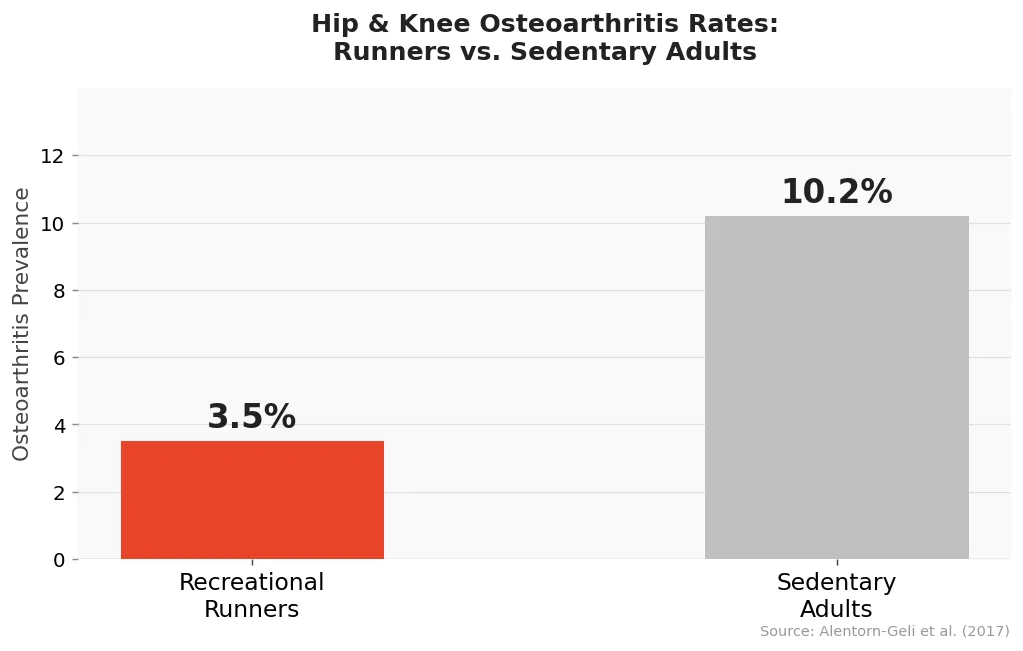
Studies have found that recreational runners have a hip and knee osteoarthritis prevalence of 3.5%, compared to 10.2% in sedentary adults who don’t run.
Running on hard surfaces doesn’t wear down your knee cartilage the way most people fear.
Cartilage needs mechanical loading to stay healthy.
Consistent running provides exactly that stimulus, which is why long-term runners tend to have healthier knee joints than non-runners of the same age.
What does threaten your knees is a different variable: rapid increases in training load on hard surfaces.
When you add too many miles on concrete too quickly, your muscles, tendons, and bones absorb more cumulative stress than they can repair between sessions.
This is how most knee problems blamed on concrete actually develop.
Patellofemoral pain, the most common knee complaint among road runners, builds from repetitive stress at the kneecap over multiple sessions, not from a single hard run on concrete.
Knee damage from concrete is almost always a training load problem, not a surface problem.
The runners most at risk are those transitioning from treadmill or track training to full-time road running without a gradual mileage build.
Following proven injury prevention principles when you switch to concrete-heavy training is the most effective way to protect your knees long-term.
RunnersConnect Insider Bonus
Download our free Stress Fracture Treatment Outline.
It’s a PDF with the treatment options for runners with stress fractures.
How Your Body Adapts to Hard Surfaces
When you transition to a new running surface, your body doesn’t just accept the change passively.
It makes immediate biomechanical adjustments.
This adaptation happens so quickly because it’s partially passive.
Your muscles and tendons automatically respond to the changing surface stiffness without conscious effort.
When you land on concrete, your muscles stiffen your leg to match the surface.
This creates a coupled system that maintains consistent shock absorption.
If you switch to grass, your muscles relax and your leg stiffness decreases.
You adapt within a single stride to the softer surface.
This immediate adjustment is why experienced runners can transition between surfaces without injury.
Their neuromuscular system anticipates and responds instantly.
Tissue adaptation takes longer, taking days to weeks with consistent training.
But the biomechanical adjustment is nearly instantaneous.
Your body’s ability to adapt to hard surfaces happens within your first few steps, not over weeks of training.
The practical implication is clear: a runner who occasionally switches from asphalt to concrete doesn’t need a long adjustment period.
But a runner who trains exclusively on concrete will benefit from gradually introducing that surface rather than jumping into high-volume training all at once.
Should You Change Your Shoes Based on Your Running Surface?
Your running shoes absorb some of the impact your legs face, but they’re one piece of a much larger system.
The interaction between shoe cushioning and surface stiffness means that the same shoes will feel different on concrete versus grass.
On concrete, your shoes compress more because they’re fighting a harder, less forgiving surface.
On grass, the surface itself absorbs more energy, so your shoes compress less and feel bouncier.
This is why running shoes wear out faster on concrete.
The combination of harder surface and greater shoe compression means more repetitive stress on the midsole.
If you’re running exclusively on concrete, you’ll need to replace your shoes more frequently than a runner on softer surfaces.
Softer cushioning shoes can help on concrete, but they’re not a replacement for smart training.
They’re a supplement to it.
The mistake many runners make is thinking that a well-cushioned shoe will allow them to ignore their concrete surface completely.
It won’t.
A good shoe reduces impact, but your leg still bears the fundamental stresses of the harder surface.
The best approach on concrete is both: invest in cushioning shoes AND apply smart load management to your training.
How Does Running on Concrete Affect Your Recovery?
Every step on concrete sends more impact through your legs than a step on asphalt or grass.
Over a 60-minute run, that difference compounds.
Your muscles, tendons, and bones absorb a higher total mechanical load on concrete than on softer surfaces during the same workout.
This higher workload per session means your body needs more time to repair and adapt between runs.
Research tracking running injury patterns consistently shows that inadequate recovery time is one of the primary drivers of overuse injuries, particularly during high-mileage periods on hard surfaces.
Where a runner on softer surfaces might feel ready for another hard effort in 36 to 48 hours, a runner doing the same workout on concrete may need 48 to 72 hours to recover fully.
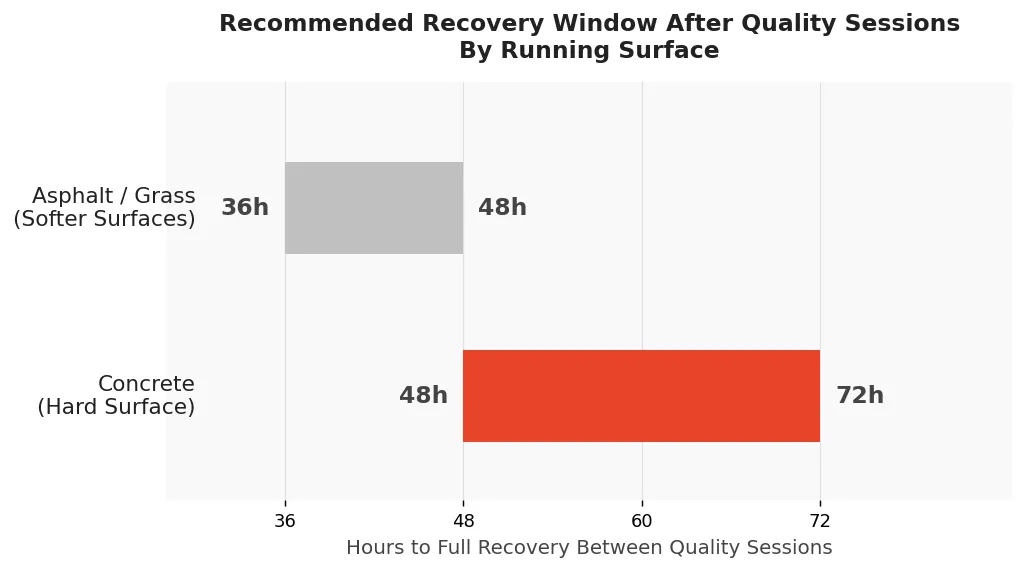
Most runners miss this because the pace, distance, and effort feel the same on both surfaces.
The surface multiplies the total demand on your legs without changing how the run feels while you’re doing it.
The simplest adjustment for recovery between hard sessions on concrete: add a full rest day between quality workouts during peak training weeks.
Replacing one easy run per week with pool running or cycling gives your legs the buffer they need to absorb the higher impact load that comes with concrete training.
What to Do If You Can’t Avoid Hard Surfaces
Most runners don’t have a choice about their running surface.
You run where you live, and if that’s concrete, here’s how to do it safely.
Start gradually. If you’re new to training on concrete, build your volume slowly over 2 to 3 weeks rather than jumping into your normal weekly mileage.
This gives your tissues time to adapt without accumulating too much stress too quickly.
Prioritize recovery. Concrete training demands more of your musculoskeletal system, so you need more recovery time between hard sessions.
If you normally run hard on Tuesday and Thursday, consider moving one of those to a softer surface or making it an easy day instead.
Mix surfaces when you can. One easy run per week on grass or a track, even just a few miles, gives your legs a break from the constant impact of concrete.
This isn’t necessary to prevent injury, but it reduces cumulative fatigue and makes your concrete running feel easier.
Invest in cushioning shoes. On concrete specifically, a moderately cushioned running shoe is worth the investment.
Shoes with good shock absorption reduce impact stress on your legs.
Replace them more frequently: every 400 to 450 miles instead of 500 to 550 miles.
Manage your training load. If you’re running exclusively on concrete, limit your high-intensity work to once per week rather than twice.
Save your speed work for when you can access a track, and keep most of your concrete running at easy pace.
Running safely on concrete isn’t about avoiding the surface.
It’s about being strategic with how you train on it.
Your body can adapt to concrete, but it needs consistency, recovery, and respect for load management to do so without injury.