
You pick up a popular pre-workout at the running store, scan the label, and see ingredients like beta-alanine, arginine, and a stimulant blend promising “explosive power.”
None of that was designed with your next track workout in mind.
Most pre-workouts are engineered for lifting. They maximize short bursts of muscle power over 45 minutes in a gym.
Running asks something completely different of your body, which means the criteria for a useful pre-workout are almost entirely different too.
A small set of ingredients actually hold up to the research for endurance athletes. A few others are actively worth avoiding.
The goal here is to give you the evidence on each so you can make an informed choice before your next speed session.
In this article you’ll learn:
- Why the standard pre-workout formula doesn’t translate to running
- Which three ingredients have the strongest evidence for runners
- Which ingredients cause GI or performance problems on the run
- Exactly when to take a pre-workout relative to your workout
Why Most Pre-Workouts Are Built for the Wrong Kind of Athlete
A pre-workout designed for the weight room is optimizing for a very specific type of stress: repeated, short bouts of maximum effort with rest between sets, lasting 45 to 75 minutes total.
Running, especially interval training and VO2max sessions, demands sustained aerobic output, efficient oxygen delivery, and tolerance for accumulating lactate over 30 to 90 minutes of continuous effort.
Those are different problems, and the ingredient list that solves one doesn’t automatically solve the other.
The ingredients worth looking for in a runner’s pre-workout are those that improve blood flow, oxygen efficiency, and aerobic energy production. The ingredients that amplify muscular pump or anaerobic glycolysis aren’t worth the cost for most runners.
Does Caffeine Actually Improve Running Performance?
Of every ingredient that appears on pre-workout labels, caffeine has the strongest evidence base for endurance athletes by a wide margin.
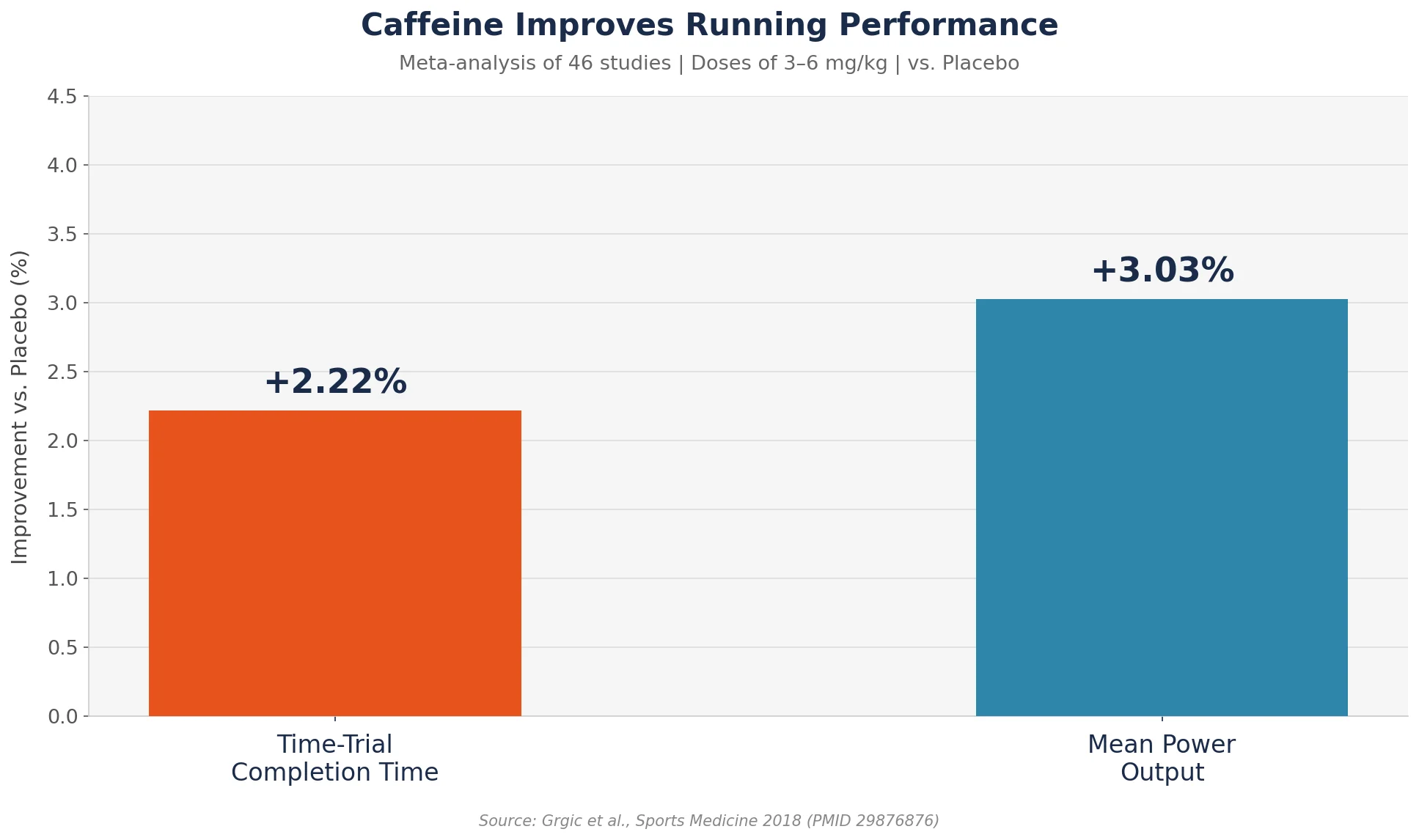
A 2018 systematic review and meta-analysis of 46 studies found that moderate caffeine doses (3 to 6 mg/kg body weight) produced a 2.22% improvement in time-trial completion time and a 3.03% improvement in mean power output compared to placebo.

For a runner at 20 minutes for a 5K, a 2% improvement is roughly 24 seconds, which is meaningful in any race context.
The mechanism runs through several channels at once.
Caffeine blocks adenosine receptors in the brain, which reduces the subjective feeling of effort and delays the onset of fatigue.
At the muscular level, it enhances calcium release in muscle fibers, which improves the force each contraction produces.
It also increases the rate at which fat is mobilized as fuel, which matters most during longer speed sessions and tempo runs where glycogen conservation counts.
Caffeine’s benefits for running are real, but individual response varies significantly. Some runners are fast metabolizers who clear caffeine quickly, while others feel jittery or experience a crash mid-workout.
If you haven’t used caffeine strategically before training, test it on a low-stakes workout before your first key session with it.
The full research on caffeine and running performance covers dosing, timing, and how tolerance affects the response in more detail.
Does L-Citrulline Malate Help Runners?
L-Citrulline malate appears in most quality pre-workout formulas and has a direct mechanism relevant to endurance athletes: it raises plasma arginine levels, which drives nitric oxide production and improves blood flow to working muscles.
A controlled crossover study found that 7 days of l-citrulline supplementation improved high-intensity exercise tolerance by 12% (589 seconds with placebo vs. 661 seconds with citrulline) and lowered the O2 uptake mean response time from 59 to 53 seconds.
Better O2 uptake kinetics means your aerobic system gets up to speed faster at the start of an interval, which matters in the first 60 to 90 seconds of a hard effort.
The aerobic-system kickstart effect is why citrulline malate shows up in research on cycling time trials and repeated sprint efforts, the types of stress that most closely mimic track intervals and VO2max sessions.
The research on citrulline malate for endurance is growing but not as deep as the caffeine literature.
The ingredient looks most useful for runners doing short, high-intensity interval work (400m to mile repeats) where getting your aerobic system engaged quickly is the limiting factor.
L-Citrulline malate is generally well-tolerated and doesn’t carry the GI risks that other pre-workout ingredients do for runners.
Does Creatine Help Runners?
Creatine works by saturating phosphocreatine stores in muscle, which gives the ATP-PCr energy system a larger reserve to draw from during explosive, short-duration efforts.
For runners, this translates to a narrow but real benefit: sprint-type efforts lasting under 10 seconds, like the final kick of a race or short hill repeats.
A 2003 study found a 5% improvement in lactate threshold during interval training for creatine users, and a 2019 meta-analysis showed a 7.5% improvement in performance for high-intensity efforts in subjects taking creatine compared to placebo.
The important caveat is that creatine’s benefits concentrate heavily in anaerobic, power-based work.
Creatine also causes water retention inside muscle cells, which means a 1 to 2 kg increase in body weight is common during the loading phase.
For marathon runners or anyone primarily training for distances over 10K, the weight gain from creatine loading likely offsets any endurance-relevant gains.
Creatine is more relevant for 5K and shorter specialists who want to maximize their sprint kick, or for runners adding strength training to their program where the power benefits carry over clearly.
RunnersConnect Bonus
Download your FREE Creatine Supplementation guide.
This PDF provides an evidence-based scientific evaluation of the common questions and misconceptions about creatine supplementation.
Which Ingredients Should Runners Skip?
Several ingredients common in pre-workout supplements create real problems for runners specifically.
Beta-alanine is one of the most heavily marketed pre-workout ingredients.
Beta-alanine buffers hydrogen ions in muscle, which is genuinely useful for efforts lasting 1 to 4 minutes, the range where acid accumulation limits performance most directly.
A systematic review and meta-analysis confirmed that beta-alanine benefits exercise capacity in that 1 to 4 minute window but found minimal effect for efforts lasting longer.
The practical problem for runners is that beta-alanine causes paresthesia, a tingling and itching sensation on the skin that can range from mild to distracting, and it can irritate the GI system during sustained effort.
The risk-to-reward ratio for most runners is poor. The itch and potential GI disturbance during a workout isn’t worth marginal benefits that are mostly relevant to 400 to 800 meter specialists.
Beetroot juice is often promoted as an endurance supplement because dietary nitrates convert to nitric oxide and can reduce the oxygen cost of exercise.
The evidence on beetroot juice for trained runners is more complicated than the marketing suggests. The benefits appear strongest in untrained subjects and diminish significantly in well-trained athletes.
High stimulant blends with 300+ mg of caffeine, yohimbine, or multiple synephrine compounds raise heart rate and anxiety without additional performance benefit over moderate caffeine doses, and they significantly increase the risk of GI distress mid-run.
If a pre-workout causes tingling, GI cramping, or anxiety during your warmup, it will get worse when your heart rate climbs. Skip it for runs.
How Should You Time Pre-Workout Before a Run?
The timing and application of a pre-workout matters as much as the formula.
Take it 30 to 45 minutes before your workout or race to allow the active ingredients to reach peak plasma concentration before you start running hard.
Caffeine’s peak blood concentration arrives roughly 45 to 60 minutes after ingestion, so timing earlier in that window is preferable for most runners.
Pre-workout is appropriate before:
- Track intervals and VO2max sessions
- Tempo and lactate-threshold workouts
- Races from 1 mile to 10K
Skip it before:
- Easy runs, where there’s no performance benefit and you’re adding unnecessary stimulant load
- Long runs, where glycogen depletion dynamics change at 90 minutes and the evidence for stimulant benefits weakens considerably
If you’re looking for a pre-workout specifically formulated for runners rather than the weight room, Sprint by 6am Run is one of the few products built around the ingredients that actually matter for endurance athletes: citrulline malate, creatine, and controlled caffeine dosing without the fillers that don’t translate to running.
RunnersConnect has an official partnership with 6am Run. Use code RC10 to save 10%.
Never use a pre-workout before a run you haven’t tested it on first. GI reactions at mile 4 of a tempo run are worse than going in without it.
| Ingredient | Evidence for Runners | Best For | Skip If |
|---|---|---|---|
| Caffeine (3 to 6 mg/kg) | Strong: 46 studies, 2.22% TT improvement | All distances, all intensity sessions | You have GI sensitivity or anxiety response |
| L-Citrulline Malate | Growing: O2 uptake kinetics improvement | Intervals, 5K and shorter efforts | No known contraindications for runners |
| Creatine | Moderate: mainly sprint/power benefits | 5K specialists, strength training blocks | Training for marathon distance |
| Beta-alanine | Weak for runners: mainly 1 to 4 min efforts | 400 to 800m specialists only | You experience GI issues or significant tingling |
| Beetroot juice | Minimal for trained runners | Untrained beginners may see benefit | You’re a consistently trained athlete |