
You dial in your training, eat the way you always do, and then a hard workout or race day leaves you doubled over with cramps and gas for hours afterward.
A sensitive stomach when running is one of the most common reasons runners abandon a workout or fall apart late in a race.
Most of it comes down to how running changes your digestion, and that responds well to a few specific adjustments.
Here’s what you’ll learn:
- Why running upsets your stomach in the first place
- Which foods set off cramps and bloating
- How to time your meals around your runs
- How to train your gut to handle more
- Whether digestive enzymes and probiotics are worth taking
Why Do You Get a Sensitive Stomach When Running?
Running upsets your stomach because hard effort diverts blood away from your gut right when it needs that blood to process food.
Research has shown that 30 to 50% of endurance athletes deal with stomach problems during hard training and racing.

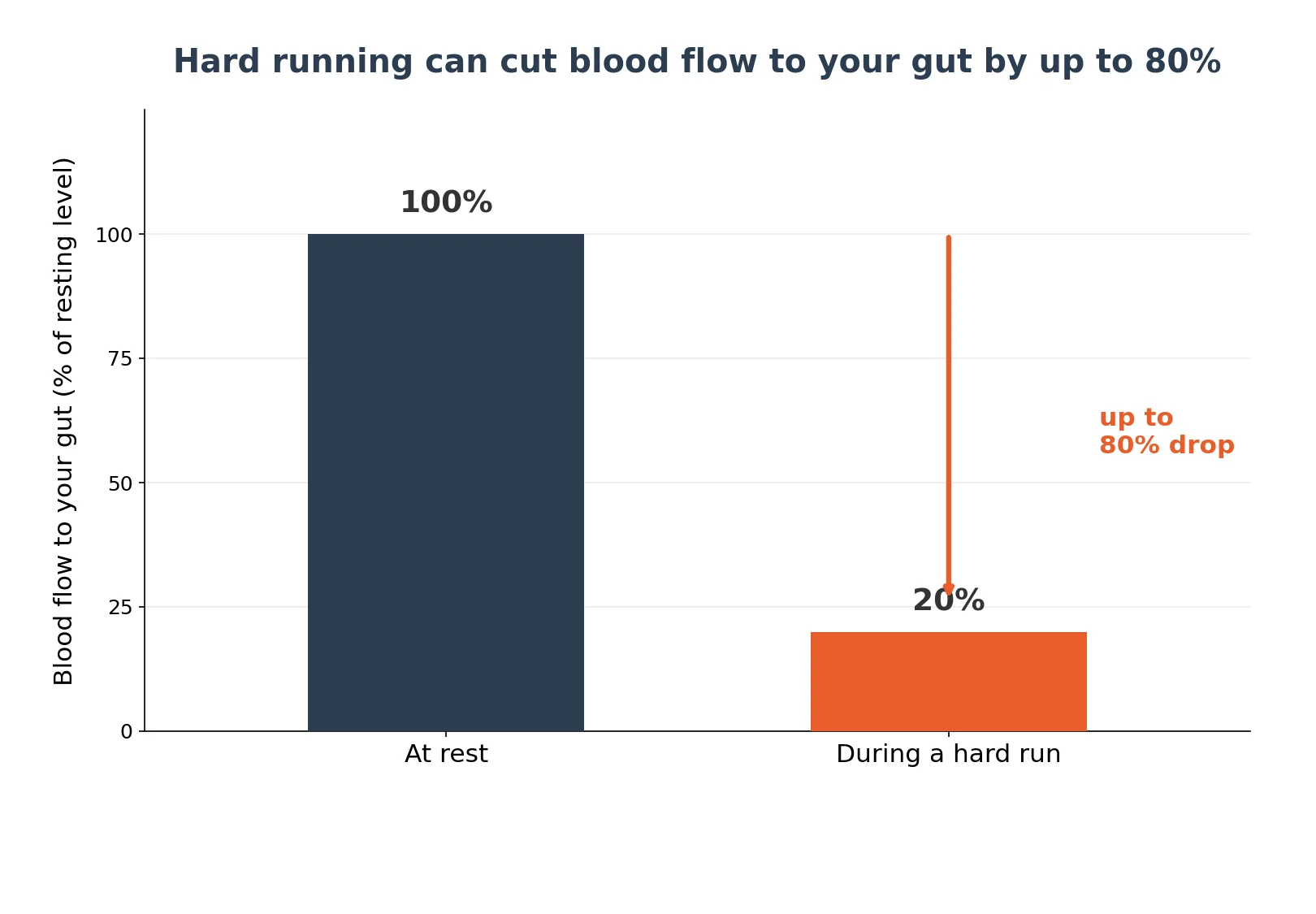
During a hard run your body sends blood to your working legs and your skin to cool you down, and studies have found that blood flow to your gut can drop by as much as 80% at high intensities.
With that 80% drop in blood supply, digestion slows and the lining that normally seals your intestine gets leakier, so food your gut would handle fine at rest now brings on cramps and bloating.
Every footstrike also jostles your stomach and intestines, which shakes up any food or fluid still sitting there.
That combination is why symptoms show up on your hardest and longest efforts rather than your easy jogs.
Sharp cramping paired with an urgent need to use the bathroom mid-run points to a separate problem covered in our guide on needing to poop while running.
Which Foods Trigger Stomach Problems When You Run?
The foods most likely to upset a sensitive stomach on the run are high in fat, high in fiber, or high in certain fermentable carbohydrates, because your gut is slow to clear all of them.
Fat and fiber both slow how fast your stomach empties, so a bagel with butter or a bowl of high-fiber cereal can still be sitting there when you start running an hour later.
A trigger that often flies under the radar is a group of fermentable carbohydrates called FODMAPs, found in foods like onions, garlic, apples, pears, wheat, beans, and milk.
FODMAPs pull water into your intestine and ferment into gas, which is exactly the load your gut cannot handle when blood flow is already low.
In a documented case, a runner who cut high-FODMAP foods for 6 days saw their exercise stomach symptoms drop from moderate to none.
You don’t need to strip these foods from your diet, only to pull them out of the meals and snacks you eat in the few hours before you run.
Fast-digesting, low-fiber carbohydrates like white toast with jam, a ripe banana, or plain oatmeal give you clean fuel with little for your gut to work on, and our guide to what to eat before a run lays out the full menu.
RunnersConnect Bonus
Download your FREE Guide where we share the Best Foods to Eat Before Running.
When Should You Eat Before a Run?
The safest window is a full meal 3 to 4 hours before a hard effort, or a small carbohydrate snack 30 to 60 minutes before an easy run.
That 3 to 4 hour gap on hard days gives your stomach time to empty before blood flow drops, so less food is left to slosh around and ferment.
Larger, higher-fat meals need the full 4 hours, while a banana or a piece of toast clears in under an hour.
The same timing logic applies to what you take in during long runs and races.
Gels and sports drinks that are too concentrated draw water into your gut and bring on cramps, so take gels with a few sips of water rather than gulping them down on their own.
Find your own timing window by testing one meal on easy runs, then lock in that meal and gap so your stomach knows what to expect.
Can You Train Your Gut to Handle More?
Your gut adapts to what you feed it during exercise the same way your legs adapt to mileage, and you can train it on purpose.
Research on athletes shows that eating carbohydrate regularly during training increases the number of carbohydrate transporters in your intestine and speeds up how fast your stomach empties.
That extra transporter capacity means you absorb more fuel per hour, with less left over to ferment and cause cramping.
The practical version is simple: rehearse your exact race-day food and drink on your long runs for a few weeks before the race.
Start with modest amounts and build up, so that by race day your gut treats the fuel as routine instead of a shock.
Do Digestive Enzymes and Probiotics Help Runners?
Digestive enzymes and probiotics can help when your sensitive stomach comes from struggling to break down food rather than from race-day blood flow alone.
These enzymes are proteins your body makes to break food into pieces small enough to absorb, and protease is the one that handles protein, the nutrient runners find hardest to digest in the amounts they need.
A controlled trial found that people taking a protease supplement held onto about 7.6% more strength in the days after hard downhill running than those on a placebo.
Probiotics work on a different front by shifting the balance of bacteria in your gut.
A 2022 review of randomized trials found only limited evidence that probiotics calm a runner’s gut, and what benefit showed up varied by strain and by person.
If you want to test this route, look for a blend built for runners that pairs a full spectrum of enzymes with probiotics, such as the partner product MAS Flush, taken in the evening so your food has time to digest before your next morning run.
For other options, see our ranking of the 6 best probiotics for runners.
| Trigger | What happens on the run | What to do |
|---|---|---|
| Low gut blood flow | Digestion slows, cramps and bloating on hard efforts | Leave 3 to 4 hours after big meals and ease into hard efforts |
| Fatty or high-fiber pre-run food | Food sits in the stomach and sloshes | Switch to low-fiber, low-fat carbs before running |
| High-FODMAP foods | Gas and water drawn into the intestine | Cut FODMAPs in the hours before you run |
| Concentrated gels or drinks | Water pulled into the gut and cramping | Take gels with water and sip slowly |
| Hard-to-digest protein | Gas and heaviness after meals | Trial digestive enzymes or probiotics |