

You hit 40 and your easy pace slows down.
Your legs feel flat for three days after a hard workout that used to leave you recovered by morning.
You’re training just as consistently as you did in your 30s, and the times keep sliding anyway.
It’s a physiology problem, and it responds to a specific set of adjustments that runners over 40 rarely make because no one explained what’s actually changing and why.
In this guide, you’ll learn:
- How much performance actually declines with age, and what the research shows about the pace of that decline
- Why recovery takes longer after 40, and the cellular mechanism behind it
- The type of strength training that directly addresses the muscle changes masters runners face
- How to restructure your intensity distribution to protect your best training weeks
- Why your protein needs are higher than they were a decade ago
How Much Does Performance Decline After 40?
The decline is real, but the picture is more encouraging than most runners expect.
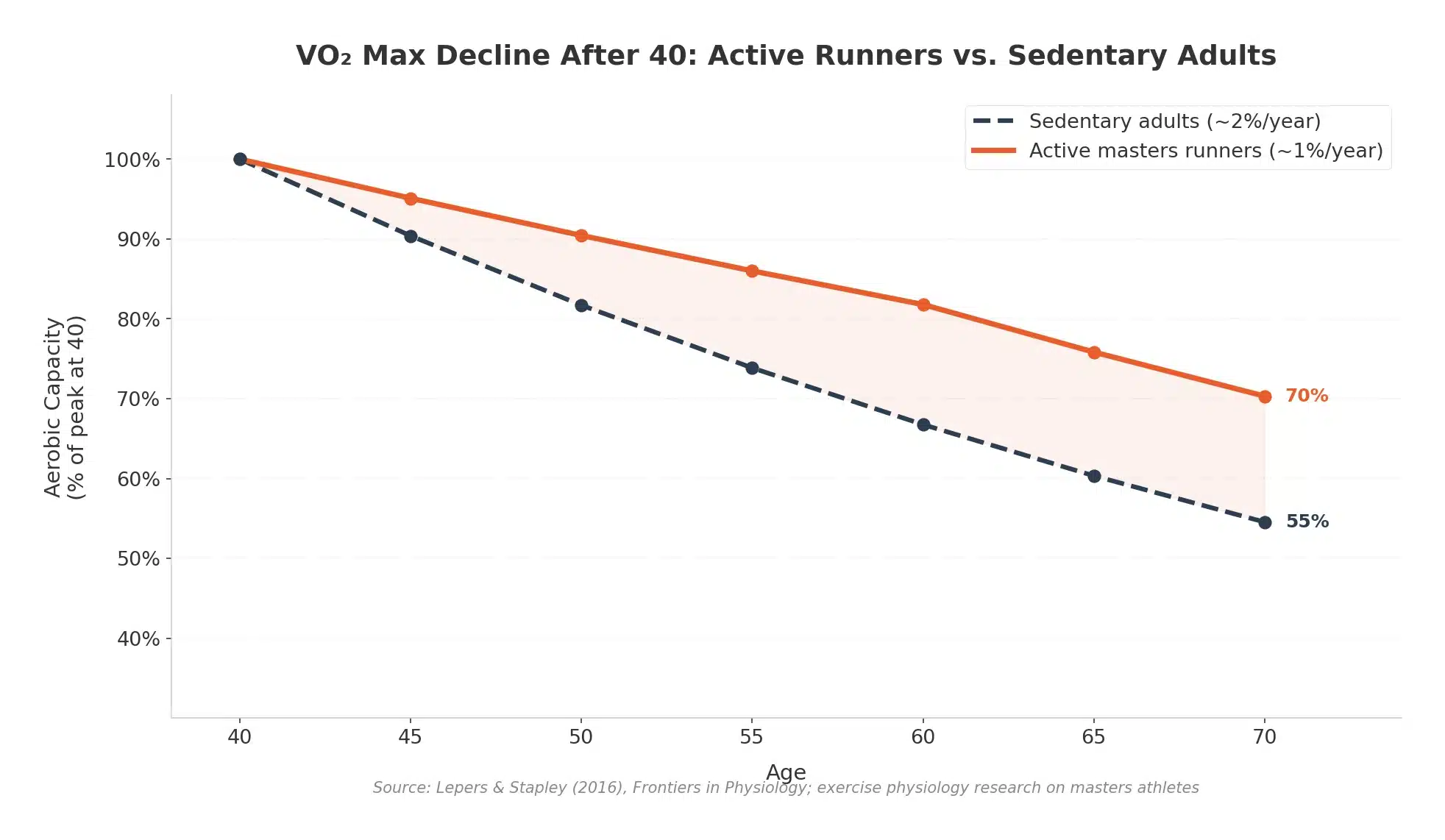
Research tracking masters athletes in endurance events found that aerobic capacity declines at roughly 1% per year in active runners after 40, about half the rate seen in sedentary adults the same age.

The primary drivers of that decline are a drop in VO2 max, a reduction in maximal strength, and a gradual loss of running economy.
All three respond to training.
The steepest drop in VO2 max typically occurs after age 60.
Lactate threshold holds up better than VO2 max with age.
A study of 168 master runners found that lactate threshold remained a strong predictor of race performance even as VO2 max declined.
The runner who keeps threshold workouts on the calendar maintains their performance ceiling more effectively than one who shifts entirely to easy volume.
The decline is manageable with the right training adjustments.
Runners who accept the change and adjust the inputs often race their best age-graded times in their 40s and 50s.
RunnersConnect Bonus
Download your FREE Age Grading Performance Calculator now.
It makes it easy to calculate your age graded performance to compare yourself against those young guns or your former self.
Why Do Masters Runners Take Longer to Recover?
The most common complaint from masters runners is that they need more rest between hard sessions than they used to.
The mechanism is cellular.
Aging muscles develop what researchers call anabolic resistance: a diminished ability to respond to anabolic stimuli including exercise and protein intake.
The muscle protein synthesis signal that fires robustly after a hard workout in a 28-year-old is blunted in a 48-year-old running the same session at the same relative effort.
The inflammatory resolution process also slows.
The cellular repair cascade that clears exercise-induced damage and rebuilds tissue takes longer to complete.
That extends the adaptation window from 24-36 hours to 48-72 hours for most masters runners.
After a hard workout, most masters runners need 48-72 hours of recovery before their next quality session, compared to 24-36 hours for runners in their 20s.
Part of this slowdown traces to NAD+ levels.
NAD+ is a coenzyme that declines naturally with age and plays a central role in mitochondrial energy production and cellular repair.
Lower NAD+ means slower turnover of damaged mitochondria and a less efficient recovery signal between sessions.
Addressing that decline at the source is what NAD+ supplementation is designed to do. MAS NAD+ is targeted specifically at masters athletes who are still training consistently but not recovering or adapting the way they used to.
In practical terms, the adjustment looks like this: schedule hard workouts on Tuesday and Saturday rather than Tuesday and Thursday.
Treat the days between as genuinely easy.
What Kind of Strength Training Do Masters Runners Need?
The general advice to do 2 strength sessions per week is correct for masters runners. But the type of strength work matters as much as the frequency.
Muscle fiber analysis across age groups shows that fast-twitch fiber area and count decline progressively from age 25 onward, with the reduction concentrated in type II (fast-twitch) fibers.
Fast-twitch fibers are responsible for power, speed, and running economy at race pace.
When they atrophy, your stride loses the elastic stiffness that makes fast running efficient. You can still train the aerobic engine, but the neuromuscular component that converts aerobic fitness into actual race speed deteriorates without deliberate maintenance.
The fix requires heavy resistance training combined with plyometric work.
Research comparing masters runners to younger runners found that muscle strength and power were significantly lower in the masters group and that these differences tracked directly with reduced running economy at race pace.
Heavy compound movements and plyometrics are the specific training stimulus that maintains fast-twitch fiber function in masters runners.
Stability work helps with injury prevention but generates a weaker signal for fast-twitch fiber recruitment than loaded compound lifts.
Prioritize: heavy single-leg deadlifts (4-6 reps, 3 sets), split squats with load, calf raises to failure, and bounding drills 2 days per week.
How Should Masters Runners Adjust Their Training Intensity?
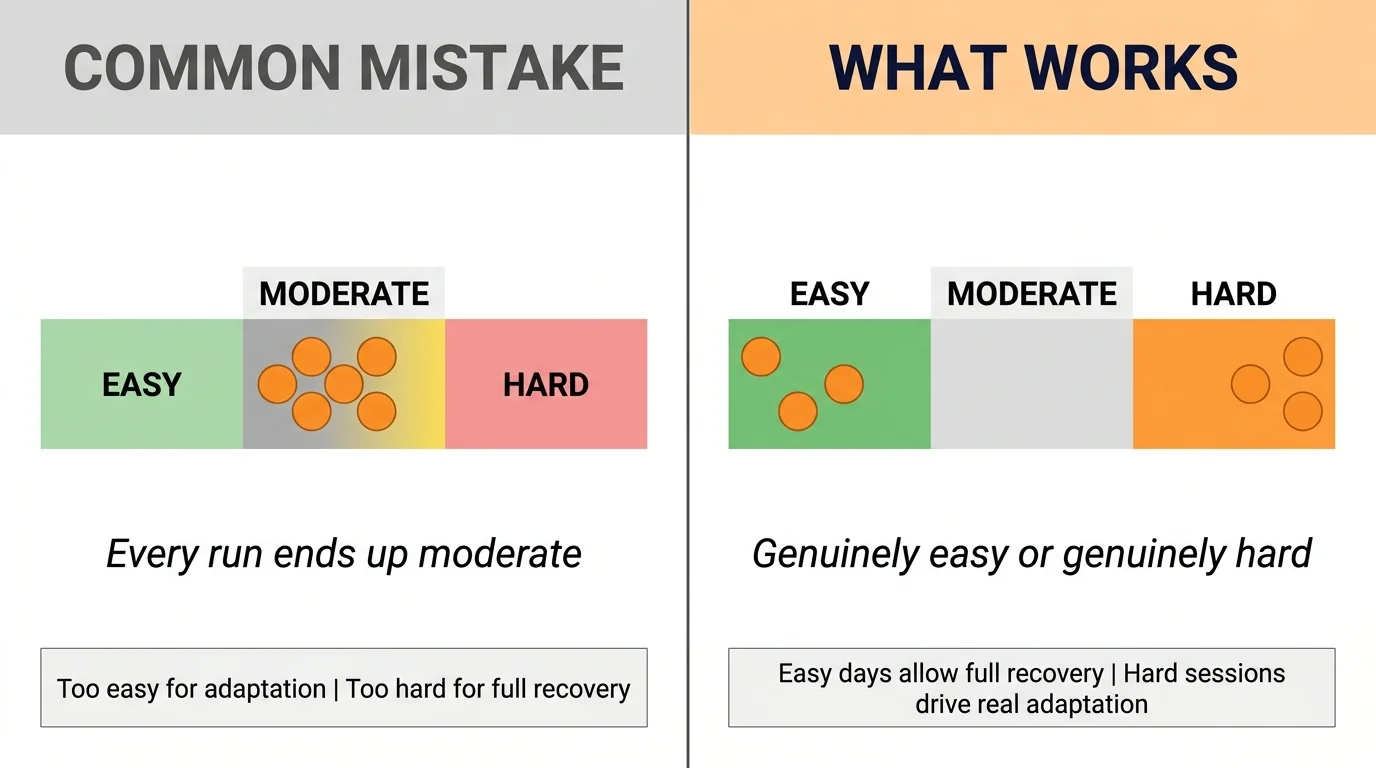
The most common training error among masters runners is compressing the intensity distribution.
Easy runs get moderately hard.
Hard runs stay moderately hard.
The result is a week of medium-effort sessions that are too easy to produce adaptation and too hard to permit real recovery.
The research on lactate threshold in masters athletes points in one direction: protect threshold and VO2 max work by making everything else genuinely easy.
A runner whose current 5K pace is 8:00/mi (4:58/km) should be running most of their weekly mileage at 10:30-11:30/mi (6:31-7:08/km) or slower.
The reason is recovery arithmetic.
Every session at 75-80% max heart rate extends your next recovery window by hours.
Running genuinely easy on off days means your hard days stay hard.
Hard days are where adaptation happens for masters runners.
Masters runners who slow their easy days by 90-120 seconds per mile often find their race performance improves because their quality sessions finally produce real adaptation instead of accumulated fatigue.
The practical weekly structure for a 40-mile (64 km) week masters runner: 2 quality sessions (threshold or VO2 max work), 1 long run at easy effort, and the remaining mileage across genuinely easy days with one full rest day built in.
How Much Protein Do Masters Runners Actually Need?
Masters runners need more protein per meal than they did a decade ago.
The key variable is the threshold for triggering muscle protein synthesis per meal.
Younger muscles respond to roughly 20-25g of high-quality protein per meal with a robust muscle-building signal. Older muscles require more leucine (the amino acid that activates muscle protein synthesis) to generate the same response.
Studies combining leucine-rich protein with resistance training in adults over 50 found significant improvements in body composition and physical function compared to resistance training alone.
That same anabolic resistance means the old “20g per meal” target often falls short.
For masters runners training 5 or more days per week, current evidence supports targeting 35-40g of protein per meal, spaced across 3-4 meals. The post-workout window within 30-45 minutes of finishing a hard session is particularly important.
Masters runners should target 35-40g of protein per meal, roughly 50-60% more per meal than the threshold sufficient for runners in their 20s.
Leucine content matters more than protein source.
Whey, eggs, chicken, and fish provi




2 Responses
Amanda’s comments are on point. I am now (gulp) 64 years old, returning to running on/off after hamstring injury 5 years ago (just after qualifying for Boston and New York marathons at age 58 but in age 40 time qualifiers). I am currently training for half marathon, having done several 5k and 10k’s these past few months. Additions to my routine: Pilates (2x/week); strength training (3x/week), stretching and foam rollers after running; foot work before running, limiting running to every other day (this was the most difficult), massage (about 2x/month) BUT still love to run and will continue as long as possible. I see a few runners in their 70s and 80s and want to be one of them when I get older!
Thanks for sharing your thoughts Patricia! No need to gulp at 64, we have plenty of inspiring runners much older than you who we need to learn from. Thanks for sharing what works for you, and glad you see others as inspiration. Did you listen to our podcast with Margaret Webb? You would really enjoy it- https://runnersconnect.net/running-interviews/margaret-webb/