
Two runners toe the line at the same 10K.
Same training load. Same VO2 max.
One finishes three minutes ahead.
The difference isn’t aerobic capacity.
It’s running economy: the performance variable most runners have never deliberately trained.
If you’ve been stuck at the same race times despite consistent mileage, this is likely the missing piece.
In this guide, you’ll learn:
- What running economy is and how it’s measured
- Why it predicts race performance better than VO2 max among trained runners
- The metabolic, biomechanical, and neuromuscular factors that control it
- The three training interventions with the strongest research support
What Is Running Economy?
Running economy is the oxygen cost required to sustain a given pace.
Think of it as your body’s fuel efficiency rating: how much oxygen you burn to cover each kilometer at a steady speed.
Research published in Sports Medicine-Open defines running economy as “the integrated composite of metabolic, cardiorespiratory, biomechanical, and neuromuscular characteristics” — a measure of how efficiently your body converts oxygen into forward motion.

In a lab, it’s measured by having you run at a set pace while a mask analyzes your oxygen consumption.
Elite runners typically use 180–200 ml of oxygen per kilogram per kilometer.
Everyday runners at the same pace often burn 220 ml/kg/km or more.
That 10–20% efficiency gap translates directly to race time: a runner burning 10% less oxygen at marathon pace can run the same perceived effort level approximately 10–15 minutes faster over 26.2 miles.
The definition of running economy also encompasses your stride mechanics, tendon stiffness, and how efficiently your nervous system coordinates each stride.
It’s not just aerobic fitness.
Why Running Economy Predicts Performance Better Than VO2 Max
VO2 max describes the ceiling of your aerobic engine.
Running economy describes how efficiently you operate below that ceiling, which is where every race is actually run.
One study found that velocity at VO2 max explained 94% of performance variance in 16K time trials, while VO2 max alone explained only 66% among runners of mixed abilities.
Among similarly trained runners, that VO2 max correlation drops even further.
The most economical distance runner ever measured had a VO2 max of only 63 ml/kg/min, yet he ran 1500m in 3:35.
His exceptional running economy compensated for modest aerobic capacity.
There’s also a training ceiling problem: VO2 max typically plateaus after 18–24 months of consistent training.
Running economy, by contrast, continues improving throughout a career with the right stimulus.
Paula Radcliffe improved her running economy by approximately 15% over her competitive career. Her VO2 max had plateaued years earlier.
What Factors Determine Your Running Economy?
Running economy isn’t controlled by one variable.
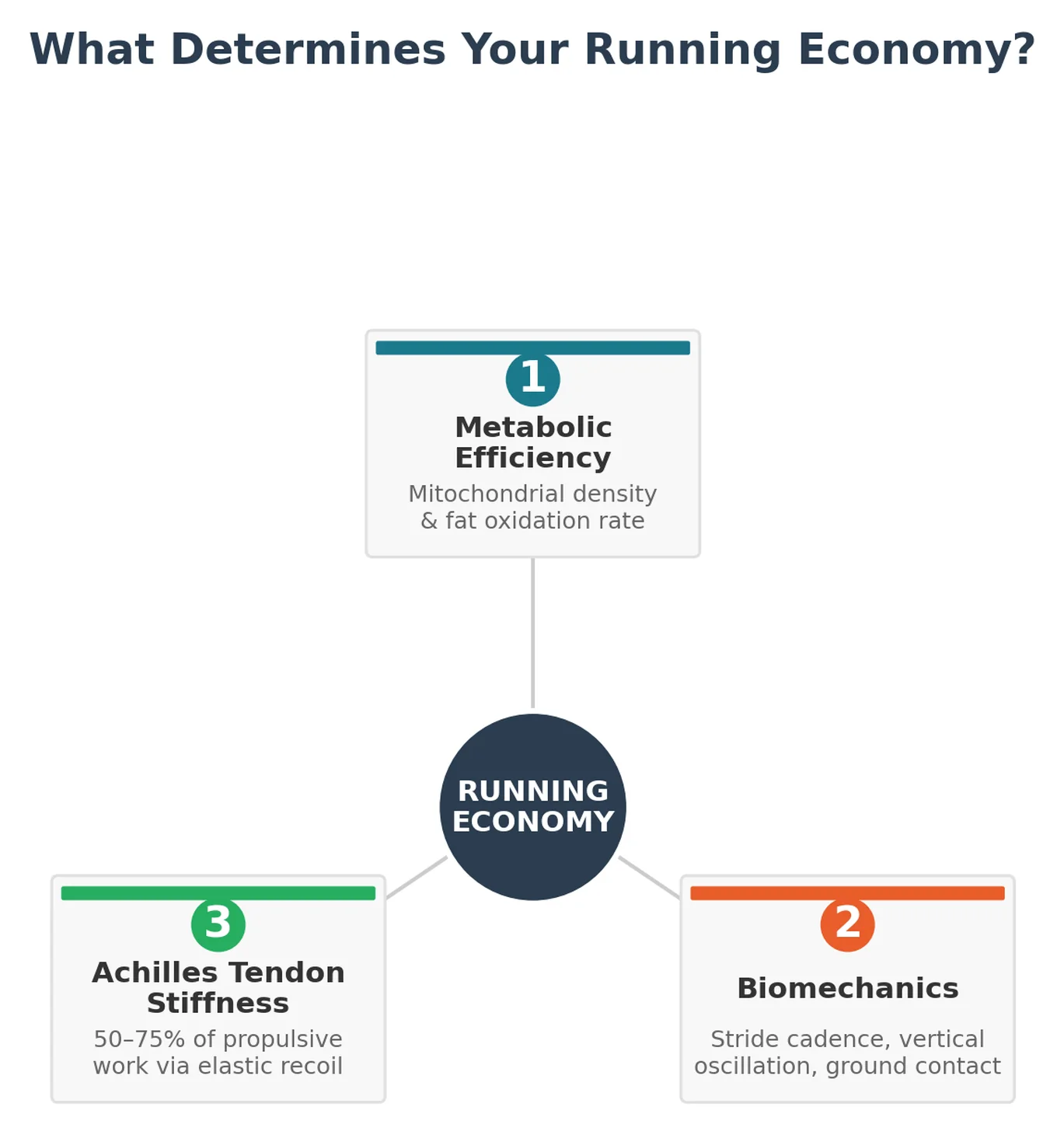
Three systems interact to produce your efficiency at pace.
Metabolic Efficiency
Mitochondrial density in your muscle fibers determines how efficiently cells produce aerobic energy.
More mitochondria means more power output per unit of oxygen consumed.
Your ability to oxidize fat at higher intensities also matters.
Fat-adapted running preserves glycogen and lowers oxygen demand at tempo and race paces.
Biomechanics: Stride, Cadence, and Bounce
A systematic review of 51 studies found that higher stride frequency was significantly associated with better running economy.
Shorter, quicker steps waste less energy than long overstriding strides that brake with each footfall.
Less vertical oscillation (less up-and-down bounce in your stride) consistently appears in elite runners compared to those with worse economy.
One common misconception: forefoot versus heel striking doesn’t significantly affect economy when you run in your natural pattern.
Runners who switched away from their natural footstrike pattern in research settings increased their oxygen cost by 5.5%. Matching someone else’s “ideal form” makes you less efficient, not more.
Achilles Tendon Stiffness
Your Achilles tendon functions as a biological spring, storing elastic energy during the loading phase of each stride and releasing it during push-off.
Research indicates that the Achilles tendon contributes 50–75% of the positive mechanical work during running. Up to three-quarters of your propulsion comes from elastic recoil, not active muscular contraction.
You can’t change your Achilles anatomy.
But tendon stiffness is trainable through the specific interventions below.
Does Plyometric Training Improve Running Economy?
Plyometrics have the strongest evidence base of any supplemental training for improving running economy.
A controlled study by Turner et al. added plyometric training three times per week to the normal running schedule of 18 recreational runners for six weeks. The plyometric group improved running economy by 2.3% at paces between 10:00 and 7:30 per mile (6:13–4:40 per km) with no change in VO2 max.
Only efficiency improved.
More striking: a recent study had amateur runners perform just five minutes of daily double-leg hopping for six weeks.
Running economy improved significantly at 12 and 14 km/h (7:30 and 6:45 per mile).
Why it works: plyometrics improve your stretch-shortening cycle (the rapid eccentric-to-concentric action at each footstrike) and increase muscle-tendon stiffness so more elastic energy is stored and returned per stride.
How to implement:
- Two sessions per week on non-consecutive days
- Build bodyweight strength first (lunges, squats) before adding plyometrics
- Start with squat jumps and bounding, progress to single-leg work
- Keep sessions to 10–20 minutes, performed when fresh
Does Heavy Strength Training Improve Running Economy?
Heavy resistance training produces a meaningful improvement in running economy, though slightly smaller than plyometrics.
A systematic review comparing heavy resistance training to plyometrics found both produce significant running economy improvements, with heavy strength training yielding an effect size of -0.32 across studies.
One 14-week strength intervention produced a 7% increase in plantar flexor strength and a 16% increase in tendon stiffness.
Oxygen consumption dropped by 4%: a meaningful gain from two sessions per week.
The key is training heavy, above 85% of one-rep max with explosive intent.
This builds maximal strength and rate of force development without adding muscle mass that would work against you.
Two weekly sessions focused on posterior chain work (squats, deadlifts, Romanian deadlifts, calf raises, single-leg exercises) provides the required stimulus.
Schedule these on the same days as hard running workouts to protect your recovery days.
RunnersConnect Bonus
Download our Heart Rate Calculator to find out what your individual heart rate zones are.
What Else Can Improve Running Economy?
Two more interventions have solid research support.
Altitude training. A 10-day altitude camp at 1,828 meters improved running economy from 61.30 to 56.44 ml O2/kg/min in one controlled study.
That’s an 8% improvement in under two weeks.
The “live high, train low” approach maximizes this: sleep at altitude where your body adapts, train at lower elevation where you maintain workout quality.
Heat acclimation. For runners without mountain access, heat training produces overlapping adaptations.
Research by Lorenzo et al. found that 10 days of heat acclimation improved plasma volume by 6.5%, cardiac output by 9.1%, and exercise economy significantly, with gains transferring to performance in cool conditions.
Heat stress triggers similar cellular adaptations as altitude exposure.
Five to ten days of training with extra layers on easy runs, or post-workout sauna sessions, can produce measurable improvements in aerobic efficiency without altitude access.
How to Measure Whether Your Running Economy Is Improving
Lab testing is the gold standard but not practical for most runners.
The accessible proxy is pace at a fixed heart rate.
Run the same course at the same perceived effort or heart rate zone every 4–6 weeks.
When your pace improves at the same heart rate, your running economy is improving.
A 2–4% improvement in running economy translates directly to 2–4% faster race times at all distances. The same oxygen cost covers more ground.
Economy gains accumulate slowly: roughly 1–2% per year with consistent, purposeful training.
Compounded over a career, that’s the difference between plateauing and continuing to improve well into your