
You’ve trained for months, and on race morning your biggest worry is whether your stomach will hold up past halfway.
A survey of 707 marathon participants found that over a third felt the urge to have a bowel movement during or right after running, and 18% had stopped a hard run or race to use a bathroom.
Those bathroom stops are the reason runners reach for Imodium before a marathon, even though we found no published trial that tested it in runners before a race.
Your gut also responds to training, the same way your legs do, so the plan that holds up is to fix the cause and keep Imodium as a tested backup.
So, in this article you’re going to learn the research-backed practical advice on:
- What Imodium does inside your gut, when it reaches its peak if you take it before a race, and the dose you should never go past
- Why ibuprofen before hard exercise raised a marker of gut injury by 85% in one study
- How 2 weeks of gut training cut runners’ stomach symptoms by about 60%, and how to fit it into your own week
- What to eat in the 24 hours before a race, and how a probiotic helped marathoners hold their pace in the final third
What Is Runner’s Gut?
Runner’s gut is the catch-all name for the stomach and bowel problems that hit during or right after a run: cramping, nausea, a sudden urge to find a bathroom and diarrhea.
A 2014 review estimated that 30% to 50% of endurance athletes deal with these complaints, and most cases are uncomfortable without being dangerous.
In the survey of 707 marathoners, 19% had diarrhea after running, and women and younger runners reported lower-bowel problems more often than men and older runners.
The bowel side of the problem is often called runner’s trots, and it’s the symptom Imodium is designed to treat.
What Causes Runner’s Gut?
Hard exercise moves blood away from your stomach and intestines toward your working muscles, and the lining of your gut struggles to work with less blood.
Research has shown that 60 minutes of hard cycling doubled a blood marker of damage to the small intestine, from 309 to 615 pg/mL.

The men in that study also absorbed more of a test sugar through their gut lining after exercise, which means the lining let through things it normally blocks.
The up-and-down jostling of every stride shakes your intestines too, and that 2014 review lists this mechanical stress as one of the 3 main causes, alongside reduced blood flow and what you eat.
A study of 221 endurance athletes found that higher carbohydrate intake during races was linked to more nausea and gas, but also to faster Ironman finishing times.
That means the answer is to train your gut to handle the fuel you need, since higher carbohydrate intake was linked to faster Ironman finishes.
The same study found that a history of stomach problems was linked to more symptoms on race day, so if your gut has failed you before, plan for it.
Ibuprofen adds to that gut damage.
In a 2012 trial, 9 trained men who took 800 mg of ibuprofen before cycling reached a peak gut-damage marker of 875 pg/mL, compared with 474 pg/mL when they cycled without it.
That means a “preventive” dose of ibuprofen before your long run likely adds to the gut injury hard exercise already causes.
Heat, coffee, dehydration and race nerves make it worse, and our sister company MAS Edge goes through each one in its guide to what causes runner’s trots.
Should You Take Imodium Before a Marathon?
Imodium slows your gut and firms up diarrhea, but we found no published study of it in runners before a race, so treat it as a backup you test in training.
Imodium is loperamide, and the FDA prescribing label explains that it acts on opioid receptors in your intestinal wall to slow the muscle contractions that push food and fluid through.
That delay gives your gut more time to pull water back out of the stool, which is why it firms up diarrhea.
The label lists constipation, dry mouth, drowsiness, dizziness and tiredness among the reported side effects.
Drowsiness or dizziness late in a marathon could hurt your race more than a short bathroom stop, which is why your first dose should never be on race day.
The label also warns against taking loperamide when you have stomach pain without diarrhea, or diarrhea with blood in the stool and a high fever.
If you get diarrhea on most long runs, see your doctor to rule out other causes, then try gut training and the pre-race food changes below, because they target the causes covered above.
To use it anyway, take it before 1 or 2 long runs first so you know how your stomach and energy respond.
The FDA warns that taking more loperamide than the label allows can cause serious problems with your heart rhythm, and the over-the-counter maximum for adults is 8 mg in 24 hours.
Never take more than 8 mg of Imodium in 24 hours, and talk with your doctor first if you take other medications or have a heart condition.
When Should You Take Imodium Before a Race?
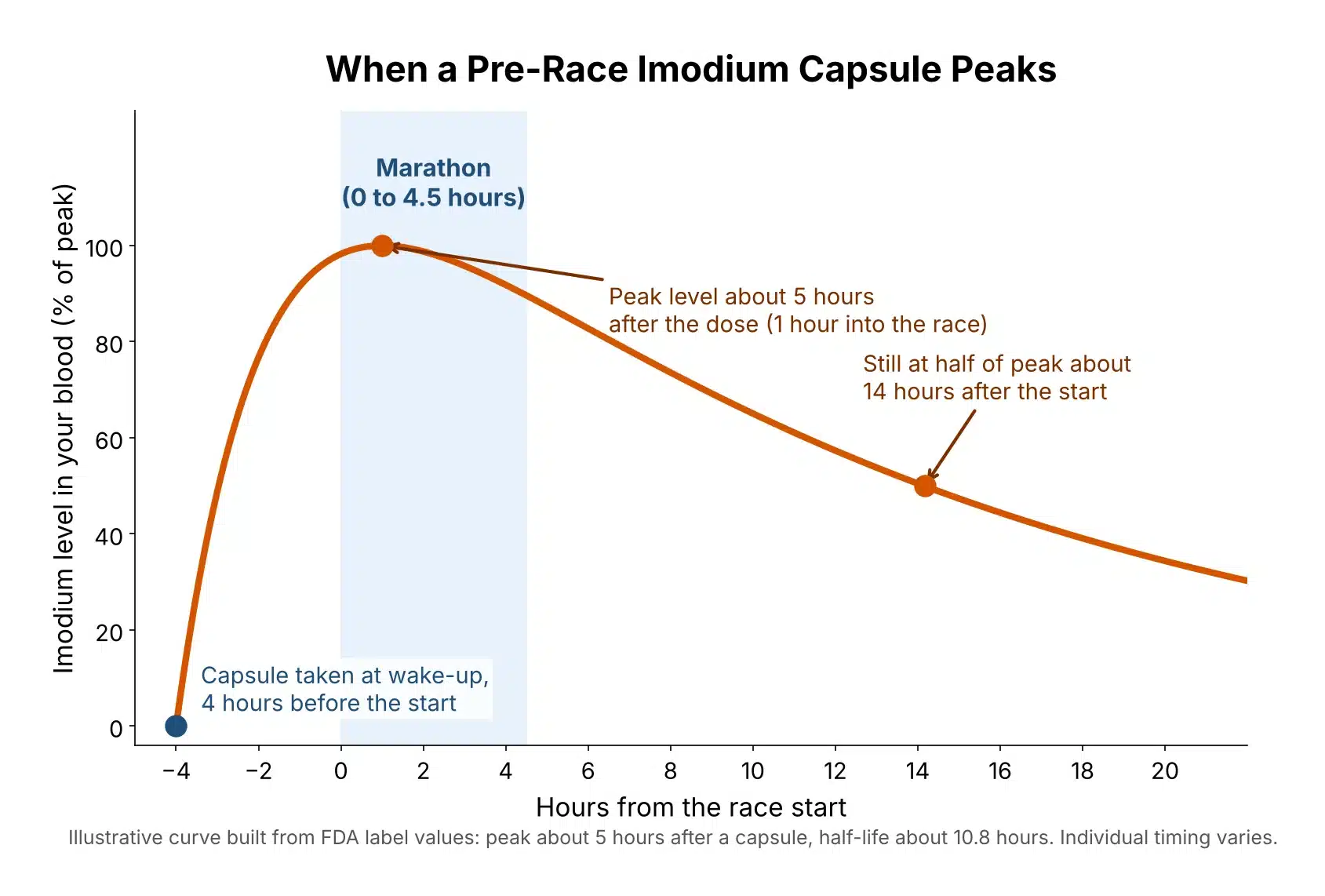
According to the FDA label, loperamide reaches its highest level in your blood about 5 hours after you swallow a capsule and about 2.5 hours after the liquid form.
It also lasts, because your body clears about half of it every 10.8 hours on average, with a range of 9.1 to 14.4 hours between people in the label’s data.
Based on that label data, which comes from people at rest, a capsule you take when you wake up, 3 to 4 hours before the start, would peak in the first 1 to 2 hours of a marathon and still be in your blood at the finish.
The over-the-counter label is written for diarrhea that has already started, with 4 mg after the first loose stool and 2 mg after each loose stool after that.
Taking it before a race is outside that label, so ask your doctor or pharmacist what dose makes sense for you before you test it on a long run.
How Do You Train Your Gut for Race Day?
Gut training means practicing your race-day fueling on training runs so your stomach and intestines learn to absorb carbohydrate while you run.
Research has shown that 2 weeks of gut training cut stomach symptoms during a 2-hour run by 60% when runners trained with gels and by 63% when they trained with real food, compared with their first test.
In both tests, the runners in that 2017 study took in 30 grams of carbohydrate every 20 minutes during the 2-hour run, which works out to 90 grams per hour.
After the 2 weeks, they covered 5.2% more distance in a 1-hour run test when they had trained with gels and 4.3% more when they had trained with food.
The placebo group, who ran the same sessions without carbohydrate, covered 2.1% less distance.
A follow-up trial from the same lab found that runners who trained daily for 2 weeks with 90 grams of carbohydrate per hour also produced half as much hydrogen in their breath, a sign that less sugar was reaching the large intestine undigested.
Gut bacteria ferment that undigested sugar, and the gas they produce can cause bloating and cramping.
Those labs used daily sessions, but a practical version for a normal training week is to use 1 or 2 runs a week, usually your long run and 1 workout, to practice the fuel you plan to use on race day.
Start around 30 grams of carbohydrate per hour, about 1 standard gel, and add roughly 10 grams per hour each week as long as your stomach stays settled.
Sports nutrition guidelines recommend 30 to 60 grams per hour for races of 1 to 2.5 hours and up to 90 grams per hour for longer races, using gels or drinks that mix glucose and fructose.
Use the same gels, drink and timing in training that you’ll use on race day, because your gut adapts to what you practice.
Ready For More?
Then start our FREE Race Day Fueling email course!
You’ll learn how to calculate when you’ll bonk, how to hydrate, what foods to eat during your race, and more! From case studies to scientific research, we’ll help you learn how to best fuel for your next race.
What Should You Eat Before a Race to Avoid Runner’s Gut?
In the 24 hours before a race, eat low-fiber, low-fat carbohydrate foods you’ve already tested before a long run.
In a survey of 55 half-Ironman triathletes, every athlete who had intestinal cramps had eaten fiber-rich foods in their pre-race meal, compared with only 10% of those without cramps.
That means swapping whole-grain bread, beans and big salads for white bread, white rice and potatoes the day before your race may lower your risk of cramping.
If you’re not sure how much fiber to cut before a race, start with your last 2 meals.
Cut fiber in your last 2 meals before a race, and eat only foods you’ve already tested before a long run.
Keep a simple log of what you ate, when you ate it and how your stomach felt on each long run, since a food you ate the day before can still cause symptoms on your run.
Does a Low-FODMAP Diet Help Runners?
FODMAPs are sugars your small intestine absorbs poorly, found in foods like wheat, onions, garlic, beans, apples and milk, and gut bacteria ferment them into gas.
A 2019 crossover study found that 7 days on a low-FODMAP diet cut recreational runners’ stomach symptom scores from 81 to 31 points.
The runners also rated how often and how hard they could train as better on the low-FODMAP week than on the high-FODMAP week.
A low-FODMAP diet is restrictive, so save it for the week before a key race, the length tested in that study, and try it before a long run first.
RunnersConnect Bonus
Download your FREE Marathon Nutrition During Your Taper Guide.
The guide contains a plan of exactly what you should be eating in the 5 days to 3 hours before your race. We give specific food recommendations to make sure you are ready on race day.
Can a Probiotic Help Runner’s Gut?
A probiotic taken daily for 4 weeks before a marathon reduced stomach symptoms in the late miles in one controlled trial.
In a 2019 study, runners who took a probiotic with Lactobacillus and Bifidobacterium strains for 28 days before a marathon had less severe stomach symptoms in the final third of the race than the placebo group.
The probiotic group slowed by 7.9% from the first third of the race to the last third, while the placebo group slowed by 14.2%.
That means the probiotic helped runners hold their pace in the part of the race where stomach trouble usually hits, though finish times between the 2 groups did not differ.
A 2025 systematic review rated the probiotic evidence as mixed, so keep gut training as your main plan, and if you try a probiotic, start at least 4 weeks before race day.
To pick one, see our ranking of the 6 best probiotics for runners.
Our sister company MAS Edge built MAS Flush with Bifidobacterium animalis, one of the species used in that marathon trial, and it’s designed for daily use in the weeks before a race.
What Should You Do When Your Stomach Goes Mid-Race?
When your stomach turns during a race, slow down for a few minutes, because the gut’s loss of blood flow is greatest at high effort.
Switch to small sips of fluid.
Space out your next gel a little longer than planned, but keep fueling, because running out of carbohydrate over the final miles slows you down too.
If you need a bathroom, take the stop at the next portable toilet you see, because holding it while your gut is cramping usually forces you to slow down anyway.
That 2014 review notes that bleeding in the gut and ischemic bowel, where part of the intestine loses its blood supply, can be serious problems in endurance athletes.
Stop running and get medical help if you see blood in your stool or have severe stomach pain or feel faint.
What Prevents Runner’s Gut Best?
Here’s a summary of each strategy, what the research found and how to use it.
| Strategy | What the research found | How to use it |
|---|---|---|
| Gut training | 2 weeks of practice cut stomach symptoms by 60% to 63% and improved a 1-hour run test by 4% to 5% | Practical version: race fueling on 1 or 2 runs a week, building toward 60 to 90 grams per hour |
| Low-fiber pre-race meals | In a survey, all triathletes with intestinal cramps had eaten fiber-rich pre-race food, compared with 10% of those without | Cut fiber in your last 2 meals before the race |
| Short low-FODMAP diet | 7 days cut runners’ symptom scores from 81 to 31 | Try it for the week before a key race |
| Probiotic | 28 days reduced late-race symptoms, and runners slowed 7.9% in the final third compared with 14.2% on placebo | Start at least 4 weeks before race day |
| Skip ibuprofen | Ibuprofen before cycling raised a gut-damage marker from 474 to 875 pg/mL | Avoid it before long runs and races |
| Imodium | Slows gut transit and peaks about 5 hours after a capsule, but we found no trials in runners | Test it on a long run first and never exceed 8 mg in 24 hours |