
You eat a bowl of bran cereal with raspberries at 6 a.m., head out for intervals at 7, and by the second rep you’re looking for a bathroom.
Fiber is one of the healthiest parts of your diet, and eaten at the wrong time it’s a common cause of cramps and bathroom stops on the run.
The answer is timing: eat plenty of fiber across the day and cut it back in the hours before hard runs and races.
Here’s what you’ll learn about fiber and running:
- Why fiber is good for runners and how many grams you need each day
- What a fiber-heavy breakfast does to your gut once you start running
- How much fiber to keep in your pre-run meal, and when to stop eating it
- Whether a low-fiber diet before a race is worth it
Is Fiber Good for Runners?
Fiber protects your long-term health, and the biggest gains come at intakes most adults never reach.
Fiber is the part of plant carbohydrate your small intestine can’t digest, so it passes into your colon intact and gives you almost no usable energy during a run.
Research has shown that people who eat the most fiber have 15% to 30% lower rates of heart disease, stroke, type 2 diabetes and colorectal cancer than people who eat the least.

The largest drop in risk came at 25 to 29 grams of fiber a day.
Most Americans fall well short of that. A 2015 position paper from the Academy of Nutrition and Dietetics reports that people in the US average just 17 grams a day, and only 5% reach the recommended intake.
For runners, the catch is timing. The bowl of black beans that helps your heart at dinner can send you looking for a bathroom if you eat it an hour before a tempo run.
What’s the Difference Between Soluble and Insoluble Fiber?
Soluble fiber dissolves in water and forms a gel, which is the sticky texture you see when oatmeal sits in the bowl.
That gel slows how fast food leaves your stomach and how fast sugar from the meal reaches your blood.
Soluble fiber also lowers cholesterol, though each serving makes only a small dent.
A 1999 meta-analysis of 67 controlled trials found that 3 grams of soluble fiber from oats, about 3 servings of oatmeal, lowered total and LDL cholesterol by roughly 0.13 mmol/L.
Insoluble fiber doesn’t dissolve. It adds bulk to stool and speeds its trip through your intestines, which is why wheat bran and vegetable skins help with constipation.
Before a run, the total grams of fiber in your meal matter more than whether that fiber is soluble or insoluble.
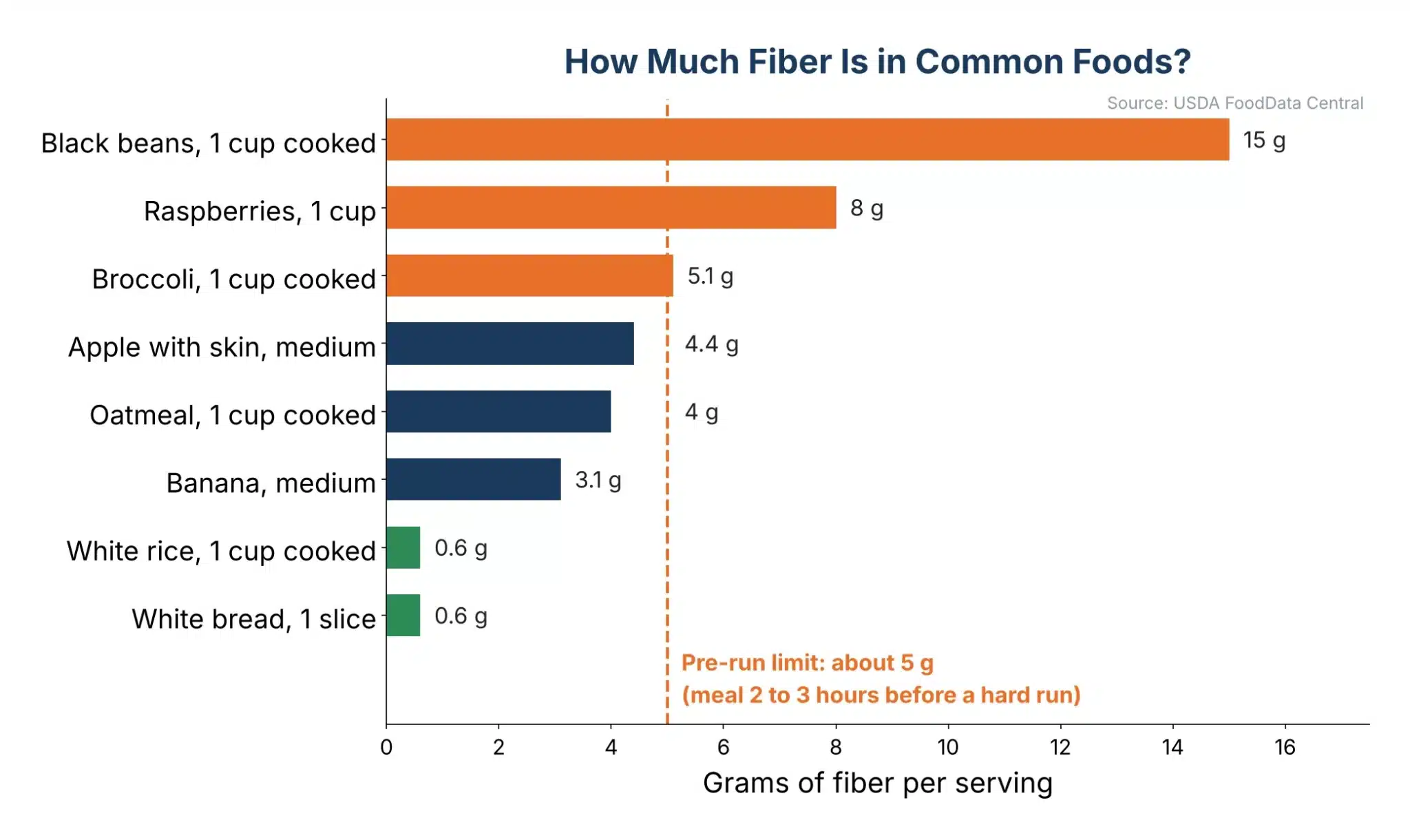
Common foods range from under 1 gram to 15 grams of fiber per serving, according to the USDA FoodData Central database.
| Food | Fiber (grams) | Main type | Before a hard run? |
|---|---|---|---|
| White bread, 1 slice | 0.6 | Very little fiber | Safe |
| White rice, 1 cup cooked | 0.6 | Very little fiber | Safe |
| Banana, medium | 3.1 | Mostly soluble | Safe for most stomachs |
| Oatmeal, 1 cup cooked | 4.0 | Mostly soluble | Test it before easy runs first |
| Apple with skin, medium | 4.4 | Both | Test it before easy runs first |
| Broccoli, 1 cup cooked | 5.1 | Mostly insoluble | Save it for after the run |
| Raspberries, 1 cup | 8.0 | Mostly insoluble | Save it for after the run |
| Black beans, 1 cup cooked | 15.0 | Both | Save it for after the run |
Why Does Fiber Before a Run Upset Your Stomach?
Fiber you eat in the hours before a run is still in your intestines when you start running, and a full gut handles hard running poorly.
Gut problems are common in endurance sport. A 2014 review estimated that 30% to 50% of endurance athletes deal with them.
During intense exercise, blood flow to your intestines drops as blood is sent to your working muscles.
The same review names that drop as one of the main causes of gut symptoms.
Fiber makes a full gut harder to run on in 3 ways:
- Delayed stomach emptying. Soluble fiber’s gel holds food in your stomach for more time than a low-fiber meal would, so more of your breakfast is still there at the start.
- Extra bulk and water. Insoluble fiber pulls water into the bowel and speeds transit, which raises the urge to go.
- Gas from fermentation. Bacteria in your colon break fiber down and release gas, and you feel it as bloating and cramping once you start bouncing.
One survey of triathletes after a half-Ironman found that every athlete with intestinal cramps had eaten fiber-rich food in their pre-race meal, compared with only 10% of athletes without cramps.
That survey covered 55 athletes, so it shows a link worth acting on.
Fiber is only one trigger for urgency on the run, and the guide to preventing runner’s diarrhea covers the rest, from caffeine to dehydration.
How Long Before a Run Should You Avoid High-Fiber Foods?
As a coaching rule of thumb, keep the meal you eat 2 to 3 hours before a workout or race under about 5 grams of fiber.
In the last hour, drop to 2 grams or less and stick to fast carbohydrate like a banana or white toast with honey.
Treat those numbers as a starting point, and adjust them after a few test runs.
Runners already cut fiber on their own before races. A 2020 survey of 388 runners found that 23% avoided high-fiber foods before racing.
Among the women in that survey, the farther a woman raced, the more likely she was to avoid high-fiber foods.
Easy runs give you more room, because your gut keeps more of its blood flow at a conversational pace.
Use easy days to test the oatmeal and fruit breakfasts you like, and save the low-fiber version for workouts and races.
The harder the session, the less fiber you want in the 3 hours before it.
Once you know your fiber limit, what to eat before a run comes down to carbohydrate and timing.
RunnersConnect Bonus
Download your FREE Guide where we share the Best Foods to Eat Before Running.
Is an Apple Before a Run a Good Idea?
An apple works before an easy run if your stomach tolerates it, but it’s a risky pick before a workout or race.
A medium apple with skin has about 4.4 grams of fiber, close to the whole pre-run budget.
Apples are also high in fructose and sorbitol, 2 sugars in the FODMAP group that bacteria in your gut ferment.
A 2018 trial put 11 runners with exercise-related gut problems on 6 days of a low-FODMAP diet and 6 days of a high-FODMAP diet.
The low-FODMAP days cut daily flatulence, loose stools and the urge to go, though symptoms during the runs themselves didn’t change.
If apples bother you, peel the apple or swap it for a banana before hard sessions.
Should You Cut Fiber Before a Race?
A short low-fiber phase in the 2 to 4 days before a race leaves less material in your gut on race morning.
Researchers found that 4 days of eating under 10 grams of fiber a day lowered body weight by about 0.6 kg (1.3 lb) compared with a normal diet of about 30 grams.
Bowel movements also fell from 2 a day to 1, which is the change you want on race morning.
The low-fiber diet matched the normal diet for calories and carbohydrate, so the weight came off without cutting fuel intake.
Hunger ratings went up on the low-fiber days, but 18 of the 19 men rated the diet tolerable.
A low-fiber phase also fits carb loading, since swapping whole-grain pasta and beans for white rice and peeled potatoes lets you eat more carbohydrate with less bulk.
Keep the phase short and go back to your normal intake after the race, since the health benefits come from eating fiber most days of the year.
How Much Fiber Do Runners Need, and Can You Eat Too Much?
The recommended intake from that same position paper is 14 grams of fiber for every 1,000 calories you eat.
That works out to 25 grams a day for women and 38 grams a day for men.
Runners eat more than average, so you need more fiber as your training load rises. A runner eating 3,000 calories a day would aim for about 42 grams.
You can overdo fiber, and gas is the first sign.
A 2022 meta-analysis of 16 trials in adults with constipation found that people taking fiber supplements had more flatulence than people in the control groups.
As a coaching rule of thumb, add about 5 grams a week until you reach your target, so the bacteria in your colon have time to adjust.
The water you drink changes how much extra fiber helps. A 1998 trial put 117 adults with constipation on 25 grams of fiber a day for 2 months.
Patients told to drink 2 liters of water a day had more bowel movements and used fewer laxatives.
Patients left to drink as they pleased averaged 1.1 liters a day and improved less.
That means fiber helped both groups, but the patients who drank more water got the bigger gain from the same 25 grams.
If you use a supplement for constipation, psyllium has the strongest evidence.
In that same 2022 meta-analysis, 66% of people responded to fiber supplements compared with 41% in the control groups.
The best results came with more than 10 grams a day taken for at least 4 weeks.
Every time you add fiber to your diet, add water with it.
How Much Fiber Should You Eat Around Your Runs?
This table shows how to time your fiber around training and racing.
| When | Fiber target | Example foods |
|---|---|---|
| Most meals on training days | 14 g per 1,000 calories (25 g women, 38 g men) | Oats, beans, berries, whole grains |
| Easy run days | Test your usual breakfast | Oatmeal with berries, an apple |
| 2 to 3 hours before a hard run or race | Under about 5 g | White rice, white toast with jam, a banana |
| Last hour before a run | 2 g or less | A banana, white toast with honey |
| 2 to 4 days before a race | Under about 10 g per day | White pasta, peeled potatoes, white bread |
| After the run | Back to your normal target | Whole grains, fruit, vegetables |