

Do you get enough iron in your diet?
Many runners don’t, especially women.
One study of female college athletes found that 31% were iron deficient!1
One method you might have heard about to increase the amount of iron in your diet is cooking your food using cast iron cookware. Absorbing iron from your pots and pans sounds completely crazy—is there any truth to this, or is it just a running old-wives’ tale?

Putting this “myth” to the test
Conceptually, the proposed process for iron from your cookware ending up being absorbed by your body as a nutrient is as follows: individual atoms of iron either flake off or are chemically absorbed by the food you’re cooking, which makes its way to your stomach where the iron gets absorbed and eventually put to use making hemoglobin, ferritin, and other iron-containing proteins.
Fortunately, testing out whether this actually happens pretty easy. All we’d need to do is cook some food in cast iron cookware, check its iron content, and compare this to the same meal cooked in non-iron cookware.
This exact experiment was described in a 1991 article in the Journal of Food Science by Y.J. Cheng and H.C. Brittin.2 An initial experiment, published in 1984, had confirmed that some iron is transferred to food cooked in cast-iron cookware, and that more acidic foods have a greater propensity to absorb iron.3
Cheng and Brittin’s study set out to get a more accurate picture of exactly how much iron is absorbed by two commonly-eaten and fairly acidic foods: applesauce and spaghetti sauce.
Using standard ingredients from a supermarket, Cheng and Brittin cooked up one hundred batches of applesauce and one hundred batches of spaghetti sauce. Fifty batches of each were cooked in cast-iron pots, and fifty were cooked in CorningWare glass dishes, which of course do not contain iron.
A small sample of each batch was analyzed for its moisture content and iron content—it was important to control for moisture content because one cooking method might drive off more water, making it appear as though there was more iron in the food, when really it was merely a concentrating effect.
Cheng and Brittin’s data confirmed that both applesauce and spaghetti sauce pick up a measurable amount of iron after being cooked in cast iron cookware.
When the foods were cooked in the glass dishes, their iron content was negligible: less than one milligram of iron per 100 grams of food (about 3.5 ounces). But when the foods were cooked in cast-iron pots, the spaghetti sauce picked up about 2 mg of iron per 100g of sauce, and the applesauce picked up 6 mg per 100g.
For reference, a typical serving of each of these—about one cup—would be around 250 g, and the recommended daily intake of iron is 8 mg for men and 18 mg for women. A typical iron supplement contains 45 mg of iron.
The moisture content of the dishes did not differ between the cookware, meaning the increase in iron content represents a true transfer of iron from the cast iron pot into the food.
The ability of cast iron cookware to impart just a little bit of iron to foods cooked in it is very convenient if you’re looking to boost your iron intake.
The amount of iron transferred to the food happens to be just enough to be a significant source of dietary iron, but not enough to pose any risk of iron overload in healthy people.
Conclusion
If you are trying to increase your intake of iron, try doing some of your cooking in cast iron pots and pans. You’ll get best results by cooking moist, acidic foods like applesauce, chili, tomato sauce, stew, and scrambled eggs.
As a rough rule of thumb, one cup of these foods will gain about six to eight milligrams of iron after being cooked in cast iron cookware.
Dry, non-acidic foods like pancakes, rice, and green beans don’t pick up much iron from a cast iron pot. Of course, your diet should also contain plenty of foods that naturally contain iron, like red meat, beans, lentils, and spinach.
How do you make sure you consume enough iron to sustain your training?
How Much Iron From Cast Iron Actually Gets Into Your Body?
The 6 to 8 milligrams per cup figure reflects how much iron transfers into your food.
Your body absorbs a fraction of that.
Iron leached from cast iron is non-heme iron, the same form found in spinach, lentils, and fortified cereals.
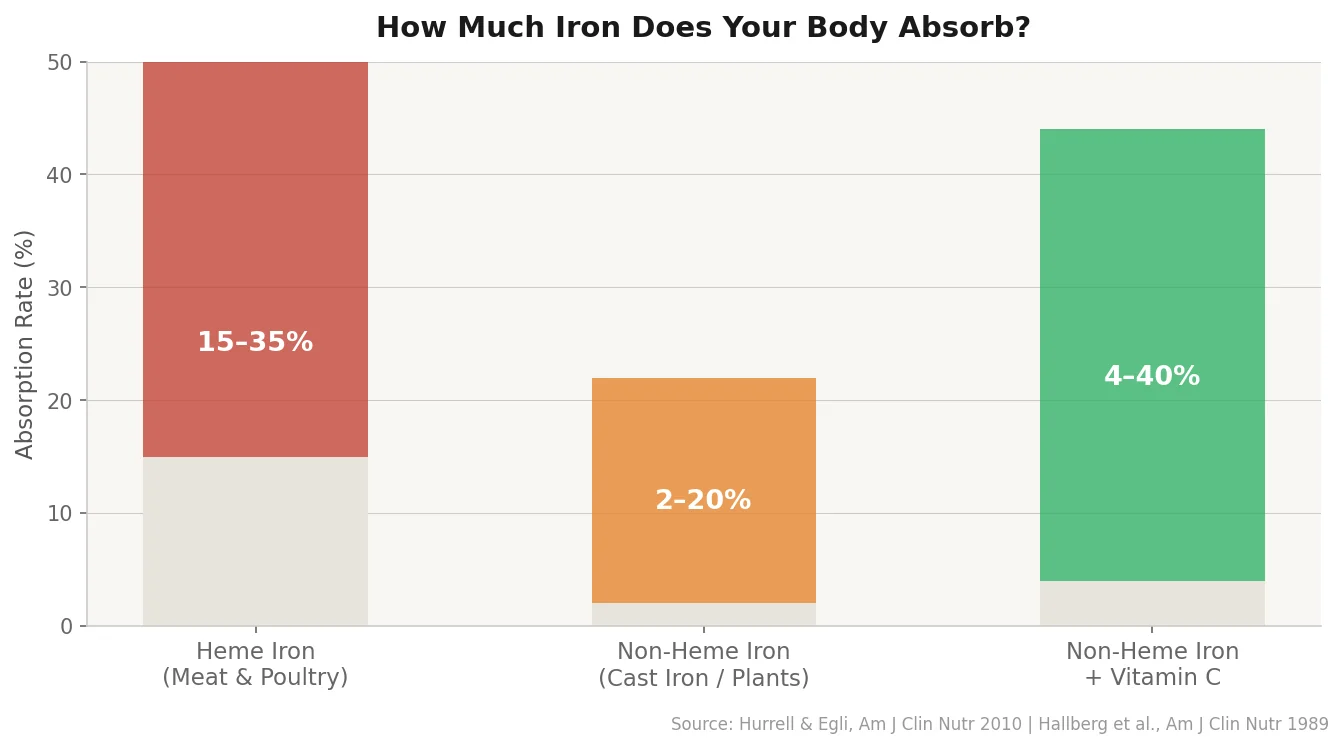
Research has shown that non-heme iron absorption ranges from 2 to 20 percent, compared to 15 to 35 percent for the heme iron in meat.

From 7 milligrams of non-heme iron, your gut typically absorbs somewhere between 0.5 and 1.5 milligrams under ordinary meal conditions.
The range is wide because other foods at the same meal either suppress or enhance how much gets through.
Coffee, tea, calcium from dairy, and phytic acid in whole grains all reduce non-heme iron absorption when consumed at the same time as an iron-rich meal.
Vitamin C works in the opposite direction.
Studies have found that 75 to 100 milligrams of vitamin C, roughly the amount in half a bell pepper or a small glass of orange juice, can more than double the amount of non-heme iron your body absorbs from that same meal.
Cooking acidic, vitamin C-rich ingredients in your cast iron skillet compounds the benefit, and vitamin C carries its own recovery benefits for endurance runners beyond iron absorption.
Can Cast Iron Cooking Help Runners With Low Iron?
For runners dealing with iron-related fatigue or low ferritin, cast iron cooking is a practical tool worth adding to daily meals.
Iron deficiency is the most common nutritional deficiency among endurance athletes.
Research tracking female endurance athletes has found rates of iron depletion between 26 and 60 percent, with higher training volume correlating with greater depletion.
A runner who cooks a cup of spaghetti sauce in cast iron gets roughly 5 milligrams of non-heme iron into that serving.
Paired with a vitamin C source, that serving might deliver 1.5 to 2.5 milligrams of absorbable iron, a meaningful contribution toward an 18-milligram daily target for women.
Combining cast iron cooking with iron-rich foods such as red meat, legumes, fortified cereals, and dark leafy greens gives you two additive iron sources in each meal.
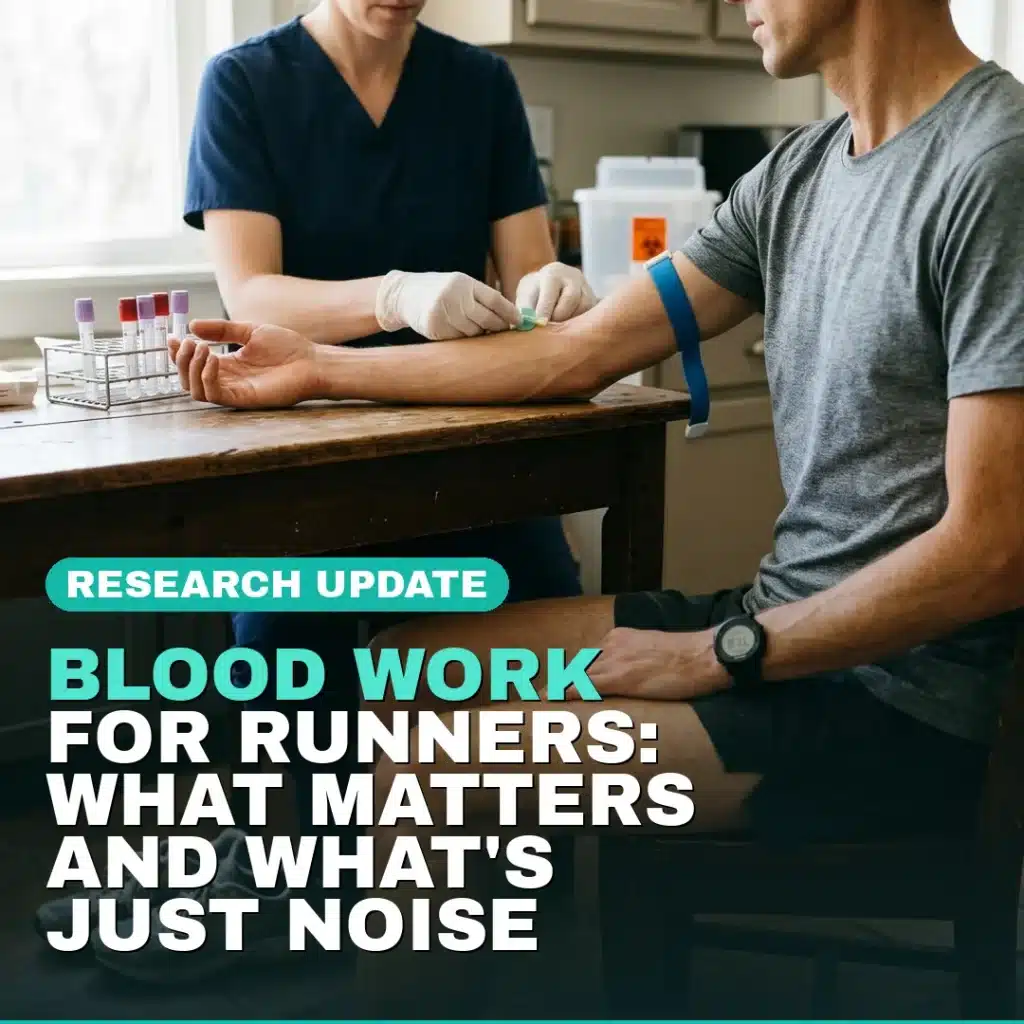
Runners who suspect iron deficiency should get a full blood panel including ferritin, since ferritin reflects stored iron and falls before hemoglobin does.
Runners with hemochromatosis or unexpectedly elevated ferritin should consult a physician before relying on cast iron cookware regularly.
It adds measurable iron to every acidic meal prepared in it.
For vegetarian and vegan runners who rely entirely on non-heme iron sources, using cast iron consistently is one of the most accessible ways to increase daily iron intake without changing food choices.
RunnersConnect Bonus
Download our FREE recovery foods guide, with the top 10 foods for each of the essential recovery vitamins, minerals and macro nutrients. Plus a sample 1-day meal plan!



3 Responses
bad idea… i ate for the first time from a cast iron skillet (christmas gift that you use to make steaks with) i made 1 scrambled egg, heck, only ate half of it. tummy ache… the pan is a bad idea for some of us *still has a tummy ache…*
Was it due to the skillet or maybe it was just a bad egg?
There are five principal types of journalism:
investigative, news, reviews, columns and feature
writing. The fact is that just because you are running advertisements and the phone is ringing with
new prospects doesn’t necessarily mean you are not missing
out on new opportunities and first time customers.
He doesn’t want to wade through mounds of jumbled words that
look like an English assignment.