

You lace up for a run with an empty stomach, wondering if eating first will help or sabotage the workout.
Most runners either skip fuel entirely before early runs or eat so close to the workout that they hit the road cramping.
The right pre-run meal sits between those extremes, and the right choice depends on your run type, your timing window, and how your stomach responds to food under stress.
So, in this article you’re going to learn the research-backed answers to:
- How to time your pre-run meal for easy runs, workouts, and races
- Which foods settle well and which trigger cramps, nausea, or urgency
- How to fuel early morning runs without feeling sluggish
- How to train your gut to handle more carbohydrate under race-day stress
- The exact carbohydrate amounts that optimize performance by distance
Why Does Pre-Run Nutrition Matter?
The three hours before your run decide how much fuel your muscles have available, how stable your blood sugar stays, and whether your stomach cooperates.
Research has shown that carbohydrates eaten before exercise raise blood glucose, spare muscle glycogen, and extend endurance performance.
Eat too close to your run and partially digested food competes with your legs for blood flow, which triggers cramping, nausea, or urgency.
Eat too far out and blood sugar drops, leaving you sluggish or lightheaded.
Your job is to find the window where food has cleared your stomach but the carbohydrate is still available to your working muscles.
How Long Before a Run Should You Eat?
Most runners should eat 60 to 90 minutes before an easy run, 90 to 120 minutes before a hard workout, and 2 to 4 hours before a race.
No single timing rule works for every runner because digestion speed depends on your metabolism, stomach sensitivity, and the food itself.
Start at 90 minutes before an easy run and shift the window by 15-minute increments until your stomach and energy both feel right.
A banana and a slice of toast 90 minutes out is a reliable baseline test.
If you feel sluggish at the start, move the meal closer to 75 minutes next time.
If you feel nausea or cramping, move the meal further out to 105 or 120 minutes.
Hard workouts and races need a longer digestion window because higher intensity pulls blood away from your stomach sooner.
| Run Type | Pre-Run Window | Why |
|---|---|---|
| Easy run or recovery | 60–90 minutes | Lower intensity, blood flow less disrupted |
| Tempo or threshold workout | 90–120 minutes | Higher intensity, stomach needs more time |
| Race day 5K | 120–180 minutes | Max intensity increases GI risk |
| Half-marathon or marathon | 180–240 minutes | Longer duration and heat raise GI risk further |
Find your personal timing window on easy runs, then use it consistently so your gut adapts.
RunnersConnect Bonus
Download your FREE Guide where we share the Best Foods to Eat Before Running.
How Much Should You Eat Before an Easy Run, Workout, or Race?
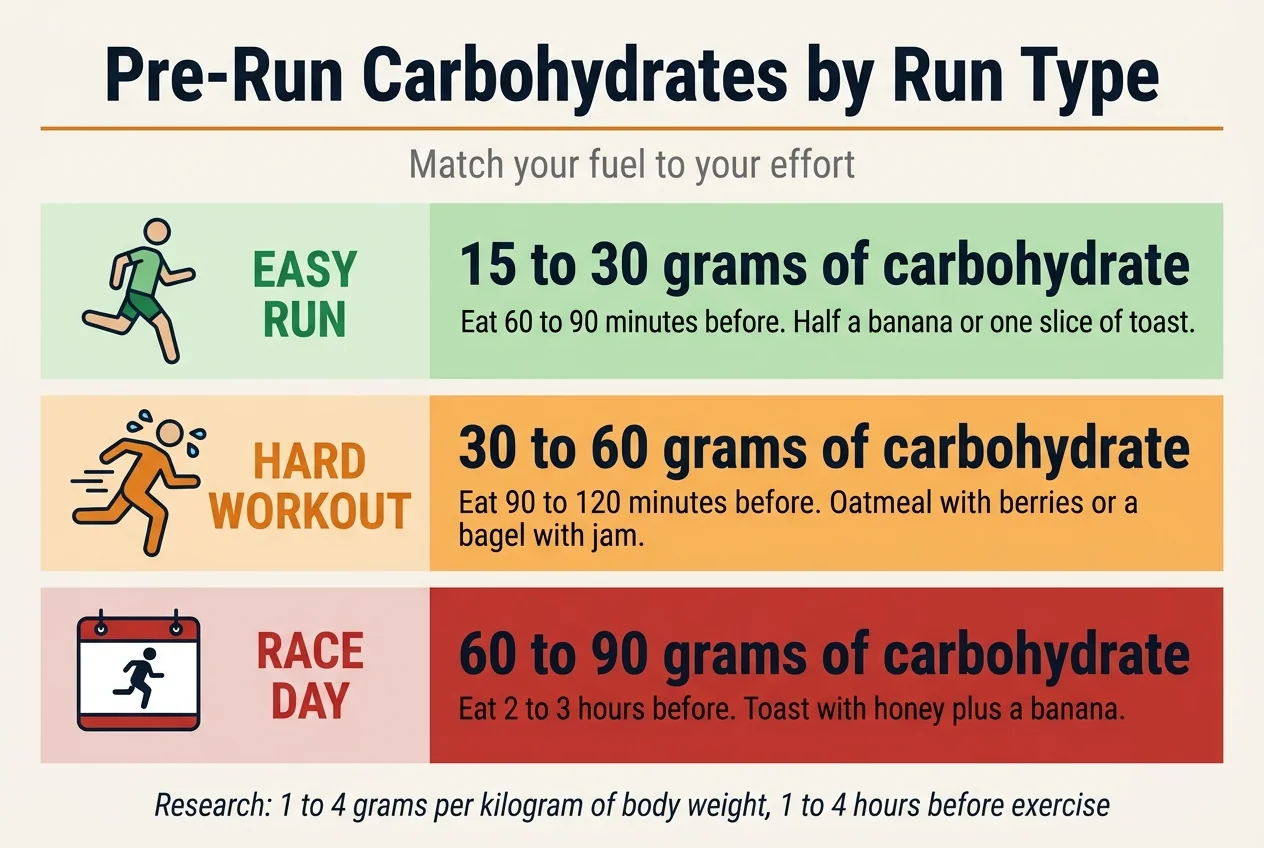
Easy runs need 15 to 30 grams of carbohydrate, hard workouts 30 to 60 grams, and races 60 to 90 grams eaten 2 to 3 hours before the start.
For a 150-pound runner, that range translates to 68 to 273 grams of carbohydrate depending on run length and intensity.
Easy runs under 60 minutes draw on glycogen you already stored from yesterday’s meals, so only a light snack is needed.
Half a banana or a single slice of toast 30 to 60 minutes out gives you 15 to 30 grams of quick carbohydrate and skips protein or fat that would slow digestion.
Tempo runs and intervals deplete glycogen faster and ask for more fuel up front.
A bowl of oatmeal with berries, a bagel with jam, or two slices of toast with honey delivers 30 to 60 grams of carbohydrate 90 to 120 minutes before the workout.
Race day is where the stakes rise because stress, heat, and high intensity all ramp up stomach sensitivity.
Eat 60 to 90 grams of carbohydrate 2 to 3 hours before the gun using food you’ve already tested in training.
Oatmeal with fruit and a drizzle of honey, or toast with jam plus a banana, gives you sustained carbohydrate without the risk of novelty on race morning.
Never try a new food on race day because your stomach needs familiar fuel under race-day stress.
Should You Eat Before an Early Morning Run?
Yes, if the run is longer than 75 minutes or harder than recovery pace, eating beforehand improves performance noticeably.
The gain is modest for easy runs under 60 minutes but meaningful for morning workouts and long runs.
The challenge is timing, because your stomach needs digestion time but you don’t want to wake up three hours before your watch start.
Match your food to the time you actually have:
30 minutes: A slice of toast with jam, four dates, or a small sports drink.
15 minutes: Liquid carbohydrate like 8 ounces of orange juice or a sports drink.
5 minutes: You’re too close to your run for solid food, so rely on yesterday’s glycogen and a few sips of water.
Waking up 15 minutes earlier to eat toast with honey beats running fasted when the morning calls for a hard workout.
What Foods Should You Eat and Avoid Before Running?
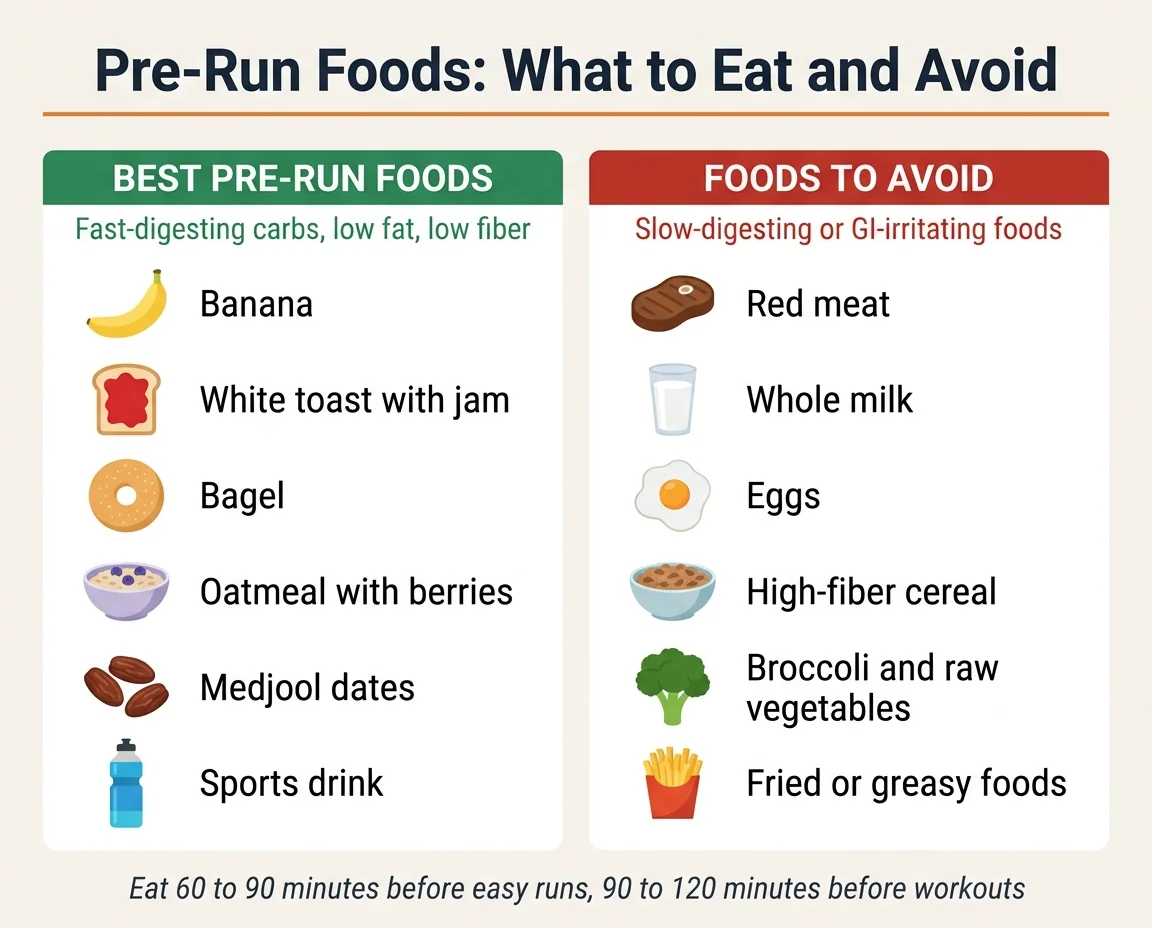
The best pre-run foods are low-fiber, low-fat, and low-protein carbohydrates that digest quickly, like white toast, bagels, bananas, dates, applesauce, and sports drinks.
Three food categories trigger the most GI distress for runners: red meat (avoided by 32% of runners), dairy (31%), and high-fiber foods (23%).
These foods take longer to clear the stomach and pull blood toward digestion right when your legs need it.
Ideal pre-run carbohydrate sources include white bread, bagels, white pasta, rice, crackers, bananas, dates, applesauce, and sports drinks.
Each digests quickly, delivers clean carbohydrate, and rarely triggers cramping when eaten inside your timing window.
Oatmeal and whole-grain toast work for many runners, but the added fiber can cause issues if your stomach is sensitive.
Avoid red meat, eggs, high-fat dairy, and whole-grain products with more than 4 grams of fiber per serving in the two hours before your run.
Emerging research suggests that runners with chronic GI issues may benefit from a short low-FODMAP trial, cutting garlic, onions, wheat, and high-fructose foods to see if symptoms ease.
For most runners, timing and portion size matter more than avoiding specific items you tolerate well.
If stomach pain is a recurring problem on your runs, the full protocol lives in our guide to how to avoid stomach pain on the run.
Can You Train Your Gut to Handle Pre-Run Food Better?
Yes, a deliberate two-week protocol of eating the same pre-run meal before training runs can cut GI symptoms by roughly 60 percent.
The adaptation happens because your intestinal lining becomes more efficient at absorbing nutrients while exercise is pulling blood away.
Pick one simple pre-run meal like toast with jam, then eat it 90 minutes before every easy run for a week.
In week two, eat the same meal 90 minutes before one tempo run and one interval workout.
As your gut adapts, you can move the window closer to your run start without triggering cramping or urgency.
For the full protocol including hydration and dietary pattern adjustments, see our guide to gut training for runners.
One study found that four weeks of probiotic supplementation with Bifidobacterium and Lactobacillus strains reduced moderate GI symptoms in marathon runners.
We use MAS Flush with our athletes at RunnersConnect because it targets Bifidobacterium and prebiotic fibers specifically for gut resilience in runners.
It also ranked first in our comparison of the 6 best probiotics for runners.
Start gut training on easy runs, never on a race-critical workout, so surprises stay in low-stakes sessions.
What Should You Eat Before a Race by Distance?
Eat 60 to 90 grams of carbohydrate 2 to 3 hours before a 5K, half marathon, or marathon, then layer in mid-race fueling only for distances above 90 minutes.
For a 5K, your final real meal lands 2 to 3 hours before the start, and it mirrors your tempo workout breakfast.
A bagel with jam, oatmeal with fruit, or toast with honey all work if they’ve been tested in training.
In the 30 minutes before the race, stick to a few sips of water or a small amount of sports drink.
Half marathons need the same 2- to 3-hour breakfast plus 30 to 60 grams of carbohydrate per hour once the race is underway.
Hit that target with sports drinks, energy gels, or whatever mid-race fuel you’ve practiced with repeatedly.
Your glycogen stores alone won’t last 90 or more minutes of racing, so mid-race fueling protects your pace in the final miles.
Marathons use a near-identical pre-race meal 2.5 to 3 hours before the gun, then 60 to 90 grams of carbohydrate per hour from aid stations and carried gels.
Cut fiber on race morning and the day before by avoiding whole grains, high-fiber vegetables, and legumes so bloating and urgency don’t catch you on mile 18.
Caffeine can boost performance for races longer than 75 minutes when taken 30 to 60 minutes before the start, but it raises GI sensitivity in some runners.
Stick with the same caffeine dose you’ve trained with, or skip it entirely if race morning is your first coffee.
Never exceed 60 grams of carbohydrate per hour during a race unless you’ve trained your gut to handle higher intakes, because excess above that threshold sharply raises GI distress.
What Are the Best Pre-Run Snack and Meal Ideas?
The best pre-run meals combine fast-digesting carbohydrate with very little fat or protein, like toast with honey, oatmeal with berries, a banana, or a bagel with jam.
| Pre-Run Option | Carbs (g) | Protein (g) | Fat (g) | Best Timing |
|---|---|---|---|---|
| Banana (medium) | 27 | 1 | 0 | 30–60 min before easy run |
| White bread + honey (2 tbsp) | 45 | 3 | 1 | 75–90 min before workout |
| Bagel + jam | 55 | 8 | 2 | 90–120 min before tempo run |
| Oatmeal (1 cup cooked) + berries | 50 | 5 | 2 | 90–120 min before hard run |
| Toast (2 slices) + jam | 40 | 4 | 2 | 60–90 min before easy run |
| Applesauce (1 cup) + crackers | 45 | 2 | 1 | 60–75 min before easy run |
| Dates (4 medjool) | 30 | 1 | 0 | 30–45 min before easy run |
| Sports drink (16 oz) | 30 | 0 | 0 | 15–20 min before run |
Portion size matters as much as food choice, because a double helping of the right food still sits heavy in your stomach.
Start on the low end of each range and scale up only if your energy dips during the run.
Does Protein Before a Run Help or Hurt?
Protein before a run helps muscle performance in small amounts but triggers cramping and nausea when the dose climbs above 10 grams within 60 minutes of your start.
Protein plus carbohydrate eaten close to a run produces higher rates of nausea and cramping than carbohydrate alone.
Keep protein to 5 to 10 grams before easy runs and workouts, which is the amount in a slice of toast or a small handful of nuts.
Avoid protein-heavy meals like eggs, Greek yogurt, and protein bars in the two hours before your run start.
The one exception is runs longer than 90 minutes, where a small protein dose helps sustain pace and limits muscle breakdown.
Adding 10 to 15 grams of protein alongside your carbohydrate is acceptable for long runs if you’ve tested the combination in training first.
For everyday runs, carbohydrate alone beats carbohydrate plus protein, so save the protein for your recovery meal afterward.
RunnersConnect Bonus
Download your FREE Guide where we share the Best Foods to Eat Before Running.
Putting It All Together
Pre-run nutrition works best as a simple system, not a complicated one.
Find your timing window through short experiments on easy runs, then lock in the same meal and window so your gut adapts over weeks.
Match your carbohydrate amount to your run type using the 15 to 30, 30 to 60, and 60 to 90 gram ranges by intensity.
Choose quick-digesting foods you’ve tested, and save protein for after the run when your stomach is calm and your muscles can use it.
When the timing and food dial in together, you hit the start line fueled, settled, and ready to run your strongest miles.



18 Responses
I’ve noticed that on race days I become very nervous and that seems to affect my digestion. That makes it hard because even with a small snack I still feel like it gives me little cramps. Is the best option just to eat even earlier on race days?
Good question, Daniel. Yes, on days of a race, you may need to eat farther away than your normal runs. The higher the intensity of the run, the less close you can usually eat your pre run meal.
I always gave myself a 2 hour window when racing. I had my last food of substance 2 hours before – usually a light sandwhich or bagel with jelly. If I got hungry for some reason, I might munch on an energy bar, but once I was within 1 hour, I didn’t eat anything.
Hope that helps.
Daniel – This is something that every runner struggles with during their running career so you are not alone. The best rule is to find what works for you. I never had a meal within 5 hours of a race. The only exception was for early morning races where I would have an energy bar or half of a bagel with a coffee about 2 hours in advance. Your issue is probably more than nerves because of how the body shunts blood away from the digestional tract during intense exercise. It’s our body’s way of getting blood where it’s needed most – the muscles. Unfortunately, that’s not good news for whatever you had for breakfast because it will sit in need of attention somewhere along your digestive system. That’s probably more than you want to know but there are three possible solutions – 1. Eat/drink less before you race. 2. Eat/drink farther from the start of the race. 3. Find a more easily digestable energy source. I look forward to following your progress!
Jeff,
I’m an ultra runner and when I hit the 50 – 70 mile mark in a 100 miler I usually suffer from an upset stomach. I’m thinking it’s too much sodium doing that. I’m not sure if you’ve done any ultra running but you have to eat to get your carbs so I was wondering if you have any suggestions.
Hi Jeff,
I am afraid we do not really specialize in the ultra marathon right now (but this can be something we can look into in the future!), but we can try and see if we can help you from a general fueling perspective, what fuel do you usually consume during your ultras? Do you get stomach upsets any other time during your regular training?
I tend to eat my Bonk Breaker bar (full size for long runs & bite size for shorter )and I also use Vega pre-workout.
I was just curious if I’m actually taking in too much, but according to this I think I might be on the right path.
Thanks. And I’m like your girlfriend no way could I eat a meal and go running. I have to be careful with what I eat before running, but found these two fuels seem to sit well in my gut thankfully.
That should be fine Brooke, and if it works for you, then keep it up! It is better to be a little over fueled then under. A bar and vega sounds like a great pre workout meal!
I just started jogging after 2 years of being lazy(Starting of with 10-15 min. Jogs)
I’m a 21 year old male and I was a short distance runner in school, so it’s save to say I was never a fan of long distance running
I got myself ProNutro but I don’t know if it will be sufficient.
Should I opt for the banana or oats option or should I brave it and go jog
Hi Jean, I am not familiar with ProNutro myself, but any of the options you mentioned should work. Test out some different options to see what works for you! Hope that helps!
I am a beginer athlete and i have less than an years expierence .
In the past year i have under gone 3 injuries , one is pattelar tendonitis,the second one is oblique injury,and at present lower left back injury.Due to the above reasons my practice sessions are breaking . I am 6’2 tall and weigh 65 kgs , and am 15 years old and i am sprinter .
please help me make myself through these obstacles
Hi Saathwik, sorry to hear about your injuries, it is likely you have some major weaknesses in your body that are preventing you from staying healthy. You should check out our course on supplemental training that is critical to a runners training, especially in the earlier stages and if you keep getting injured, this becomes even more important. http://strength.runnersconnect.net
You should also make sure you are not increasing your training too quickly, this article may also help you. https://runnersconnect.net/running-injury-prevention/why-runners-get-hurt/
Hope this helps! We would love to have you join us on the strength course!
I have been running on and off for a little while now and I find if I go to the bathroom just before I run I still need to go within 5-10 mins of starting my run, what would you recommend to help this is there any foods this or anything else?
Yup, if you read the article we tell you how to specifically address this issue.
Hello. I am new to jogging so I am doing the walk/run thing until I build up my fitness. I go first thing in the morning for about 30 minuets. By doing this I am not eating before I go. I have been told that my body will take the energy it needs from my mussel mass rather than body fat? Is this correct?
Hi Narelle, thanks for reaching out. It is good to hear that you are being smart, and there is nothing wrong with walk running until you get used to it a little more (we actually believe in that https://runnersconnect.net/coach-corner/dont-shun-runwalk-method-experienced-beginners-alike-can-ultilize-runwalk-smarter-training/). As for eating before, we actually have a different article that will help you with this 🙂 https://runnersconnect.net/running-nutrition-articles/carbohydrate-intake-overnight-fast/ Hope this helps!
@ Brooke…. How Do u like the vega pre workout??? I’ve been wanting to try it but I’m iffy about preworkouts… I hate the ones that make me feel like I want to rip my skin off…. I’ve found a few that get me thru but they taste like crap….