

After a marathon or a hard week of training, it’s tempting to reach for ibuprofen to take the edge off sore legs.
But ibuprofen raises the risk of kidney injury during long runs, which is why tart cherry juice has become a popular natural alternative for pain and inflammation.
The idea started in the lab, where researchers found that anthocyanins from cherries, the pigments that make them red, blocked the same COX enzymes as ibuprofen and naproxen about as well as the drugs did.
The question is whether cherries ease pain and inflammation in a runner’s legs the same way, and whether they can replace ibuprofen after a hard race.
In this article, you’ll learn the research on tart cherry juice for runners, including:
- How much it lowered pain and inflammation in runners after long races
- Why it’s a safer choice than ibuprofen during long runs
- Whether you can take tart cherry juice and ibuprofen together
- How much juice or concentrate to drink, when to start and why to save it for race weeks
Does Tart Cherry Juice Reduce Inflammation After a Run?
Drinking tart cherry juice in the days around a hard race lowers two blood markers of inflammation for up to 48 hours afterward.
A 2010 trial gave 20 marathon runners either tart cherry juice or a placebo drink for 5 days before the race, on race day and for 2 days after it.
After the marathon, the runners drinking cherry juice had lower levels of interleukin-6 and C-reactive protein, two blood markers of inflammation, than the runners on the placebo.
Their leg strength also came back faster in the 2 days after the race.
Newer research has tested this across many more athletes.
A 2026 review of 19 trials found that tart cherry juice helped athletes get their muscle strength back faster after hard exercise and lowered C-reactive protein, a marker of inflammation, for up to 48 hours.

That means tart cherry juice can help your legs feel ready for normal training sooner after a race or a long, hard run.
The same review rated the certainty of the evidence as low to moderate, because the trials were small and their results varied.
Does Tart Cherry Juice Help With Muscle Pain From Running?
Tart cherry juice reduced pain in runners after a long race, and it protects your strength even more reliably than it eases soreness.
Researchers tested it at the Hood to Coast relay in Oregon, where each runner covered an average of 26 km (16 miles) over 24 hours.
For 7 days before the race and on race day, the runners drank 12 oz (355 mL) of tart cherry juice or a placebo cherry drink twice a day.
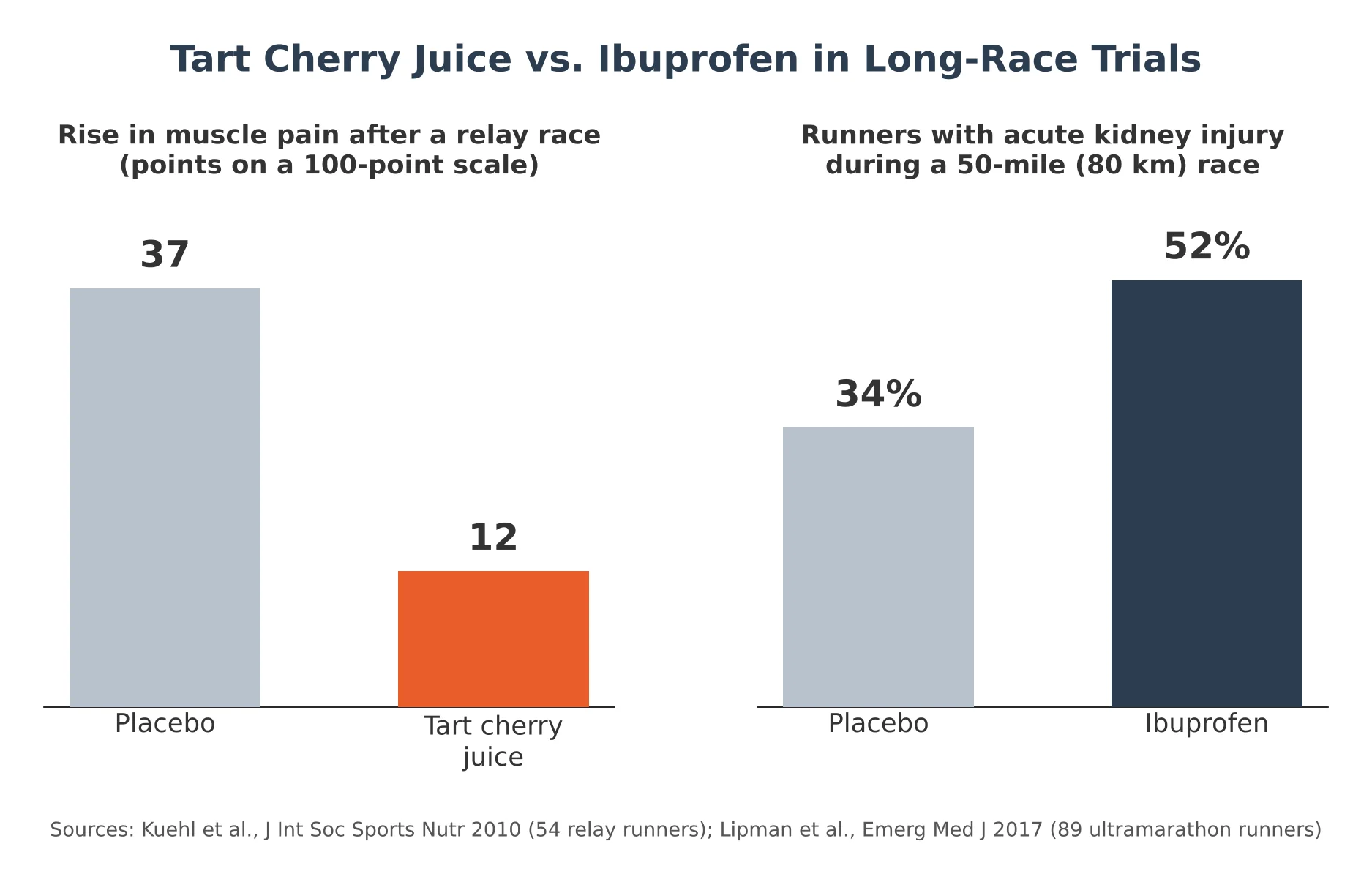
A randomized trial showed that runners who drank tart cherry juice had about one third the rise in pain after the race that runners on the placebo had, 12 points versus 37 points on a 100-point pain scale.
That means you can expect to finish a long race less sore if you’ve been drinking tart cherry juice the week before.
The effect on strength is even clearer.
In a 2006 study, men did hard arm exercises designed to damage the muscle, and their strength loss over the next 4 days averaged 22% with a placebo but only 4% with tart cherry juice.
Soreness results are less consistent, because the 2026 review found no clear drop in muscle soreness when it pooled all 19 trials.
So judge tart cherry juice by how quickly your strength returns in the days after a race.
RunnersConnect Bonus
Download our FREE recovery foods guide, with the top 10 foods for each of the essential recovery vitamins, minerals and macro nutrients. Plus a sample 1-day meal plan!
Is Tart Cherry Juice Safer Than Ibuprofen for Runners?
Tart cherry juice is the safer choice, because ibuprofen raises your risk of kidney injury during long runs.
Ibuprofen and other NSAIDs relieve pain by blocking COX enzymes, which lowers the prostaglandins that drive pain and swelling.
Those same prostaglandins help keep blood flowing to your kidneys and protect your stomach lining, so blocking them during a long run removes that protection when your kidneys are already under stress.
A 2017 trial found that 52% of runners taking ibuprofen during a 50-mile (80 km) race developed acute kidney injury, compared with 34% of runners taking a placebo.
Ibuprofen didn’t make runners less sore either.
At the 100-mile (160 km) Western States race, runners who took ibuprofen the day before and on race day were just as sore afterward as runners who took nothing, and they had higher blood markers of inflammation.
That means taking ibuprofen during a long race adds risk to your kidneys without making your legs any less sore.
This guide to ibuprofen and running covers the kidney and blood sodium risks in more detail.
Ibuprofen still has a place for a short time after an acute injury, but it shouldn’t be your answer to normal soreness after a hard run.
Can You Take Tart Cherry Juice and Ibuprofen Together?
No study has tested tart cherry juice and ibuprofen taken together, so there’s no research on how the combination affects runners.
The same is true for aspirin, naproxen and meloxicam.
Both tart cherry anthocyanins and these drugs act on the same COX enzymes, which is why the lab research compared them directly.
If you take ibuprofen or another NSAID regularly, or you have kidney or stomach problems, ask your doctor or pharmacist before you add tart cherry juice.
For ordinary soreness after a long run or race, the simpler option is to skip the ibuprofen and use tart cherry juice on its own.
How Much Tart Cherry Juice Should Runners Drink?
The running studies used tart cherry juice twice a day, starting 5 to 7 days before the race, which is more than a glass with breakfast.
Should You Drink Tart Cherry Juice or Concentrate?
Tart cherry concentrate is tart cherry juice with most of the water removed, so a serving is about one eighth the size.
A serving of 100% tart cherry juice is usually 8 oz (240 mL), while a serving of concentrate is about 1 oz (30 mL), or 2 tablespoons, mixed with water.
Most of the research used Montmorency tart cherries, so look for 100% Montmorency juice or concentrate rather than a cherry juice blend.
Check the serving size on the label, because juice and concentrate servings differ so much that it’s easy to drink far less than you intended.
When Should Runners Start Drinking Tart Cherry Juice?
Every running trial in this article used a loading period before the race, so a single glass after the finish line is unlikely to give you the same results.
Start drinking tart cherry juice twice a day 5 to 7 days before your race, keep going on race day and continue for 2 days after it.
Tart cherry can also help on race day, because a 2020 analysis of 10 studies found a small improvement in endurance performance when athletes took it anywhere from 7 days to 1.5 hours before testing.
Should You Drink Tart Cherry Juice Every Day?
Save tart cherry juice for race weeks and your hardest training blocks rather than drinking it all year.
The oxidative stress from hard training is part of the signal your muscles respond to when they adapt, which is why loading up on antioxidants like vitamin C can reduce what you gain from your workouts.
Researchers haven’t tested daily tart cherry juice for this, so save it for the weeks when recovery matters most.
RunnersConnect Bonus
Download your FREE Marathon Recovery Schedule for Runners.
It’s a PDF showing how to recover correctly in the 3 weeks post marathon, plus our cross training guide with over 20 sample workouts for the most common cross training types
Does Tart Cherry Juice Help Runners Sleep or Avoid Getting Sick After a Marathon?
Tart cherries also contain melatonin, and 2 small studies point to benefits beyond your muscles.
In a 2012 study, 20 adults who drank tart cherry juice concentrate for 7 days had more melatonin in their urine and slept longer than when they drank a placebo.
A 2015 pilot study of 20 marathon runners found that none of the runners drinking cherry juice reported cold symptoms such as a sore throat in the 2 days after the race, compared with 50% of the runners on the placebo.
Both studies were small, so treat the extra sleep and fewer post-race colds as a possible bonus rather than the main reason to drink it.
Tart Cherry Juice vs. Ibuprofen: How Do They Compare for Runners?
This table puts the research on each one side by side.
| What was measured | Tart cherry juice | Ibuprofen |
|---|---|---|
| Pain after a long race | About one third the rise in pain of a placebo (relay runners) | No less soreness than taking nothing (100-mile runners) |
| Inflammation after the race | Lower interleukin-6 and C-reactive protein after a marathon | Higher inflammation markers after a 100-mile race |
| Strength recovery | Faster across 19 trials | Not measured in these studies |
| Kidney injury during an ultramarathon | Not studied | 52% with ibuprofen vs 34% with a placebo |
| How to use it | Twice a day from 5 to 7 days before a race to 2 days after | Short-term use for an acute injury, not routine soreness |




8 Responses
Drinking tart cherry juice has really helped my endurance and pain relief. Since I live in Michigan I am able to get it locally from Traverse Bay Farms. I add an ounce to my smoothie every morning and two ounces about a week before a half marathon.
While it does seem to reduce pain and muscle damage, is not this muscle damage the point of running? If this product reduces inflammation, could it potentially reduce our adaptation to the training stimuli?
Great question and point, Kyle. I think there is a huge debate right now about the role on inflammation in training. My theory is that a little inflammation is good, and is indeed the point of training. However, excess inflammation, especially that which leaves us too sore to run well the next day, can be something runners can improve. With tart cherry juice, you’re able to reduce some of that inflammation naturally (rather than with NSAIDs, which I am against) while also drinking a healthy product. So, it’s a balance between providing just enough inflammation reduction, without that being the sole purpose or taking 800mg of ibuprofin and overdoing it.
How much juice does 90-100 cherries produce? It can get expensive, so I’d like to try the dose the study used.
I have fibromyalgia how much should I take per day and how long until I feel the resolts of taking the tart cherry juice?
One ounce of the tart cherry juice concentrate mixed with 7 ounces of water to make the 100% pure glass of cherry. This will get the recommended dosage.
Try http://www.cherryworks.com and feel the difference!
Thanks for the suggestion Michelle! Glad it helps you!