

If you’re like most runners I know, you get blood work once a year at a physical, scan the results for anything flagged, and move on when nothing shows up as out of the ordinary.
But, routine bloodwork for a runner can be much more valuable than just a cursory check for health anomalies.
It can tell you if you’re recovery properly, if you’re responding positively to training, or even if you’re at risk for getting sick, low iron or overtraining.
And thanks to advances in telehealth getting routine bloodwork has never been easier.
So which blood test results actually matter for a runner, and how do you use them to see what your training is changing?
To give an evidence-based answer, let’s look at the research-backed practical advice on…
- The 3 blood markers that matter most for runners, and why a “normal” result can still mean you’re at risk as a runner
- How testing at the start, middle and end of a training cycle shows what is improving and what isn’t
- When a result means your health comes before your next PR
- How to make routine blood work simple and easy
Which Blood Markers Actually Matter for Runners?
The blood markers worth tracking fall into two groups.
The first is the standard tests your doctor reads against a healthy range, and the second is the signals that show how your muscles, bones and immune system respond to training.
Which Standard Blood Tests Should Runners Ask For?
Each of these has a runner-specific reason to check it, even when your result comes back “normal.”
- Ferritin: Ferritin stores your iron and drops long before hemoglobin, the iron number on a standard blood count, so ask for it by name. In a 2014 study, runners with low ferritin who restored their iron raised their VO2max 3.3%, while their hemoglobin didn’t change.
- Vitamin D: A 2015 analysis of 23 studies found 56% of athletes had levels below 32 ng/mL, with the risk 85% higher in winter and spring, so test it in late winter.
- Thyroid hormone (T3): T3 drops when you don’t eat enough for your training, which the International Olympic Committee calls Relative Energy Deficiency in Sport, or REDs.
- Testosterone (especially for men): In a 2025 study of 213 elite athletes, the 45% who showed signs of REDs had lower testosterone than athletes without signs of REDs.
Iron is the one most runners get wrong, and I’ve covered it in depth in our articles on ferritin targets for runners and iron deficiency in runners.
What Can Inflammation, Muscle and Bone Signals Tell You About Your Training?
Most of these signals aren’t on a standard panel, but they are the ones that show how hard a race or training block is on your body, whether you’re responding and recovering properly, and if you’re on the verge of getting sick, burnout, etc.
- Interleukin-6 (inflammation): Your working muscles release IL-6 during hard training to start the repair process, and a 2021 study found it rose 4-fold after a marathon. A rested level that keeps climbing from one draw to the next can be a sign your recovery isn’t keeping up.
- Tumor necrosis factor and interleukin-10 (inflammation): Tumor necrosis factor turns inflammation up and interleukin-10 turns it back down. Tracking both shows whether your body is switching inflammation off between hard sessions.
- Myostatin and interleukin-15 (muscle): Both help control how your muscles grow and repair. In the same study, they were still 25 to 53% below their normal levels three days after the race, which shows how long muscle repair keeps running after a hard effort ends.
- Decorin (connective tissue): Decorin helps organize the collagen in your muscles and the connective tissue around them, so it reflects how that tissue is handling your training load.
- FGF21 (metabolism): Your body releases FGF21 when it runs short on fuel. A level that rises across a build can flag that you aren’t eating enough for your training.
- Parathyroid hormone (bone): Parathyroid hormone pulls calcium out of your bones when blood calcium drops. In a 2015 study of 32 female cyclists, it rose during a 90-minute ride, and a calcium-rich breakfast beforehand kept it about a third lower.
Because these signals move with every hard session, one result on its own tells you little. Comparing them across rested blood draws shows whether your body is adapting to the training or falling behind it.
These are the types of biomarkers that a standard test won’t show (and your doctor or lab may not even offer them).
That’s why we recommend using a service that is focused on blood work for athletes, like our partner Sedona.
Their tests provide over 1000+ biomarkers, all grouped into the areas of performance they impact.
Which Blood Test Results Are Just Noise?
Many blood markers change for days after a hard run, so the timing of your blood draw can matter as much as the result.
A 2005 study took blood from 15 non-elite runners before a marathon and for two weeks after it.
Research has shown that after a marathon, creatine kinase peaks at 15 times its normal level the next day and takes a full week to return to baseline.

Lactate dehydrogenase, another muscle damage marker, doubled and stayed high for two weeks.
That means a blood draw the week after a race or a big long run can show “abnormal” muscle damage markers in a healthy runner.
Exercise also changes your blood within minutes.
A 2023 study measured 4,163 proteins in the blood of 75 adults during a treadmill test and found that 765 of them changed at peak effort.
Most of them were back to normal within an hour.
So a draw taken after your morning run measures that run, not your training.
No single result tells you whether you’re overtrained either.
The joint consensus statement from the European College of Sport Science and the American College of Sports Medicine reviewed the proposed blood markers of overtraining syndrome.
None of them, from hormones to immune markers, met the criteria to diagnose it.
Here is how to take a blood draw that measures your training instead of your last workout:
- Test in the morning, fasted, before you train. Food and exercise both shift your results within hours.
- Wait 48 to 72 hours after your last hard workout or long run. Muscle damage markers rise after hard sessions and need a few days to settle.
- Wait about two weeks after an illness or a race. Inflammation raises ferritin and can hide low iron.
- Keep the conditions the same every time. Same time of day, same lab, same point in your training week.
One high muscle marker after hard training is noise, but the same marker moving the same direction across two rested blood draws is a signal worth acting on.
Why Is “Normal” Blood Work the Wrong Benchmark for Runners?
First off, the reference ranges on your lab report describe the general population, and most of that population doesn’t train.
A result inside the range tells you that you’re unlikely to have a disease, but it doesn’t tell you whether that level supports the training you’re doing.
Ferritin, the protein that stores iron in your body, shows the gap most clearly.
Many labs don’t flag ferritin until it falls below about 12 ng/mL.
The ferritin targets I use with runners are at least 35 to 40 ng/mL for women and 40 to 50 ng/mL for men.
That means a runner at 20 ng/mL gets a “normal” result from their doctor and keeps training on low iron stores.
The ranges mislead in the other direction too.
A 2022 study compared nine years of routine blood work from 3,588 elite athletes with the reference ranges labs use for everyone else.
Research has shown that creatine kinase, a marker of muscle damage, runs up to about 1,476 U/L in healthy male athletes, more than three times the top of the normal range of 400 U/L.
Liver enzymes, creatinine and urea also sat above the general population range in healthy athletes.
So a doctor reading your results against the standard ranges can miss low iron and flag normal training as a problem in the same report.
That’s why you need to know which markers matter for runners, read them against runner targets, and compare each result with your own previous ones.
Why Should You Test More Than Once During a Training Cycle?
One blood test is a snapshot, and your iron, vitamin D and energy levels move as your training changes across a build.
A 2022 study took fasted morning blood draws from 54 college cross country runners four times a season for two seasons.
Research has shown that 57% of women and 35% of men on a college cross country team became iron deficient at least once across two seasons, even with a dietitian providing iron supplements.
That means one test would have caught only the runners who happened to be low on that day.
Testing more than once also gives you your own baseline.
A 2019 review of blood monitoring in athletes concluded that athletes vary so much from person to person that population ranges are of limited value.
A meaningful change has to be measured against your own previous results.
Space your blood draws about 8 weeks apart, which gives a change in your diet, supplements or training time to show up in your results.
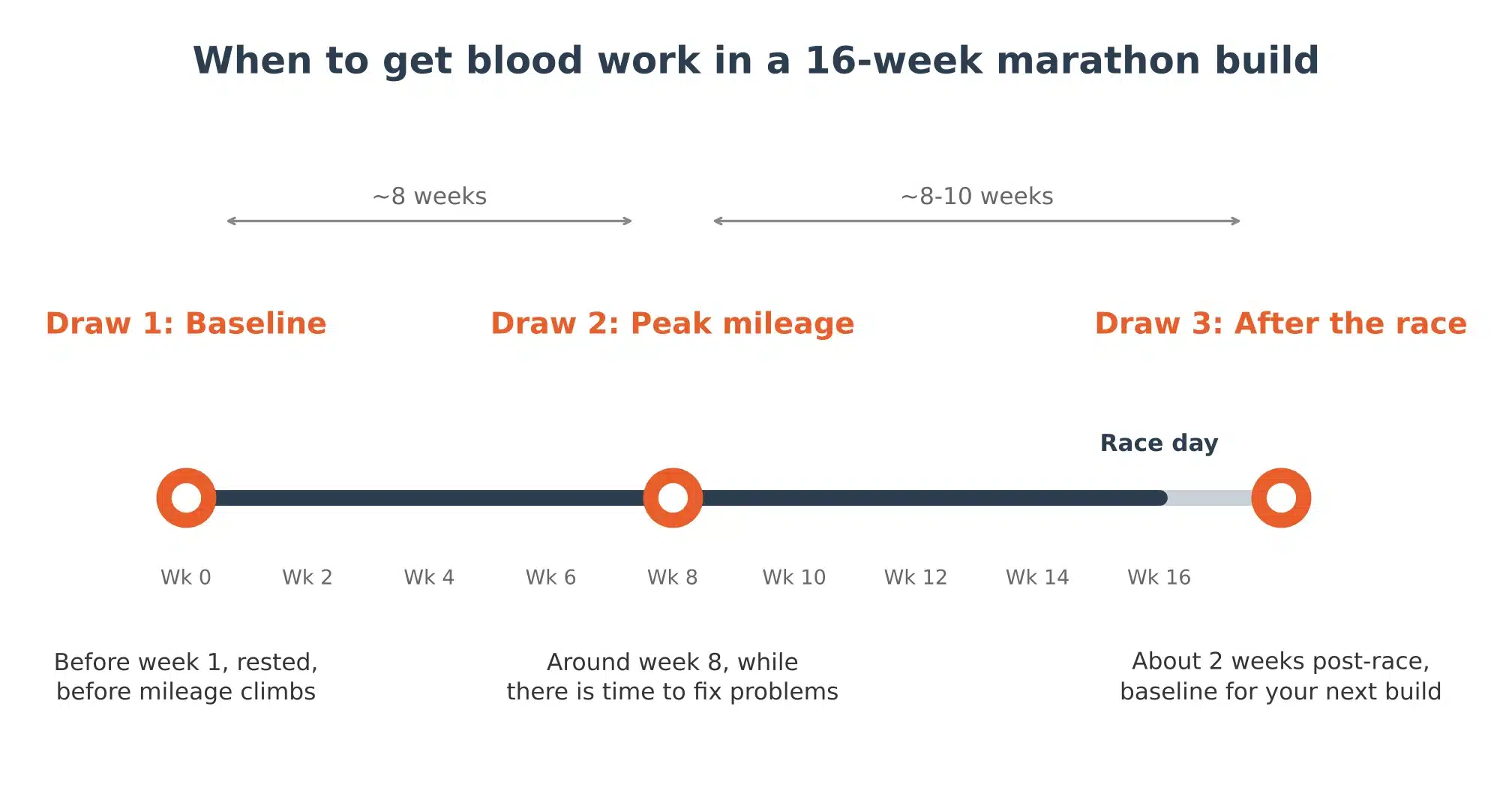
For a 16-week marathon build, that works out to three blood draws:
- Before week 1. This is your baseline, taken when you’re rested and before the mileage climbs.
- Around week 8, at your highest mileage. This is your point of highest training load, and there’s still time to fix a problem before race day.
- About two weeks after the race. This shows what the build changed, and it becomes the baseline for your next one.
The mid-build draw also helps when your times stop improving while your miles and effort stay the same.
The 2014 iron study showed that low iron can hold back your VO2max without changing your hemoglobin.
That makes a dropping ferritin result one of the first things to rule out when you hit a plateau.
If you only test twice, take the baseline and the peak mileage draw.
How Do You Make Routine Blood Work Easy?
The hardest parts of routine blood work are (1) finding an easy way to get it done; (2) making it affordable; and (3) remembering to do it.
Here are some tips, recommendations and strategies to make it easier to add to your plan.
- Put your blood draws in your training plan. When you write out your next training plan, add a draw before week 1 and another at your peak mileage week, each on a morning after an easy day or rest day.
- Add runner markers to your annual physical. Your doctor already orders a basic panel, so ask for ferritin, vitamin D and T3 to be added to the same draw.
- Order the tests yourself. In most US states, the large national lab chains let you order common tests like ferritin and vitamin D online and get your blood drawn at one of their locations without a doctor’s visit, though a few states restrict this.
- Use the same lab and keep every result in one place. Labs can use different methods and ranges, so sticking with one lab and saving each result in a single spreadsheet or app makes it easy to compare draws.
- Use an at-home service built for athletes. Our partner Sedona sends a trained professional to your home to take your blood, so there’s no lab visit to fit around your training.
With Sedona, your first draw sets your baseline, and early-access members are able to test again every two months, which lines up with the 8-week spacing above.
Each result is recorded in the Sedona app, so you see what changed since your training started, including the inflammation, muscle and connective tissue signals above.
Tracking change this way has research behind it: in a 2021 study of previously sedentary adults, 102 blood proteins tracked how much each person’s fitness changed over 20 weeks of training.
Sedona is in a private, invite-only beta right now, so you’ll request an invite on their site.
Get Your Baseline Before Your Next Training Block Starts
The most useful blood test you’ll take is the first one of your training, ideally before it starts ramping up, because every later result gets compared against it.
Book it for the week before your training starts, in the morning, fasted, and at least 48 hours after your last hard run.
Ask for ferritin, a full blood count, vitamin D, and T3, plus testosterone for men.
Then schedule your next draw for your peak mileage week, about 8 weeks later, so you see what changed while there’s still time to act on it.
| Blood Marker | What to Look For | When to Test | Signal or Noise? |
|---|---|---|---|
| Ferritin | At least 35 to 40 ng/mL for women and 40 to 50 ng/mL for men. Labs often flag it only below about 12 ng/mL. | Before the build, at peak mileage, and two weeks after the race. | A drop across two rested draws is a signal to act on. |
| Vitamin D | Above 32 ng/mL. 56% of athletes fall below it. | Late winter, when levels are lowest. | A winter drop is expected, so compare against your own late-winter result. |
| T3 and testosterone | A fall from your own baseline points to eating too little for your training. | When training climbs and you feel flat, lose weight without trying, or your periods change. | A falling trend is a health warning, even if race times improve. |
| Creatine kinase and other muscle damage markers | Healthy athletes can sit more than three times above the normal range. | Only 48 to 72 hours or more after a hard session, and two weeks after a race. | A single high result after hard training is usually noise. |