

The pasta dinner the night before a race is one of running’s oldest traditions, but a bowl of white rice has become a popular alternative.
Rice has a reputation for being easier on the stomach, pasta has a lower glycemic index, and potatoes have their own loyal following.
So, which of these is the best carbohydrate for carb loading and for the meal before a run?
To give an evidence-based answer, let’s look at the research on:
- How much carbohydrate you need the day before a race, and what that looks like on your plate
- What to eat before a long run, and whether the glycemic index of rice and pasta changes how you run
- Why white rice usually beats brown rice in the last 24 hours
- Where potatoes, sweet potatoes and whole grains fit into your training week
Is Rice or Pasta Better for Carb Loading?
When you carb load, the total grams of carbohydrate you eat matter far more than whether those grams come from rice or from pasta.
A 2011 study of 257 runners in the London Marathon found that runners who ate more than 7 grams of carbohydrate per kilogram of body weight (3.2 g per lb) the day before the race ran faster and slowed down less than runners who ate less.

The researchers only tracked how much carbohydrate each runner ate, so the result applies whether those grams came from rice, pasta or bread.
That means the best carb loading food is whichever food lets you reach your daily total without upsetting your stomach.
Rice and pasta can both do that job, and it’s easier to mix the two with other carbohydrates than to rely on one.
If you want the full day-by-day plan, this guide to modern carb loading protocols walks through it.
RunnersConnect Bonus
Download your FREE Marathon Nutrition During Your Taper Guide.
The guide contains a plan of exactly what you should be eating in the 5 days to 3 hours before your race. We give specific food recommendations to make sure you are ready on race day.
How Much Rice or Pasta Do You Need to Carb Load?
A proper carb load takes far more food than one big pasta dinner the night before.
In a 2002 study of 8 endurance-trained athletes, eating 10 grams of carbohydrate per kilogram of body weight (4.5 g per lb) for 1 day nearly doubled their muscle glycogen.
Eating the same way for 2 more days didn’t raise their glycogen any further, so 1 big day of eating is enough to fill your stores as long as you rest or run very little that day, as the athletes in the study did.
For a 150 lb (68 kg) runner, 10 grams per kilogram works out to 680 grams of carbohydrate in a single day.
Cooked pasta has about 31 grams of carbohydrate per 100 grams (3.5 oz).
That means the same runner would need to eat about 2.2 kg (4.9 lb) of cooked pasta to hit 680 grams from pasta alone.
Even the lower target of 7 grams per kilogram from the London Marathon study adds up to about 1.5 kg (3.4 lb) of cooked pasta.
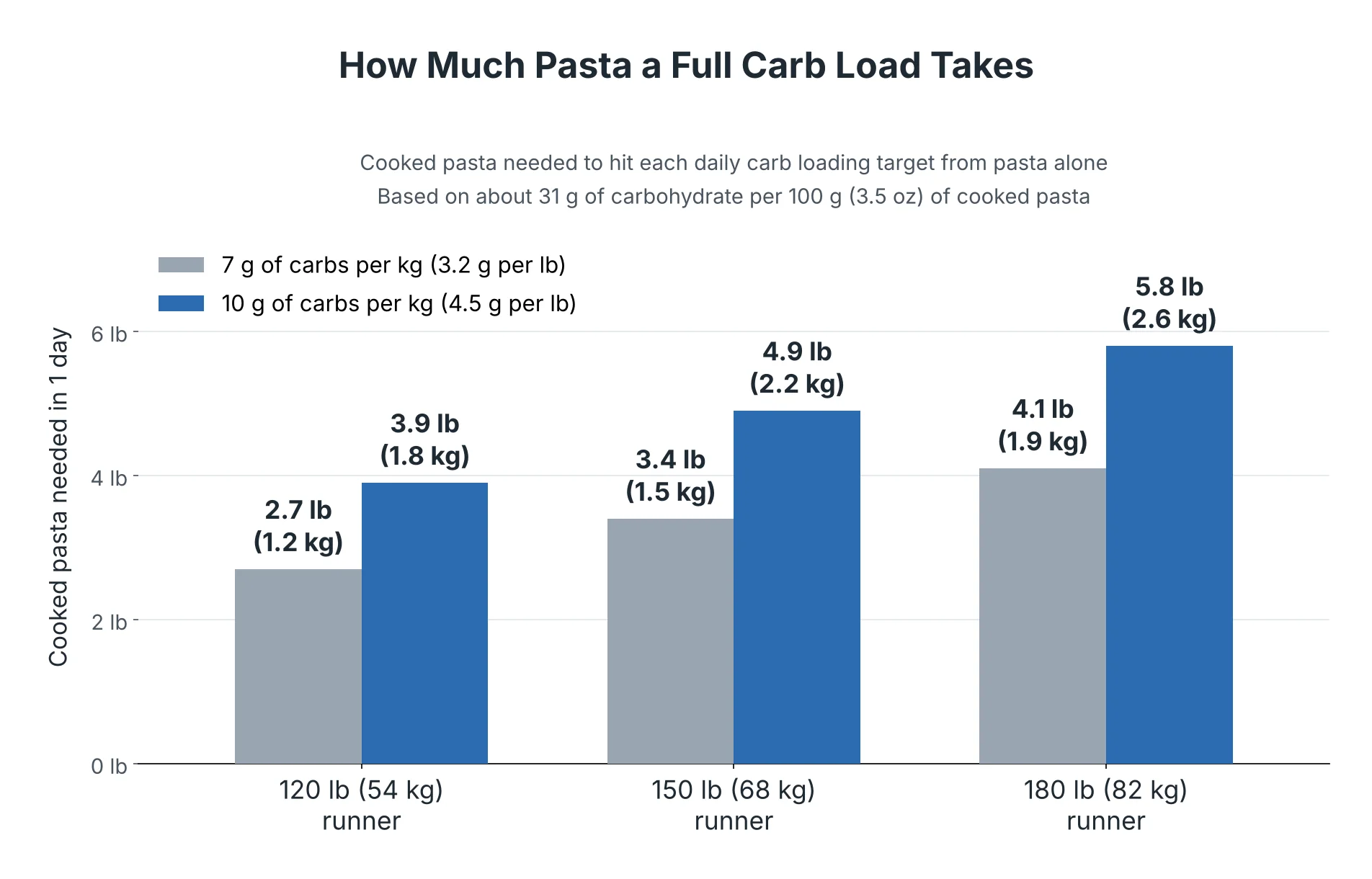
Spread your carbohydrate across rice, pasta, bread, potatoes and sports drinks so you never have to eat the whole day’s total in one sitting.
Several smaller carbohydrate-heavy meals and snacks across the day are also easier to eat than one huge dinner the night before the race.
The athletes in that 1-day carb loading study ate high glycemic index foods, the kind that raise your blood sugar quickly.
Should You Eat Rice or Pasta Before a Long Run?
A carbohydrate-rich meal a few hours before a long run adds minutes to how long you can run before you tire, whether that meal is built on rice or on pasta.
A 2002 study of 10 male runners found that a carbohydrate meal eaten 3 hours before a treadmill run to exhaustion let them run for 111.9 minutes, compared with 102.9 minutes after a placebo.
That’s about 9 more minutes of running at the same effort from one meal.
Adding a sports drink during the run stretched it further, to 125.1 minutes.
In a 2008 follow-up from the same research group, the pre-run meal held 2.5 grams of carbohydrate per kilogram of body weight (1.1 g per lb), eaten 3 hours before running.
For a 150 lb (68 kg) runner, that’s about 170 grams of carbohydrate, or roughly 550 grams (1.2 lb) of cooked pasta.
Eat your pre-run meal about 3 hours before a long run or race, which is the timing both of these studies used.
A bowl of white rice or white pasta with a little sauce and some bread works well here, and the next question is whether choosing rice over pasta changes how you run.
Does the Glycemic Index of Rice and Pasta Matter Before a Run?
Pasta does have a lower glycemic index than rice, but a lower GI doesn’t change how fast you run.
The glycemic index, or GI, ranks foods by how quickly they raise your blood sugar, with 70 or higher counted as high and 55 or lower counted as low.
In the international GI tables, boiled white rice scores 73 and white spaghetti scores 49.
A 2017 review of 19 trials found that low-GI meals eaten before endurance exercise gave no clear performance benefit over high-GI meals, whether or not the athletes also took carbohydrate during exercise.
That means you can choose rice or pasta for your pre-run meal based on what sits well in your stomach and how much time you have to digest it.
A high GI is no reason to avoid white rice or potatoes either, since high-GI foods are what the athletes in the 1-day carb loading study ate.
Is White Rice or Brown Rice Better Before a Race?
In the 24 hours before a race, white rice is usually the better choice because it has less fiber than brown rice.
Fiber slows digestion and leaves more bulk in your gut, and every stride you run jostles whatever is still in there.
When researchers surveyed 55 triathletes after a half Ironman, every athlete who had intestinal cramps had eaten fiber-rich foods in their pre-race meal.
Only 10% of the athletes without cramps had done the same.
Keep brown rice, whole wheat pasta and other high-fiber grains out of your last few meals before a race or a hard long run.
The same low-fiber approach works for what you eat the night before a long run.
On normal training days, whole grains are the better pick because they give you more fiber, vitamins and minerals than white rice or white pasta for a similar amount of carbohydrate.
Brown rice, whole wheat pasta, quinoa and oats belong in your everyday meals, and white rice and white pasta take over when a race is close.
Are Potatoes Good for Carb Loading and Long Runs?
Potatoes are one of the most useful carbohydrates a runner can eat, both in the days before a race and during long efforts.
A boiled potato scores 78 on the GI tables, so it raises your blood sugar quickly, and it’s easy to eat in large amounts when you’re carb loading.
A 2019 study of 12 trained cyclists found that eating potato purée during a 2-hour ride produced the same time trial result as energy gels, 33.0 minutes each, compared with 39.5 minutes on water alone.
That means plain potatoes kept blood sugar as high as gels did, so they work as a real fuel for long efforts.
Sweet potatoes score 63 on the GI tables and bring more fiber and vitamin A than white potatoes, so they fit better in everyday meals than in your last meal before a race.
Which Carbohydrates Should You Eat and When?
Here’s a chart that matches each carbohydrate to the part of your training week where it works best.
| Carbohydrate | Glycemic index | Best time to eat it |
|---|---|---|
| White rice (boiled) | 73 | Carb loading and pre-race meals |
| White pasta | 49 | Carb loading and pre-race meals |
| Potato (boiled) | 78 | Carb loading and fueling on long efforts |
| Brown rice (boiled) | 68 | Everyday training meals |
| Whole wheat pasta | 48 | Everyday training meals |
| Sweet potato (boiled) | 63 | Everyday training meals |
| Rolled oat porridge | 55 | Everyday training breakfasts |
RunnersConnect Bonus
Download your FREE Guide where we share the Best Foods to Eat Before Running.



10 Responses
Thanks a lot… I completely forgot about barley.. I love barley.
Matt! 🙂 Happy to help! It is so easy to get stuck in a rut with food!
I really appreciate the attention to detail in this article, and I’m impressed that you mentioned spaghetti squash as an alternative to pasta. I also like the focus on potatoes and sweet potatoes/yams.
However, your analysis is missing a factor: the toxin load of the food. All grains contain significant amounts of toxins, with wheat being the worst offender. Did you know that 85% of people show an immune response to wheat gluten? Other grain toxins include WGA, phytic acid, and saponins. Runners in particular should avoid wheat and other grains, because even though they may not notice any problems with digestions, the toxins will increase inflammation.
With this in mind, white rice actually becomes the healthiest form of rice, because the only toxins in rice are in the husk, which is completely remove in white rice. So white rice is a safe source of carbs (like potatoes & squash).
(the same does not apply to wheat or other grains — white flour still has plenty of gluten and other toxins, so both whole wheat and white flour should be avoided)
Mike,
Thanks for the comment and bringing up another perspective. The idea that some grains, legumes and plants have “anti-nutrients” is something I have heard a handful of times and have not yet had the chance to do enough research myself to see where I fall. On the other hand, from the research and studying I have done, I found that many of those “anti-nutrients” get broken down in legumes and plants when they are cooked, sprouted or eaten with fermented foods. For example, lectins, phytic acid and protease inhibitors are all “deactivated” by cooking, sprouting or fermentation. Also, some of these “anti-nutrients” like, saponins found in spinach and oats, have some positive aspects. Saponins may increase and accelerate the body’s ability to absorb calcium and silicon.
Here is one theory I have regarding these “anti-nutrients”. Are we experiencing more negative effects from grains, legumes and plants because we are not longer taking the time to prepare the food properly. History shows the preparation of wheat used to consist of soaking, sprouting, milling, then cooking. Now, as a nation, we have cut out the soaking and sprouting and jumped to the milling and cooking for a cheaper, quicker process.
We also are not eating many fermented foods anymore, because fermentation takes time and we no longer “need” to ferment foods to keep them good with refrigerators and freezers.
So, are we experiencing more issues with grains and legumes, simply because we are no longer taking the time to prepare the appropriately?
Mike, your thoughts are great, and I believe they bring up some great questions! I will continue to research this topic specifically to see what I find. Thanks for your comment!!
Hi, sorry I never followed up on your comment. I just wanted to mention that you should look up the book “The Perfect Health Diet” by Dr. Paul Jaminet & Dr. Shou-Ching Jaminet. They discuss a lot of these concepts. They also have a website/blog at http://perfecthealthdiet.com/ .
Happy running!
Mike
GREAT ARTICLE!!!! I’m doing a half next week so this will help me a TON for my meal preparations this week.
You should do a similar article on protein for the post-recovery.
Thank,s Jordan. Good luck in your half marathon!
Already done on the part of protein. Get ready for some good reads 🙂
4 essential protein supplements for runners
Protein for Runners – Your Questions Answered
Post workout recovery fuel
What to Eat Before and After Easy Runs, Long Runs and Different Types of Workouts
The Two Windows for Optimal Recovery After a Hard Workout or Race
Thanks Jeff. I always enjoy the advice on RunnersConnect. I like that you are science based. My only question is about all the fiber pre-race. Doesn’t this increase the chances you will need a bathroom break during the marathon? I read elsewhere to avoid all the fiber by eating regular pasta and white rice … Runner’s trots can kill your time! What are your thoughts on this?
This doesn’t apply to pre-race nutrition. I would read our in-depth article on pre-race nutrition here: https://runnersconnect.net/running-nutrition-articles/pre-race-marathon-nutrition/