

A 2014 study of endurance athletes found that more than 60% of non-elite endurance runners were unintentionally underfueling during their highest training weeks
More importantly, the researchers found that this happened not because they were dieting, but because they didn’t realize how dramatically their needs had changed.
If you’ve ever entered a spring training block feeling fit and motivated, only to end up flat, irritable, sore, or questioning your training halfway through, you’ve felt the impact of that gap firsthand.
The frustrating truth is that this isn’t always a fitness problem or a sign you need more recovery days, it’s often a fueling problem, and the consequences extend far beyond one bad workout.
A 2024 narrative review found that athletes who fail to meet energy intake requirements face compromised training adaptations, reduced muscle mass, decreased bone mineral density, and increased injury susceptibility.
The good news is that understanding the unique nutritional demands of heavy training blocks can transform how you feel, recover, and ultimately perform on race day.
That’s why in this article I am going to share some unique insights on metabolism I learned from registered dietician, Amber Velasquez, lead coach at MetPro who specializes in working with endurance athletes.
She’s going to also help you…
- Understand why your metabolism responds differently during peak training and what happens when you don’t keep up
- Break down the specific macronutrient targets research shows you need during heavy training
- Give you practical timing strategies for before, during, and after your runs that you can implement immediately
What Is Underfueling, and How Much Food Is Enough?
Underfueling means the food you eat doesn’t cover both your training and the energy your hormones, immune system and tissue repair need every day.
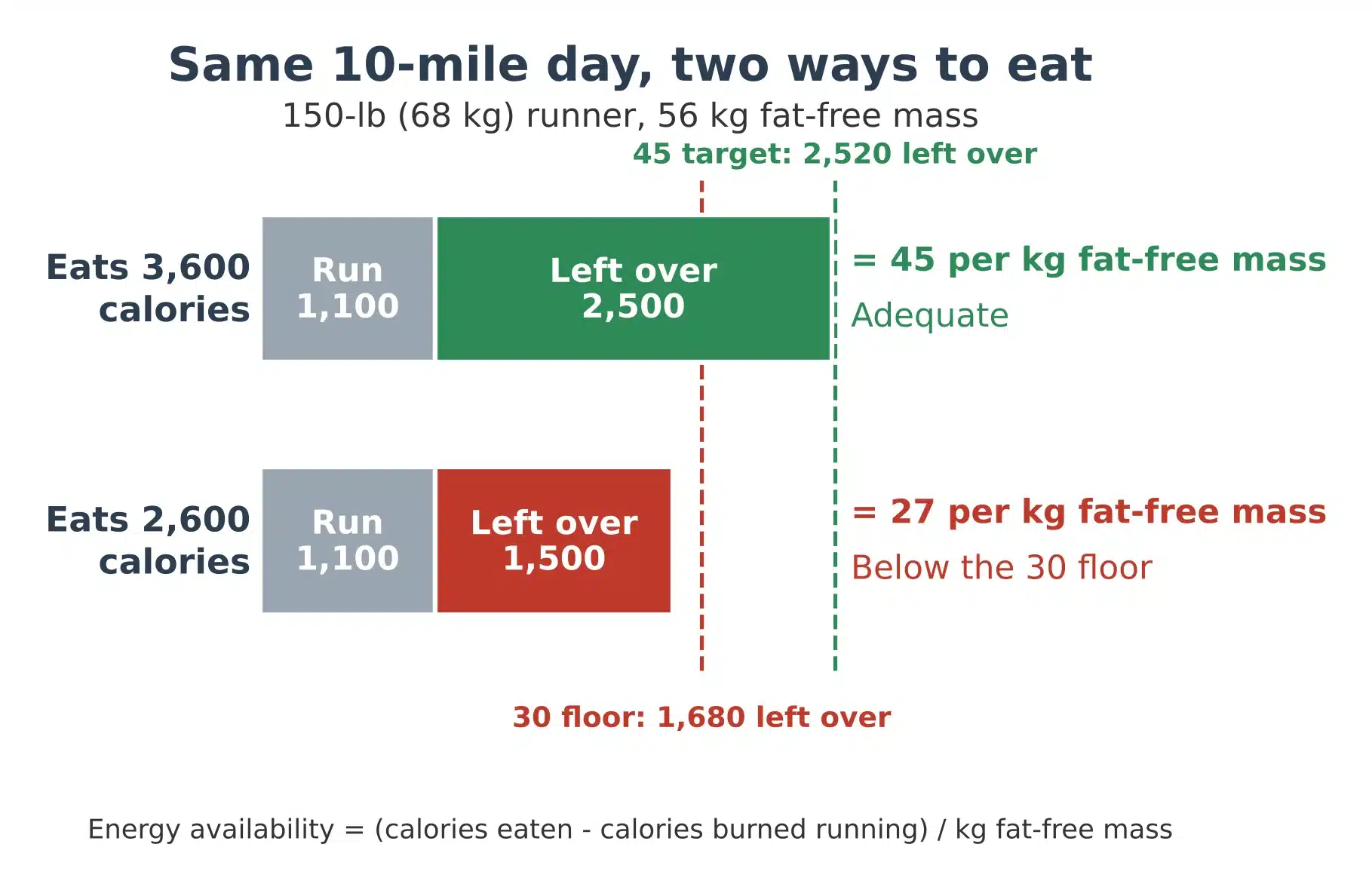
Sports scientists measure this with a number called energy availability: the calories you eat, minus the calories you burn exercising, divided by your fat-free mass in kilograms.
Whatever is left after training is the energy available for those everyday jobs, including rebuilding the bone and muscle your runs break down.
Researchers treat about 45 calories per kilogram of fat-free mass each day as adequate energy availability for health.
A controlled 2003 study found the hormone signal that runs the menstrual cycle stayed normal at 30 calories per kilogram of fat-free mass and was disrupted at 20 and below.

That means you want to aim for about 45 calories per kilogram of fat-free mass each day.
Dropping under 30 calories per kilogram of fat-free mass puts your hormones at risk.
As an example, take the same 150-pound (68 kg) runner used in the carbohydrate section below.
At 18% body fat, that runner carries about 56 kg of fat-free mass.
Multiply 56 kg by 45 calories and you get roughly 2,500 calories that need to be left over after training, every day of a heavy block.
A 10-mile (16 km) run burns about 1,100 calories for that runner.
The 1,100-calorie figure uses the common estimate of 1 calorie per kilogram of body weight for every kilometer you run.
Together, that comes to 3,600 calories.
If that runner eats 2,600 calories on the same day, energy availability drops to about 27 calories per kilogram of fat-free mass.
That’s below the 30 calories per kilogram of fat-free mass line, even though 2,600 calories already feels like a big day of eating.
RunnersConnect Bonus
Download our FREE recovery foods guide, with the top 10 foods for each of the essential recovery vitamins, minerals and macro nutrients. Plus a sample 1-day meal plan!
What Are the Warning Signs That You’re Underfueling?
Most of the signs of underfueling look like ordinary training fatigue, so it helps to know the full list before you blame your plan.
The 2023 International Olympic Committee consensus on energy deficiency in sport includes these among the main warning signs:
- Fatigue that rest days don’t fix. Easy runs feel hard, and heavy legs carry over from one week into the next.
- Workout paces slipping while training stays the same. Workouts you hit easily a month ago start to feel out of reach.
- Missed or irregular periods. For women, a cycle that becomes irregular or stops altogether is one of the clearest signals.
- A drop in sex drive in men. Low energy availability lowers testosterone, and reduced libido is one of the few signs men can notice without a blood test.
- Getting sick more often. Colds and other infections show up more frequently during heavy blocks.
- Bone stress injuries. Stress reactions and stress fractures become far more likely.
- Irritability and low mood. Changes in mood often appear alongside the physical signs.
In men, testosterone can drop within days.
In a 2024 trial, male runners ate only enough to reach 15 calories per kilogram of fat-free mass for 4 days.
Their testosterone fell from 23.8 to 20.3 nmol/L, and their fatigue scores nearly doubled.
When the same runners ate enough to reach 45 calories per kilogram of fat-free mass, neither measure changed.
Research on elite distance athletes found that those with missed periods or low testosterone had about 4.5 times more bone injuries than athletes with normal hormone levels.
That means a missed period or a drop in libido is a reason to check your food intake before it turns into weeks off with a stress fracture.
If your cycle has changed during a training block, the guide to missed periods in runners explains what to do next.
Why Underfueling Is So Common and So Damaging
Here’s a scenario that plays out constantly among runners in heavy training blocks:
You’re logging more miles than ever, eating what feels like a reasonable amount, and yet you feel flat, fatigued, and like you’re getting slower instead of faster.
This is metabolic adaptation in action and it’s one of the most misunderstood concepts in runner nutrition.
When your body consistently receives less energy than it needs for daily functions and training demands, it doesn’t just power through the deficit.
Instead, it compensates by becoming more “efficient”. This means slowing metabolic rate, reducing energy expenditure, and prioritizing survival over performance.
“Your metabolism starts to slow down because you’re not eating enough, and it’s in fight-or-flight mode at that point. The body doesn’t know you’re training for a spring marathon, it just knows it’s not getting enough fuel for the demands being placed on it.”
Your body essentially enters a protective state, conserving resources rather than adapting to training stress.
Workouts feel harder, recovery takes longer, and the fitness gains you’re working so hard for simply don’t materialize.
And one of the biggest reasons this happens to so many runners is that the nutrition advice you see for the general population simply does not apply to you during a heavy training block.
With that understanding, let’s dig into the nutritional differences and how to prevent metabolic adaptation from sabotaging your training.
Carbohydrates: Your Primary Training Fuel
Research shows that endurance athletes need 7-10 grams of carbohydrates per kilogram of body weight daily during heavy training to adequately replenish glycogen stores.
For a 150-pound (68 kg) runner, that’s 476-680 grams per day, which is far more than most runners actually consume.
This lack of carbohydrate intake happens for three reasons.
- Most runners don’t know they need to consume this many carbohydrates, so it’s not something they pay attention to.
- Eating this many carbohydrates isn’t something that usually happens naturally and it’s something most runners have to pay attention to.
- A lot of runners have body composition goals alongside performance goals, so they reduce their carbohydrate intake (especially given the demonification of carbs on social)
But, the research is almost universally clear that higher carbohydrate diets increase endurance performance and recovery.
We’ll get into the specifics of how to do this later in this article, but keep in mind that carbohydrates are critical to your training and race day performance.
Protein: More Important Than You Think
While protein is certainly having its moment in the public dialogue about nutrition, there are still a lot of misconceptions.
The uncomfortable truth is that most runners dramatically undervalue protein.
But protein is by far the most critical macronutrient when it comes to fueling of the recovery process after running.
In fact, a systematic review found that protein supplementation during marathon preparation dramatically improved the speed of recovery and reduced both metabolic and muscular damage.
Your target should be 1.8 to 2.0 grams of protein per kilogram of body weight (0.8 to 0.9 grams of protein per pound of bodyweight) during intense training.
This may sound like a lot, but if you want to support your training properly it can be easy to fit in high-quality proteins when you focus on the right fuel choices.
Fats: The Overlooked Recovery Nutrient
Of all the macronutrient mistakes Velasquez encounters, the war on dietary fat might be the most damaging.
“I see a lot of runners take their diet to the extreme of being low-fat,” she says. “Cutting fat might help with some body recomposition, but recovery is not going to be as great as it could be.”
Dietary fat supports joint health and transports fat-soluble vitamins (A, D, E, and K) to where they’re needed.
Without fat, most of your fat-soluble vitamins are basically just being excreted.
You should target 20-35% of total calories from fat, prioritizing fatty fish, avocados, nuts, seeds, and olive oil.
Can Underfueling Cause Weight Gain?
Underfueling often stalls the scale, which can make it look like you’re eating too much.
The metabolic slowdown described earlier shows up as a drop in the calories you burn at rest.
A 2015 study of female endurance athletes measured resting metabolic rate directly in a lab.
Athletes eating below 45 calories per kilogram of fat-free mass burned 28.4 calories per kilogram of fat-free mass each day at rest.
Those who reached 45 calories per kilogram of fat-free mass burned 30.5 calories per kilogram of fat-free mass each day at rest.
For a runner with 56 kg of fat-free mass, that’s about 120 fewer calories burned every day.
The athletes in that study averaged a normal body mass index, so their body weight gave no outward sign of the energy shortfall.
Burning fewer calories at rest offsets part of the deficit, so cutting food produces less weight loss than the math predicts.
A stalled scale then tempts you to cut even more food.
If you cut carbohydrates to lean out during a heavy block, check your intake against the 45 calories per kilogram of fat-free mass target above.
Your body weight is a poor test of whether you’re eating enough, so judge your fueling by how you recover and how your training responds.
The stalled-scale problem gets a full breakdown in why you might not lose weight when you eat less and run more.
Practical Implementation: Making It Work in Real Life
Theory and numbers are useless without execution.
If you want a do-it-yourself option, check out our free runner’s calorie calculator.
Just input your details and then details of your run or workout for the day and you’ll have a good breakdown of the carbohydrates, proteins and fats you need to support your training.
RunnersConnect Bonus
Want to download this calculator? Simply enter your email and we’ll send you the excel version so you can access anytime!
I highly recommend you consider tracking your macros for a week (temporarily).
In my experience, most runners overestimate how much they’re eating, and even just a week of honest tracking reveals the gap between perceived intake and what you actually need.
If you want something more tailored to your exact metabolic profile, unique needs and help and support throughout your training, I highly recommend you check out MetPro.
Amber is just one of the amazing coaches on their team who specialize in working with endurance athletes.
I consider myself pretty educated in the nutrition space, but I learned so much and made progress much faster when I worked with them last spring. The data they were able to provide was so insightful and something I still use today.
Regardless of how you approach it, make sure you’re not underfueling this spring training season.