
In 2014 study of non-elite marathoners, runners who used a personalized, structured fueling schedule finished 4.7% faster than runners who fueled by feel or a generic recommendation.
For a 3:50 marathoner, that is nearly an 11 minute difference based on a fueling plan alone.
And the reasons this happens can be boiled down to a handful of common mistakes most runners make.
In this article, we’ll…
- Explain what each mistake is and why runners make it
- The scientific evidence for why it impacts race performance
- And concrete steps you can take to make sure you don’t make the same mistake at your next race.
1. Practicing Your Fueling Only on Easy Long Runs
Practicing your fueling on easy runs tests your stomach under conditions that don’t accurately simulate race day.
The reason you need to practice your fueling plan is that hard running pulls blood away from your digestive system and sends it to your legs, which slows down your ability to absorb and digest glycogen.
A 2017 systematic review reports that blood flow falls by about 80% after an hour of running at 70% of maximum oxygen uptake.
An easy long run doesn’t pull blood away from the stomach like racing at marathon pace does.
Therefore, you need to train your gut under the same conditions you’ll experience on race day.
Luckily, this doesn’t take too long.
A 2023 review of gut-training studies found that 2 weeks of repeated fueling practice cut exercise gut symptoms by 26 to 47% and raised carbohydrate absorption by 45 to 54%.
That means when done correctly, you train your stomach to go from tolerating 45 grams an hour to one that handles 90 grams an hour.
How to Practice Fueling at Race Effort
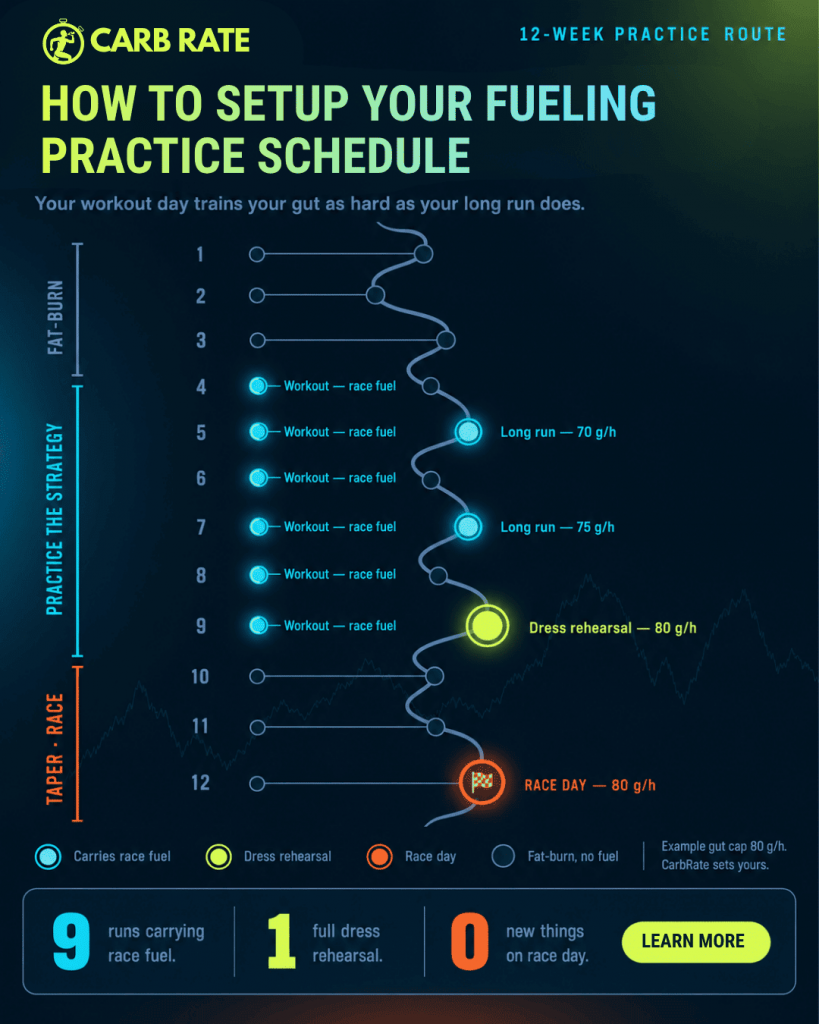
Move your fueling practice onto the runs where your effort matches race day: tempo runs, race pace segments, and the last third of your long runs.
Start at the hourly rate your stomach already handles and raise it by about 10 grams an hour every week or two.
Keep the products identical to the ones in your race plan, down to the flavor.
If you’re unsure exactly how to do this with your schedule, I recommend checking out a new, science-based fueling app we’ve partnered with called CarbRate, which creates a specific practice schedule for you.
The CarbRate practice schedule is based on a carb target that starts where your stomach is today and climbs toward your race-day number, so the adaptation happens on autopilot instead of by guesswork.
2. Treating a Missed Feed as Something You Can Make Up Later
A missed feed is a permanent hole in your race, because your gut has a hard ceiling on how fast it can absorb carbohydrate.
Researchers have measured that ceiling directly and while it varies from runner-to-runner based on how much they’ve practiced, the ceiling sits between 60-90 grams per hour.
So you can’t just double up a fueling station since your gut can’t absorb it.
Most runners don’t think this will happen to them this because no one plans to intentionally miss a planned fueling.
But, feeds get missed for completely ordinary reasons.
- The aid station sits on the far side of the road.
- The table has already run out of cups or there’s too much traffic to grab one easily
- The gel is in the one pocket you cannot open with cold hands.
- You’re on a hill or a tough section of the course and you’re pushing hard
- Your stomach is sloshing or not feeling good from a previous fuel
How to Stop Losing Feeds on Race Day
Count feeds rather than gels.
Know before the gun how many feeds the plan calls for and roughly where on the course each one lands.
Set a repeating alert on your watch so the reminder does not depend on you doing arithmetic at mile 18.
You can also use an app like CarbRate, which runs in the background on your phone and sends you audio or apple watch alerts before each feed, so you can plan without needing to think about it.
3. Not Spacing Your Fueling Based on the Course
The best fueling plans take into account the course you’re running on, both in terms of where the aid stations are located and the elevation profile.
Let me illustrate why you need to take these two factors into account:
Most runners typically have a plan, like take a gel every 30 minutes.
But, what if that 30 minute interval happens just as you hit the biggest hill on the course?
Taking gel and water going up a hill, when you’re already pushing your effort and likely breathing harder than normal means it’s more difficult to get that fuel down.
Plus, you’re now running harder and that means your stomach is even less able to digest and absorb that fuel, so you’ve increased the chances it will sit heavy in your stomach.
The second factor is aid station placement.
Aid stations sit at fixed points on the road, and at your pace to those points are almost never 30 minutes apart.
Even if you’re carrying your own gels, you’re likely using water along the course to wash them down, which means your plan to fuel every 30 minutes gets stretched or compressed.
How to Move Your Feeds Onto the Course
Pull up the official course map and mark every aid station in both miles and kilometers. Or, you can see if your race aid stations are already documented here.
Mark the climbs on the same map.
Then move each planned feed to the last aid station that comes before a climb rather than the one partway up it.
4. Using the Same Fueling Plan on a Hot Day That You Built for a Cool One
A hot race changes your fluid needs, your carbohydrate type and potentially your finish time and you need to properly account for each one in your fueling plan.
Fluid Requirements and How it Changes How Many Gels You Will Need
On a hot day you drink more, and if the cups hold sports drink then every extra cup is extra carbohydrate you did not plan for.
As an example, if your original hydration plan was to drink 20 oz of sports beverage every hour, you’ll also be consuming around 35 grams of carbohydrates within that hour.
But, if you need to drink more on a hot day, you’re also increasing the amount of carbohydrates you’re consuming. That means the gel you also planned to take will likely exceed your body’s limit of carbohydrate processing.
That’s not to mention the extra fluid that is now in your stomach.
This is what leads to an upset stomach, bloating and even potentially a shut down of the digestive system.
Carbohydrate Type
Heat also changes what your carbohydrate should be made of.
In a study run at 90°F (32°C), eight cyclists swallowed the same total carbohydrate in two different forms – pure glucose and glucose mixed with fructose.
The pure glucose group capped carbohydrate absorption at 46 grams an hour while the glucose/fructose group managed to absorb 68 grams an hour.
That means in hot temperatures, a fuel that contains both glucose and fructose means you’re able to absorb about 36% more usable carbohydrate per hour.
Finish Time
Research has shown that optimal race temperature is between 39 and 50°F (4 and 10°C).
For every 18°F (10°C) above that optimum, runners typically slow by about 3.9%, which turns a 4:00 marathon into 4:09.
This means you potentially need to account for this extra time on the course in your fueling plan.
How to Rebuild Your Plan for a Hot Race
Once you get close enough to race day to get a decent read on the conditions, recalculate your feeling plan based on the forecast.
If it’s going to be how, switch to a product built on both glucose and fructose in roughly a 2:1 ratio.
Then protect your fluid intake, because dehydration is the thing that actually impacts your gut and fueling plan the most.
5. Drinking at Every Aid Station Because You Are Afraid of Dehydration
Drinking at every station is how runners finish a marathon heavier than they started.
Researchers sampled blood from 488 finishers at the Boston Marathon and found 13% below the normal range for blood sodium, with 0.6% low enough to be dangerous.
Blood sodium falls when you take in more fluid than you sweat out, because the sodium already in your blood ends up diluted.
Three things predicted it independently: gaining weight over the course of the race, finishing in more than four hours, and sitting at either extreme of body size.
Runners who gained weight were about four times as likely to finish with low sodium, and runners over four hours were about seven times as likely as those under 3:30.
That means the runners most at risk are the ones on the course longest, taking a cup at every table because they were told dehydration would ruin their day.
Drinking too much water is the failure mode a fixed drinking schedule produces, because the schedule has no idea what your sweat rate is.
How to Set a Fluid Target You Can Trust
Perform a sweat test after running in different weather conditions in training.
Weigh yourself naked before and after an hour long run in conditions close to your race.
Add back whatever you drank during the run, and the difference is your sweat rate for that hour.
Plan to replace most of that number and never more than all of it.
6. Taking All Your Caffeine at the Start Line
Taking caffeine before the race starts puts the peak benefits from caffeine consumption (both the physical and the mental) in the first hour of the race, when you’re least likely to need it.
This means your late-race caffeine will likely be less effective or potentially give you jitters due to higher than normal total caffeine intake.
Instead, save the caffeine for later in the race, when the mental and physical benefits hit harder.
In a 2016 trial, 15 trained cyclists rode for 120 minutes and then completed a time trial. After 80 minutes of that initial ride they took either 100 mg of caffeine, 200 mg, or none at all, mixed into their drink.
- The caffeine-free group took 28:41 to finish the time trial
- The 100mg group took 27:36 to finish the trial
- And the 200mg group took 26:36 to finish the trial
That means 100-200mg taken deep into a hard effort measurably improved performance more than no caffeine at all.
How to Split Your Caffeine Across the Race
Add up the caffeine already sitting in your gels, because most runners are carrying more than they realize.
Hold at least one caffeinated gel back for the final third of the race.
Mark which gel is which before the start so you are not reading labels with sweat in your eyes.
Start by Writing Your Plan Down
Every fix for these common mistakes on this list happens before you even hit the start line because it all begins with proper planning.
Write your plan out in grams and minutes, then attach each feed to a point on the course where you can reach water.
Practice that exact plan on your race pace segments and the last third of your long runs, and adjust it for the forecast in the final week.
Measure your sweat rate once so your fluid number is a measurement instead of a guess.
If you fix only one thing before your next race, make it the written schedule.