

You hit mile 10 of your marathon, and the energy gel you took at mile 5 sits like a brick in your stomach.
Nausea builds and your pace drops.
You dig through your hydration pack and find the applesauce pouch you grabbed as backup.
One squeeze later, the cramps ease and your legs feel lighter.
You run the last 16 miles stronger on whole food than you did on engineered fuel.
This happens to more runners than sports nutrition companies want to acknowledge. Commercial gels work brilliantly for some athletes and wreak digestive havoc on others.
Your stomach might tolerate natural carbohydrates better than the thickened, stabilized formula that engineered gels use.
So, in this article you’re going to learn the research-backed practical advice on natural alternatives to energy gels that actually work on race day.
- Which whole foods deliver carbs as reliably as gels and which ones don’t
- Why your stomach tolerates apples and bananas better than commercial gels
- How to fuel a marathon exclusively on natural carbs without sacrificing performance
- When gels still make sense (and when you should skip them entirely)
Why Runners Tolerate Natural Carbs Better Than Gels
Commercial energy gels are engineered to pack maximum calories into minimal volume, which creates a problem for your stomach.
A typical gel packs 20 to 25 grams of carbohydrate into about 1 oz (30 ml), which makes it a far more concentrated dose of sugar than a sports drink or a piece of fruit.
That’s why gel labels tell you to take each one with water.
Taken without enough water, that concentrated sugar sits in your stomach longer, which can trigger nausea and cramping.
This happens especially when you’re running, because blood diverts away from digestion and toward your legs.
Whole foods spread their carbohydrate through more water and bulk.
Applesauce has a texture similar to gel but is mostly water, so it goes down easily mid-run.
A 2012 study of 11 runners found that eating raisins or commercial sport chews during 80 minutes of running produced the same 5 km time trial afterward, 20.6 vs 20.7 minutes, with only mild stomach symptoms on either.
The carbohydrate tolerance picture becomes more nuanced when you look at the types of sugar involved.
Most commercial gels use glucose and fructose blends specifically because those sugars are absorbed through different intestinal transporters (SGLT1 for glucose, GLUT5 for fructose).
Whole foods contain multiple carbohydrate types naturally.
Bananas deliver glucose, fructose, and sucrose in a single fruit.
Honey contains roughly equal parts glucose and fructose.
Dates contain a mix of glucose and fructose.
That means whole-food carbohydrate can fuel a run about as well as commercial fuel, so the better choice is whichever one your stomach handles.
If you consistently experience stomach distress on gels but tolerate solid carbs during training runs, the issue is likely the gel formulation itself, not carbohydrate supplementation as a category.
For runners prone to GI distress during racing, a targeted probiotic formulated for endurance athletes can reduce symptom severity further.
MAS Flush contains Bifidobacterium strains shown in research to reduce GI symptoms by 50–57 percent in marathon runners, making it a practical complement to a natural fueling strategy.
It also ranked first in our comparison of the 6 best probiotics for runners.
Which Whole Foods Match Gel Carbohydrate Delivery
Gel and whole food aren’t interchangeable, but many natural foods match gel calories so closely that the difference disappears in practical running.
Standard energy gels deliver 20–25 grams of carbohydrate per serving, which takes up about 1–1.5 ounces of volume.
Here’s how common natural carbs stack up against that benchmark:
| Food | Portion Size | Carbs (grams) | Practical Notes for Running |
|---|---|---|---|
| Applesauce (single pouch) | 3.2 oz (90 g) | 10–20g | Sweetened pouches sit near 18–20g and unsweetened near 10–12g, so check the label; no chewing required; easy on the stomach |
| Honey (liquid or packet) | 1 tablespoon | 17g | Pure glucose/fructose blend; absorbs quickly; requires water to consume; viscosity similar to gel |
| Banana (medium, 7–8 inches) | 1 whole fruit | 27g | Contains glucose, fructose, and sucrose; slower digestion due to fiber and resistant starch; requires chewing; most portable; cost: $0.20–$0.50 |
| Raisins (small handful) | 1/4 cup (40g) | About 30g | Concentrated carbs; requires extensive chewing; choking risk on run; better as pre-run fuel; cost: $0.30–$0.60 |
| Dates (large Medjool, pitted) | 1 date (24g) | 18g | Glucose/fructose mix; chewy texture (easier than raisins); portable; cost: $0.30–$0.50 |
| Dried apricots (medium halves) | 5–6 pieces | 20g | Similar to dates; chewy; less commonly used by runners but viable alternative |
Applesauce is the closest gel equivalent in texture and convenience: a squeeze pouch, no chewing, and a lower cost, though most pouches carry fewer grams than a gel.
Single-serve applesauce pouches (typically sold in baby food sections) deliver 10–20 grams of carbs, depending on whether they’re sweetened, for $0.50–$1.00 per serving, compared to $1.50–$2.50 for commercial gels.
Honey works the way a gel does: it’s a concentrated mix of glucose and fructose that you squeeze in and chase with water.
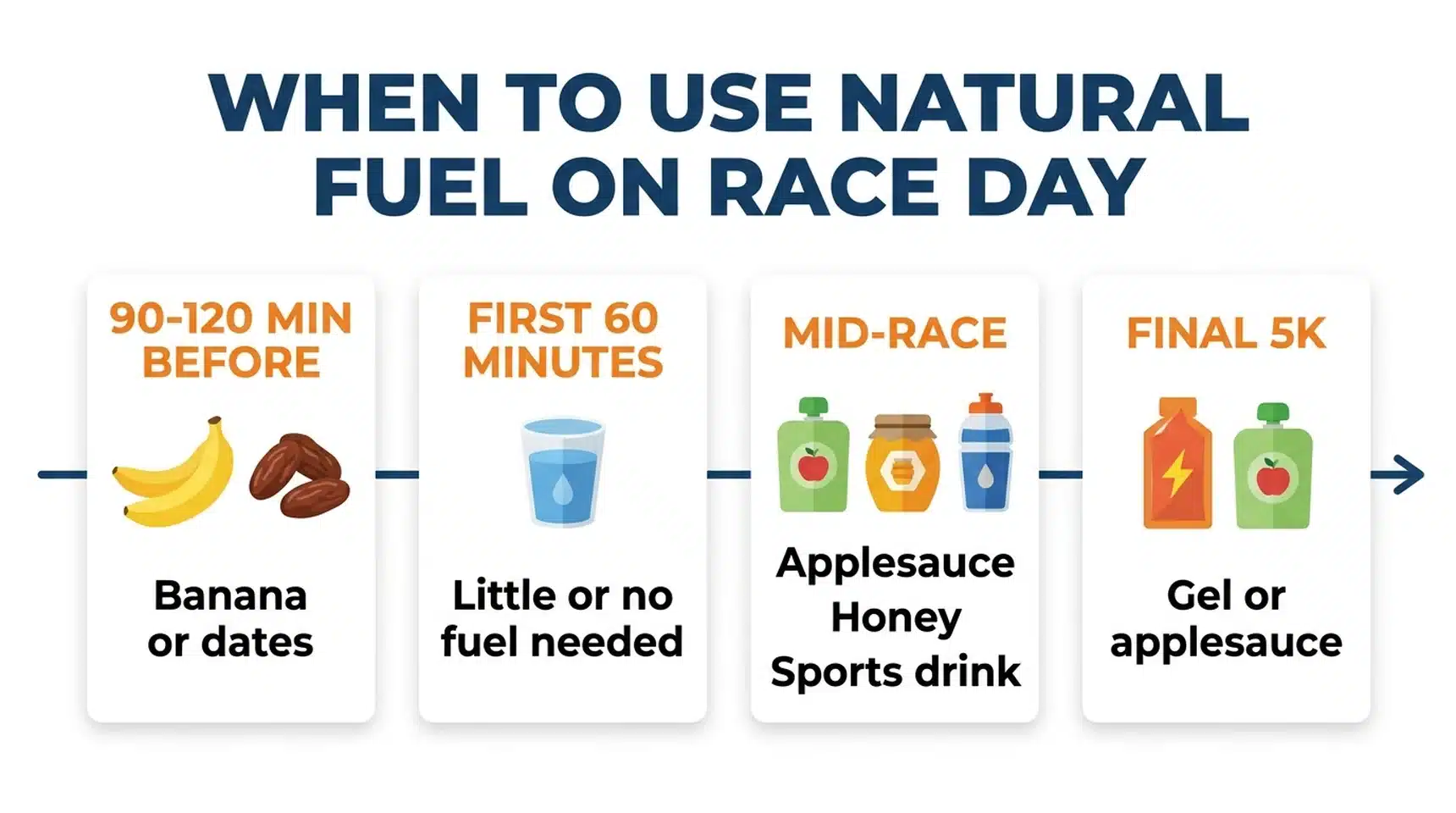
Bananas are the most portable natural option and require zero packaging, but their higher fiber content slows digestion slightly, making them better suited to pre-run fueling (90–120 minutes before start) than mid-race supplementation.
Raisins and dates offer portable carbohydrate density but require significant chewing and present choking hazard during hard running, so they work best as training fuel or pre-race loading, not race-day fueling.
Applesauce pouches and honey packets are the whole-food options that come closest to how a gel works during a run.
Practical Fueling Timing: When to Use Natural Carbs vs Gels
The right fuel depends entirely on what stage of your run or race you’re in.
Pre-run fueling (60–120 minutes before you start):
Natural whole foods excel here because slower digestion aligns with your energy timeline.
A banana 90 minutes before a race releases carbs steadily as you warm up, avoiding the sugar spike-and-crash that can occur with gel taken too early.
Early race fueling (first 60 minutes):
Most runners don’t need fuel during the first hour if the pre-race meal was adequate.
For ultra-marathons or very long efforts, natural carbs work fine during this window because there’s no urgency yet.
Mid-race fueling (75–180+ minutes, the critical window):
This is where gel design becomes relevant because you’re running hard, your stomach is jostled by impact, and you need carbs now.
Applesauce packets and honey packets still work and absorb quickly at this stage.
Bananas require more chewing, which distracts from pacing and can trigger nausea during hard running, while raisins and dates increase choking risk when you’re breathing hard.
For marathoners at recreational pace (3:30+), natural carbs suffice throughout. For faster runners targeting sub-3:00 times, alternating gels with applesauce or honey reduces stomach load without sacrificing the absorption speed you need late in the race.
Final 5k push: Gels regain advantage because you need carbs rapidly and chewing would be disruptive. Applesauce still works, but any other whole food becomes impractical.
For most non-elite runners doing marathons, alternating gels with applesauce or honey reduces overall GI distress without sacrificing performance, because you don’t hit the carbohydrate absorption ceiling that makes pure-gel fueling necessary for elite athletes.
A practical race strategy: fuel every 25 to 30 minutes with 20–25 grams of carbs (either a gel or 1 to 2 applesauce pouches, alternating to reduce gel-induced nausea) plus water.
Test this exact strategy on your longest practice run before race day, because individual tolerance varies dramatically.
When you practice your marathon nutrition in training, you find out which fuel strategy your stomach can handle under race-day stress.
Ready For More?
Then start our FREE Race Day Fueling email course!
You’ll learn how to calculate when you’ll bonk, how to hydrate, what foods to eat during your race, and more! From case studies to scientific research, we’ll help you learn how to best fuel for your next race.
The Carbohydrate Absorption Problem Gels Claim to Solve
Understanding why gels were engineered in the first place clarifies when you actually need them.
All carbohydrate absorption hits a ceiling.
If you consume only glucose (a single transportable carbohydrate), your small intestine can absorb about 60 grams per hour, because only one intestinal transporter (SGLT1) handles it.
A 2005 study of trained cyclists showed that by combining glucose with fructose (which uses a different transporter, GLUT5), you can push carbohydrate oxidation rates up to 105 grams per hour, because you’re using both pathways simultaneously.
Over a 3-hour marathon, 105 grams per hour would add up to more than 300 grams of carbohydrate.
This represents an enormous caloric advantage late in the race when glycogen stores deplete.
Whole foods often contain this dual-carbohydrate makeup naturally: bananas deliver glucose, fructose, and sucrose, honey is roughly 50-50 glucose and fructose, and applesauce is a mix.
They partially bypass the single-transporter ceiling, but not as efficiently as engineered gels that optimize glucose-to-fructose ratios specifically.
However, this advantage only matters if you’re pushing hard enough to need 90+ grams of carbohydrate per hour.
Most recreational runners stay well below that threshold.
A 4-hour marathoner burns roughly 2,500 to 3,000 calories total, consuming maybe 50–60 grams of carbs per hour from fueling, which is at or below the single-transporter ceiling.
For that runner, the absorption advantage of dual-carb engineering disappears. Natural carbs work equally well.
The multi-carbohydrate absorption advantage that makes gels superior mainly applies to elite marathoners running sub-3:00 times, because recreational runners don’t hit the carbohydrate ceiling with natural fuels.
Can a Sports Drink Replace Your Energy Gels?
A carbohydrate drink can fuel you as well as a gel can, as long as you drink enough of it.
That means the form your carbohydrate comes in matters far less than how many grams you get in each hour.
Volume is where a drink falls short of a gel, because the same carbohydrate comes spread through far more fluid.
Most sports drinks are 6 to 8% carbohydrate, so an 8 oz (240 ml) cup gives you about 14 to 19 grams.
To get 60 grams an hour from a 6% drink alone, you’d have to drink about 34 oz (1 liter) every hour.
That’s a lot of fluid to take in from aid station cups at race pace.
So a sports drink works best as one piece of your plan, covering your fluid and part of your carbohydrate while applesauce or honey covers the rest.
If you gag on anything thick, a drink is also the easiest way to get carbohydrate in without touching a gel.
Check the label before race day, because the sugar concentration of your sports drink decides how many grams each cup gives you.
How Do You Fuel a Marathon Without Gels?
Fueling a marathon or a long run without gels comes down to hitting a carbohydrate target each hour with foods you can carry and swallow while running.
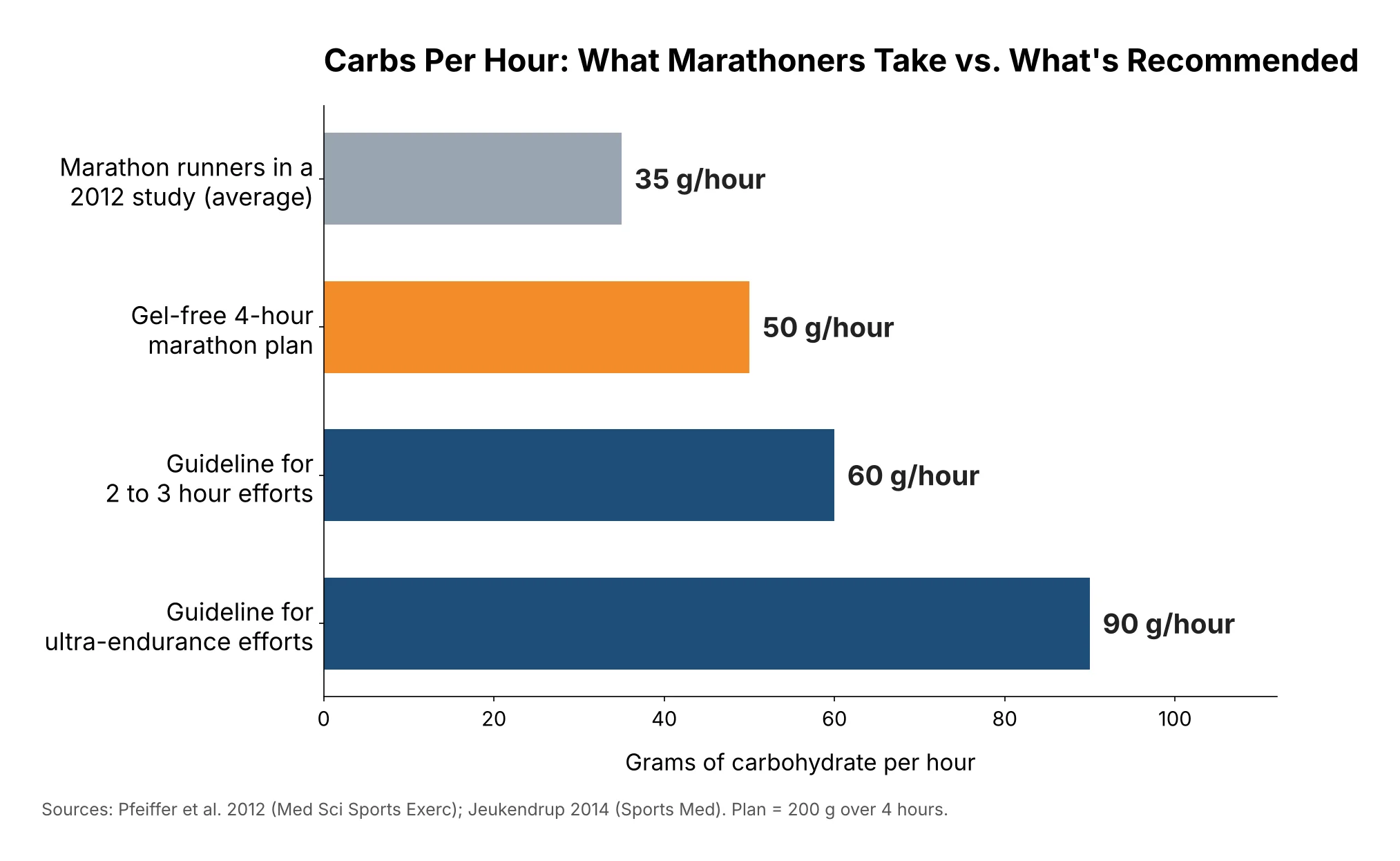
For efforts lasting 2 to 3 hours, current sports nutrition guidelines recommend about 60 grams of carbohydrate per hour.
That carbohydrate can come from a liquid, a semi-solid or a solid food.
The target can come down a little at an easy or moderate effort.
In real races, marathoners tend to take in far less than 60 grams an hour.
That means the typical marathoner in that study raced on a little over half the carbohydrate the guidelines call for.
With natural foods that shortfall is hard to avoid, because most servings carry fewer grams of carbohydrate than a gel.
The simplest way to close that gap is to start with the total and work backward.
A 4-hour marathoner running at a moderate effort and aiming for 50 grams per hour needs about 200 grams of carbohydrate across the race.
Here’s one way to build those 200 grams without a single gel:
| Fuel | Serving | Carbs per serving | Servings | Total carbs |
|---|---|---|---|---|
| Sweetened applesauce pouch | 3.2 oz (90 g) | About 18g | 6 | 108g |
| Honey | 1 tablespoon (21 g) | 17g | 3 | 51g |
| 6% sports drink at aid stations | 8 oz (240 ml) cup | About 14g | 3 | 42g |
| Total | 12 | About 200g |
Spread the 9 applesauce and honey servings across the race, one roughly every 20 to 25 minutes from the 30-minute mark, and take water with each one.
Pick up the 3 cups of sports drink at aid stations along the way, ideally between your applesauce and honey servings.
The trade-off is weight, because whole foods carry their carbohydrate in more water and bulk than a gel does.
The 6 pouches and 3 tablespoons of honey you carry weigh about 600 g (21 oz) and hold about 160 grams of carbohydrate.
Standard gels with 25 grams of carbohydrate would carry the same 160 grams in about 210 g (7.5 oz), so the natural version weighs nearly 3 times as much.
You’ll need a vest or a belt with room for all of it, or a friend on the course who can hand you the second half.
Rehearse this exact plan on your longest training runs, because carrying and eating this much real food is a skill you train your gut to handle, just like the miles.
DIY Alternatives: How to Make Natural Fueling Work at Scale
If you’re committed to racing on natural carbs, execution matters as much as food choice.
Applesauce strategy:
Source single-serve pouches from brands like Mott’s, which sell 3.2-ounce pouches in bulk for $0.40–$0.60 each, about half gel cost.
Test them on 3–4 training runs before committing to race day, and consume with water the same way you would a gel.
Honey packets:
Single-serving honey packets from coffee shops or grocery stores ($0.10–$0.20 each) carry about 11 to 12 grams of carbs, roughly half a gel, so plan on 2 per gel.
Squeeze directly into your mouth and chase with water, because absorption is faster than applesauce.
Some runners find honey harder to swallow without gagging, so test extensively before committing to race day.
Banana timing:
Bananas work best as pre-run fuel, eaten 90–120 minutes before the start of your race.
Don’t attempt to eat a banana during a hard run, because choking risk is real and the chewing load distracts from pacing.
Homemade honey-oat fuel paste:
Mix honey (2 tbsp, ~34g carbs), rolled oats (3 tbsp, ~12g carbs), and a pinch of salt into small mason jars or plastic containers.
This creates a thick paste with roughly the same carb density as gel but more satisfying texture, and many runners tolerate it better than commercial gels during training runs.
Dried fruit (raisins and dates):
Better as pre-race loading or training fuel than mid-race supplement, because chewiness and density work against you when breathing hard.
If using on race day, do so in the first 60 minutes of racing when pace is easier and you have time to chew properly.
Test your chosen natural carb source on at least three practice runs before race day, because individual tolerance to carbohydrate type, fiber content, and form (liquid vs. solid) varies dramatically.
Natural carbs are not inherently superior for performance. They’re alternatives when gels trigger GI distress or when budget limits fuel spending.
What Natural Carbs Can’t Replicate (And When It Matters)
Honesty: natural carbs have real limitations that gels were specifically engineered to overcome.
Concentration and volume:
A gel packs 20–25 grams of carbs into 1–1.5 ounces, while most whole foods require larger volume or multiple pieces.
A banana is 3 times the volume of a gel, raisins require a large handful, and dates need 3–4 pieces to match gel carbs.
More volume means more stomach filling, which can trigger nausea during hard running.
Absorption speed and flexibility:
Gels are engineered to absorb fastest exactly when you need carbs most, late in a race when you’re fatigued.
Bananas, dates, and raisins are slower-digesting due to fiber, so the carbs don’t hit your bloodstream as quickly when you’re bonking at mile 20. Honey and applesauce are faster, approaching gel speed.
Consumption ease:
Gels require no chewing, minimal jaw effort, and no choking risk when consumed properly.
Running hard while eating a banana or raisins increases choking hazard and steals attention from pacing. Applesauce requires only squeezing, which is why it works best as a natural fuel during hard running.
Practical logistics:
Gels fit neatly into vest pockets, belt loops, or hand-carry flasks.
Bananas bruise and get squishy in a warm backpack, so they’re better carried separately or eaten at aid stations. Applesauce pouches and honey packets fit pockets identically to gels.
Performance ceiling:
The fastest marathoners require 90+ grams of carbs per hour to maximize performance, and only dual-carb-engineered gels hit that rate reliably.
Recreational runners don’t need that ceiling, so natural carbs suffice.
For racers targeting sub-3:00 marathons gels remain the better tool, while natural carbs work equally well for runners at 3:30 pace or slower.
The Bottom Line: When to Choose Natural Alternatives
Natural carbohydrate fueling makes sense in three specific scenarios.
First: You consistently experience GI distress on commercial gels (nausea, cramping, or stomach urgency) that doesn’t happen with whole foods.
In this case, gel formulation, not carbs themselves, is the problem, and switching to applesauce or honey is often the fix.
Second: Your budget is limited and you race frequently. Applesauce pouches and honey packets cost half what commercial gels do, which adds up over a training year of practice runs and races.
Third: You’re a recreational marathoner (3:30 or slower finish time) racing for the experience, not placing.
Your absorption rate isn’t a performance limiter, so fueling comfort and ease matter more. Natural carbs remove digestive anxiety and often improve race-day experience.
Gels remain the better choice for elite racers, shorter hard efforts (5k to 10k), and situations where volume or consumption ease is critical.
In practice, most runners benefit from a hybrid approach: natural carbs for training runs, gels for race day (or a mix of both, alternating to spread GI load). Test extensively before committing any fuel strategy to your most important race.