

Most masters runners know they should strength train, and most of the advice they get is about staying strong.
But after 40, you lose power about twice as fast as you lose strength.
Strength is how much force your muscles can produce, and power is how quickly they can produce it.
Running depends on power, because your foot is only on the ground for a fraction of a second each stride.
So what should your strength training focus on to slow that loss down?
To give an evidence-based answer, let’s look at the research-backed practical advice on…
- Why you lose about 24% of your leg power between ages 45 and 65, but only about 12% of your leg strength
- How losing power shortens your stride by 13% by age 60, even though your cadence stays the same
- Why 6 weeks of heavy lifting made masters marathoners 6% more efficient at marathon pace, and lighter weights did nothing
- The 5 exercises to put at the center of your strength training, and how to fit them into your running week
How Much Faster Do You Lose Power Than Strength as You Age?
Your muscles lose power about twice as fast as they lose strength.
A 2002 study of 54 elite masters weightlifters aged 40 to 87 found that their leg power dropped 1.2% a year while their leg strength dropped 0.6% a year.

That means between ages 45 and 65 you lose about 24% of your leg power and about 12% of your leg strength.
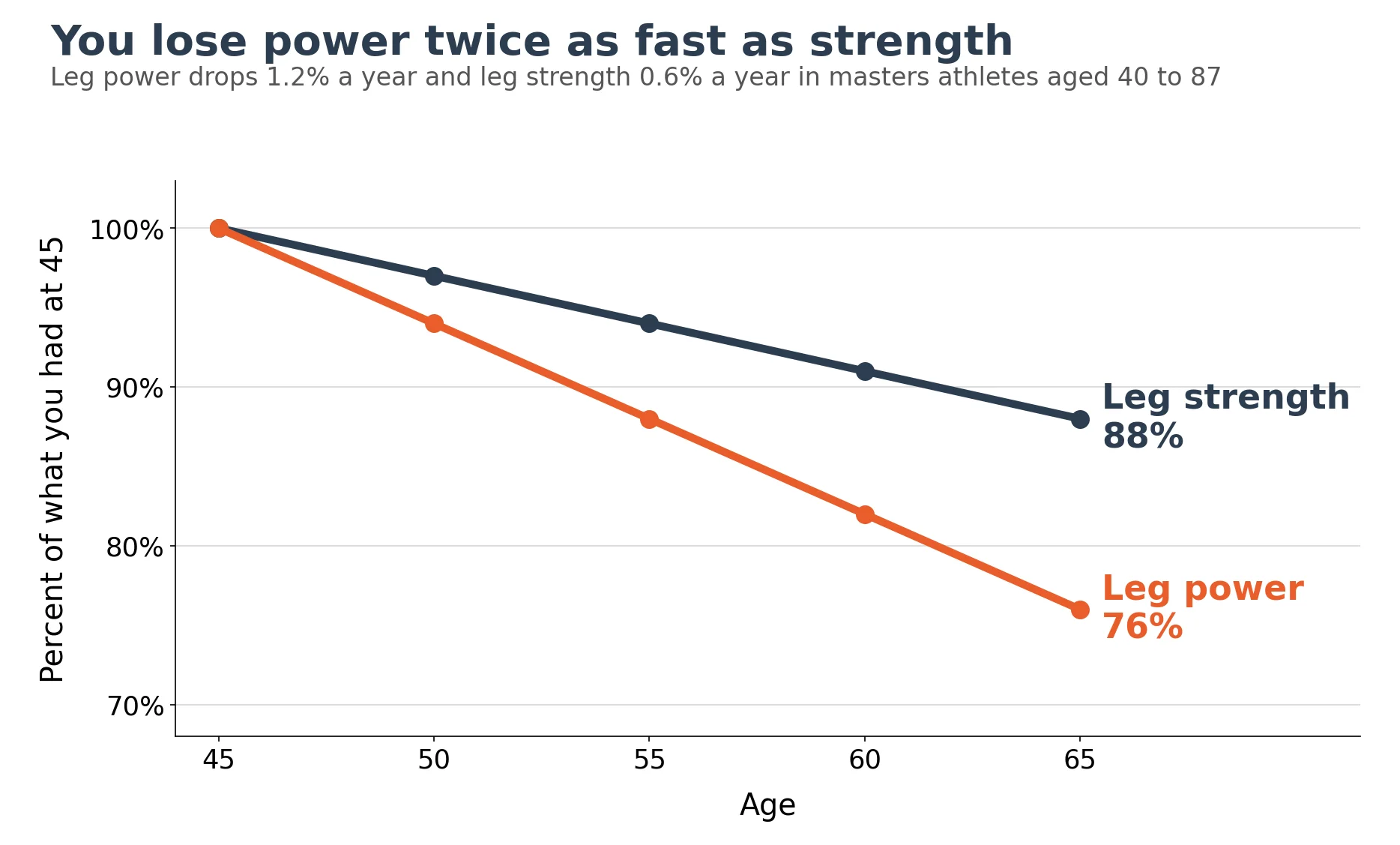
Untrained adults of the same ages lost power and strength at almost exactly the same rates as the weightlifters.
But the weightlifters had 32% more power on average, so an 85-year-old lifter produced as much power as a 65-year-old who didn’t train.
A 2020 study of 1,305 adults aged 20 to 93 found that leg power starts to drop after age 40.
Power drops faster than strength because of what happens to your fast-twitch muscle fibers.
Fast-twitch fibers are the muscle fibers that contract quickly, and they produce most of your force when you sprint, jump or push off hard.
A 2006 study took muscle samples from 91 male sprinters aged 18 to 84 and compared the size of their fast-twitch and slow-twitch fibers.
The fast-twitch fibers were smaller in the older sprinters, and the slow-twitch fibers were the same size at every age.
That means the fibers you need to move fast shrink first, even in athletes who train for speed.
Why Does Losing Power Slow Your Running Down?
Losing power makes your stride shorter, and a shorter stride at the same cadence means a slower pace.
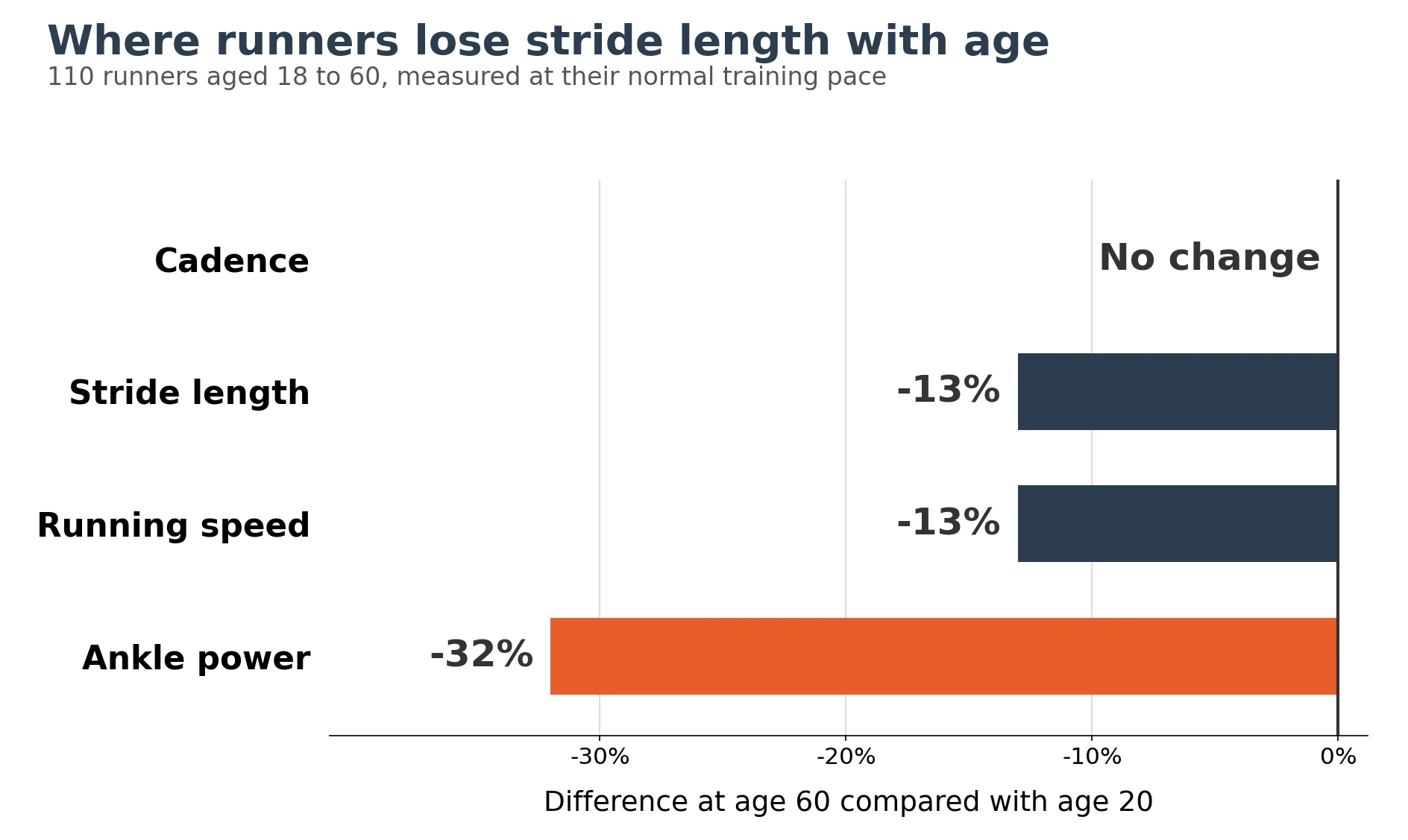
A 2016 study of 110 runners aged 18 to 60 found that stride length and running speed were both 13% lower at age 60 than at age 20, while cadence stayed the same.
The researchers also measured how much power each joint produced during the push-off.
Power at the hips and knees didn’t drop with age, but power at the ankles was about 30% lower at 60 than at 20.
That ankle power comes from your calf muscles, which push you off the ground at the end of every stride.
That means your calves are where you’re losing stride length.
Your running economy holds up much better than your power does.
Running economy is how much oxygen you use to run at a given pace.
A 2011 study of 51 competitive runners found no difference in running economy between runners aged 18 to 39, 40 to 59, and 60 and older.
The runners over 60 did have less power than the two younger groups, and across the whole study the runners with less strength and power ran slower.
Luckily, power responds to training, even in your 60s and 70s.
What Should Masters Runners Focus On in Strength Training?
Your strength training should focus on power: heavy weights, lifted fast, plus jumps and calf work.
A lot of the strength advice for runners over 40 goes the other way, with light weights, high reps and slow stability exercises.
Stability work has a place for injury prevention, but it doesn’t train your muscles to produce force quickly.
Here are the 4 things the research says your strength training needs.
Should Masters Runners Lift Heavy Weights?
Heavy weights for a few reps do more for a masters runner than lighter weights for many reps.
Researchers have tested this directly in masters marathoners.
A 2013 study split 16 marathoners, average age 44, into 3 groups: one lifted heavy, one lifted lighter weights for more reps, and one only ran.
The heavy group did 4 sets of 3 to 4 reps at 85 to 90% of the most they could lift, twice a week for 6 weeks.
The lighter group did 3 sets of 10 reps at 70% of the most they could lift, on the same schedule.
After 6 weeks, the heavy group’s maximum strength was up 16% and their running economy at marathon pace had improved by 6%.
The lighter group and the running-only group saw no change in either.
That means lifting twice a week only made these runners more efficient when the weight was heavy enough that they could manage just 3 or 4 reps.
This was a small study with 5 or 6 runners in each group, so treat the 6% as a best case.
How Fast Should You Lift the Weight?
Lift the weight as fast as you safely can on the way up, and lower it under control.
Power is force multiplied by speed, so lifting slowly trains the force and leaves out the speed.
A 2022 review of 20 trials in 566 adults over 60 found that lifting the weight fast on the way up led to modestly bigger gains in physical function than traditional strength training.
The people in these trials had an average age of 70 and were not runners.
But the instruction works for any lift you do: once your form is solid, drive the weight up as fast as you can.
Do Masters Runners Need Jumps and Hops?
Jumping exercises, called plyometrics, train your muscles and tendons to produce force in the short time your foot is on the ground.
A 2024 study had 20 runners aged 30 to 50 add either jump training or weight training to their running, twice a week for 10 weeks.
Both groups improved their running economy by 2%, and neither group ran a faster 5K at the end of the 10 weeks.
That means jumps improved running economy as much as lifting weights did, which makes them a good option on days you can’t get to a gym.
Start small, because jumping is harder on your muscles and joints than lifting.
In a 2020 study of men with an average age of 69, 3 of the 14 who did jump training dropped out with a muscle strain or knee pain.
Begin with low hops on two feet, and spend a few weeks lifting first if you’re new to strength training.
Why Should Your Calves Get Extra Attention?
Your calves need their own heavy work because the ankle is where masters runners lose power.
In the 2024 study, the runners who gained the most calf raise strength tended to improve their running economy the most.
The researchers found no such link for the leg press or the leg curl.
Researchers have also looked at whether fast running protects ankle power.
A 2018 study found no difference in ankle power between middle-aged runners and younger runners who trained at the same paces.
That means how fast you train may matter as much as your age for ankle power, so keep strides and short hill sprints in your week.
What Are the Best Power Exercises for Masters Runners?
These 5 exercises cover all 4 areas.
- Squat or split squat. Use a weight you can lift 3 to 5 times, and stand up as fast as you can on every rep. Do 3 to 4 sets with 2 minutes of rest between them.
- Deadlift or single-leg deadlift. Use the same sets and reps as your squat. This trains your glutes and hamstrings, the muscles that extend your hip on every stride.
- Heavy calf raise. Hold a weight and do 3 sets of 6 to 8 reps on one leg. Do some sets with your knee straight and some with it bent, because each position works a different calf muscle.
- Ankle hops. Hop on two feet with your knees almost straight, and spend as little time on the ground as you can. The runners in the 2024 study started with 3 sets of 8 to 10 jumps.
- Strides or hill sprints. Run 6 strides of 20 seconds after an easy run twice a week. Or start with 2 hill sprints of 10 to 12 seconds up a steep hill at near-full effort, with full recovery between them.
Squat
Single-leg deadlift
Calf raise
Ankle hops
How Do You Fit Power Training Into Your Running Week?
Two strength sessions a week is enough, which is what the runners did in both the heavy lifting study and the jump training study.
Put those sessions on the same days as your hard running workouts.
Masters runners need 48 to 72 hours to recover from a hard session, and lifting on workout days keeps your easy days easy.
If you’re new to lifting, spend the first 2 weeks on lighter weights for 10 to 12 reps while you learn the exercises.
After those 2 weeks, move to heavier weights and add the ankle hops.
Keep strength training in your week once race training starts, and adjust the focus for your race distance and injury history.
Knowing which exercises to do on which days, and when to add weight, is the hard part to get right.
That’s why we built our Strength Training for Runners program, which shows you exactly which days to strength train and how to progress toward your race.
Make Your Strength Training Heavier and Faster
After 40, your power drops about twice as fast as your strength, and your calves lose the most.
So the most useful change you can make is to lift heavier weights for fewer reps and move them fast.
Start at your next session by swapping one high-rep exercise for 3 sets of 3 to 5 heavy reps.
Then add heavy calf raises and a few sets of ankle hops twice a week.
| Focus | Why it matters after 40 | What to do |
|---|---|---|
| Lift heavy | Heavy lifting improved masters marathoners’ running economy by 6% in 6 weeks, and sets of 10 at a lighter weight did not. | 3 to 4 sets of 3 to 5 reps, twice a week. |
| Lift fast | Leg power drops 1.2% a year after 40, twice as fast as leg strength. | Drive the weight up as fast as you can with good form. |
| Jump | 10 weeks of jump training improved running economy by 2% in runners aged 30 to 50. | Start with 3 sets of 8 to 10 ankle hops. |
| Train your calves | Ankle power is about 30% lower at age 60 than at age 20. | 3 sets of 6 to 8 heavy single-leg calf raises. |
| Run fast | Middle-aged runners had the same ankle power as younger runners when both trained at the same paces. | 6 strides of 20 seconds twice a week, or short hill sprints. |