

Coffee before running is one of the few legal performance boosts that nearly every runner already has in the kitchen.
It’s also the one runners worry about most, because coffee has a reputation for dehydrating you and sending you looking for a bathroom at mile 2.
I’ll admit, the dehydration fear is what kept me from using caffeine when I was running at an elite level. But I was wrong.
Elite athletes figured this out long ago. An analysis of 20,686 doping-control urine samples found caffeine in 73.8% of them, which means about 3 out of every 4 athletes had caffeine in their system when they competed.
The good news is that the same dose and timing work for everyday runners, and getting them right takes about 5 minutes of planning.
In this article, you’ll learn:
- How much time caffeine takes off a 5k or a marathon
- Exactly how much coffee to drink for your body weight
- How long before a run to drink it
- Whether coffee dehydrates you or upsets your stomach
- Why you don’t need to quit caffeine before race day
Is Drinking Coffee Before a Run Good for Your Running?
Caffeine cuts minutes off endurance races, and the effect shows up at real race distances like the 5k.
A 2018 meta-analysis of 46 studies found that 3 to 6 mg of caffeine per kilogram of body weight made endurance time trials 2.22% faster than a placebo.

That means a 4-hour marathoner would finish about 5 minutes sooner with the same fitness.
The benefit holds for non-elite runners too. A 5k time trial study gave 15 well-trained and 15 recreational runners either 5 mg of caffeine per kilogram or a placebo.
The well-trained runners ran 1.1% faster on caffeine, and the recreational runners ran 1.0% faster.
For a 25-minute 5k runner, 1.0% is about 15 seconds.
Caffeine won’t replace training, and 2 of the 46 studies in that meta-analysis found slower times on caffeine. That’s why you test it in training before you rely on it in a race.
Ready For More?
Then start our FREE Race Day Fueling email course!
You’ll learn how to calculate when you’ll bonk, how to hydrate, what foods to eat during your race, and more! From case studies to scientific research, we’ll help you learn how to best fuel for your next race.
Why Does Coffee Make Running Feel Easier?
Caffeine lowers how hard a given pace feels, so you can hold a quicker pace at the same effort you’d normally give.
During a long run, a brain chemical called adenosine builds up and signals fatigue. Caffeine blocks the receptors adenosine binds to, so less of that fatigue signal gets through.
A 2005 meta-analysis of 21 studies found caffeine lowered ratings of perceived exertion by 5.6% during steady exercise compared with a placebo.
That means a pace that normally feels like a 7 out of 10 feels closer to a 6.6 on caffeine.
The same analysis found that effort ratings at the end of exhausting exercise were the same with or without caffeine.
So caffeine doesn’t make the last hard minutes of a race hurt less, but it lets you cover more ground at goal pace before you reach them.
Caffeine lowers perceived effort by about 5.6% at the same pace, so you can hold goal pace at a lower effort rating.
How Much Coffee Should You Drink Before a Run?
The dose that improves race times is 3 to 6 mg of caffeine per kilogram of body weight.
The International Society of Sports Nutrition’s 2021 position stand sets that range and notes the lowest dose that works may be as little as 2 mg per kilogram.
Taking more than 6 mg per kilogram won’t take more time off your race. The position stand notes that doses around 9 mg per kilogram cause a high rate of side effects without adding any extra speed.
To turn milligrams into cups, you need to know roughly how much caffeine is in your coffee.
The FDA estimates that 400 mg of caffeine equals about two to three 12-ounce (355 mL) cups of coffee, which works out to roughly 130 to 200 mg per cup.
| Body weight | Low dose (3 mg/kg) | High dose (6 mg/kg) | 12 oz cups for the low dose |
|---|---|---|---|
| 121 lb (55 kg) | 165 mg | 330 mg | About 1 |
| 150 lb (68 kg) | 204 mg | 408 mg | 1 to 1.5 |
| 181 lb (82 kg) | 246 mg | 492 mg | 1.25 to 2 |
| 209 lb (95 kg) | 285 mg | 570 mg | 1.5 to 2 |
Start at the low end. A 150 lb (68 kg) runner gets the proven benefit from about 200 mg, which is about one 12-ounce (355 mL) coffee.
Start with 3 mg of caffeine per kilogram of body weight, because the higher 6 mg dose adds side effects faster than it adds speed.
How Long Before a Run Should You Drink Coffee?
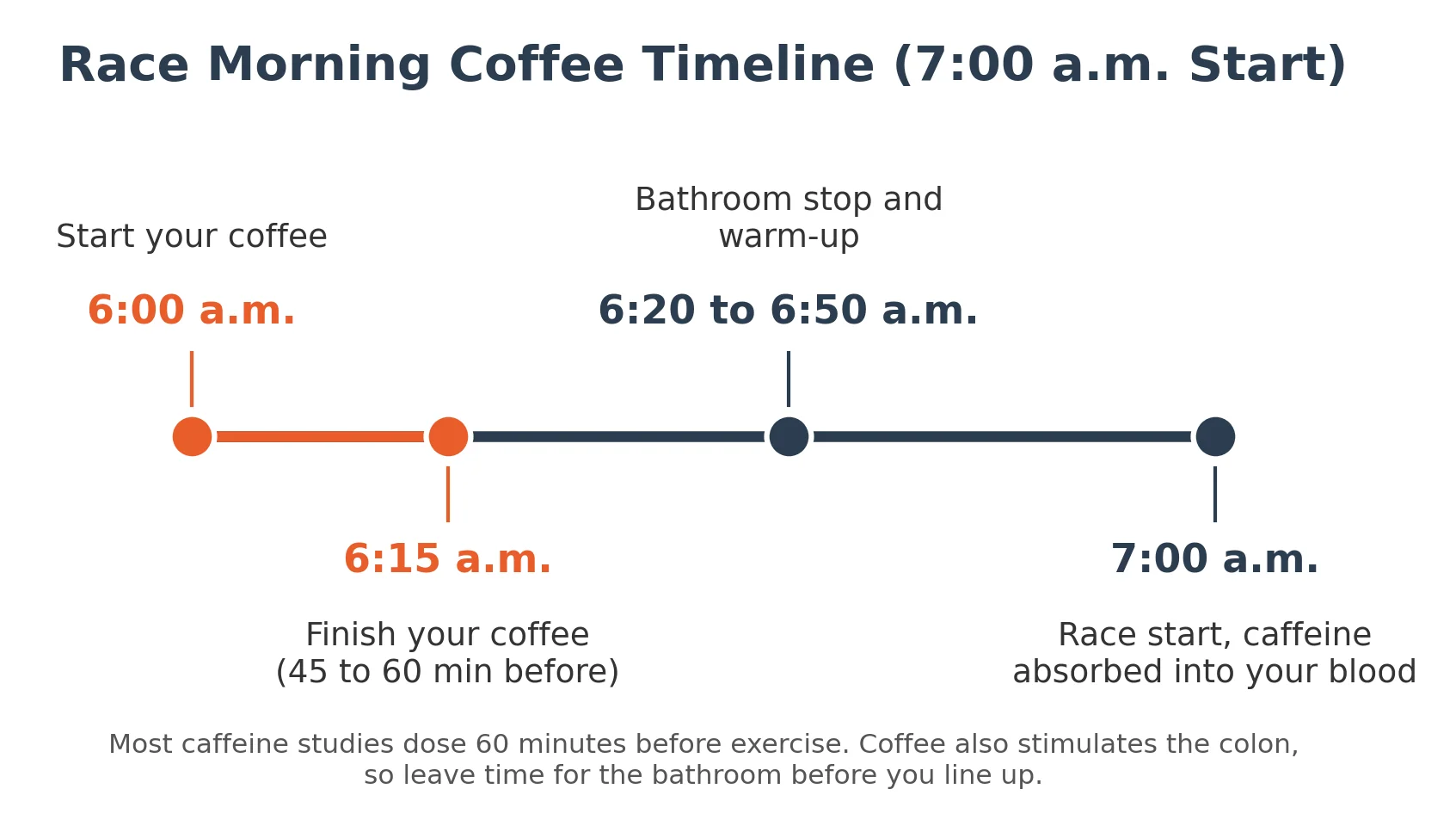
Drink your coffee about 45 to 60 minutes before you start running.
In the research behind the 2021 position stand, 60 minutes before exercise is the most common timing, since caffeine from a drink or capsule takes time to be absorbed into your blood.
Caffeinated gum is absorbed through the lining of your mouth, so you can chew it closer to the start than the 60 minutes a drink or capsule needs.
For a race with a 7:00 a.m. start, that means finishing your coffee between 6:00 and 6:15 a.m., about when you’d eat a light pre-race breakfast anyway.
If you’re pairing coffee with food, this guide on what to eat before a run covers how much to eat and how early.
Finish your coffee 45 to 60 minutes before the start so the caffeine is in your blood when the race begins.
Will Coffee Dehydrate You or Upset Your Stomach on a Run?
Coffee in normal amounts doesn’t dehydrate you, but it can speed up your need for a bathroom.
Does coffee dehydrate you before a run?
Caffeine has a mild diuretic effect, which is where the fear of dehydration comes from.
A 2014 study found that drinking 4 cups of coffee a day for 3 days produced the same 24-hour urine output as drinking the same amount of water, 2,409 mL on coffee against 2,428 mL on water.
That means your morning coffee counts toward your fluid intake instead of subtracting from it.
Why does coffee make you need the bathroom?
Caffeinated coffee makes your large intestine contract, which is the urge you feel not long after your first cup.
A study measuring pressure inside the colon found that caffeinated coffee increased colon activity 60% more than water and 23% more than decaf, about the same increase as eating a full meal.
That’s why the 45 to 60 minute timing helps on race morning, since it leaves time for a bathroom stop before you line up.
If coffee still gives you stomach trouble mid-run, you can build tolerance with the same approach used in gut training: practice your race-morning routine before long runs and hard workouts.
Do You Need to Cut Back on Caffeine Before a Race?
You don’t need to cut caffeine in the days before a race to get the full performance benefit.
The old advice was to quit coffee for a week before a race on the theory that daily coffee drinkers get less out of a race-day dose.
A 2017 trial tested that idea in 40 trained cyclists split into 3 groups by their usual caffeine intake: low at 58 mg a day, moderate at 143 mg a day, and high at 351 mg a day.
Each group rode a time trial after taking 6 mg of caffeine per kilogram, and all 3 groups improved by a similar amount.
That means a daily coffee habit won’t blunt the race-day boost, so there’s nothing to gain from giving up coffee during race week.
Keep your normal coffee routine during race week and take your planned caffeine dose on race morning.
Coffee, Caffeine Pills, or Gels: Which Works Best for Running?
Coffee works as well as pure caffeine, so pick the source your stomach handles best.
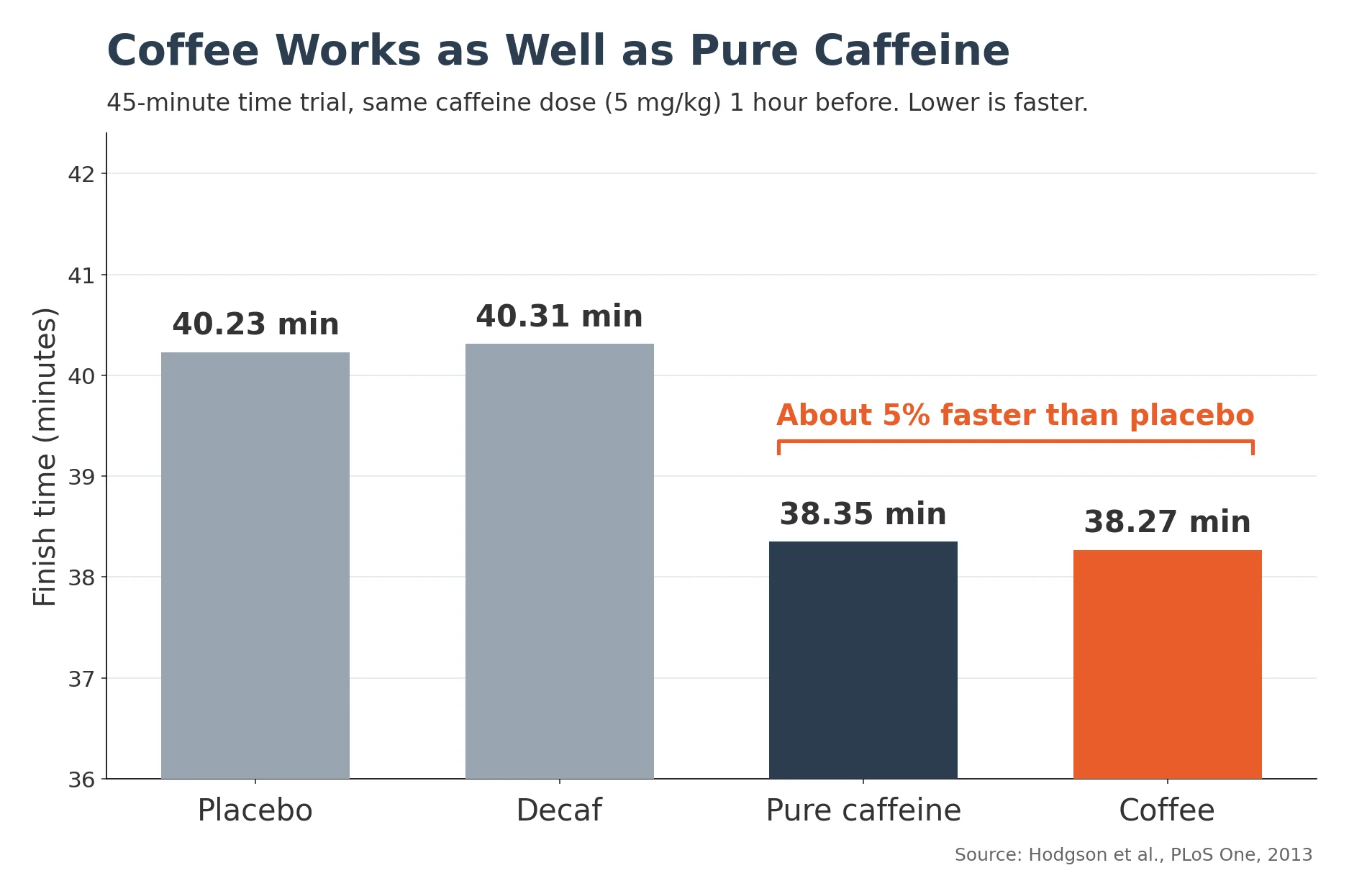
Researchers have tested coffee against caffeine directly. In that study, 8 trained cyclists and triathletes drank either pure caffeine at 5 mg per kilogram, instant coffee with the same caffeine dose, decaf, or a placebo 1 hour before a 45-minute time trial.
The riders finished in 38.35 minutes on caffeine and 38.27 minutes on coffee. On placebo they took 40.23 minutes.
That means coffee and caffeine each made the riders about 5% faster, and decaf did nothing.
The source matters more for your stomach and your dose control than for speed.
- Coffee: the easiest option on race morning, but the caffeine content changes with the bean and how it’s brewed.
- Caffeine pills: an exact dose with no extra fluid, useful if coffee gives you heartburn.
- Caffeinated gels or chews: a way to top up caffeine late in a half marathon or marathon, with the dose printed on the label.
Whichever you choose, try it before a long run or workout first, so you learn your dose and stomach tolerance before race day.
Coffee Before Running: The Quick Recap
Here’s a summary of how to use coffee before a run or race.
| Question | Answer |
|---|---|
| Does it improve race times? | About 2% faster in endurance time trials, and 1% in a 5k |
| How much? | 3 to 6 mg per kg of body weight, starting at 3 mg |
| When? | 45 to 60 minutes before the start |
| Will it dehydrate you? | Moderate coffee hydrates about as well as water |
| Cut back before a race? | No, your usual intake doesn’t reduce the benefit |
| Best source? | Any source works, so choose the one your stomach tolerates |



43 Responses
Amazing article. Very thorough. You guys really do your research. It has always been difficult for me to drink coffee in moderation. I would start out drinking a cup a day and it would end up being a pot before too long. I quit cold turkey about 6 months ago. I felt like quitting allowed me to sleep better and, in turn, train better. Never tried using it as strictly a performance enhancer. I might now after reading this.
Thanks for the compliment, Jason. Yeah, if you’re drinking too much coffee, it can definitely affect your sleeping patterns. When people ask me if I want a cup after dinner or something, I always joke and say “sorry, I only use caffeine as a performance enhancer”. It gets a laugh, but it’s kind of true.
Can you write the same article, but for beer….?
Not a bad idea, actually. While there is certainly no (or at least very little) performance enhancing benefits to drinking beer – for running at least, it would be interesting to look at how it can or cannot derail your training.
I always quit alcohol entirely the week of the race. Love a beer after a good race though. Probably not the ideal recovery tool.
Actually, beer has a significant amount of carbs in it which is ideal for recovery. After weekend races in college we would go out and get a nice jag going, wake up the next morning with little to no soreness and then be able to pound out a nice workout two days later. I’ve tried other things for recovery but for some reason the (my) Body responded well to the nector of the gods (fortunently).
I would love to hear some experiences using caffeine pills! Awesome article
Hi June,
I just ran my first half marathon in Toronto. I found the use of 2 caffeine pills, spaced throughout the race, plus my high carb snacks (Awake chocolate – has equivalent of caffeine in half cup of coffee, and Reeces peices) plus hydrate every few km, resulted in a really fun, exciting run for me. I am 51 and had a time of 2 hr 14 min. which beat my “unofficial” half around the block at home by 8 minutes. I would definitely recommend supplementing with caffeine as it works for me, plus find a snack you really like. I couldn’t gag down a gel and wasn’t keen on the chew candies they sell for running.
I’ll take the comments in a different direction….. I use coffee to help me, uh, you know, jump start the stomach emptying process prior to going out for a run in the morning 🙂 Works great for that!
Wow, I really like the links to the research publications. That’s a really nice touch that just confirms all the credibility. Jeff keeps getting more and more thorough with his articles. I may have to cancel my subscription to Runners World and do all my reading here. (except I do like the ads in Runners World).
Hope everyone has had a nice holiday so far!
This was a great article that I have been interested about in the past. I have never really been into coffee but have heard from time to time how it benefits runners.
I decided to try it last week before one of my workouts (3x2mile repeats). I felt great before and during the workout. I had a lot more energy going into the workout than I normally feel especially because I am a post work runner. I am not sure it the caffeine helped me nail the workout or if it mentally made me think I had more energy. Either way I think that it paid off.
My question is since I am not a regular coffee drinker how many times should I try drinking coffee before I should feel comfortable doing it before a race?
Also after I know that the coffee will sit right in my stomach how many times should I drink coffee before a run to make sure I am use to it. (once a week, once a month,etc). It made alot of sense in the article when it said you shouldn’t drink it during workouts because workouts are meant to prepare you for race day.
Please let me know what your guys thoughts are.
Thanks
Billy
I am glad you enjoyed the article, Bill. Great questions, too.
I think you should try drinking coffee or using caffeine before a race about 3-4 times to ensure you’re comfortable with it. I never liked coffee before a race (it gave me heart burn), but celestial seasonings fast lane tea worked really well. You don’t have to you use coffee to get the benefit from the caffeine. Likewise, I would maintain drinking caffeine every 3 weeks or so, just to keep your system used to it. Perhaps the days you have a big workout or just a day you’re feeling flat would be a good choice every once in a while to keep you acclimated.
Should be a nice thing to add to the race day routine to see if we can’t push everything a little further!
I rarely drink coffee. Last night after my dinner I fancied a cup, so I had one. An hour os so later I went for a 5k training run 9I’m doing a 10k run next week), and knocked 1 minute 20 seconds off my best time.
Started me thinking whether careful use of caffeine might be a boost during the race, and that in turn led me to this web page. Very interesting reading and confirms what I’d suspects – the caffeine probably helped me out a lot.
I was concerned whether over the course of a 10k run you might get a high followed by a low, which would obviously be counter-productive, but it seems like that wouldn’t be the case.
Interesting stuff.
I’m no nutritionist but I have done a lot of research and have some-what of a medical background. I had similar questions but my theory is this (based on no research just what I know of physiology)…
We don’t get a crash from the high we already receive from running in the middle if the run. Also, because it helps us produce more endorphins than we already do the “high” will last longer anyways. Granted, everyone has a different metabolism; therefore, we all reach our peaks a lows at different times, but the duration of caffeines effects last for hours. Plus, the effects of running, though they might feel tiring, will keep you energized anyways (again everyone is different but even though we may feel tired we couldn’t go take a nap right after running). Another point is this–When our body starts telling us to stop (when we feel tired) we have not even come close to using all our energy (i’m not sure of the exact number but I think it’s under 20%). If caffeine helps enhance those chemicals which energize us anyways, those energy stores would be depleted slower.
This is all in theory, but it would make since to me; especially considering that caffeine also aides in fat utilization. Just some thoughts…
I’m a director for a tv station and I use the Dr max Powers Burn on occasion when I need a boost. Great way to wake you and keep you more alert. I wake up at 3 AM every weekday and sometimes it catches up to me. If I take it before the show it keeps me alert throughout the two hours that I direct.
Don’t drink soda and ingest all those extra calories, dyes and corn syrup. Drink some water and take the Max Powers Burn. I’ve been using them for years when I need to and they still work for me everytime. So glad I found this product.
Thanks for the extremely thorough article. For my caffeine, I use gu and Jolt Energy gum. I read about Jolt a while back and really like it.
Hi I’m doing half marathon tomorrow, I’m thinking of trying caffeine for the first time? Would I be ok to have a coffee half hour before my run ?
Hi Susie! A good rule of thumb is that you should never try anything new on race day. Therefore, NO, it would not be a good idea to have coffee before your race. Experiment with caffeine and coffee on your training runs first. If you find it works well, then you can try on race day. Good luck!
Hi jeff, Thankyou for advice, I’ll take it on board, This run is part of my marathon training, but I haven’t got the energy like I use to have, I seam to be struggling a bit, :)))
One interesting fact with coffee is that instant coffee has much more caffeine than espresso. I read somewhere that a single shot of espresso has 30mg caffeine but a single teaspoon of instant coffee has 70-90mg.
..Also that caffeine has zero taste .. all the flavour of espresso coffee is in the oil.
So if you really want the caffeine hit without having to drink loads of coffee , just use instant coffee
Actually, caffeine tastes HORRIBLY! It’s very bitter and weird, I’ve actually tasted the pure stuff. But it is true with the espresso, drip/filter coffee is the way to go if you’re thinking about the caffeine content 🙂
This article is great! I was really skeptical about it at first before I gave it a try myself! My cousin bought me a frap from star bucks before I ran and wow it was something else! Now would the effects wear off or would the body become tolerant to it if I drink it everyday? Because I’m one of those people who prefers not to be talked to until I get my cup of the day in and I always do my trainings in the mornings and I definitely don’t want to lose that feeling of “less effort” like I felt that day I drank the frap because I ran my PR for a 5K
Question: It says that an optimal amount for a 150lb person is 340mg. Is that accurate? a can of Red Bull has only 80mg and most coffee only has about 150 or so, It seems one would have to ingest a lot of coffee to get the best amount. Maybe caffeine pills would be better? My wife works at Starbucks and she gets me the instant Via coffee and that only has about 140 per cup, I’m not big on coffee so this seems like an awful lot of coffee to drink before a run to get the optimal amount of caffeine. I’m about 160lbs so i’d have to have about 3 cups of coffee.
Indeed, it’s a lot of caffeine. As the article mentions, that’s going to be about 2-3 cups of coffee. For some that’s a lot, for others that’s a normal day 🙂
I am a big coffee drinker, so this is a big plus for me. Halleluiah, Coach, for writing this article! I’m sharing this with my runner friends and my husband who thinks running on caffeine is a no-no. Btw, do you think you can write an article on migraine and running?
I am a Indian .my age is 19 and weight is 58kg .i am a 1500mtr runner .so sir tell me that at what time i will take caffene and what is the doses ?
I am happy whenever I read any positive comments about caffeine since I love my morning coffee so much. So thanks for putting all the research together.
But I’m also an English teacher, so I have to say that “dearth” as in “after reading this dearth of information” is the wrong word. “Dearth” means “a scarce supply; lack.” In contrast, you supplied an abundance of information. (Sorry, I just couldn’t help myself).
And I hope that I NEVER see the word “dearth” used in reference to the world’s coffee reserves!
Hi – Great article.
I take a caffeine gel 20 mins before the start of a marathon or HM race and then alternate 1:1 “normal” gel/caffeine gel as the race progresses.
If I know there is a particularly difficult section coming up then I’ll go the caffeine about 20 mins before hand e.g. Heartbreak Hill, Boston.
Works for me better than drinking strong coffee itself
Great article. Never drink caffeine before an event. Ran a half marathon a week ago & took 4 minutes off my previous two half marathon times. Had a coffee before the race, ( dont know why, just did. ) felt great. It didn’t seem like an effort. Maybe the caffeine was the reason why!
Very good article. Can we use the coffee powder mix with lemon & salt?
Awesome article! One correction though, Colombia is the name of the country, not Columbia as in South Carolina.
Hi. Caffeine tablets work well for larger doses and do not upset most people’s stomach. They commonly come in doses of 100 mg or 200 mg. Often times they can be bought in capsules, so you can pop open the capsule, pour out the granules and use as much or as little as you want. For example, on a tempo run, i might only want the effects of a weak coffee, so i woud pour half the granules of a 200mg capsule into my cup of tea, and that about does it.
I drink my coffee in the morning along with a lot of water, I want more caffeine but not the extra trips to the bathroom and liquid sloshing in my stomach. Been using Gu gel for about 4 years, ready to use more caffeine!! For my weight I’d need about 300mg I’m used to 40! Couldn’t possibly take 2 packs of clif shot blocks or chomps? Anything else out there that’s simple, quivk, effective without the extra liquid??
Thanks for this article! All the suggested drinks to help you get your caffeine are great sources, but the best one i found was Nos Active Energy Drink. It packs a forceful, if not un benificial punch of caffeine! It contains about 221 mg per 22 oz bottle. its probably the largest source you can get from a drink.
Great article. We love a shot of coffee before a big race. none of the other so called high caffeine drinks come close to a shot of espresso.
Keep it up.
Thanks Gaz, glad you found something that works!
I have to run 1 km in 4 mins for railway PET. my weight is 72 kg age is 31. I can run in 1km in 5 mins. I have 20 days for race. How can I cut my time to 4 mins.
Hi Pawan, you may want to check out this post, see if you can add some speed to your training, if you are not already. We are not able to give you a plan as we do not know enough about you, but hopefully this can help a little if you do have a base as a runner https://runnersconnect.net/coach-corner/interval-training-and-running-performance/
Am running 5km in 24min and i want it to do in 22mins so plz guide me about it. And my weight is 80kg .should i try caffeine? Tell me some caffiene tablets
Hi Ritesh, you would be best off making sure you are fueled correctly, and racing the 5k to perform. Here is an article on race plan for 5k https://runnersconnect.net/race-plan-5k-run/ and 5k specific training https://runnersconnect.net/running-training-articles/5k-specific-training/ hope this helps!
I’ve been off caffeine for years. When I used to drink cola, if I went too long without a drink (over a day), I’d get a bad headache. I never got into drinking coffee though (even the smell of coffee nauseates me). I’ve been looking at the gels and other fuels, and basically have been focusing on those without any caffeine. But after reading this article, I wonder if they might be useful once I start looking at longer runs. If I only use it sparingly, e.g. a few times during training to gauge the effects, and during an actual race itself, would that avoid the addiction/headache type issues? Or would I be courting headache/withdrawal issues each time I use it?
Hi Louis, thanks for sharing your thoughts. It would probably be helpful for you in the longer races, and you may enjoy this podcast episode with Alex Hutchinson where we discuss it further https://runnersconnect.net/running-interviews/alex-hutchinson-performance/ Take a listen and see what you think. If you saved it for race day and workout days, you should not have the same problems you have before as you will not be taking it enough. Hope this answers your question.