
You dial in your training, your pacing, and your fueling, and then your gut decides the day for you.
Cramping, bloating, gas, or an urgent bathroom stop can undo a workout or a race faster than any hill. For many runners, dairy is the trigger hiding behind those symptoms.
Lactose intolerance is one of the most common reasons milk, cheese, or a yogurt before a run turns into stomach trouble on the run. The good news is that it is manageable, and most runners can still keep some dairy in their diet once they know their limit.
Here’s what you’ll learn:
- Why your body stops digesting lactose well, and why that is the norm
- Why dairy bothers your stomach more when you run than when you sit still
- How much lactose most people can handle
- The practical ways to keep dairy without the GI fallout
- How to protect your calcium and bones if you cut back
What is lactose intolerance, and why do most people have it?
Lactose intolerance is the digestive trouble that follows when your body can’t break down lactose, the natural sugar in milk and dairy.
Your small intestine makes an enzyme called lactase that splits lactose so you can absorb it. Most people make plenty of lactase as babies and then produce less of it after early childhood.
When there isn’t enough lactase, undigested lactose travels into your large intestine, where gut bacteria ferment it and produce gas and bloating, then the cramps and diarrhea you feel afterward.
Reduced lactase after childhood is the default setting for most of the world’s adults, so this is a normal variation in human biology rather than a disease.
A national health panel concluded that many people who avoid dairy for lactose intolerance can still handle moderate amounts, because reduced lactase and true symptoms are not the same thing.
Having low lactase is called lactose malabsorption. Getting symptoms from it is lactose intolerance, and plenty of people who malabsorb lactose feel fine on normal servings.
So a diagnosis of lactose intolerance rarely means giving up dairy for good. It means finding the amount your gut can handle.
Why does dairy hit your stomach harder when you run?
Running raises the odds that any borderline food, dairy included, turns into a GI problem.
When you run hard or long, your body sends blood to your working muscles and skin and pulls it away from your digestive tract.
A 2017 systematic review found that as running intensity and duration climb, blood flow to the gut drops, which injures the intestinal lining and lets more undigested material pass through.
That means the same glass of milk you handle on the couch can leave lactose sitting in an already stressed gut during a run, so the fermentation and cramping are stronger than they would be at rest.
Race-day nerves add another trigger on top of that.
A survey of 109 distance runners found that 43% had nervous diarrhea before competition, and those runners were more likely to report milk-intolerance symptoms.

So if dairy only wrecks you on run days or race mornings, that is your gut and your nerves stacking on top of a lactose you were already struggling to digest.
If stomach trouble on the run is a regular problem for you, the fixes go beyond dairy, and you can dig into the full picture in our guide to stomach pain when you run.
RunnersConnect Bonus
Download your FREE Guide where we share the Best Foods to Eat Before Running.
How much lactose can you actually handle?
Most people with lactose intolerance can handle far more lactose than they expect, and spreading it across the day raises the amount further.
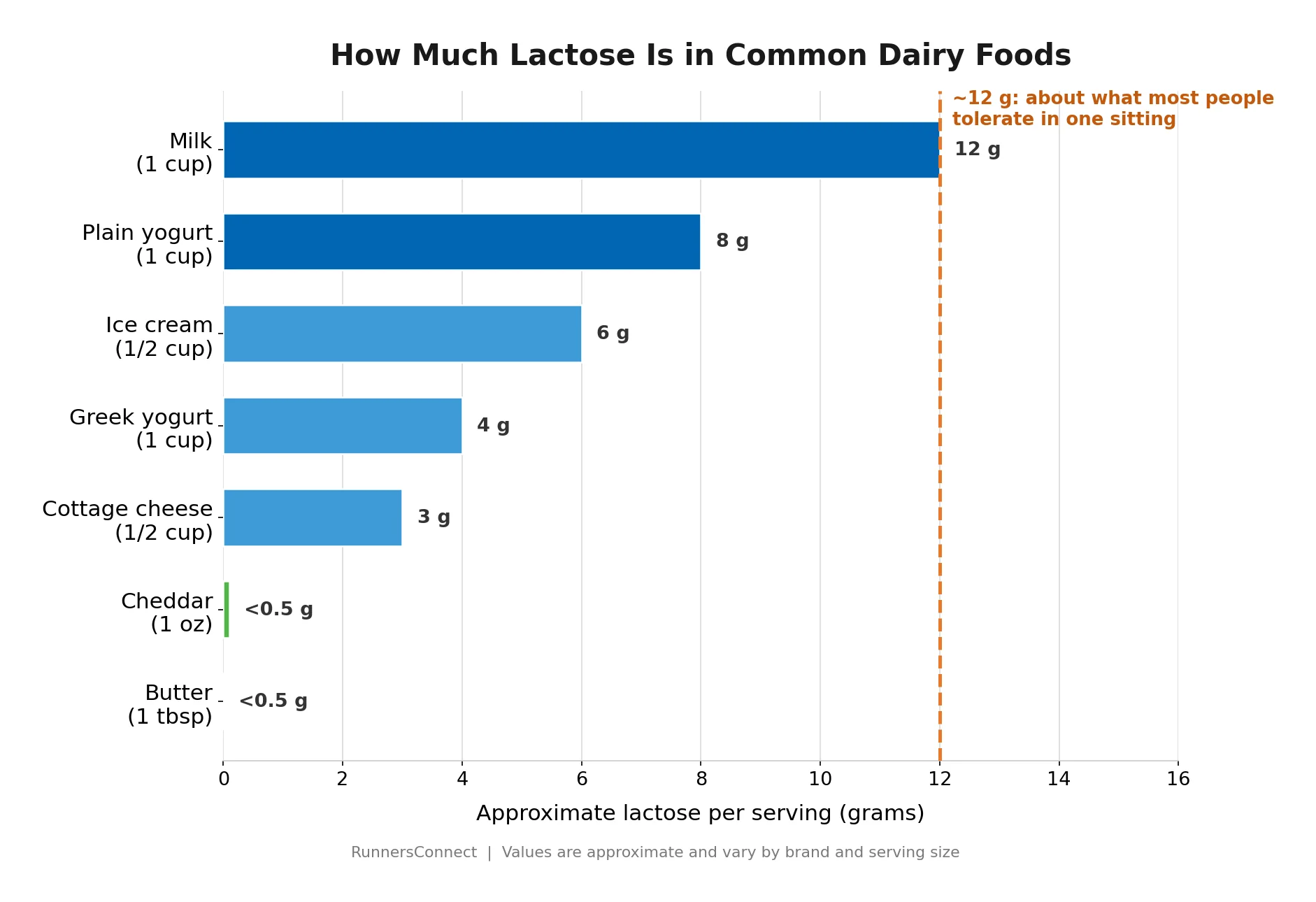
A review of 36 trials found that most lactose-intolerant adults tolerate up to 12 grams of lactose in a single sitting, about the amount in one cup of milk, with no or minor symptoms.
Twelve grams gives you a target to aim for, which is finding the amount your gut handles and building your dairy around it.
Lactose also varies a lot between dairy foods, which is why some hit you harder than others.
- High lactose: a cup of milk carries roughly 12 to 13 grams.
- Medium lactose: yogurt and soft cheeses land lower, often 5 to 8 grams a serving.
- Low lactose: hard, aged cheeses like cheddar and parmesan and most butter have close to none.
Your own limit will still take some trial and error, since sensitivity differs even among people who malabsorb lactose.
How can you manage lactose intolerance as a runner?
Managing lactose intolerance comes down to controlling the dose, the form, and the timing of the dairy you eat.
Take a lactase enzyme or switch to lactose-free dairy
Lactase pills add the enzyme your gut is short on, and lactose-free milk is regular milk with that enzyme already added.
Both let you eat normal servings of dairy without the undigested lactose reaching your colon, which is the simplest fix on days you want milk or a creamy meal.
Reach for yogurt and hard cheeses
Fermented and aged dairy are the easiest for most intolerant runners to digest.
Research on yogurt shows the live bacteria carry their own lactase and keep digesting lactose for you inside your gut, which is why yogurt often goes down fine when milk doesn’t.
Hard cheeses lose most of their lactose during aging, so cheddar and parmesan are usually safe even in normal amounts.
Time dairy away from your hard runs
Keep high-lactose foods away from the hours right before a tough workout or race.
Since running already slows and stresses your gut, giving lactose time to clear before you start removes one of the biggest triggers for mid-run cramping.
Build tolerance with small, regular doses
Your gut can adapt if you feed it a little lactose consistently rather than avoiding it entirely.
In a controlled study, adults who took daily lactose for about 2 weeks cut their flatulence roughly in half as their colonic bacteria adjusted.
If dairy is only part of a broader sensitive stomach, a short low-FODMAP trial reduced GI distress in runners with a history of exercise-related gut symptoms.
Control the dose, favor yogurt and hard cheese, and keep milk away from your hard efforts before you decide dairy is off the table.
How do you get enough calcium without dairy?
If you do cut back on dairy, calcium becomes the number to watch, because runners lean hard on their bones.
A 2-year study of young female runners found that each extra daily cup of skim milk was linked to a 62% lower rate of stress fractures.
That finding is specific to young women, but it points to a wider truth for every runner: low calcium and poor bone density raise your injury risk.
You can hit your calcium target without milk through calcium-fortified plant milks, canned salmon or sardines with the bones, tofu set with calcium, and leafy greens like kale and bok choy.
If dairy comes out of your diet, replace the calcium on purpose rather than assuming your other foods cover it.
Should you get tested, or just experiment on yourself?
You have 2 ways to confirm dairy is your problem: a clinical test or a careful self-experiment.
A doctor can order a hydrogen breath test, which measures the gas your gut produces after a lactose dose and gives a clear yes or no.
You can also run your own trial by cutting dairy for 2 weeks, then adding back one type at a time and tracking how your stomach responds around your runs.
The self-test is often more useful for a runner, because it shows how much you can handle and which foods you can get away with.
Practice your race-morning food in training the same way, so nothing new reaches your gut on the day it matters. Our guide to preventing runner’s diarrhea covers the rest of the race-day plan.
| Strategy | What to do | Best for |
|---|---|---|
| Lactase pills / lactose-free milk | Add the enzyme or buy it pre-added | Days you want normal milk or creamy meals |
| Yogurt and hard cheese | Choose fermented and aged dairy | Everyday, milder dairy |
| Timing | Keep high-lactose foods away from hard efforts | Pre-workout and race morning |
| Gradual adaptation | Small daily doses to build tolerance | Raising your long-term limit |
| Calcium swaps | Fortified plant milk, canned fish, tofu, greens | Protecting bone health if you cut dairy |