

You wake up on a hard workout morning with a sore calf, and the bottle of ibuprofen on the shelf looks like an easy fix.
Take two, dull the ache, get the session done.
That plan feels reasonable, and it is one of the most common mistakes runners make.
Taking ibuprofen before running gives you no performance benefit, and during a long race it can endanger your kidneys and drop your blood sodium to unsafe levels.
Here is what you will learn about using ibuprofen and other anti-inflammatory drugs around your running:
- Whether it is safe to swallow ibuprofen before a run or a race
- What the drug does to your kidneys and sodium during long efforts
- Whether it reduces soreness or lactic acid
- How anti-inflammatories interfere with the training adaptations you are working for
- The one situation where reaching for ibuprofen makes sense
Can You Take Ibuprofen Before Running?
Taking ibuprofen before a run is a bad idea for almost every runner, almost every time.
Ibuprofen belongs to a group of medicines called non-steroidal anti-inflammatory drugs, or NSAIDs, a group that also includes Advil and naproxen.
These drugs work by blocking the enzymes that produce prostaglandins, the chemicals that drive pain and swelling.
The problem is that those same prostaglandins help control blood flow to your kidneys and your gut while you exercise.
Block them right before you ask your body to run for an hour, and you strip away a safety system at the exact moment you need it most.
Taking ibuprofen before a run or race does nothing to improve how you perform.
Is It Safe to Take Ibuprofen Before a Race?
Swallowing ibuprofen before a long race carries the highest risk of any timing, and it is also the most common.
When you run for hours, blood flow shifts away from your kidneys and toward your working muscles and skin.
Your kidneys lean on prostaglandins to keep enough blood moving through them during that stress.
Ibuprofen removes that support, and the result can be acute kidney injury.
A randomized trial in ultramarathoners found that runners taking ibuprofen were 18% more likely to develop acute kidney injury than those on a placebo, and the drug did nothing to reduce their pain.

The danger does not stop at your kidneys.
By slowing how fast your kidneys clear water, ibuprofen lets your blood sodium fall too low, a condition called hyponatremia.
A study of Boston Marathon runners found that roughly 13% crossed the line with low blood sodium, which in severe cases causes seizures and can be fatal.
An NSAID during a long, hot race puts a second strain on a system that is already struggling.
Does Ibuprofen Help With Soreness or Lactic Acid?
Ibuprofen does not clear lactic acid, and it does not reliably reduce the muscle soreness that follows a hard run.
Lactate leaves your blood within an hour of finishing, long before soreness ever sets in, so no pill is fighting it the next day.
The soreness you feel one or two days later comes from tiny tears in the muscle, and researchers have tested whether NSAIDs help with it directly.
Research on runners at the Western States 100 found that those using ibuprofen felt no less sore than those who avoided it, and showed higher levels of inflammation in their blood.
The drug left them more inflamed than the runners who went without it.
If your goal is less soreness after a hard session, the evidence points toward recovery habits rather than a bottle.
Simple tools like sleep, protein, easy movement, and a few of the methods in our guide to getting rid of muscle soreness after a hard run do more for you than an NSAID and carry none of the risk.
RunnersConnect Bonus
Download our FREE recovery foods guide, with the top 10 foods for each of the essential recovery vitamins, minerals and macro nutrients. Plus a sample 1-day meal plan!
Can Ibuprofen Slow Down Your Training Gains?
The inflammation you are trying to shut down is the signal that tells your muscles to rebuild stronger.
Every hard run creates small amounts of muscle damage, and your body answers by delivering blood and nutrients to repair the tissue.
That repair is how you get fitter, and it depends on the very inflammatory response ibuprofen suppresses.
Work on athletes taking ibuprofen after exercise showed that the drug shut down the normal rise in muscle protein synthesis, the process that builds new muscle.
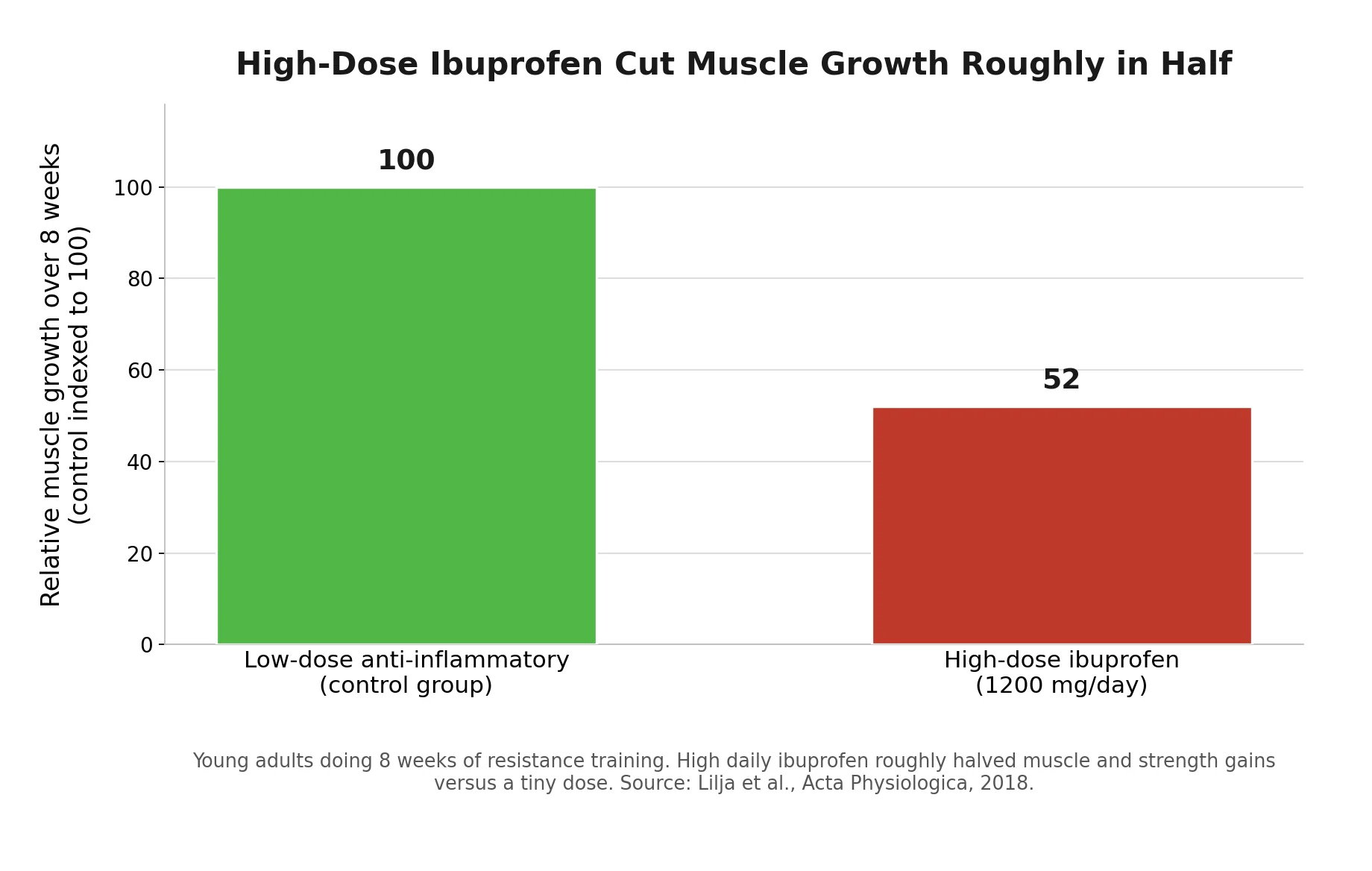
In a study of young adults doing 8 weeks of training, those taking high daily doses of anti-inflammatories gained roughly half the muscle and strength of those taking a tiny dose.
The same pattern shows up in endurance work, where ibuprofen given during endurance training canceled the adaptations that the training would otherwise produce.
Take ibuprofen after your key workouts as a habit, and you lose part of the adaptation those workouts were meant to produce.
How Long After Taking Ibuprofen Can You Run?
If you have already taken ibuprofen for a headache or an unrelated ache, wait until the dose has cleared before a long or hard effort.
A standard dose stays active in your body for about 6 hours, so an easy short run later in the day carries little concern.
The caution applies to long runs and hot-weather efforts, where the kidney and gut risks climb.
Running while ibuprofen is active also stresses your digestive system.
Athletes who took ibuprofen before exercise showed more damage to the gut lining and more intestinal leakage than when they exercised drug-free.
That gut damage is one reason NSAIDs are linked to the stomach cramping and bleeding runners can hit during long events.
For any effort over an hour, run drug-free and let the ache be your guide.
When Is It OK to Take Ibuprofen?
There is one situation where a short course of ibuprofen makes sense: the first 1 to 2 days after an acute injury.
A sudden ankle sprain, a muscle strain, or a fresh bout of tendon pain produces swelling large enough to slow healing on its own.
During that brief window, a short course of an NSAID can ease pain and calm excess swelling while you rest.
After those first couple of days, step back and let your body’s own repair process finish the job.
What ibuprofen should never be is a tool to mask pain so you can keep training or racing through it.
Numbing a warning signal lets a small problem grow into a longer layoff, and a smarter path is a proper return to running after an injury.
Reserve ibuprofen for the first 48 hours of an acute injury, never as a way to push through pain on the run.
Ibuprofen and Running at a Glance
| Situation | Should you take ibuprofen? | Why |
|---|---|---|
| Before a run or workout | No | No performance benefit and it strips kidney and gut protection |
| Before a long or hot race | No | Raises risk of kidney injury and low blood sodium |
| After a hard session for soreness | No | Does not reliably reduce soreness and reduces training gains |
| First 1 to 2 days of an acute injury | Short course is reasonable | Calms excess swelling while you rest |
| To push through pain during training | No | Masks a warning sign and invites a bigger injury |




83 Responses
I think I read in Advanced Marathon Training that Ibuprofen can actually be (fatally?) dangerous on long runs because of the combined effect of dehydration and the drug on your liver.
Yes, NSAIDs can actually be dangerous to your health when running. In addition to liver damage, they also thin the blood, which can cause issues. The scientific evidence on this for runners is a little sparse, which is why I didn’t cover it in this article. However, I am glad you brought it up.
Coach, I don’t know what the hell i have but it is extremely painful. I weigh 250 pounds and i try to exercise by run/walking. One morning, while doing this, my knee made a pop sound and WOW!! pain like crazy. I went to the doctor, did an x-ray and he gave me ant-inflammatory and pain meds. He said the extra weight is causing problems.
I rested, as recommended, for three weeks but felt better and decided to get back to exercising. While doing the actual walk/run routine i felt fine. About two hours after the workout, however, my ankle was swollen, my knees were stiff and extremely painful. I am planning to go back to the doctor but i would like to ask you advice on how i can deal with this. I really enjoy my exercising routing and is getting depressed because of the pain and my inability to go out and exercise. I take advil for the pain, it helps but as soon as it wears off the pain is back in full force.
Hi Cynthia, sorry to hear about your problems while running. It may just be that you are trying to advance too quickly. We wrote an article on the walk run method, and you may want to begin with more walking until your body gets used to the movement. https://runnersconnect.net/coach-corner/dont-shun-runwalk-method-experienced-beginners-alike-can-ultilize-runwalk-smarter-training/
Hope this helps!
I am proud to say I have never taken NSAIDS for anything running related 🙂 I do drink Tart Cherry juice daily for its anti-flammatory qualities. Is that okay?
Jami,
Drinking Tart Cherry juice is a much safer option than using NSAIDs. From new research that has been published in recent years the best option would be to let the inflammation run its course but we do not live in an ideal world. We are usually in the middle of a training cycle or close to a big race when we encounter inflammation. Rather than take time off we fight through the inflammation and try to find remedies that will help ease the pain. That’s where the NSAIDS and natural remedies come in to play. From all of the articles I have read and the studies conducted drinking Tart Cherry juice is a much safer option than NSAIDs.
I was an IB popper for about six months – since I took up running. I THOUGHT I was doing myself a favor – avoiding injury / pain as much as possible. The problem is that I could NOT tell if my body was in pain or not and so I continued running. I think my injuries were partially attributed to the inability to feel pain.
After reading this article – and articles similar to this – I stopped (Cold turkey) taking IB. That was a month ago. Result? I have had ZERO injuries in the past month AND I can
F-E-E-L the natural pain / recovery receptors in my body.
I know when to take it easy (up to and including skipping a day of running altogether) and I know when my body is in the mood for an all-out workout. Even my toning has improved because I can F-E-E-L when my muscles have recovered enough to push forward or when I need to back off (i.e. I keep doing this and I’ll get injured).
Articles like this blog need to be posted in EVERY gym – written on EVERY exercise contract. I did NOT know that I might (oh Hell – WAS) slowing down my body’s recovery. In turn, I was INCREASING my injuries which – indirectly – foreced me to take more IB.
In the past month I have taken IB two times (three pills at a time for a total of SIX pills in a month – what I used to take in one day – more even.) I took it once because I was going to be on my feet all day at a festival (bad lower back) and I took it one more time because of another all-day-on-my-feet event. They had NOTHING to do with running.
Getting off the IB kick has been OUTSTANDING for my workout. Thanks for an informative post.
Thanks for sharing your story, MaiLinda. I am glad you got of the IB and started to listen to your body and got healthy as a result. I think a lot of others will benefit from hearing your experience, so thank you again for sharing. Best of luck with your training and racing this summer!
I’ve been a recreational runner for a few years, participating in 5 and 10Ks and using running to keep in shape. Earlier this year, I started to have heel pain, so I took six weeks off and started back up this past weekend. I woke up Sunday morning barely able to walk, went to the doctor and sure enough – plantar fasciitis. He prescribed anti-inflammatory medication, but a prescription. I no longer have any pain, but I’ll listen to his “no running for three weeks” advice while I do my stretches and heal. Since I don’t have pain, I figured I don’t have inflammation, so I took myself off of the medication. I don’t see a reason to take it when I can walk perfectly fine without any pain whatsoever. I can’t wait to run again!
Thank you for sharing, Kaira. Here is what I suggest for treating plantar fascia pain:
1. Heat your foot in warm water (up to the ankle.achilles) for 10 minutes.
2. Stretch your calves (upper and lower). Hold each stretch for 30 seconds, repeat 2-3 times.
3. Massage the bottom of your heel. I like using a golf ball and running my foot and arch over the golf ball. You want to deep massage on the toes, arch, and heel. You should massage for 5-10 minutes.
4. Ice your heel and arch area for 10 minutes after each run or any time during the day.
5. Sleep in a strassburg sock or a night splint (a little more money, but more comfortable) if you can get one. This prevents the foot from tightening at night, which means lots of pain in the morning and tearing from the fascia. It will be uncomfortable at first, but will get more normal as you wear it more.
I had plantar facitis. It was SO painful.
I found the best way to deal with it is,
1) before you get out of bed in the morning religously take your right foot in your left hand
2) With your left hand bend your foot towards you gently
3)With your right hand massage your right heal with your thumb. The movement shoulf be firm and move your thumb from your heal up your foot.Do it 20 times, then repeat to the left foot etc.
4) You must do it 10 times to each foot Before you get out of bed.
5) It sounds a lot but takes about 10 minutes.
6) Believe me it is the most beneficial 10 minutes of your day!!!!!!!!!!
I’m a pharmacist (and also a runner), so I found this article very interesting. You bring up a good point about the properties of NSAIDs which you supported very well with the research available. I would recommend to your readers who need something for soreness or minor injuries to take acetaminophen (Tylenol) instead of NSAIDs like ibuprofen, naproxen, or aspirin. Acetaminophen does not have the same anti-inflammatory characteristics as NSAIDs, but is pretty much strictly a “pain reducer”. While taking acetaminophen, make sure to limit your intake to no more than 4000mg a day, as daily amounts in excess can cause liver damage.
Thanks for your your comment and expert opinion, Casey. Tylenol is definitely a good choice, but I also caution runners not to mask pain too much. Sure, a temporary issue like a blister or even a sprained ankle is ok, but relying on pain killer to get through a run shouldn’t be something a runner does more than a few times.
Thanks for the max dosage recommendation, I think that will help a lot of runners out.
thanks for the info. i am currently recovering from rotator cuff tendonitis. i took 12 weeks off to let the inflammation drop off and am now starting to return to exercise. since i spent 12 weeks trying to stop the inflammation i have assumed it’s my biggest enemy and want to make sure it doesn’t come back. while i try to figure out what my shoulder can handle work out wise my plan is to come home from a work out, apply ice and take 800 mg of ibuprofen and then wait for them both to wear off and hope for no pain and no inflammation. if no pain or inflammation, i’ll plan to stop ice and ibuprofen take a day off to rest and add 10 percent to my work out the next day and repeat the single dose of ice and ibuprofen as a preventative measure and wait and see again. does this sound like a good plan while i try to get back to normal or am i overdoing it?
Hi Scott, I think this sounds like a good plan. It’s a nice balance between getting the inflammation our but letting the body heal on its own. Good luck with the recovery!
i’m obviously not a runner. 🙂 a surfer 🙂
Hi, I’m not a runner but I have had an injury due to a fall that requires an inflammatory tablet to which the doctor advised me to go on Advil. Since I have read your blog I feel I shouldn’t be taking this medication – that I should just take a couple of headache tablets 4 times a day.
My injury was to my ankle (sprained left) and also twisted my back. I’m on other medication so I don’t know how they would interact with them. So I thank you for what you have said and I am going to let my ankle/back right them selves.
In the last 6 marathons, I’ve taken Advil on the first night after the race. From a recommendation of a friend, I took it because it allowed me to sleep all through the night without waking up from the muscle soreness/pain while I try to get comfy. This is the only time I pop IB. The soreness the next few days are bearable and I don’t need the Advil. The question is, is this the same acuteness you talk above in the article, or something entirely different? Am I hampering the healing process this first night? Thanks for a very informative article.
Great question, Aileen. This is a specific case and it’s not too much concern, especially since it helps you sleep. You’re not inhibiting the recovery process that much by taking one dose of Ibuprofin. As long as you’re not using it everyday or masking an injury with it, you’ll be ok.
I have developed headaches that set on during a run and last all day. It doesn’t matter whether I run 30 min or much more. It isn’t a dietary issue. It has been recommended to me by my doctor to take ibprofen before I run. The idea is that blood vessels are dilated inappropriately causing these awful headaches. So far it has worked and I have been able to run again. I am hoping that it is a temporary thing. I would appreciate any thoughts. I simply cannot run without it.
As much as it may not appear logical to you, you must increase your water intake,for sure before, during, and after your exercise. -AND- no chugging either – If your Dr. says it’s something related to vasculature dilation, then maybe try and become less hypovolemic by drinking a little more water for your exercise which in turn could benefit the extra vascular capacity that your body is creating during exertion. I would always get headaches cycling cause I never felt like I needed to drink water – they were the worst pulsating kind of headaches ever. But I drank more often, even when I felt like I didn’t need to, little sips over the course of a two hour ride – and I am very happy and headache pain free after workouts.
@maria – im sure your doc suggested this but do you think this might be related to dehydration? Dependent on your body weight you should be drinking between 2-3 ltrs a day.
Hi, I have achilles tendernitis and it drives me crazy of a morning, it takes about ten mins before i can walk properly and it aches at night, there is no tear there but ultrasound showed 8mm thickness difference to my other achilles, how can this be treated?
Ouch. Here is a very helpful article on achilles tendonitis . Hope that helps!
I am currently training for a marathon and my legs get so sore after 20 kms. Would Tylenol and perhaps starchy foods help me achieve 22 more kms?
My doctor has prescribed an NSAID,ketoprophen, because of arthiritis (ankylosing spondylitis). This is an extended release NSAID that breaks down, not in the stomach, but further down the tract. I’m on the smallest dosage 200mg, so are there options? Marathon PR of 3:33 two years ago and the last two marathons have been at 3:40. Might this by why? 42 years old.
Thank you for a great article! I’m a new runner and have definitely tried the NSAID trick a couple of times, so this is good to know!
I’ve been experiencing some pain in my knee and it was recommended that I try a glucosamine MSM 1,400mg/day. Based on the information here that sounds like it may not be helpful, though. Have you come across anything about this supplement in your research?
I may have left this a bit late but I can’t find a direct answer to my specific problem and you seem to be able to handle all angles. I have an arduous 54 hilly bike race this weekend. I have been suffering from neck and shoulder discomfort for at least a year with no apparent solution. In a practise ride last weekend I was really hurting in the last few miles. Would taking 800mg of ibruprophen or 1000mg of paracetemol before I leave be a good idea just to see me through but not affect my performance?
I am not a runner but I have had some injuries in past doing squats. Recently they are coming back to haunt me. Should I take advil or not and for how long
Great Article- I just had an MRI and found out I have Capsulitis in my big toe and second toe- Dr. put me on Steroids and anti-inflammatories for 6 days. I just finished the last dose and it still hurts a bit which makes me nervous to even try running again yet. Does that mean my inflammation is still there?
My Dr. also gave me 800 milligram Ibuprofen so I’m not sure I want to keep taking those, but this is so new to me that I would like to know if any of you have this problem, or if you have any advice that would help me sooooo much.
thanks 🙂
I broke my tib and fib 4 mos. ago. I’m regaining strength and flexibility and my doc recommended ibuprofen during this time. What’s your suggestion at this point? I hike, uphill mostly as downhill is still a killer, and do PT exercises and drive for a living. These three things can inflame my injury. Stainless plate, pins and screws are now present. Could the ibuprofen inhibit my full recovery?
I am currently dealing with Osteitis Pubis resulting of ignoring my core weakness/instability while running and playing Australian Rules Football. I also had a small indirect inguinal hernia which was impeding my recovering and have recently had this repaired.
My surgeon (a runner himself) advised that I take a 2 week course of IB during my rest period which I have just started to aid in the OP recovery. My plan is to complete this course without any activity and stop using the IB once I return.
My surgeons opinion supports your post about not using IB as a pain mask but its worth noting that IB should not be completely ignored during your recovery. The key is to stop taking IB before prematurely assessing your injury and returning to activity.
For me, good Injury management is about doing everything you possibly can to recover before getting back into it. The extra time sitting out is painful however coming back early and doing more damage is much worse.
Hello Coach, i have a friend that has massive quad pain that prevents her from running. She has tried taking time off, Icing, Ice baths, Foam rolling, soft tissue massage, better stretching, and even e-stim to try to help her with the pain. (Not all at once haha) I just wanted to know what you think she might be missing, she does not take anti-inflammatory medicine at all.
Wanted to know what you think? She is a high school level athlete and more rest is a hard a hard Pill to swallow.
Thanks for reading
help…I will have upcoming race this Sunday, my left leg its been numb since Monday…how to fix this.
I can tell you when to take them: when an injury is very slow to heal and turns chronic. Sometimes after all modalities have failed I have cleared a months-long injury with a two day ibuprofen cycle. The NSAID disrupts the inflammation cycle and ends the pain somehow. I don’t know the science behind it, I just know that it works for me. Cycle = 600mg every 5 hours for two to three days straight, sometimes a week for more egregious injuries
I’m new to running. I just started it about 4-5 weeks ago. At the beginning, I can’t run more than 200 m without running out of breath. At the last run, I was able to run about 2km before running out of breath.
The problem is, I was diagnostic for RA when I was about 13yo, since then there were few times when it got worse and stop me from physical activity for couple of weeks to months. But soon after medication it get better and most of the times, its almost like there is nothing wrong with my joints.
I’ve been in remission for years, but getting overweight, so I start running. Sometimes, its hard to decide, whether its the early symptom of RA, or just another common soreness. Especially in my first few days of running, there are times when I decide to take Voltaren 50mg or Deflamat (both diclofenac) or ibuprofen, depend on how bad it felt.
I’m not sure how wise is that decision now but from my experience, taking NSAID when early RA symptom shows is something that help me to stay in remission for years.
On second note, after I read this article (about a week), I try to avoid taking NSAID and so far no sign of RA on rampage.
Thanks for the great article!!! I have an injury in my inner left knee and it hurts when running (not walking), or if I turn my body to the right and forget to lift my left leg (I realize not ideal mechanics, but something I can’t change overnight). I think this would be be considered more of a chronic injury since I don’t recall one specific incident when I injured it. I’m try to figure out if it is inflamed or not since there’s no noticeable signs. Since I don’t see anything I’m assuming there is none or it is only minor. My question is to find my best course of action regarding the use of Ibuprofen. The pain has bee there on and off few a few weeks, but I think I aggravated it in the last week or two with some rigorous runs of 8 – 13 miles. Do you think I should take ibu? I’m also wondering about the heat v. ice. It seems like heat is the way to go, but I think it causes a little throbbing and also increased sensitivity right afterwards. Is this normal? I know I’m asking a lot, but I’ve got a marathon in 2 weeks and want to get the most bang for my buck in a short period of time.
Thanks,
Scott
Thanks for the article. I’ve been taking 3-4 ibuprofen before running for the last year since I started running. I don’t normally read much about running, but I was pushing myself by trying to do 50 miles in a week and have a some knee pain so I decided to do some research.
John, that sounds like simple runners knee. Too much increased mileage too fast. I did that during training for my 2nd marathon. Hit me the last long run before the race and I was out. Can’t do anything but rest, walk, slowly work back up in mileage stopping when it hurts. Some say glucosamine supplements help, but it takes a while of taking it to build up in your system.
I am running in the Pittsburgh marathon on Sunday. I went to the dentist on Wednesday for a filling but it turned into a root canal. I do have sensitivity in the area and they gave me Ibuprofen 800 mg 1 every 6 hours. Can I take this up through Saturday morning and then switch to Tylenol? I do not want it to affect performance.
Ouch. Yes, this is different than using ibuprofen to recover or limit running-related pain. Best of luck!
I have never taken NSIADs after feeling sore or slight twinge after a run (up to 30mi) after 3 good months of running this spring I suffered some kind of heel injury (tenderness is the best way I can describe it) I have not ran in 3 days now and I do not know if I should be taking the nsaid, icing, or compressing! They all seem to inhibit healing
Wow, this makes sense. I have bounced back fairly quickly from the 3 inuries over the last 5 years with simple rehab. Took a couple ibuproferin righ after a badly sprained ankle. Then a couple more when I tore my rotator cuff, didn’t touch it for my knee issue. Didn’t continue after the first day of injury. Key was rehabbing and working back patiently, and the tough one for me, get a full night’s sleep.
I wonder though. What about icing? I did ice. Also, I’m curious how much worse it may be for the people who take the cortisone injections?
So what about icing? During my rehabs of previous injuries, severe sprained ankle, rotator cuff, plantar fasciitis, and knee. I iced regularly. I’ve been a big advocate of icing because it does not have side effects of anti inflammatories.
I’m glad I came across this article, but it raises a series of additional questions and comments. So I’d like to open up the dialog about it.
I believe enough physical exertion and time under pressure (and microtears) will trigger a release lactic acid which will build up in the muscles and lead to muscle burns (similar to getting too close to a fire or being in the sun can burn skin). This can effect recovery time. Much of what I’ve researched suggested that releasing the lactic acid build up (I assumed it was to prevent further inflammation) will shorten recovery time, but it comes at a tradeoff. The tradeoff may be it may not be 100% as effective per workout as letting muscle burn fully and recover, but the extra time the muscle burn puts you out of commission before you can repeat the exercise or strength training may be worth it if you can repeat the exercise twice as often with half the results or better.
In the case of strength training and speed training, it may be possible to limit the exertion to 10-20 seconds under tension or less per muscle and avoid the lactic acid muscle burn entirely. If the result is a regiment that is 40-80% effective but can repeated on a daily basis or even many times throughout the day (although you probably will see diminishing returns each time in the same day and may need to do a bit less each time or less time under tension each time over the course of a day) it may be a worth while trade off for many… But it comes at the cost of one which fails to cause body to release the natural growth hormone into your blood stream. From my perspective, I had planned upper body work in this ultra fast recovery time just under the amount of time before lactic acid muscle burn is triggered, and lower body work just over the minimum needed to release the growth hormone which is around 20 seconds under tension so as to produce the minimum amount of burn possible. Since I was doing running anyways, I already would be needing recovery time and I already was probably over training a little bit. In terms of building muscle mass, you may be best off just doing the maximum amount of work once a week, but my goal is also burning fat and losing calories through running to slim down.
However, that brings up other questions as to the relationship between lactic acid build up and its role in inflammation. (I suspect the lactic acid causes the pain sensors which trigger the inflammatory response to signal to the brain and body’s system begin to heal)
For my purposes, my goals when it comes to running are to improve my cardio and cardio endurance, burn calories, lose fat. If I inhibit muscle growth that otherwise would result from the running, I don’t really care all that much. If I lose the ability to gain speed and leg strength and agility with the trade off of a faster recovery, I’m fine with that. But what I do have a problem with is if it limits long term range of motion, limits or reduces long term strength, speed, flexibility, etc. I’m not very interested in risk of long term injuries, but if it merely is a risk to slow down my recovery time a few days I’d prefer to avoid it, but for the right tradeoff, of being able to run say an extra day per week then okay. I really don’t know where the tradeoff is and how hard I should be willing to push myself with regards to running. Nevertheless, I have sought out ways to speed up the recovery time.
Here are some remedies I’ve heard with regard to recovery from running or strength training.
Eating bananas (I think it’s for Magnesium&Potassium), cherry juice (as mentioned), icing muscles and cold showers or icebaths. I’m told these help relieve the lactic acid to prevent muscle burn [and reduce further inflammation?]. Extra-virgin olive oil contains the chemical “oleocanthal” that supposedly acts similarly to ibuprofen and omega 3 fatty acid which I’ve heard also can act as natural antiinflammatory.
Also, light exercise that is less damaging to joints (biking, swimming) following maybe 24 hours after a run supposedly helps your muscles release some of that excess lactic acid build up to prevent it from burning too badly. I imagine this is the best course of action because it isn’t going to eliminate inflammation and is only going to prevent your muscles from further lactic acid muscle burn from an excess build up and further inflamation that may damage recovery time? I imagine you may not get the full benefits as a result, but the trade off seems to be a faster recovery time and ability to burn more calories (if that is your goal of running rather than reducing time, increasing speed and strength) which in my circumstance is worth the trade off. My intuition says this is okay and should be done for my goals. I also suspect that magnesium, potassium is fine as it is more about preventing further lactic acid damage and more extreme unnecessary amounts of inflammation.
But Icing, cold showers, cold therepy etc that take down inflammation might be more of a question of how much and what the tradeoff is. I’m starting to think you want a small amount of inflammation, and you want to prevent excess inflammation for the right balance of health, training often as I want to, and still getting some of the benefits of the healing process and increased blood flow and natural repair and strength building benefits.
Would like you to weigh in if you could.
Mike, to start I think you’re a little confused about how lactic acid works. That kind of throws off everything you wrote. Here is a good piece: https://runnersconnect.net/running-training-articles/science-of-lactic-acid/
Interesting. That’s a real paradigm shift for what I was taught back in high school and the old rehashed ideas that have been repeated since. I had to do some more research and reflect on this new information. Sounds like getting body conditioned to produce lactate is important in the long term.
After looking up what they do, getting enough magnesium and potassium still makes sense on paper as it regulates important functions in the body and gets the muscles enough fluids and build and produce proteins. Both getting the nutrients to your body and distributed to your muscles and regulating glucose levels (to prevent them from getting too high) would be important in delaying the use of glucose as energy and production of acid in allowing you to exert more force before the acid takes place as well as aid with building and distributing the proteins and energy needed to aid repair. However, the function potassium has of regulating the acid-base balance is probably not the reason why bananas help you recover.
I was also taught to ice which may help with excess inflammation, but now I am putting into question if that is necessary or even helpful aside from reducing inflammation during acute injuries. As to light biking or swimming or “light days” following strenuous ones, I was always taught this was better than resting but the reason explained was that it was to get body to release excess “lactic acid”. While perhaps it is helpful in training body to continue to deliver and produce lactate, as a conditioned response, most likely the effects on reducing soreness were either the placebo effect or for other reasons.
I still have 3 questions:
1)Do you have any input on whether icing can be beneficial in situations where inflammation has not reached extremes (such as in acute injury)?
2)Do you have any input on if light biking or swimming in hours following a more strenuous exercise is beneficial to recovery, and if so, why?
3)Do you have any advice or references on minerals and nutrients and supplements to aid in muscle repair and boost recovery time?
I am really starting to love this website.
Thanks,
Mike
Coach Jeff,
I have been a runner for about 6 years (12 – 18 miles a week), I have had pain in my right ankle almost from the start. I have been to the doctor 4 times for this but they never can put their finger on what is causing it, I recently started taken 400 MIL. of Ibuprofen before my runs and this has made a huge difference in the pain during my runs, this has made me think I may have some arthritis in that ankle (I am 53) Should I be taken something other then Ibuprofen for this. your thoughts are greatly appreciated.
Bob
Hi guys im new to this forum and i do p90x never be able to run due to a certain medical condition and i think i have popped or sprained my calf can anyone suggest anything cause when doing plyos i cant jump as far as i sued to due to the pain can anyone suggest any pain relief that will ease or even cure it my email address is James_Howard54@yahoo.com i would like the answer there as i will rarely be in here if at all thank you so very much.
Coach Jeff, don’t you think it’s a little contradictory to say it’s advised to use anti-inflammatories during those 2-3 days? I would say those are the most important days to NOT them since you want your body to respond to the injury asap.
The word “acute” is key to that sentence (as is sudden). An acute injury would be something like a sprained ankle. In this case, there’s too much inflammation. I also pointed to the research study to back up the claim.
I’m with Dardan M. Do not take anti-inflammatories in the 1st 2-3 days post acute injury. This will impair the healing process due to the effects of platelet aggregation (your bodies ability to clot and heal).
The article sourced to back up this claim does not address this issue. However there are many research articles which prove anti-inflammatories reduce healing time in the acute phase.
Keep it simple for the first 2-3 days. Rest Ice Compression Elevation.
Hi Mark, thanks for sharing. We are constantly searching for more research on these topics, and if you do come across another source for the effect of anti-inflammatories (or what runners can do instead), we would love to see. Thank you for your advice!
I can’t edit my post but here’s an interesting article to read if you ever get the time:
http://startingstrength.com/articles/misinflammation_sullivan.pdf
Jeff,
I’m racing the NYC marathon in a couple of weeks, hoping to dip under 2:40.
I’ve been fighting what seems to be achilles tendonitis for the past two weeks. Icing/heat, heel lifts, sleeping with the stretching sock, running with a brace, and adding cushioning insoles have been helping a great deal.
My concern, though, is that on race day, the injury could flare up again over the 26.2 mile distance, as it has during prior 20+ mile long runs.
I am considering carrying an ibuprofen or aspirin with me on race day and to take it if the injury flares up in the second half of the race in order to get me through to the finish.
Running fast at NYC is my primary goal for the season, and I am planning to take a couple of weeks off after the race regardless of how the achilles does.
So, am I making a big mistake by using ibuprofen during a goal race to help ensure I make it to the finish if necessary?
Thanks for the great site!
Really interesting. I am very interested in what you said: “the difference in healing properties between “normal” inflammation and excess inflammation or not clearly understood by scientist.” I recently asked my doctor: “If inflammation is the body’s healing response why would I ever want to take anti inflammatories?” His answer basically didn’t make any sense…and as you stated…is because they just don’t know! How can this be possible?! Can you point me in the direction of articles that discuss the topic? I find it fascinating that with billions in health care we don’t know this yet…seriously?!
Hi Chris, glad you enjoyed the article. We have linked to our resources within the article if you would like to read about them more, but it is not surprising that your doctor responded in a confusing manner. You will just have to continue to spread the knowledge, so we can make sure as many people as possible do know 🙂
Hello all,
This morning, I had a little twinge in my knee while running; it went away quickly and was minor so naturally, I didn’t worry about it. However, I started to notice some minor swelling above and below my knee cap a few hours later, along with some minor discomfort. I’m assuming this is something I shouldn’t use ibuprofen for? This is very out of the blue for me because I have never had an issue like this before. Thanks in advance for any replies!
Hi Allison, sorry to hear you had pain in your knee. You would be best to give it a bit of time to see if it calms down. It might be best to take tomorrow off running, especially if it is still swollen or hurts to walk or run. Swelling is how your body lets you know it is fixing something. Best to let it try to heal naturally first 🙂
Thank you for your response, Tina. I did decide to opt out of using ibuprofen since the swelling and discomfort are only minor. Tomorrow is a planned rest day for me anyway, so it works out nicely! I am hoping I will be good to go for my Saturday run. I am not really sure what’s going on, as there really is no apparent cause that I can think of. I am in sort of ‘off-season’ right now. My mileage has been pretty low in order to give my body a break from hard training. Logically, my injury risk should be almost zero. I’m a bit frustrated since the situation just doesn’t seem to add up : (.
Glad to hear you stayed away from the Ibuprofen! Coincided nicely with your rest day, and especially if you are in your off-season. If there is no specific source, it is likely that your body is just fatigued and giving you warning signs that you are pushing it a little too hard. Taking it easy for a few weeks will be good for your body, and will likely give it the downtime it needs to feel good again! Recovery is just as important as running hard. Be patient, and keep listening 🙂
Thank you again for your reply! By taking it easy, do you just mean backing off a little on intensity and mileage? Or do you mean complete rest? I do have full range of motion and I can walk and move around normally without any pain. The swelling seems to have gone down as well. I would like to be careful, but at the same time, I don’t want to do too litte. Thanks again!
Probably okay to keep running, but reducing the mileage and intensity until your knee is fully healed. If the swelling has totally gone, you are probably good to resume training. Maybe take it easy this weekend to be safe, and if all is okay, you should be fine. Hope this helped! Keep in touch, will be interested to hear how you get on this weekend!
Thank you for your response, Tina. I did decide to opt out of using ibuprofen since the swelling and discomfort are only minor. Tomorrow is a planned rest day for me anyway, so it works out nicely! I am hoping I will be good to go for my Saturday run. I am not really sure what’s going on, as there really is no apparent cause that I can think of. I am in sort of ‘off-season’ right now. My mileage has been pretty low in order to give my body a break from hard training. Logically, my injury risk should be almost zero. I’m a bit frustrated since the situation just doesn’t seem to add up : (.
I have been researching vaso-dilators to try and help me preform in my events in track. I have read about how ibuprofen has a vasodilator property to it, would it be helpful for me to take it before an event to try and dilate my blood ways even if I do not have an injury that requires the anti-inflammatory effects of the medication? If this is not advised would you recommend something like Nitric Oxide as a vasodilator?
I would not recommend taking it to increase the performance of your racing. You should try to race naturally as much as possible. it is not a good idea to take ibuprofen or nitric oxide to help you perform. Run clean!
Thank you so much for this article. I’ve been searching the internet for 2 days for this!
About 3 weeks before my first half marathon I turned my ankle on mile 3 of a 10 mile race. After a few minutes, I shook it off and completed the race. It was sore on the interior of my ankle by mile 6 but I could handle it and after the race it didn’t feel too bad. Next day very mild soreness that disappeared quickly. I knew I had done a dumb thing but figured I got lucky and it was fine. I did no RICE at all. It hadn’t bothered me at all.
Yesterday (2 weeks to the 1/2 marathon), I went to do my final training run. 2.5 miles in I felt the ankle start to hurt, 3.5 miles I ran to the drug store and grabbed some Ibuprofen and 4.2 miles, I stopped and called an Uber car. It was really pretty painful. I think I could have pushed through, but not sure of it and figure it was a definitely sign to stop running.
I HAVE to run this 1/2 marathon. I have raised quite a bit of money in sponsorships for a cause very near and dear to my heart. My family including my 5 year old daughter has been living and breathing the events, fundraising and race for almost a year. It would be crushing to me to miss it.
I took Ibuprofen last night and this morning. Based on this article it sounds like my window has passed.
So I’ll stop taking the Ibuprofen. I also brought a compression brace I will 24/7 until the race, keep up my cardio with cycling, and no running at all. I normally do high rep weight training once per week and now scared to do that and injure something else. I I’ll grab the tart cherry juice. Day of race maybe Tylenol and compression socks.
I thought about popping in to see a sports doctor but with work travel I won’t be able to do so until 9 days before the race. At that point I’m almost 2 weeks after the ankle turn. Not sure if there is anything they can do at this point.
Is there anything else you would suggest? This race really means the word to me.
Hi Mindy, I am not sure there is much we can suggest to you that will help you during the race. The ankle brace and support should ease some of the pain, but your best bet is probably to rest it for at least a few days to let it heal as much as possible. That will make the race a little more difficult, but as we found in our research, you will probably not lose much fitness. Just try to stay off it as much as possible, and wear comfortable shoes. Hope this helps! Best of luck! https://runnersconnect.net/running-injury-prevention/losing-running-fitness/
Hey there! I have been diagnosed with a minor stress fracture on my tibia, I work on my feet for 8 hours stretch, commute with a bike. I am able to walk without limping but the pain pops up & down whenever it wants. It has been 5 weeks since the injury has taken place as I am still healing for another 10-12 weeks. I have been on & off of ibuprofen for the first week & currently switched over to aspirin. My second follow up with my ortho resulted with a lot of swelling in the bones, this has gotten me thinking since my ortho instructed me to keep taking NSAIDs to reduce swelling. Pain is bearable, shall I just stick it out & not take any NSAIDs at all? How should I go about this injury as I feel like I cannot trust my ortho. He hasn’t been any help other than keep taking my money only to tell me I need to rest.
Hi Abby, he is right in telling you to rest, and for most people, taking the NSAIDS would be what they need to keep the pain away, but it is your personal choice. It is not great for your body to take them for an extended period of time, but if there is still a lot of swelling in there, it may still be a good idea. Once you get to the point where it does not hurt to walk, then you can probably come off the ibuprofen for definite. Hope this helps!
I have really bad osteoarthritis in left knee—I no longer can run, but I still walk, and hike. Ibuprofen definitely helps—if I take it after a long hike…Reduces pain, stiffness quite a bit. I will need total knee replacement soon—I’ve been a long distance runner, hiker for 50 years….So, in the meantime before surgery—is it ok to take ibuprofen after a long hike???? Thanks….
Hi Lennie, thanks for sharing what helps for you. We cannot recommend based on your specific case, that is something that you would best discuss with your physician, but if it eases the pain enough to allow you to do something you enjoy, then it will be okay from time to time. Best of luck!
Interesting. Last week was a tough training week for me, so I decided to start popping ibuprofen after the runs and before bed. Strange thing is…On my Sunday long run, a distance I had ran the week before – I struggled very much to get through it, and ended up over exhausting myself and sacked on the couch and then in bed the rest of the evening. My first thought was the ibuprofen and wondering if it was hindering my recovery from the weeks training. This week, as an experiment…I’m sucking it up, going with the muscle soreness and not taking any Ibuprofen and we’ll see how this Sundays run goes. 🙂
Hi Karen, thanks for sharing. Good for you! Know you see why your body reacted how it did, but yes, it is always best to allow natural healing. The muscle soreness will fade, and you will be stronger for it. The soreness keeps that reality check, so you do not push too hard. Make sure you are allowing for some easy days in there. Good luck!
Coach, good day. I’m a novice runner, I jog 30 – 40 mins every morning before leaving for work. I skipped my routine for two days. When I started again my shin hurt like bad. I could barely do three minutes without stopping. Should I go ahead with the ibuprofen or wait a while for my leg to heal. Even now my leg hurt while walking. Would really appreciate any advice you can render. Thanks……
Hi David, thanks for reaching out. By now you have probably decided what the best course of action was for your shin. If it was that painful, it was probably a good idea to rest, and you should stretch your calves and get a massage to make sure tight muscles are not the issue. We also have a post on shin splints, which may help you, the exercises recommended will make a huge difference and mean you can keep running. Hope this helps, and hope you are feeling better! https://runnersconnect.net/running-injury-prevention/the-ultimate-guide-to-shin-splints-for-runners/
Hi guys,
I’ve been doing long distances for some time now, but just recently started to have some hip/right buttock pain. I took a week off and then went out for a 16 miler and the pain began to creep up again, So I broke down and went to a dr. He did some xrays and gave me a diagnosis of bursitis. This is my first running injury and this is my first time taking an a naisd (Ibu profen) in I can’t even remember how long! I have a very hilly half marathon 6 days from now and my hip is feeling almost 100%. I don’t know if it’s just the ibu profen and I should not run until the day of the race, or if I’m okay to do a few runs this week. I’m just bummin’ because I feel like I’ve been losing fitness while I’m doing all of this sitting around!
Of all these years of running, I’ve never done stretching before runs. Perhaps this is a sign I should begin
Dear Coach
Hi , I am deepak from india, I have done a couple of HALF marathon, and planned to do a Full marathon which is just 25 days from now, In my last two training session of (20mil long run ) i suffered knee pain , which i m sure is of IT band , i have not taken any drugs as of now, But tried to do short run 6 miles. The pain started again. Can u advice , as i wana desperately do my First Full Marathon ,
thanks