
You have been running 4 days a week for two years and your race times have stopped moving.
The natural assumption is that you need to add miles to your existing runs.
The variable you have been ignoring is frequency.
Running 6 to 7 days a week trains your body in ways that 3 to 4 days simply cannot replicate, and the reason is not weekly mileage.
It is the rate at which you trigger adaptation, the size of each impact load, and how often your aerobic system gets pushed into a productive zone.
So, in this article you’re going to learn the research-backed practical advice on how running 6 to 7 days a week trains the body better than running 3 to 4 days a week.
- Why daily aerobic stimulus produces bigger mitochondrial and capillary gains than concentrated sessions
- How spreading the same mileage across more days reduces per-run impact and improves form
- What the research says about injury risk at high frequency versus low frequency
- How elite runners structure 6 to 7 days a week without burning out
- A safe progression for adding days to your current schedule
Does running more days per week actually produce better adaptations?
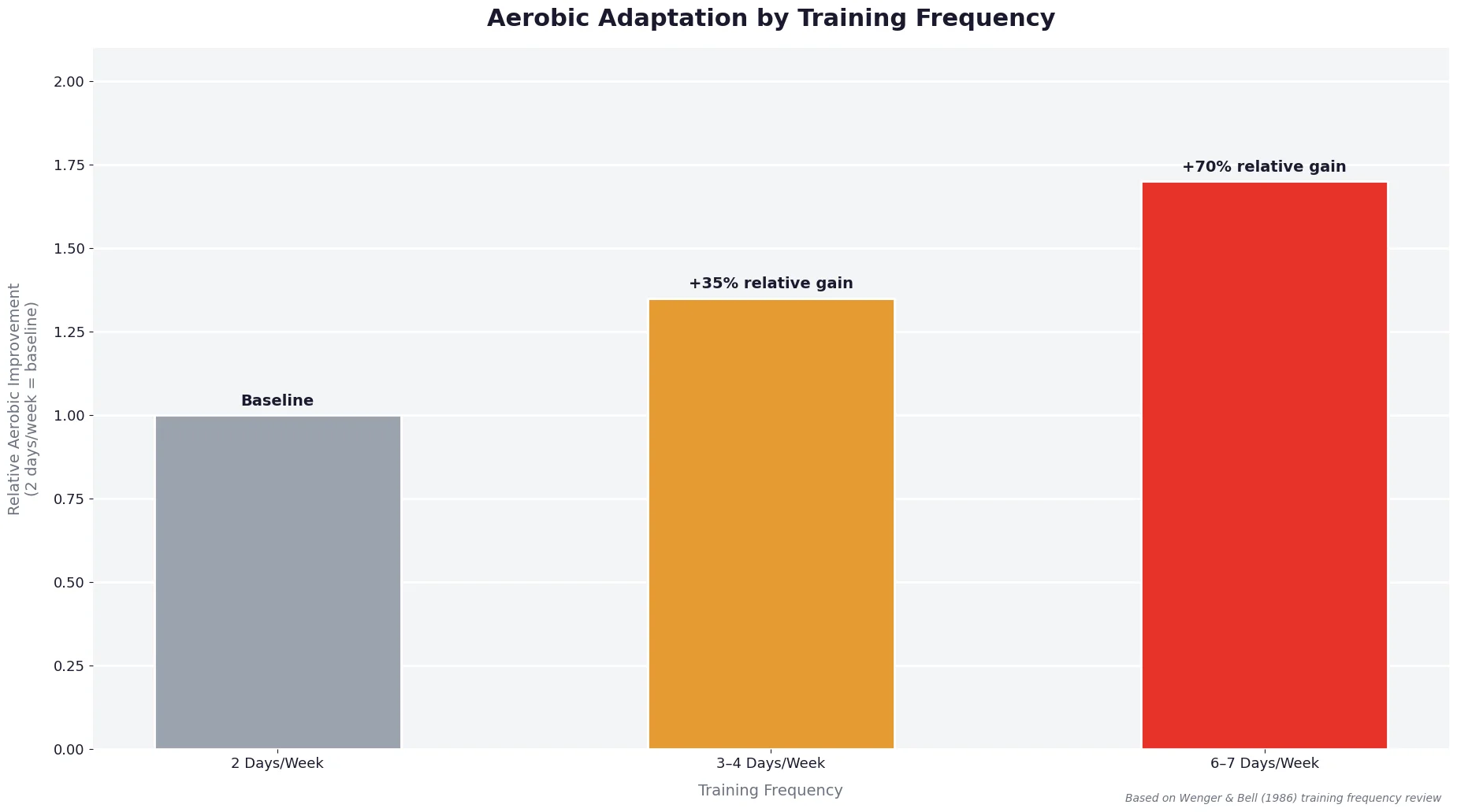
Higher training frequency drives larger improvements in aerobic capacity, even when total weekly volume is similar.
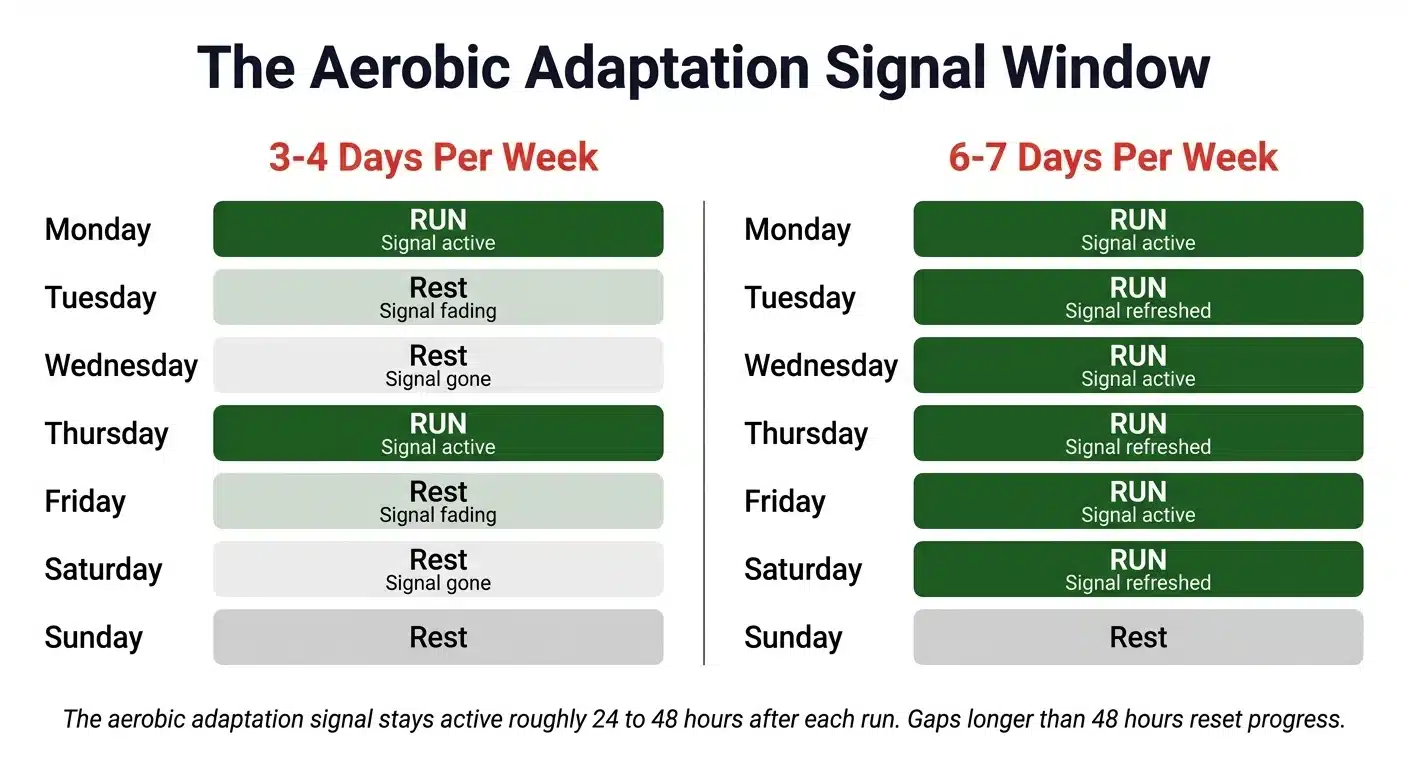
Your body adapts to running through a chain of cellular changes that turn over on a roughly 24 to 48 hour cycle.
A landmark review found that higher training frequencies of 6 sessions per week produced larger VO2max gains than 4 sessions, which produced larger gains than 2 sessions per week.

Every time you run, you trigger a brief signaling cascade that tells muscle cells to build more mitochondria and more capillaries.
That signal fades within roughly 24 to 48 hours.
If you run 4 days a week, you spend 3 days with that signal switched off.
Run 6 days a week and the signal is firing nearly every day.
The result is a steeper adaptation curve over the same training block.
Cumulative aerobic stimulus across the week is what drives chronic adaptation, not the size of any single workout.
Why is the same weekly mileage better when spread across 6 days?
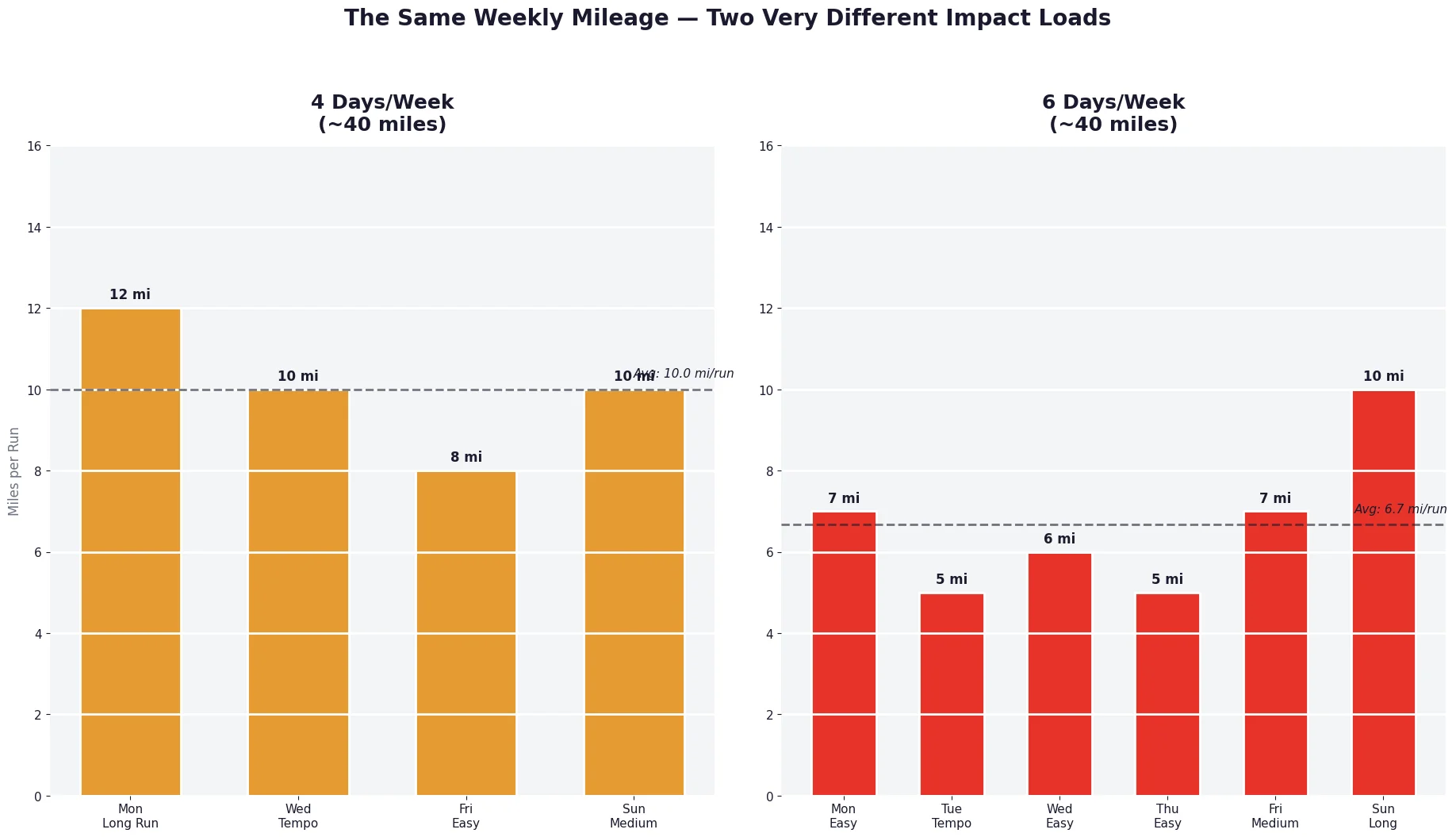
Forty miles divided across 6 days looks identical on paper to 40 miles across 4 days, but your body experiences them very differently.
The 4-day version forces longer individual runs, which raises per-session impact load and fatigue.
The 6-day version keeps each run shorter, which protects form and lets you run more of your miles at a truly easy aerobic pace.
This matters because your easy runs only build the aerobic engine when they stay in the easy zone, and the longer a single run goes, the more pace tends to drift upward as fatigue accumulates.
Shorter, more frequent sessions are easier to keep honest.
They also distribute connective tissue stress more evenly across the week.
A systematic review of training errors found that the strongest predictor of running injury is a sudden spike in weekly volume per session, not the total number of days run.
That is why piling miles into fewer sessions tends to cause problems sooner than spreading them across more days.
Spreading a fixed weekly mileage across 6 days lowers the impact per session and makes every easy run stay easy.
Is running 6 or 7 days a week too much for your body to recover from?
The answer depends almost entirely on how hard each of those days is run.
If you treat every run as a workout, even 4 days a week will break you down.
If you treat 4 or 5 of those days as easy aerobic running, 6 to 7 days a week becomes recoverable for the average healthy adult.
A systematic review of elite distance runners found that world-class 1500m runners and marathoners run 6 to 7 days a week using a pyramidal or polarized intensity distribution with roughly 80 percent of mileage in the easy aerobic zone.
The elite model is not about running fast every day.
It is about running often and mostly easy.
That structure keeps stress hormones, muscle damage markers, and central nervous system fatigue inside the window your body can clear between sessions.
The runners who get cooked on 6 days a week are the ones running every easy day too fast.
The intensity of your easy days, not the number of days, decides whether 6 to 7 days a week is sustainable.
Does running more often increase your injury risk?
The evidence on frequency and injury is mixed, and once you look closely, frequency itself is rarely the variable that matters.
What matters is how quickly you got to your current frequency and how much your weekly mileage has changed in the past month.
Research has shown that runners who increased their weekly distance by more than 30 percent over a 2-week window had a significantly higher rate of injury than runners who progressed gradually, regardless of total days run.
Several studies have actually found the opposite of what runners fear.
In some recreational running cohorts, higher weekly frequency was associated with a lower injury rate, likely because the per-run impact load was smaller.
Other studies found running only 1 day a week was a risk factor for women compared with running 2 to 5 days a week.
The pattern that emerges is that training load progression is the variable that drives injury, not the raw count of days.
The rate of change in your training, not the number of days, is the primary modifiable injury risk.
How does daily running build the aerobic engine that 3-4 days cannot?
Aerobic adaptations are built through repeated, low-grade stress applied across many sessions.
Mitochondrial biogenesis, capillary density, blood plasma volume, and muscle glycogen storage all respond to the frequency of the stimulus.
A classic study found that mitochondrial enzyme activity in trained muscle increased by approximately 30 percent after 7 to 10 days of consecutive aerobic training.
That is a massive jump in cellular machinery for energy production, and it happened because the stimulus was applied daily without long gaps.
Later research using detailed proteomic analysis showed that 14 consecutive days of endurance training produced extensive remodeling of the mitochondrial proteome and a 17.5 percent increase in VO2 peak.
Three days a week of running produces these same adaptations, but more slowly and to a smaller absolute degree.
If you want the engine to grow faster, you have to feed it the signal more often.
Aerobic adaptations scale with how often the signal is delivered, which is why daily running outpaces 3 to 4 days a week on every cellular marker that drives endurance.
Can you safely run 4 days in a row, or do you need rest days?
Running 4 days in a row is entirely safe when 3 of those days are at a true easy pace.
The myth that you need a full rest day between every run comes from a misreading of how recovery works for endurance runners.
Easy aerobic running is so low-impact relative to your maximum capacity that it actually promotes recovery rather than blocking it.
Blood flow to working muscles clears metabolic byproducts and shuttles nutrients faster than complete rest does.
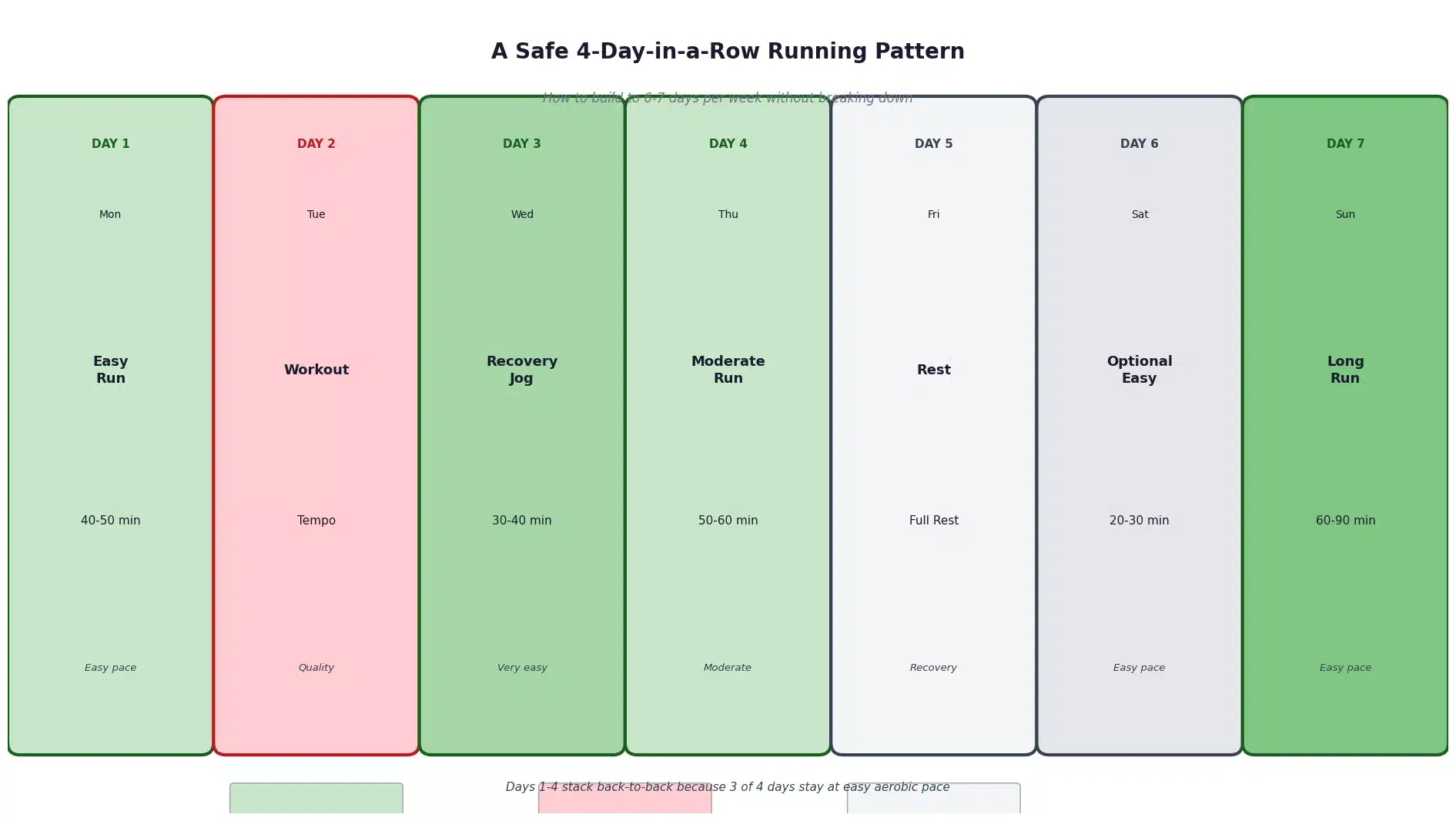
A workable 4-in-a-row pattern looks like this.
Day one is an easy 40 to 50 minutes.
Day two is a workout or tempo.
Day three is an easy 30 to 40 minute recovery jog.
Day four is a moderate or long run.
The total stress is distributed, and the recovery jog on day three is short and slow enough to leave you fresher than a complete rest day.
Elite runners use this structure constantly because it builds aerobic depth without breaking down.
Four days in a row is normal and productive when most of those days stay at conversational pace.
When is running 3-4 days per week the right choice?
Running 6 to 7 days a week is not the right answer for every runner.
If you are new to running, your connective tissue needs more time to adapt to impact than your cardiovascular system does, so 3 days a week with cross-training is the safer entry point.
If you are returning from injury, every additional day adds risk before the underlying issue has fully resolved, and 3 to 4 days lets you rebuild without re-aggravating tissue.
If your life genuinely cannot fit 6 daily runs without sleep deprivation, then 4 high-quality days will outperform 6 rushed, under-recovered days every time.
The hierarchy is sleep first, then training frequency.
Strong 3 to 4 day plans built around 2 quality sessions plus a long run will get a beginner or busy adult to a respectable half marathon or marathon.
The 6 to 7 day advantage shows up when you are trying to break through a plateau or chase a meaningful PR.
How do you add days to your weekly schedule without breaking down?
Add days slowly and one at a time.
The biggest mistake runners make jumping from 4 to 6 days is adding two days at once and matching the duration of their existing runs.
Start the new day at 20 to 30 minutes of true easy running.
Hold that for 3 weeks before considering any extension.
Add days before adding distance to existing runs, because the marginal aerobic gain from a new day is larger than from extending a current day.
Watch three signals during the transition.
Morning resting heart rate should stay within 5 beats of your normal baseline.
Sleep should remain unchanged.
Lingering soreness past 48 hours is a flag to back off.
A safe path from 4 days to 6 days takes roughly 8 to 10 weeks, not 2.
Add a single short, easy day every 3 to 4 weeks and the transition from 4 days to 6 days happens without injury.
The bottom line on running frequency
Running 6 to 7 days a week produces faster aerobic adaptation, more efficient distribution of impact stress, and a closer match to how elite runners actually train.
The catch is that it only works when the majority of your days are run at a true easy pace and when you arrived at that frequency through gradual progression.
If you are stuck on 3 to 4 days and your times have flattened, adding days is almost always more productive than adding miles to your existing runs.
Start with one short easy day, hold for 3 weeks, and let the cumulative aerobic stimulus do the work that a bigger Saturday long run cannot.