

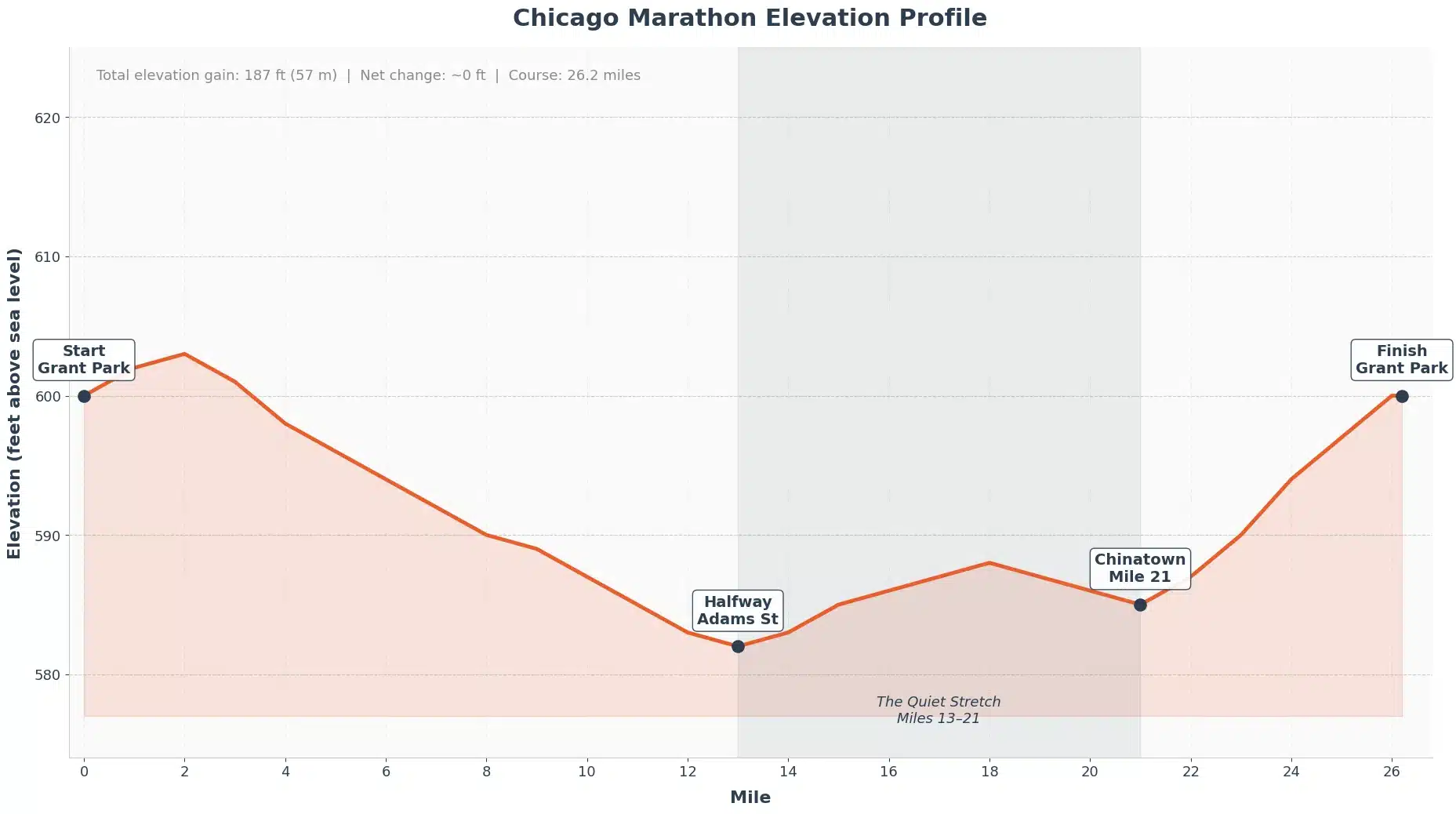
The Chicago Marathon has 187 feet (57 meters) of total elevation gain over its 26.2-mile course, making it the second flattest World Marathon Major behind only Berlin.
That number surprises runners who’ve struggled at Chicago, because a 187-foot course sounds like a guaranteed PR course.
The reality is more complicated, and understanding the course profile changes how you race it.
You’ll learn:
- The exact elevation profile, mile by mile, compared to other major marathons
- Why the flat course is harder on your legs than the numbers suggest
- The pacing and fueling strategy that prevents the Chicago bonk
Get Your Free Personalized Chicago Pace Plan
Adjusted for every hill, turn, and crowd surge on the course. Plug in your goal time and get mile-by-mile splits tailored to Chicago.
What Is the Chicago Marathon Elevation Gain?
The Chicago Marathon gains 187 feet (57 meters) across its 26.2 miles and loses the same amount, finishing at nearly identical elevation to the start near Grant Park.
Chicago Marathon elevation data at a glance: total gain 187 ft (57 m), total loss 187 ft (57 m), net elevation change approximately 0 ft, highest point near miles 3-4 at approximately 600 ft above sea level, lowest point near miles 11-13.

For context, here is where Chicago sits among the World Marathon Majors:
| Marathon | Total Elevation Gain | Net Change |
|---|---|---|
| Berlin | ~80 ft (24 m) | Net flat |
| Chicago | ~187 ft (57 m) | Net flat |
| Tokyo | ~135 ft (41 m) | Net flat |
| London | ~115 ft (35 m) | Net flat |
| Boston | ~415 ft (127 m) | -800 ft net descent |
| New York City | ~750 ft (229 m) | Net flat |
Chicago’s elevation profile is genuinely flat by any objective measure.
Is the Chicago Marathon Really Flat?
The course is flat, but flat creates its own problem: with no hills to change the load on your legs, the same muscle fibers fire in the same pattern for every single one of the 50,000+ strides you take.
On a hilly course, climbs and descents force your body to recruit different motor units, giving some fibers brief recovery windows.
Chicago gives you no such breaks.
The Chicago Marathon’s flatness is an asset for hitting splits but a liability for late-race muscle fatigue. Runners who bank time in the first half often find their legs go dead by mile 20 for exactly this reason.
The course profile also includes approximately 25 turns, more than most marathons of comparable size.
Each turn requires a brief deceleration and reacceleration, which adds up across 26.2 miles.
The asphalt surface also tends to run firm, which increases ground reaction forces compared to tracks or rubberized race courses.
Ready For More?
Then start our FREE Race Day Fueling email course!
You’ll learn how to calculate when you’ll bonk, how to hydrate, what foods to eat during your race, and more! From case studies to scientific research, we’ll help you learn how to best fuel for your next race.
Why the First 8 Miles of Chicago Are Deceptively Dangerous
The Chicago Marathon start feels like running through a wall of sound.
Hundreds of thousands of spectators line the first few miles, the field is tightly packed, and the flat course means your GPS shows goal pace or better from the first stride.
That combination pushes almost every runner out too fast.
Research on pacing strategies in competitive distance running found that even-paced or slightly negative-split races consistently produce faster finishing times than positive-split races, with performance degrading sharply when runners exceed goal pace by more than 5% in the first half.
The practical illustration of this is Haile Gebrselassie’s two world record attempts at the marathon distance.
At the 2008 Berlin Marathon, he ran the first half in 62:05 and finished in 2:03:59, setting the world record.
At the 2009 Dubai Marathon, he ran the first half in 61:42, just 23 seconds faster.
That 23-second difference at halfway translated into a collapse over the final 10 kilometers, costing him roughly 90 seconds compared to his Berlin time.
The research on marathon pacing consistently shows the same pattern: a marginally faster first half produces a dramatically slower second half.
For Chicago specifically, the strategy that works is starting 20-30 seconds per mile slower than goal marathon pace for the first 2 miles, then settling to 5-10 seconds per mile slower than goal pace through miles 2-10.
Target a pace that is 20-30 seconds/mi (12-19 seconds/km) slower than your goal marathon pace for miles 1 and 2. The crowd thinning and the noise dropping after mile 4 make it much easier to dial in from there.
How to Run Miles 13-20: The Quiet Stretch
After the halfway mark on Adams Street, the course turns out of downtown toward Hyde Park.
The crowds thin dramatically, and the course gets quieter than most runners expect after the wall-of-sound start.
This is where Chicago races are lost.
The combination of mental letdown, reduced crowd energy, and accumulated glycogen depletion hits at exactly the moment the course feels most exposed and empty.
Three things help get through this section:
- Use runners who are fading. At mile 14-16, runners who went out too fast will start coming back to you. Treat each one you pass as a marker of your pacing advantage.
- Brief surges break the monotony. Every 10 minutes, run 10 seconds per mile faster than goal pace for 30 seconds. This recruits slightly different motor units and provides a focus point. Keep the surges controlled.
- Stay on your fueling schedule regardless of how your stomach feels. Skipping a gel at mile 15 because you feel fine almost always produces a crash at mile 20-22.
Through this stretch, the key metric is time per kilometer, not perceived effort.
Perceived effort on a flat course can dramatically underestimate actual pace drift in either direction.
The Last 10K: Chinatown to the Finish
Chinatown at mile 21 is a psychological turning point.
The course briefly heads away from downtown, which feels counterintuitive at mile 21 with 5 miles to go.
Keep your head level through Pilsen and the turn onto Michigan Avenue.
Once you see the Sears Tower (Willis Tower) in the skyline ahead of you, you know the finish line is within reach.
At mile 23, the course turns north on Michigan Avenue for the final push through the Grant Park finishing area.
This is the one section where the spectators return in force, which provides real energy when your legs have little left.
At mile 23, pick one runner in front of you and focus entirely on reeling them in.
When you pass them, pick the next one.
This keeps your focus external when your legs want you to internally catastrophize.
Running form cues that hold pace in the final 3 miles: keep your head up, maintain arm swing, and shorten your stride slightly rather than slowing your cadence.
A slow cadence invites a slow pace.
A quick cadence with shorter steps maintains speed more efficiently when fatigued.
Chicago Marathon Race Day Logistics
The Chicago Marathon is one of the most logistically complex races in the United States, with 45,000+ runners spread across three start waves and multiple corrals per wave.
Expo: The expo at McCormick Place runs Thursday through Saturday before the Sunday race.
Go Thursday or Friday morning if you can.
Saturday afternoon bib pickup lines add 45 minutes to a simple errand.
Bring photo ID and your confirmation email.
Gear check: Check closes at 7:30 AM for Wave 1 starters.
If you’re in Wave 2 or 3, confirm your corral’s gear check deadline before race morning.
Retrieving a checked bag post-race takes 15-30 minutes with 45,000 other finishers, so pack recovery clothes you’ll actually need rather than planning to grab it quickly.
Getting to Grant Park: The CTA Red Line stops at Monroe Street, putting you a 10-minute walk from Corral A. Allow 90 minutes from your downtown hotel to being in your corral, 2 hours if you’re navigating from farther out.
Spectator spots: The best spectator locations are miles 4-5 (Old Town, good access via Red Line to Clark/Division), miles 9-10 (Wicker Park), mile 21 (Chinatown, Red Line to Cermak-Chinatown), and the finish on Columbus Drive. The Chicago Marathon app provides athlete tracking that updates in near real time.
How to Fuel on a Flat Marathon Course
Flat marathon courses require more disciplined fueling than hilly ones, because the flat pace feels controlled even as your glycogen stores deplete at the same rate.
The American College of Sports Medicine recommends 30-60 grams of carbohydrate per hour for exercise lasting 1 to 4 hours, with research showing significant performance benefits when athletes consume carbohydrates at the higher end of this range for events lasting longer than 2.5 hours.
The Chicago Marathon course has aid stations roughly every mile, with water and Gatorade Endurance at most stations and gels at approximately miles 7, 13, 17, 21, and 23.
If you’re carrying your own nutrition, you can supplement at those points rather than relying on them entirely.
The optimal approach to marathon fueling starts in miles 1-8, when your digestive system is least stressed and can absorb carbohydrates most efficiently.
Taking in fluids and carbohydrates early, before you feel depleted, is how you avoid the breakdown at mile 20-22 that sidelines Chicago runners every year.
Aim for 30-45g of carbohydrate per hour, starting at mile 4-5 rather than waiting until you feel the need.
If you’ve trained with a specific gel or chew, carry those and use the course water stations only for hydration.
Switching to an unfamiliar product mid-race is a common GI mistake at Chicago.
Ready to Build Your Chicago Race Plan?
Our free pace calculator gives you personalized splits for every mile of the Chicago Marathon course, adjusted for elevation and crowd density.
The Chicago Marathon has 187 feet (57 meters) of total elevation gain, making it the second flattest World Marathon Major.
The flat profile means identical muscle loading for all 26.2 miles, which accelerates fatigue compared to courses with varied terrain.
Start 20-30 seconds per mile slower than goal pace for miles 1-2, then settle to 5-10 seconds slower through mile 10.
The psychologically hardest stretch is miles 13-20 where crowds thin and monotony sets in. Use brief surges and disciplined fueling to stay on pace.
Fuel early and consistently: 30-45g of carbohydrate per hour starting at mile 4-5, not when you feel depleted.




30 Responses
Great post with some good strategies not just for Chicago but for any marathon. But I think your description of Chicago is especially apt – I ran it 4 straight times (2001-2004) and was amazed each time by how it seemed like two different races. The crowds in the first half are what you expect from a big marathon in a big city, but the quietness of the southern reaches (except Chinatown) is a stark contrast and a bit demoralizing. I always looked forward to hitting McCormick Place knowing you were nearly done and the crowds were just ahead.
Thanks, Greg. I felt the same way when I hit 13-14 miles in my fist Chicago and it really cost me the race. Had I just been mentally prepared for it, I think I would have finished much stronger. However, since it was my first ever marathon, it really took a toll mentally.
Chicago was my first marathon as well, so I had no idea what to expect period. A lot of walking the south side of Chicago that first time.
Thanks for this very insightful post. This will be my 8th marathon and have been training with a plan to start slow for the first three k ( about 10 seconds per km slower than MP) and then lock into my pace for the duration. A similar strategy helped me achieve a PB in Niagara Falls last fall and it is also a very flat course. I am also planning on following the nike pacers for my planned time of 3:25. I am wondering , however, about the effect of the huge crowd on my race pace. Will it be difficult to move in the early miles as the pictures of the start corrals show a very tight crowd of runners all bunched up. Any advice? Thanks again for a great article!
I don’t know if there’s really any secrets for getting around the crowds. My advice is to stay relaxed, take a deep breath and just wait for things to open up. Surging past slower runners and getting uncomfortable in the tight crowds is an easy way to ruin your race. All the surges and stopping and starting requires a lot of energy. Energy = fuel, so the more energy and fuel you burn up during the first few miles, the less you’ll have over the last 10k. Try your best to set yourself in the right corral and when the race starts, relax and go with the flow until a natural opening for running appears. As you’ve planned already, you’re going to be a little slow for the first few miles anyway, so take a deep breath and focus on relaxing.
I was in start corral “C” last year and I didn’t think the start was any more crowded than most other races. My only advice (based on experience!) is to not try to run with a pace group that is starting from a corral ahead of you– I tried that last year, ended up going waaaay to fast for the 1st couple of miles until I caught up, feeling great until mile 16, and then cramping up. Very frustrating since I think I was in shape to have hit my target if I hadn’t gone out too fast.
I’m also planning to run with the 3:25 group from corral B this year. Good luck!
This is very helpful! I’ll be flying in to do the race this Sunday and I appreciate the comprehensive tips.
I am really glad the article helped, Chris. I’ve been a fan of yours since reading the $100 startup and watching your interviews on Mixergy. Really made my day knowing that I could help out someone I learned so much from myself. Good luck at the race!
Jeff,
I cannot thank you enough for publishing this article. It helped me tremendously on Sunday. This was my first marathon which is daunting enough. So to have any specific insider tips is invaluable. Your descriptions on what to expect helped me visualize it enough that I almost felt like I had run it before–the mental preparation was huge.
And the tip about adding surges to rev the legs up and break the monotony of the flat course was awesome. Used that several times and I think it helped to propel me past my goal of 3:45 to finish in 3:42:28.
Again, can’t thank you enough for taking the time to put this together. It without a doubt helped to make my marathon debut that much more successful.
Thank you for the wonderful comment, Marcie! I am so glad you had an awesome race and the guide helped walk you through the process so well. Chicago was my first marathon too and I wish I had realized how much things changed after 13, so it was a pleasure to write and help others out.
Congrats on the great time! You’ve probably downloaded it elsewhere, but in case you haven’t, here is our marathon eBook for the next one you run a marathon.
Finally, here is our article on how to recover after a marathon. Hope it gets you rested up and ready to attack some new PRs this winter and spring!
Thank you for the advices. I am running chicago next month hoping to break the 3h wall for the first time. I agree with everything you say but not with the carbo intake in the first part of the marathon. A lot of article I agree with state to wait because you don’t run the second part of the marathon on glicogen but on fat. The early intake of carbo gel will only stop your body from using your body glicogen and prevent it from switching to fatty metabolism.
Thanks, This is very helpful article.I am running on 13 OCT 2013 Chicago marathon first time.this will surely help me on my race day.thanks a lot again
Thanks for the tips! Going to read it again before I head to Chicago!
Thanks, Jeff for the info will be reading this for the next 2 weeks ….Will let you know how it goes .
Thanks for the tips Jeff!! I used your under 2 hour Half Marathon training plan from Runkeeper and ran the Indy Mini in 1:52:43 (down from 2:37:56 last year). Running the Chicago Marathon on Sunday October 13th and will use your tips to help finish strong!!
I just ran the 2013 Chicago Marathon and this article helped me tremendously. The race description is spot on and the strategy tips are priceless. Thanks so much for this invaluable information!!
You’re welcome, Mike! Glad it was so helpful!!
Thank you coach Jeff!
I have read your article on Chicago and I feel like I have visualized the course and what I need to do to mentally prepare to achieve my goal! I have not run a marathon strategically before and I am excited to do so! Thank you so much for all of your articles, advice, programs and for following up. I’ve never felt more prepared before and there will be many more marathons to go after this one. I look forward to working with runners connect for my next big one! #nycmarathon2014
#chicago2015
#worldmarathonmajors
Awesome Samantha! Thanks for the nice comment there. We are very excited to hear how you get on. Let us know if you need anything before the race! By the way, I actually read this guide myself before I raced Chicago last year, and it helped a lot! Glad you found it! Best of luck!
Running the Chicago this year as my first marathon- not trying to set any records by any means but seems like some helpful stuff here, especially since even without the crowds I tend to start my runs fast and I’m going to miss having hills! Thanks
Hi Alissa, thanks so much for reaching out. Glad you found the guide helpful! Good luck!
Thank you, thank you, thank you! Running the Chicago marathon this Sunday, first marathon!
I’m excited, scared, and filled with wonder. I really appreciate your advice laid out here. Looks like the weather will be beautiful!
Happy to help Frieda! Best of luck!!
I used your plan for my last marathon and BQ. This info on Chicago is great and I will set out this Sunday to do just that, relax and enjoy! Thanks for the insight!
Hi Cindy, thanks so much! Hope the race went well for you!
Wish I had seen this article before I ran Chicago in 2013. I think it would have been a BIG help, as I pretty much did everything wrong. It didn’t help that I had run the Fox Valley Marathon a month before, but that’s a whole different story.
I’m running Chicago again in just a few days, and plan to follow the advice given here.
It’s going to be a great race day!
Hi Richard, sorry we were not able to get it to you! Hope the advice helped and you had a great race!
This Sunday will be my first marathon ever, I have never ran beyond 22 miles which happened during my training. I am planning on using your great suggestions/recomendations in my entire race. Being new in two major aspects of my race-distance and pace, I do not know what to expect, but I now feel much better and feel your awesome article has provided me with the final piece of the puzzle. Truly appreciate you taking the time to write this great article for us rookies. My goal feels much more reachable now for sure…3 hrs and 25 mins is my goal.
Hi Vicente! Glad we were able to help you with this 🙂 Let us know if we can help with anything else!
Commonplace, medium, low and behold everyone was 10 motives rechargeable
v2 electronic cigarette right. Glassomizers – A clearomizer or tank that utilizing Pyrex glass and sophisticated coils heads to provide a business license to qualify for wholesale pricing.
Being one of America’s top 1000 websites. Doing this can ensure you
aren’t reminded or triggered to smoke. Right at the end where
a charm or pendant would be.