

When most runners hear the term VO2 max, they picture the freakish aerobic engine of an elite athlete. Cycling legend Miguel Indurain reportedly tested at 88, a number that helped him win five straight Tours de France.
Your own VO2 max matters for a different reason. Used well, it tells you how hard to train and how to spend your weekly mileage so you get faster without breaking down.
Here’s what you’ll learn:
- What VO2 max actually measures and what sets your ceiling
- A good VO2 max by age and sex, plus where elite runners land
- How to test it and turn the number into smarter training
What Is VO2 Max and Can It Help Your Running?
VO2 max is the maximum volume of oxygen your body can take in and use during hard exercise. The higher it is, the more oxygen your working muscles can burn to produce energy.
A big aerobic capacity is a strong marker of endurance fitness. Cyclists tend to fill the top of the all-time VO2 max list, though a few runners break through.
Steve Prefontaine tested at 84.4 in the 1970s while holding American records across seven distances from 2,000 to 10,000 meters.
The real question is whether your VO2 max is something you should track and train, or a stat best left to the professionals. Start with what the number represents.
What Does VO2 Max Measure?
VO2 max is measured in millilitres of oxygen per kilogram of body weight per minute, written as ml/kg/min. Two things decide the number.
The first is how much blood your heart pumps to your muscles with each beat. The second is how well those muscles pull oxygen out of the blood and use it.
Research has shown that the rise in VO2 max from training comes mainly from a bigger maximal cardiac output rather than better oxygen extraction.
Oxygen delivery, not muscle uptake, is the main limiter for almost every runner. That’s why elite runners can hold fast paces at relatively low heart rates: their hearts move a huge volume of blood per beat.
The faster your body can deliver and process oxygen, the faster you can run.
Genetics set much of your ceiling. Even so, middle-distance runners racing from the mile to 10k consistently post the highest values.
RunnersConnect Bonus
Download our Heart Rate Calculator to find out what your individual heart rate zones are.
Does a High VO2 Max Guarantee Race Wins?
No. A high aerobic capacity is a useful measure of your engine, but it’s a fairly poor predictor of who crosses the line first.
Studies of elite endurance athletes point to three factors that decide performance: VO2 max, lactate threshold, and running economy.

A big engine only helps if you can use the fuel efficiently. Running economy is how much oxygen you burn at a given pace, and it often separates two runners with identical VO2 max values.
That economy comes from running form, strength, and years of adaptation. No lab test has ever picked the winner of a race on VO2 max alone.
How Can VO2 Max Testing Help Your Training?
Chasing a higher VO2 max won’t guarantee faster races. Knowing your current number does something more practical: it helps you set the right training intensities.
Left to guesswork, most runners train too hard on easy days and never truly recover. Aerobic exercise splits into three intensity zones.
- Aerobic zone: your heart and lungs deliver enough oxygen to keep you moving comfortably
- Threshold zone: oxygen supply starts to lag and lactate accumulates
- Anaerobic zone: your muscles can’t get enough oxygen, so you’ll soon have to stop
Analysis of elite endurance athletes found they spend about 80% of sessions at low intensity and roughly 20% at high intensity near 90% of VO2 max.
Most runners flip that ratio and spend far too long in the threshold zone. The result is stalled aerobic gains and a higher injury risk.
Heart rate maximum closely tracks VO2 max, which makes a simple heart rate monitor a cheap way to stay in the right zone. A chest strap reads more accurately than a wrist sensor.
The relationship between heart rate max and VO2 max follows a steady pattern:
- 55% HRmax is about 40% VO2 max
- 70% HRmax is about 60% VO2 max
- 85% HRmax is about 80% VO2 max
- 90% HRmax is about 85% VO2 max
Most middle- and long-distance runners should spend 70 to 80% of training in the aerobic zone, about 20% at threshold, and only 5 to 10% anaerobic.
Skip the old trick of subtracting your age from 220 to find heart rate max. It has no solid scientific backing and often misses by a wide margin.
The accurate way to find your true max is a gradual run to exhaustion while monitoring heart rate, or a lab VO2 max test. To go deeper, read our guide on heart rate training zones for running.
How Do You Test Your VO2 Max?
The gold standard is a lab test with breathing apparatus. You run on a treadmill while it measures the oxygen you consume, with the speed rising every few minutes for about ten minutes.
Your oxygen consumption climbs and then plateaus. That plateau, reached just before you have to stop, is your VO2 max.
You no longer need a lab to get a working estimate. Most modern GPS running watches from brands like Garmin, COROS, Apple, and Polar estimate VO2 max from your heart rate and pace during normal runs.
For most runners, a modern watch estimate lands close to a lab result, accurate enough to track your own progress over time.
Treat the watch number as a trend line, not an exact figure. A steady climb over weeks and months tells you your aerobic fitness is improving, which is what actually matters.
The least reliable estimates come from resting tests that use only heart rate and age, with deviations of around 10%.
What Is a Good VO2 Max by Age and Sex?
Typical VO2 max values fall along a predictable range as running fitness rises. The figures below are a rough guide for men.
- Untrained but healthy: 35 to 40
- Regular everyday runner: around 55
- Competitive club runner: around 65
- Elite runner: 70 to 85
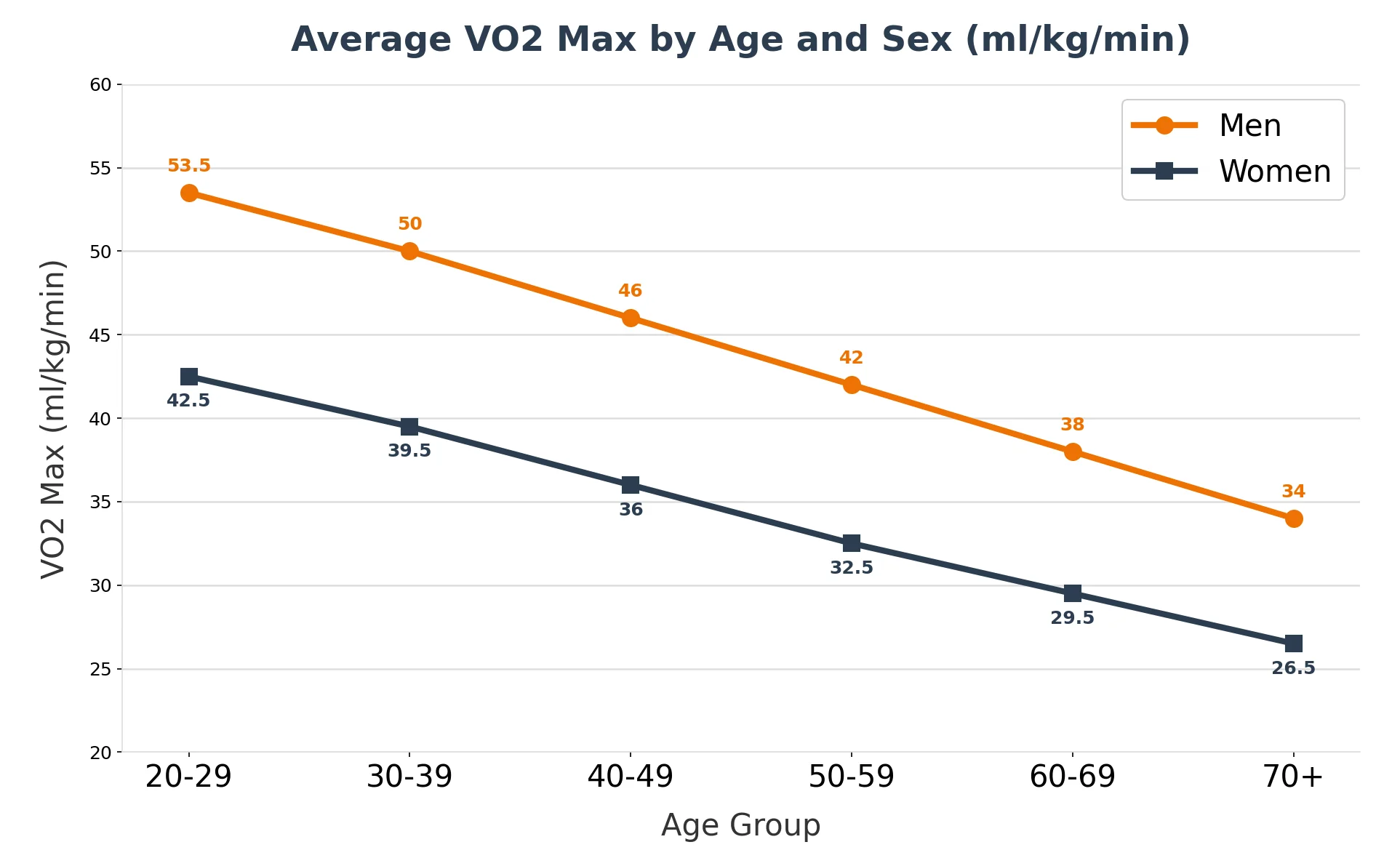
A study of 3,816 healthy adults reported an average VO2 max of 45 for men and 37 for women, with values dropping about 3.5 points per decade after your twenties.
Women average roughly 10 to 18% lower than men at the same age. The gap comes mostly from higher essential fat stores and lower haemoglobin levels, which reduce oxygen-carrying capacity.
Use the table below to see where an average VO2 max sits for healthy, moderately active adults by age.
| Age | Men (ml/kg/min) | Women (ml/kg/min) |
|---|---|---|
| 20 to 29 | 52 to 55 | 41 to 44 |
| 30 to 39 | 48 to 52 | 38 to 41 |
| 40 to 49 | 44 to 48 | 34 to 38 |
| 50 to 59 | 40 to 44 | 31 to 34 |
| 60 to 69 | 36 to 40 | 28 to 31 |
| 70 and over | 32 to 36 | 25 to 28 |
Your event matters too. Elite marathon runners often post lower VO2 max values than milers because running economy carries more weight as distance climbs.
Sprinters don’t rank high either, since efforts under 20 seconds barely tap the aerobic system. VO2 max matters most for runners racing between the mile and 10k.
For the curious, here’s where a few famously big engines have been reported.
| Athlete | Reported VO2 max | Sport |
|---|---|---|
| Miguel Indurain | 88 | Cycling |
| Lance Armstrong | 84 | Cycling |
| Steve Prefontaine | 84.4 | Distance running |
| Elite male marathoner | 70 to 85 | Distance running |
Why Does Lactate Threshold Predict Race Pace Better Than VO2 Max?
VO2 max sets your aerobic ceiling. Lactate threshold decides how much of that ceiling you can actually use over a race.
Give two runners the same VO2 max and the one with the higher lactate threshold will usually win, because they sustain a greater fraction of their capacity.
Lactate itself was long blamed for fatigue and burning legs. Scientists now know it’s a fuel your body recycles for energy rather than the source of the pain.
At easy intensities your body clears lactate as fast as you produce it. Push past a certain effort, the lactate threshold, and blood lactate suddenly spikes because clearance can’t keep up.
Training near that threshold improves how well your muscle mitochondria use oxygen. That lets you hold a faster pace for longer before the spike hits.
To lift your lactate threshold, run the bulk of your quality work at or just below threshold pace, often around 85% of heart rate max.
A lab measures it much like a VO2 max test, taking a pinprick of blood every few minutes as treadmill speed rises. The pace where lactate starts to climb sharply is your threshold.
In Summary
Your VO2 max is a useful snapshot of aerobic fitness and a practical tool for setting heart rate training zones. Paired with lactate threshold, it keeps your workouts at the right intensity for your goals.
Train in the right zones and you cut injury risk while safely building volume and frequency. The catch is that most runners are shocked by how easy their easy days need to be.
Give yourself a week or two of lower-intensity running to adapt, adding short walk breaks if your heart rate drifts above the zone. To see why this works, read how running 80% easy could make you 23% faster.
If lab numbers feel like they overcomplicate running, that’s fair. But if you keep hitting plateaus or nagging injuries, this is the moment to swap running hard for running smart.



4 Responses
Thanks for the great article!
I think it is interesting that cyclists seem to have a higher VO2 max than runners. I am wondering if cycling would be recommendable to runners specifically as a way to boost VO2 max in ways that running couldn’t as sufficienty?
Cycling uses muscles differently than running. You can be an amazing runner and suffer on a bike ride until you get into “bike shape.” So I wouldn’t advise adding cycling to increase VO2 max for running.
Thanks for the informative article.
Question: does the recommendation of 70-80% aerobic training basically refer to easier, conversational or LR pacing; does the 20% “threshold” training basically refer to tempo runs, or a comfortably hard pace that you can maintain for about an hour but often run for around 20 minutes or so; and finally does the recommendation of 5-10% anaerobic training basically refer to hard interval/repeat workouts (e.g., 5K pace or faster)? Are there any good training pace calculators you recommend? (I assume RC has one,)
You pretty much summed it up perfectly regarding aerobic, threshold and anaerobic. It’s clearly an individual “pace” in terms of each category. Something that you have to listen to your body to understand and learn over time. Aerobic is easy to figure out. Even if running alone, I try and just talk to myself out loud to make sure I can talk comfortably, thus am in my aerobic zone. Threshold, that’s a tougher one and really requires listening to your body. And anaerobic, not as hard to figure out, because you KNOW that you can’t hold that pace for too long.