You finish a hard run and the chills hit, sometimes hard enough to make you shiver through dry clothes in warm weather.
Or mid-race, your skin erupts in goosebumps while your legs are burning and your heart rate is at its ceiling.
Both experiences are normal, and both come from the same physiological system.
One of them, chills that arrive while you’re still running in the heat, can be a warning you need to act on immediately.
You’ll learn:
- Why your body triggers chills after hard workouts
- What the core-to-skin temperature gap is and why it causes shivering
- When chills during a run are a heat illness warning sign
Why Do You Get Chills After Working Out?
Post-workout chills happen because your body’s heat-retention system activates too late.
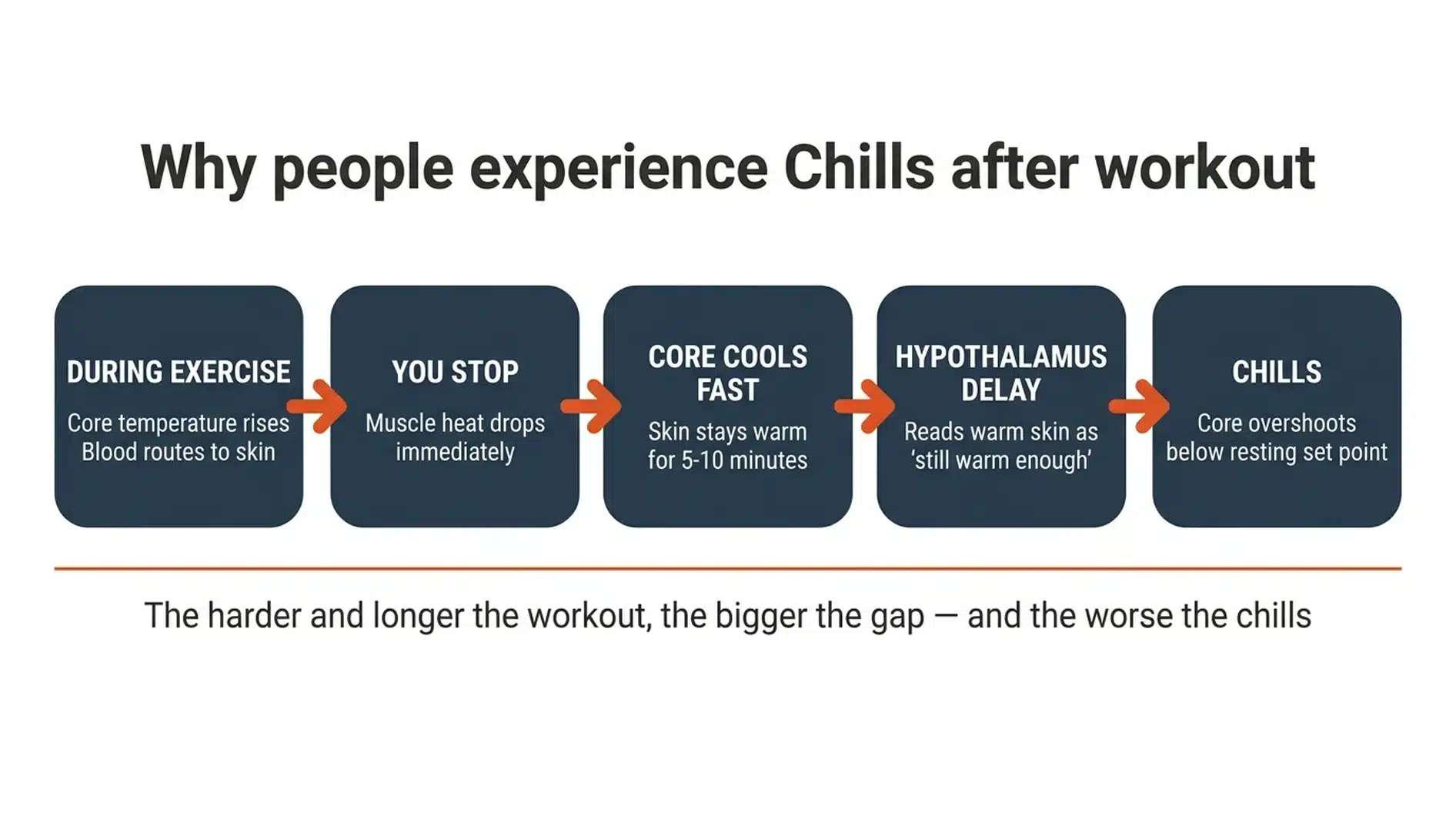
During a hard session, your muscles generate metabolic heat and drive your core temperature up.
Your body responds by routing blood to the skin surface, releasing that heat through sweat and radiation.
When you stop, muscle heat production drops almost immediately.
Your core temperature begins falling. But your skin stays warm from the heat it’s still radiating outward.
Your brain’s thermostat, the hypothalamus, reads that warm skin signal and delays activating vasoconstriction and shivering.
Research has shown that after exercise, the vasoconstriction threshold rises from 37.1°C to 37.5°C and the shivering threshold rises from 36.2°C to 36.5°C, meaning your body waits longer to activate heat-retention responses after a hard workout than it does at rest.

By the time those responses finally trigger, your core has already dropped below its resting set point.
Shivering then activates to bring core temperature back up.
The intensity of the shivering reflects how far your core dropped before the hypothalamus responded.
That’s why chills after a long race can feel violent even on a warm day.
Post-workout chills are your thermoregulatory system doing its job. The hard workout drives them, not a problem with your body.
What Creates the Core-to-Skin Temperature Gap?
Your body has two separate temperature sensor systems: one in your core and one at the skin surface.
During exercise, these two systems detect very different temperatures. That gap is what triggers shivering when you stop.
Research has shown that skin blood flow increases substantially during exercise to enhance heat loss, with cutaneous vasodilation driven by rising core temperature rather than ambient conditions.
Your core heats up from muscle activity.
Blood routes to your skin surface to dump that heat into the air.
When you stop running, skin blood flow persists for 5 to 10 minutes while your core cools rapidly.
The hypothalamus reads the warm skin as “still warm enough” and holds off on shivering.
Ambient temperature plays a smaller role than you’d expect.
This is why running in the heat doesn’t protect you from post-exercise chills. Ambient conditions affect how much you sweat, but the core-skin gap is created by your muscles regardless of outside temperature.
Running in warm weather does not prevent post-run chills. The mechanism is internal, driven by metabolic heat from your muscles, not the air temperature around you.
RunnersConnect Bonus
Download your FREE Temperature Calculator now.
It will help estimate how much your times will be impacted by hot weather. Find out exactly how much to adjust your summer workout and race paces.
Why Do You Get Goosebumps When Running Hard?
Goosebumps during hard running come from your sympathetic nervous system, driven by catecholamine release.
Research has shown that adrenaline and noradrenaline rise 1.5 to more than 20 times above resting levels during exercise, depending on intensity and duration.
When you push into high-intensity effort, your body floods the bloodstream with catecholamines, primarily adrenaline and noradrenaline.
These hormones prepare your muscles for high output: heart rate climbs, blood redirects to working muscles, and your nervous system heightens awareness.
One side effect is piloerection.
Norepinephrine binds to receptors on the arrector pili muscles, the tiny muscles at the base of each hair follicle, causing them to contract.
The hair stands on end. Goosebumps appear.
This is why goosebumps appear during race efforts and hard intervals but rarely during easy runs.
Intensity drives catecholamine release, which drives sympathetic activation, which triggers the piloerection reflex.
Goosebumps during a hard run are a catecholamine response. The same hormonal surge driving your effort is also raising your hair follicles.
Does Workout Intensity or Duration Make Chills Worse?
Higher-intensity workouts produce more metabolic heat and more catecholamine release, both of which intensify the post-exercise response.
An easy 30-minute run generates less core heat than a hard 30-minute tempo at the same duration.
When you stop, the core-skin gap is smaller after easy efforts, and chills are milder.
Duration compounds this effect.
Marathon runners typically experience more severe post-run chills than 5K racers.
Extended effort accumulates enormous metabolic heat over 2 to 3 hours, creating a larger core-skin gap by the time you cross the finish line.
Over that time, your body redirects a significant volume of blood to your skin for heat dissipation.
The core-skin gradient is much larger at the marathon finish than after a 5K.
The shutdown of heat production is equally abrupt regardless of duration, but the gap your body must bridge is far greater.
This same mechanism applies across exercise modalities.
Chills are common after hard cycling intervals and intense strength sessions for the same reason: the trigger is metabolic heat and sympathetic activation, both of which occur across exercise types.
Are Chills While Running in the Heat a Warning Sign?
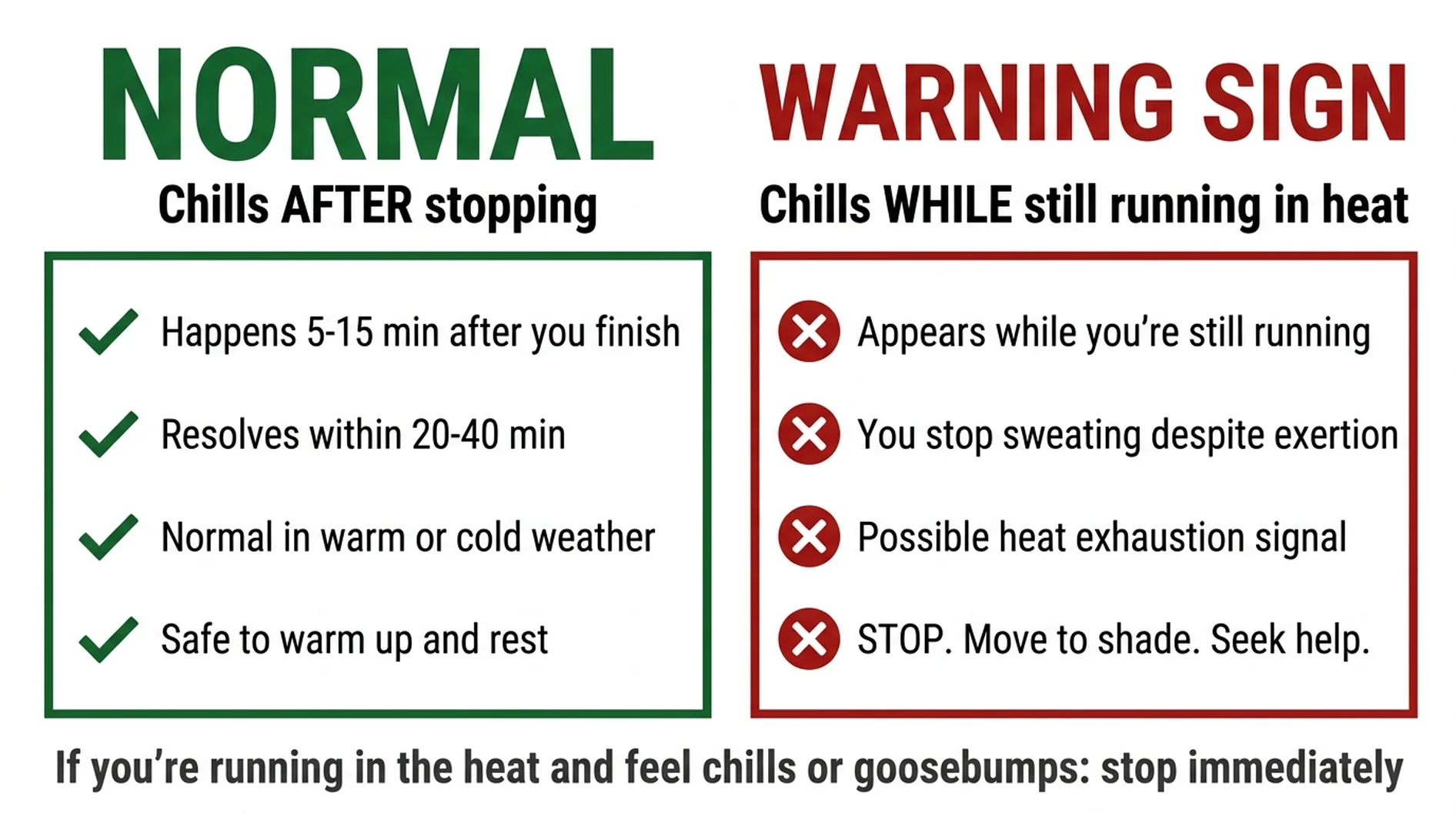
Post-workout chills are normal. Chills that appear while you’re still running in hot conditions are a different situation entirely.
When chills, goosebumps, or sudden coldness develop during exercise in the heat, your body may be losing its ability to regulate temperature effectively.
Research has shown that heat exhaustion can produce symptoms including chills, goosebumps, and cessation of sweating as the thermoregulatory system becomes overwhelmed, preceding the transition to heat stroke.
The pattern to recognize is this: you’re running in the heat, you stop sweating despite the exertion, and you feel a wave of cold or get goosebumps.
That’s your thermoregulatory system struggling, not recovering.
If you experience chills, goosebumps, or sudden skin coldness while still running in hot weather, treat it as an emergency signal.
Slow to a walk immediately.
Move to shade or a cool environment.
Drink cool fluids if alert and able to swallow.
Seek medical attention if symptoms don’t resolve within minutes or if confusion, weakness, or dizziness accompany the chills.
The decision to stop is always correct when these symptoms appear mid-run in the heat. Finishing the workout is never worth the risk of heat stroke.
For a full breakdown of how heat affects performance and how to prepare for hot-weather racing, see our guide on running in the heat.
Chills during a run in hot conditions are not normal post-exercise physiology. Stop running, move to a cool environment, and seek help if symptoms don’t resolve quickly.
RunnersConnect Bonus
Download your FREE Sweat Rate Calculator now.
If you are unsure about how to calculate how much water to consume, and electrolytes to use, this will give you your exact needs.
When Should Post-Workout Chills Concern You?
Post-exercise chills are normal and typically resolve within 20 to 40 minutes as your core temperature stabilizes at its resting set point.
Two situations warrant closer attention.
Chills that persist beyond 60 minutes after stopping exercise may indicate your thermoregulatory system is struggling to restabilize.
Chills accompanied by confusion, difficulty coordinating movement, or extreme weakness may signal post-exercise hypothermia, a condition that occurs most often in cold, wet environments after prolonged effort.
Cold-weather races are the highest-risk context.
A runner who finishes wet and exhausted in 40°F (4°C) weather with wind is losing heat far faster than someone who finishes in warm conditions.
If the shivering is violent, relentless, or accompanied by altered thinking, seek warmth and medical attention immediately.
The timeline matters: 20 to 40 minutes is normal, 60 minutes is a yellow flag, and any confusion is a red flag regardless of timing.
How to Reduce Chills After a Workout
You can’t eliminate post-exercise chills without eliminating the hard effort that causes them.
You can reduce the intensity and duration of the discomfort with deliberate choices before, during, and after your workout.
Add a cool-down jog.
A 10-minute easy jog after hard intervals lets your core temperature begin declining while your muscles still generate some heat.
This reduces the core-skin gap when you finally stop, which means less aggressive shivering.
Keep moving after you finish.
Sitting still in cool air immediately after running accelerates heat loss from your skin while your core is already dropping.
Walking 5 to 10 minutes slows the core temperature drop and reduces the overshoot into shivering territory.
Layer immediately after stopping.
Putting on a dry layer while your body is still warm limits how fast ambient air cools your skin.
This slows the skin-to-core gradient and gives your hypothalamus time to activate heat-retention responses before the gap becomes too large.
Hydrate during and after your run.
Fluid depletion from sweating reduces blood volume, which limits your body’s ability to manage heat transfer efficiently.
Maintaining adequate hydration with electrolytes keeps your thermoregulatory system responsive.
Time cold plunges carefully.
Cold water immersion immediately after a hard run accelerates heat loss from your skin and widens the core-skin gradient.
If you use ice baths or cold plunges for recovery, waiting 2 to 4 hours after exercise reduces the risk of intense chills compounding the post-run response.
The cool-down jog is the single most effective intervention: it bridges the gap between full effort and full stop, giving your thermoregulatory system time to adapt rather than overshoot into shivering.
Small decisions about cool-down duration, clothing timing, and movement patterns add up to meaningfully shorter and less intense post-run chills.
Post-workout chills happen because your body’s heat-retention system delays activating after exercise. The vasoconstriction and shivering thresholds shift upward during a workout, so your hypothalamus waits too long and your core overshoots below its resting set point.
The core-skin temperature gap drives shivering: skin stays warm from ongoing blood flow for 5–10 minutes after

Jeff Gaudette, M.S. Johns Hopkins University
Jeff is the co-founder of RunnersConnect and a former Olympic Trials qualifier.
He began coaching in 2005 and has had success at all levels of coaching; high school, college, local elite, and everyday runners.
Under his tutelage, hundreds of runners have finished their first marathon and he’s helped countless runners qualify for Boston.
He's spent the last 15 years breaking down complicated training concepts into actionable advice for everyday runners. His writings and research can be found in journals, magazines and across the web.