You’re in the middle of a 6-mile run at what feels like a comfortable effort, somewhere between your easy pace and your tempo pace.
It’s not fast enough to hurt, but it’s not so slow that you’re breezing along.
You’ll tell your friends later that it was “just a regular training run,” and in your mind, that moderate effort probably counts as building aerobic fitness.
After all, you logged the mileage.
Here’s what’s actually happening to your body during that run.
You’re spending energy without the benefit of recovery or adaptation.
Your heart rate is too high to truly recover, but too low to trigger the training adaptations that drive performance.
Coaches call this the gray zone, the moderate-intensity trap, and for many runners this zone is the actual definition of junk miles.
Most running advice tells you that junk miles are easy miles, the miles that don’t “count” toward fitness because they’re not hard enough.
That framing is a misconception that has caused real confusion among everyday runners.
Easy miles are the foundation of distance running, not the problem.
The actual problem sits in the middle ground, the moderate-intensity runs that steal recovery time without delivering the training effect you’re seeking.
The original term “junk miles” came from elite coaches trying to justify high mileage to skeptics, not from a directive to eliminate easy running.
So, in this article you’re going to learn the research-backed practical advice on what junk miles actually are and how to spot and fix them in your own training.
- Why the original meaning of junk miles has been widely misread for decades
- How easy miles actually form the foundation of polarized training
- What the moderate-intensity trap really is and why it costs you more than it gives
- Three concrete ways to identify junk miles in your own schedule
- The fastest way to replace junk miles with training that actually works
What Does “Junk Miles” Actually Mean?
A junk mile is a run done at a moderate intensity, typically 70 to 85% of your max heart rate or a steady effort where you can hold a conversation but not easily.
That intensity occupies the middle ground between true recovery and true challenge.
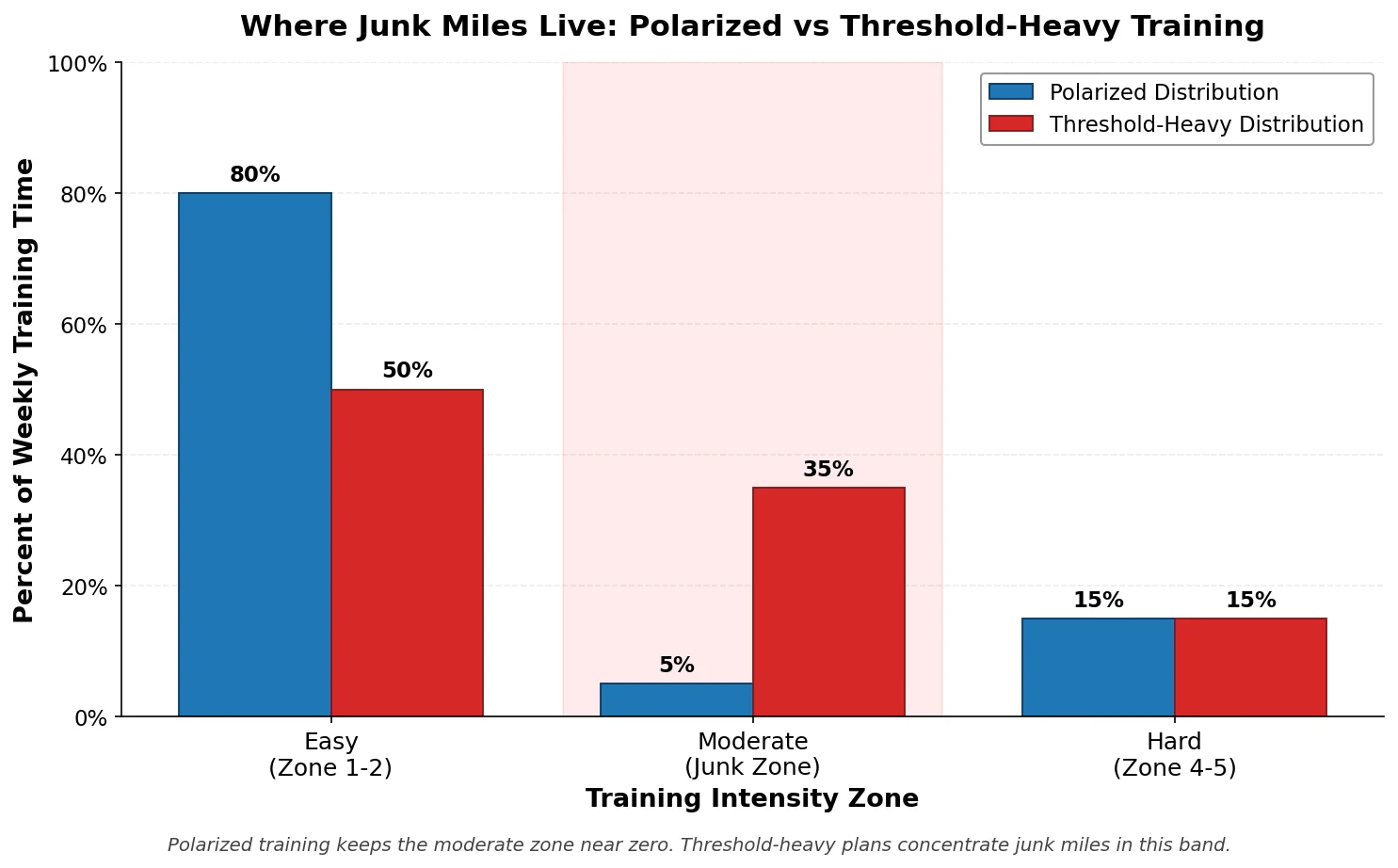
Research on training intensity distribution in endurance athletes shows that polarized training (the bulk of volume at low intensity with focused hard workouts) produces greater performance gains than balanced or threshold-heavy approaches.
These runs don’t trigger the aerobic adaptations that come from sustained easy effort, yet they’re hard enough to delay recovery from your harder workouts.
You get the fatigue cost of a workout without the training stimulus.
A run at true easy pace (60 to 70% max HR, conversational) recovers you and builds aerobic fitness.
A run at tempo or threshold (85 to 95% max HR) challenges your system and drives adaptation.
A run at 75 to 85% max HR does neither especially well.
The original “junk miles” label was applied by elite coaches whose runners covered 100+ miles per week, where the distribution of effort across that volume mattered enormously.
Recreational coaches later misread the concept and started telling everyday runners that easy running itself was the problem.
Where Did the Term “Junk Miles” Come From?
The term emerged in elite distance running during the 1990s and 2000s, when coaches like Renato Canova were designing training for runners covering 120+ miles per week.
At those volumes, the distribution of effort became critical.
If you ran 100 miles with too much of it at moderate intensity, you’d accumulate fatigue without the corresponding performance gain.
The “junk” label was applied to the moderate-intensity miles that wasted recovery resources.
The concept then got translated into coaching clichés and training advice for everyday runners.
Many recreational running coaches latched onto the “junk miles” phrase without the original context.
They started telling runners that easy miles were the enemy and that logging slow miles was a waste of effort.
That advice spawned the FIRST training program and other low-mileage, high-intensity approaches.
You probably don’t run 120 miles per week.
You’re more likely running 20 to 50 miles per week, and at those volumes the danger is doing a little bit of everything at moderate intensity.
That pattern is the opposite of polarized training and exactly how you end up with actual junk miles.
The misinterpretation of junk miles has convinced many runners that easy running is wasteful when the opposite is true.
Why Easy Miles Are the Foundation of Polarized Training
Modern endurance training research, pioneered by Stephen Seiler and reinforced by studies on elite athletes across running, cycling, and cross-country skiing, confirms that polarized training is the most effective approach.
Polarized training means you run a lot at easy pace and you run sometimes at hard pace, with very little time in the middle.
The aerobic foundation built by easy running is non-negotiable for anyone training for distance events.
Easy miles develop mitochondrial density, teach your body to use fat as fuel efficiently, strengthen connective tissue, and build the aerobic base that makes hard workouts actually effective.
A 2007 study found that runners using a polarized approach (low intensity plus high intensity, minimal moderate) improved their 5K times significantly compared with runners using a threshold-heavy distribution.
Years of follow-up research have confirmed the pattern repeatedly.
Easy running is purposeful, specific training that targets the aerobic system rather than peak intensity.
If you’re running easy miles, you’re building exactly what distance racing demands.
RunnersConnect Bonus
Download your FREE Long Run and Aerobic Pacing Calculator now.
Need help converting your race times to your optimal easy and long run pace? Download our FREE calculator and we’ll do the math for you.
What Is the Moderate-Intensity Trap?
The actual junk miles in your week are runs done at 75 to 85% of max heart rate or a pace that feels “medium hard.”
These are the steady efforts, the tempo-pace “workout” runs that don’t have structure, the moderate climbs and rolling hills where you’re working but not quite at threshold.
The mechanism is physiological.
Easy running below 75% max HR triggers aerobic adaptations and recovery because the pace is sustainable and lactate stays low.
Hard running above 85% max HR triggers the threshold and VO2 max adaptations that build your top-end capacity.
Moderate running sits between these two productive windows.
You accumulate fatigue without triggering the adaptation you’re chasing.
The moderate-pace trap is particularly dangerous in long runs.
Many runners execute their weekly long run at a pace that feels “controlled” or “moderate,” thinking it strikes the right balance between effort and sustainability.
That approach actually accomplishes the least.
Your long run should either stay truly easy as an aerobic base builder, or have specific workouts embedded inside it (a tempo section, threshold work).
A long run at pure moderate pace accomplishes neither goal.
How Do You Identify Junk Miles in Your Own Training?
The diagnostic is straightforward if you apply three tests to the runs in your training log.
Test 1: The Heart Rate Test.
If you wear a monitor, check your average heart rate during the run.
True easy running sits at 60 to 70% of max HR, around 120 to 140 bpm depending on fitness and age.
True hard running sits at 85 to 95% max HR, around 160 to 180 bpm.
If your “easy” runs are landing at 75 to 82% max HR, you’re in the moderate zone.
If your workouts aren’t designed around a specific pace or threshold target, they’re probably moderate-intensity junk.
Test 2: The Talk Test.
During the run, you should be able to speak in full sentences at easy pace.
At hard pace, you should be able to speak only a few words at a time before gasping.
If you’re at a pace where you can speak but feel like you need to take breaths between phrases, you’re in the moderate zone.
That sensation is the signature of junk miles.
If your easy runs require conscious effort or feel like training, they’re probably moderate-intensity and stealing recovery without delivering benefit.
Test 3: The Pace Check.
Compare your easy-run pace to your recent race paces.
If your easy pace is only 90 to 100 seconds slower per mile than your 5K race pace, you’re probably running too fast.
Easy pace should be 2 to 3 minutes per mile slower than 5K pace, or roughly 75 to 110 seconds per kilometer slower than 5K pace.
The Karvonen formula uses max HR and resting HR to calculate exact zones, but the simple rule works for most runners: if your easy pace feels like training, it’s moderate intensity.
How Do You Replace Junk Miles With Useful Volume?
Fix 1: Slow your easy runs to true easy pace.
This is the most direct fix.
If you’re doing a run at 75 to 85% max HR “just to get the miles in,” slow down.
Remove 90 to 120 seconds per mile and run at a true easy pace where conversation is comfortable.
Your heart rate will drop, your recovery will improve, and the run will become genuinely useful aerobic volume.
This adjustment is appropriate for most of your weekly mileage.
Fix 2: Add structure to anything that was meant to be a workout.
If the run was meant to be hard, give it real structure.
Instead of “go run 6 miles at a medium effort,” run 2 miles easy, 4 miles at threshold pace (or 3 times 8 minutes at threshold with recovery jogs), then 1 mile easy.
Now you have a real stimulus.
Or run 8 times 3 minutes at VO2 max pace with equal jog recovery.
The workout has a purpose and triggers a specific adaptation.
Moderate-intensity “practice races” are junk, while structured workouts deliver the stimulus you came for.
The single most impactful change is converting one moderate-intensity run per week into a true easy run, which improves recovery and makes your hard workouts more effective.
Fix 3: Redistribute your weekly volume.
If you’re logging 5 runs per week and most are moderate intensity, cut to 4 runs and make them polarized: 3 easy, 1 hard with speed work.
Or keep 5 runs but designate 3 as easy, 1 as hard, and 1 as a medium-long run at easy pace.
The structure forces you out of the gray zone where junk miles live.
How Are Recovery Runs Different From Junk Miles?
Recovery runs are easy miles by design, typically done the day after a hard workout at a pace so easy it might feel almost absurdly slow.
A true recovery run sits at 60 to 65% max HR, a pace where talking is completely natural and effort is minimal.
They serve a specific purpose: activate recovery without adding training stress.
That purpose is the opposite of a junk mile.
A recovery run is easy intentionally and an easy run is easy by design.
Both are foundational in polarized training and both deliver clear physiological benefits.
A junk mile is the run that fits neither category, the one that feels like a workout but doesn’t have the structure or intensity to trigger adaptation.
What Should You Take Away About Junk Miles?
You can stop fearing easy mileage.
The work is making sure your easy miles are actually easy and your hard workouts are actually structured.
The gray zone, where moderate-intensity runs live, is where you waste effort and delay recovery.
Identify those runs with the three tests above.
Then either slow them down to true easy pace, convert them into structured workouts, or restructure your week around polarization.
Most runners see faster progress after eliminating junk miles than they ever do from running less and working harder.
| Training Zone | Heart Rate (% Max) | What It Does | How It Feels | Example Pace |
|---|---|---|---|---|
| Easy | 60 to 70% | Aerobic base, recovery, mitochondrial development | Conversational, sustainable | 9:30 to 10:30/mi (5:54 to 6:31/km) |
| Moderate (Junk Zone) | 75 to 85% | Fatigue without clear adaptation stimulus | Harder than easy and easier than a workout | 8:30 to 9:00/mi (5:17 to 5:35/km) |
| Tempo and Threshold | 85 to 92% | Lactate threshold and aerobic capacity | Challenging, speech limited to a few words | 7:30 to 8:00/mi (4:40 to 4:58/km) |
| VO2 Max and Hard | 92 to 98% | VO2 max, anaerobic capacity, speed | Very hard, brief intervals only | 6:30 to 7:15/mi (4:02 to 4:30/km) |