You’ve spent the last few years in low-drop running shoes, maybe even zero-drop minimalist shoes that brought you closer to barefoot running. Now you’re thinking about making a switch.
Maybe your coach told you that higher-drop shoes would help with an Achilles issue, or maybe you’re just tired of managing the constant calf tightness that comes with minimal cushioning.
Either way, you’re standing in a running store looking at shoes with an 8 to 12 mm heel drop, wondering whether the switch will feel too different.
The switch itself is simple. What causes injury is doing it too fast, before your body has adapted to the new heel angle.
Your body has adapted to running in low-drop shoes over months or years. Your Achilles tendon has learned to handle constant loading.
Your calf muscles have shortened to match the low-drop angle. Your foot strike pattern has likely shifted forward.
When you jump straight into high-drop shoes, you force all of those adaptations to reverse at once, and that reversal is where the injuries come from.
So, in this article you’re going to learn the research-backed practical advice on:
- How shoe drop affects your running biomechanics
- Why your calves and Achilles get sore when you transition
- The exact timeline for a safe transition
- A week-by-week protocol you can follow
- Which runners are at highest risk during the switch
What is shoe drop and why does the number matter for your running?
Shoe drop is the height difference between the heel and the forefoot of your shoe, measured in millimeters.
A zero-drop shoe has the same amount of cushioning under the heel as under the forefoot. A 10 mm drop shoe has 10 mm more cushioning under the heel than under the forefoot.
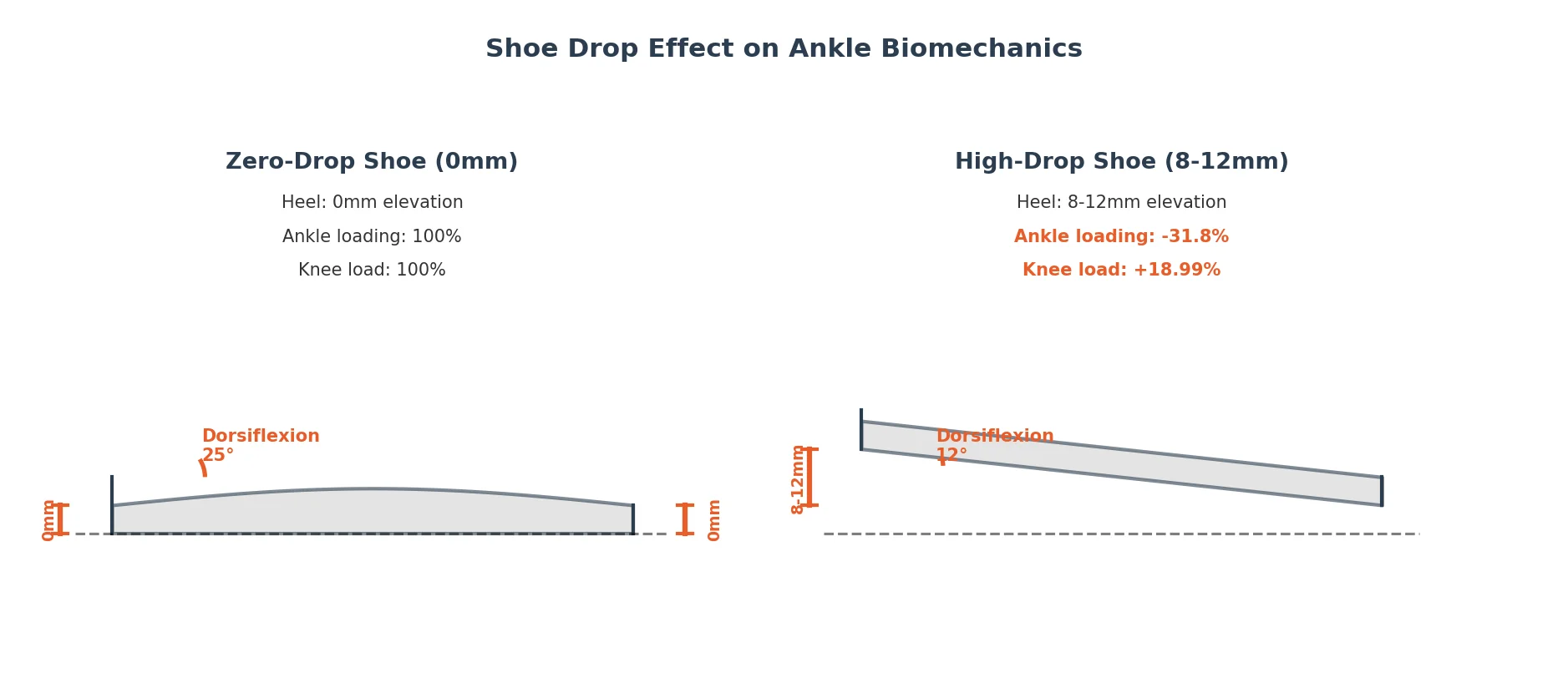
The number matters because it changes the angle of your foot at initial contact with the ground.
When your foot is elevated at the heel, your ankle dorsiflexes (bends upward) less at contact, your forefoot strikes at a shallower angle, and you are primed to land on your rear foot. When your foot sits flat or low, your ankle dorsiflexes more, your forefoot makes contact first or at the same time, and you are positioned to land on your midfoot or forefoot.
This angle difference cascades through your entire lower body, affecting how much force your knee absorbs, how hard your hip has to work, and how much stress loads onto your Achilles and calf.
Research has shown that increasing shoe drop from 0 mm to 8 mm decreases loading rates at the ankle by 31.8% but increases knee extension moments by 18.99%.
That means high-drop shoes take stress off your ankle and forefoot, then move some of that load up to your knee.
Shoe drop determines which parts of your body handle the most impact on each stride, not whether your running is any good.
What happens to your body when you transition to higher-drop shoes?
When you start wearing higher-drop shoes, your movement pattern changes immediately, even on the first run.
Your ankle no longer has to dorsiflex as much because the heel is already elevated. That smaller ankle motion moves your strike point backward on your foot, shifting you toward a rearfoot strike.
Your stride length increases because you land with a longer lever arm at the ankle.
Your knee angle at initial contact increases, which changes how much your knee flexes through the landing.
Your hip extensors (glutes and hamstrings) work harder because your torso sits differently when you land more on your heel than on your midfoot.
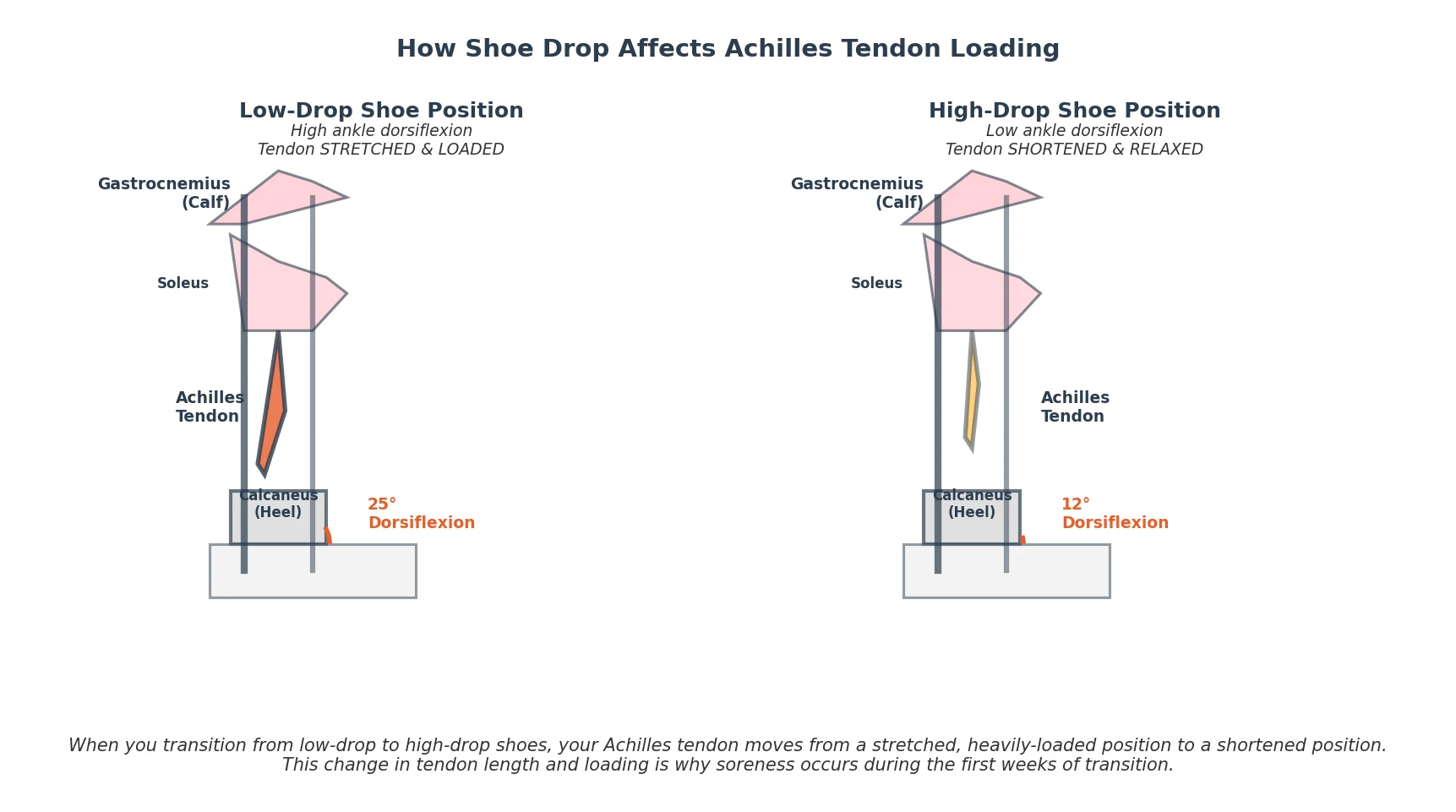
The most important change is at the back of your leg: your Achilles tendon and calf go from heavily loaded on every run to suddenly unloaded.
Your Achilles tendon has spent months or years under constant tensile stress in low-drop shoes.
When you reduce that load quickly, the tendon isn’t prepared for the change in force distribution. At the same time, the shorter dorsiflexion range means your calf now works in a shortened position.
That shortened position is what creates the tightness and the delayed soreness.
Soreness shows up days after your first high-drop run because your calf and Achilles adapt slowly to the new ankle angle.
Why do your calves and Achilles tendon get sore during the transition?
The soreness you feel in your calves and Achilles during the transition means you’re asking those tissues to work in a position they haven’t adapted to yet.
A 12-week study of runners transitioning from rearfoot-strike running in standard cushioned shoes to minimalist shoes found that Achilles tendon loading increased across all groups.
Runners who made the transition with a forefoot strike pattern showed a 20.3% increase in peak Achilles force.
The loading rate increased by 37.2%.
The reverse holds when you go from low-drop to high-drop shoes. You aren’t adding Achilles load, but you are changing how that load spreads along the tendon, and you are shortening the position your calf works in during the stride.
Your calf muscle fibers are tuned for the position they’ve held for months. When your ankle angle changes, those fibers go through a period of micro-damage and rebuilding, and that rebuilding is what you feel as soreness.
Slow progression and targeted strengthening prevent most of that soreness. Jump into high-drop shoes too quickly and it’s close to guaranteed.
RunnersConnect Bonus
Struggling with Achilles Tendonitis or Retrocalcaneal bursitis? Download our Achilles Injury Prevention Routine.
It’s a PDF with images and descriptions of the 10 most effective prevention and rehab exercises for runners with Achilles issues.
How long does it actually take to transition safely?
If you want a single number: 8 to 12 weeks for a safe transition, with 10 weeks being the realistic target for most runners.
The timeline depends on a few factors.
If you’re currently running 20 miles per week with no significant injury history, 8 weeks is reasonable. If you’re running 50+ miles per week, you need the full 12 weeks because your body is handling more total impact load.
If you have a history of calf strain, Achilles tendonitis, or plantar fasciitis, your body needs more time to adapt because those tissues are already sensitized.
Your age matters too. Runners over 40 tend to take slightly longer to adapt to new footwear patterns, though individual variation is huge.
That number comes from runners who skip the intermediate steps. They go from cushioned shoes with a 10 mm drop straight to zero-drop or 2 mm shoes, overnight, with no gradual progression.
The 14% who avoid injury are the ones who progress slowly. A safe transition takes 8 to 12 weeks, and that timeline is non-negotiable if you want to avoid injury.
What’s the week-by-week protocol for transitioning safely?
The protocol has a simple foundation: start low, go slow, and mix your shoes for the first several weeks.
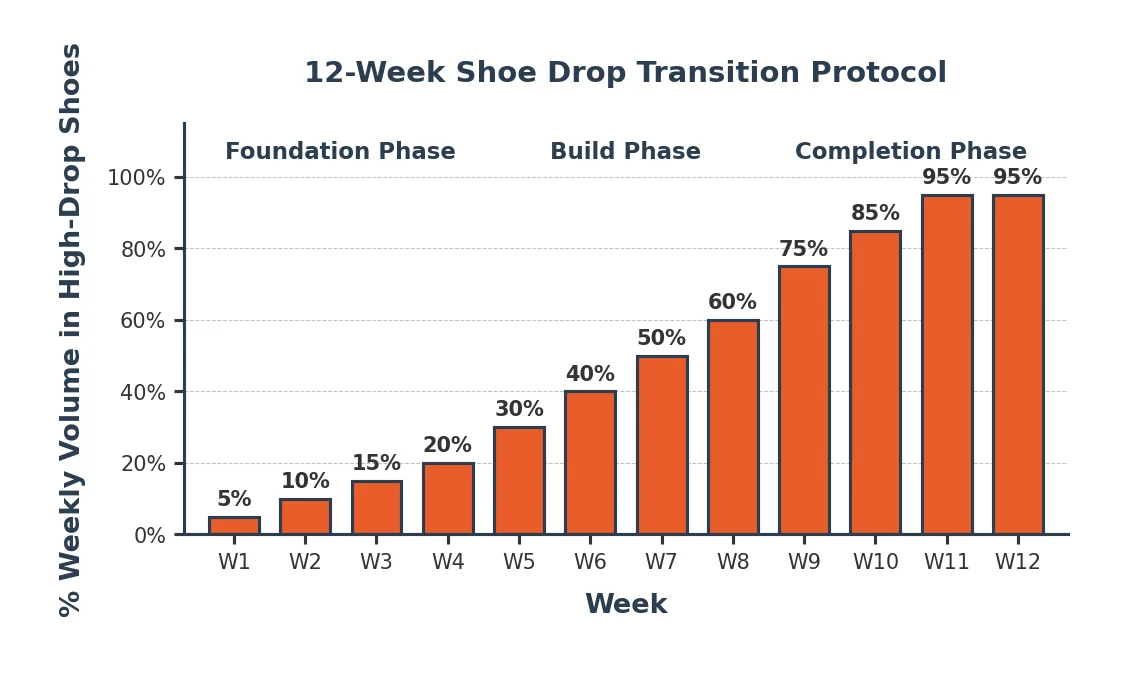
“Start low” means your first week in higher-drop shoes should be 5% of your weekly running volume.
If you run 30 miles per week, that’s 1.5 miles in the new shoes during week 1.
The other 95% of your miles stay in your low-drop shoes.
Weeks 1–4: The Foundation Phase
Week 1: Run 5% of your weekly volume in high-drop shoes. Most of this will be easy runs.
Week 2: Increase to 10% of your weekly volume in high-drop shoes. You can wear them for easy runs or one short tempo segment, but keep the stress low.
Week 3: Progress to 15% of your weekly volume in high-drop shoes. You can run one full easy run in the new shoes this week.
Week 4: Reach 20% in the new shoes. You’re still wearing your low-drop shoes for 80% of your running.
Weeks 5–8: The Build Phase
Week 5: 30% of your volume in high-drop shoes. Start adding some tempo work or fartlek in the new shoes.
Week 6: 40% in high-drop shoes. You can do a short speed workout in them, but save your longest run for your low-drop shoes.
Week 7: 50% in high-drop shoes. You’re now splitting your miles evenly between both shoe types.
Week 8: 60% in high-drop shoes. Only your longest run or one tempo run stays in the low-drop shoes.
Weeks 9–12: The Completion Phase
Week 9: 75% in high-drop shoes. Keep one easy run in your low-drop shoes for variety.
Week 10: 85% in high-drop shoes. Mix in the low-drop shoes only occasionally.
Week 11–12: 95% in high-drop shoes. You can keep one easy run per week in your low-drop shoes for variety, but you’re now primarily in high-drop shoes.
The key word in that protocol is “mix.” Research has shown that runners who rotate several different shoe models reduce injury risk because varying the stress patterns prevents overuse of any single structure.
That same research found that runners using a stepwise progression with both shoe types at once reached a 70.8% success rate, well above the injury rates seen in runners who switched abruptly.
Don’t picture those 12 weeks as “wearing new shoes” then “wearing old shoes.” Picture them as wearing both shoes in a ratio that shifts a little each week.
Across the entire 12-week period, you should also do calf and Achilles strengthening twice per week. Single-leg calf raises, eccentric heel drops, and isometric calf holds prepare your Achilles for the new demands and head off the post-run soreness that derails most transitions.
Calf strengthening exercises are essential during this phase, not optional extras.
The week-by-week progression works only if you stick to it, so jumping ahead two weeks because you feel good will undo the adaptation.
Which runners are most at risk during the transition?
Injury risk during the transition isn’t the same for everyone. Some runners follow this protocol with zero soreness.
Others follow it perfectly and still end up with a calf strain.
The runners at highest risk share these characteristics:
A history of calf strain or Achilles tendonitis. Your tissues are already sensitized, so they react faster to any change in load or angle.
A large jump in drop. Going from a very low drop (0–2 mm) to a very high drop (10–12 mm) creates a bigger biomechanical shift, which means more adaptation work for your body.
High current mileage (50+ miles per week). Your total impact load is already high, so adding the stress of adaptation on top of it raises the risk.
Over 40 and returning to running after time off. Older tissues and recently deconditioned tissues both take longer to adapt to new movement patterns.
More than two weeks off running in the past six months. If you’re managing a recent minor injury or came back from a break, your tissues are already below their normal adaptation capacity.
If you fit any of these profiles, extend your transition from 12 weeks to 14–16 weeks and prioritize calf strengthening above everything else.
Do you need to change your running form when you switch shoe drops?
Your running form changes when you switch shoe drops, but intentionally altering your technique is not required and often creates more problems than it solves.
When you run in higher-drop shoes, your foot strike shifts rearward on its own. You land more on your heel because the heel elevation makes that the path of least resistance.
You don’t need to force a heel strike. It happens automatically.
Your cadence drops slightly and your stride length increases slightly, both without any conscious effort.
Runners get into trouble when they try to keep their low-drop form (high cadence, fast foot turnover, high knee drive) while running in high-drop shoes. That works against the shoe’s biomechanics and creates injury risk instead of preventing it.
Higher-drop shoes move your strike point rearward with no coaching cues needed. The joint-loading changes documented in the research drive that adaptation for you.
The one intentional change worth making is subtle: land with a slight knee bend instead of a straight or locked knee. That reduces impact forces and gives your muscles and tendons time to absorb the shock.
Everything else (strike pattern, cadence, stride length) adapts on its own if you follow the progression protocol.
The minimalist to maximalist shoe transition protocol follows the same rule: let your body find its natural adaptation pathway instead of trying to override it.
Let your body adapt to the shoe instead of forcing form changes, because your biomechanics adjust more accurately than your conscious cues do.