

A tempo run and an interval run both make you faster.
They do it in entirely different ways: different paces, different recovery periods, different physiological targets.
The confusion comes from the names.
“Intervals” can refer to any workout with segments, including tempo intervals, which are a specific type of threshold workout.
That ambiguity means runners often use the terms interchangeably when they shouldn’t.
Here’s what you’ll learn:
- What separates a tempo run from an interval run at the physiological level
- When tempo intervals work better than either workout alone
- Which type to prioritize based on your race goal
What Is a Tempo Run?
A tempo run is a continuous effort run held at your lactate threshold pace for 20 to 40 minutes.
Your lactate threshold is the fastest pace you can sustain before lactate accumulates in your blood faster than your body can clear it.
For most trained runners, that pace falls at roughly 85% of maximum heart rate, which corresponds to about 10-mile to half-marathon race pace.
A useful rule of thumb: your tempo pace should feel “comfortably hard.” You can speak in short phrases but wouldn’t want to hold a conversation.
At this intensity, your body is still in balance between lactate production and clearance.
Running at or near threshold pace repeatedly over weeks forces your body to raise the ceiling on that balance point.
That adaptation is what lets you sustain faster paces for longer.
A standard tempo run might look like this on your schedule:
2 mi warm-up, 4 miles at threshold pace, 1 mi cool-down
The continuous nature of the effort is what distinguishes a tempo run from intervals: no breaks, no recovery windows, sustained work from start to finish.
RunnersConnect Bonus
Download our Heart Rate Calculator to find out what your individual heart rate zones are.
How Do You Find Your Tempo Run Pace?
Your tempo pace sits at approximately your current half marathon race pace.
Research has shown that lactate threshold is one of the three primary factors determining distance running performance, and the most directly trainable intensity target for runners who want to sustain faster paces for longer.

For most trained runners, the gap between 5K race pace and tempo pace is 25 to 35 seconds per mile (16 to 22 seconds per km).
A runner with a 22-minute 5K runs 5K effort at approximately 7:06/mi (4:24/km).
Their tempo pace falls around 7:35 to 7:40/mi (4:43 to 4:46/km).
Three methods work reliably across fitness levels:
- Race-time method: Use your most recent half marathon finish time as your target tempo pace per mile. No formula required.
- Heart rate method: Target 83 to 87% of your maximum heart rate during the effort.
- Talk test: You should be able to speak a short sentence but not hold a conversation for more than a few words.
If you want a pace number tied to your actual physiology rather than a formula estimate, lactate threshold testing measures your threshold pace directly.
The most common error is running too fast.
A tempo run that crosses into interval territory shifts the adaptation from threshold development toward VO2 max training, changing the physiological response you are targeting.
What Is an Interval Run?
An interval run alternates between hard efforts and recovery periods.
The hard efforts target a higher intensity than a tempo run, typically 90 to 95% of maximum heart rate, which corresponds to your VO2 max pace (roughly 3K to 5K race effort).
Because the intensity is higher than you could sustain continuously, the rest periods between efforts allow partial recovery before the next rep.
A classic interval structure might look like this:
2 mi warm-up, 6 x 800m at 5K pace with 90 seconds rest, 1 mi cool-down
Or the 4×4 structure used in research:
4 repetitions of 4 minutes at 90 to 95% HRmax, with 3 minutes of easy jogging between each rep.
Research has shown that 4×4 minute interval runs at 90 to 95% maximum heart rate improved VO2 max by 7.2% over 8 weeks, significantly more than the same training volume performed at lactate-threshold intensity (85% HRmax), which improved VO2 max by only 1.8%.
Intervals improve VO2 max because the repeated short exposures to high intensity accumulate enough time near maximum oxygen uptake to drive adaptation without the excessive fatigue of one long continuous effort at that pace.
The recovery periods aren’t just rest.
They’re the mechanism that makes the next hard effort possible.
What Is the Key Difference Between a Tempo Run and an Interval Run?
The core difference comes down to three variables: intensity, recovery, and the energy system each workout trains.
| Variable | Tempo Run | Interval Run |
|---|---|---|
| Intensity | 85% HRmax (threshold) | 90 to 95% HRmax (VO2 max) |
| Duration per effort | 20 to 40 min continuous | 2 to 5 min per rep |
| Recovery | None, continuous effort | 1 to 4 min between reps |
| Primary target | Lactate threshold | VO2 max and running economy |
| Best for | Half marathon, marathon | 5K, 10K, speed development |
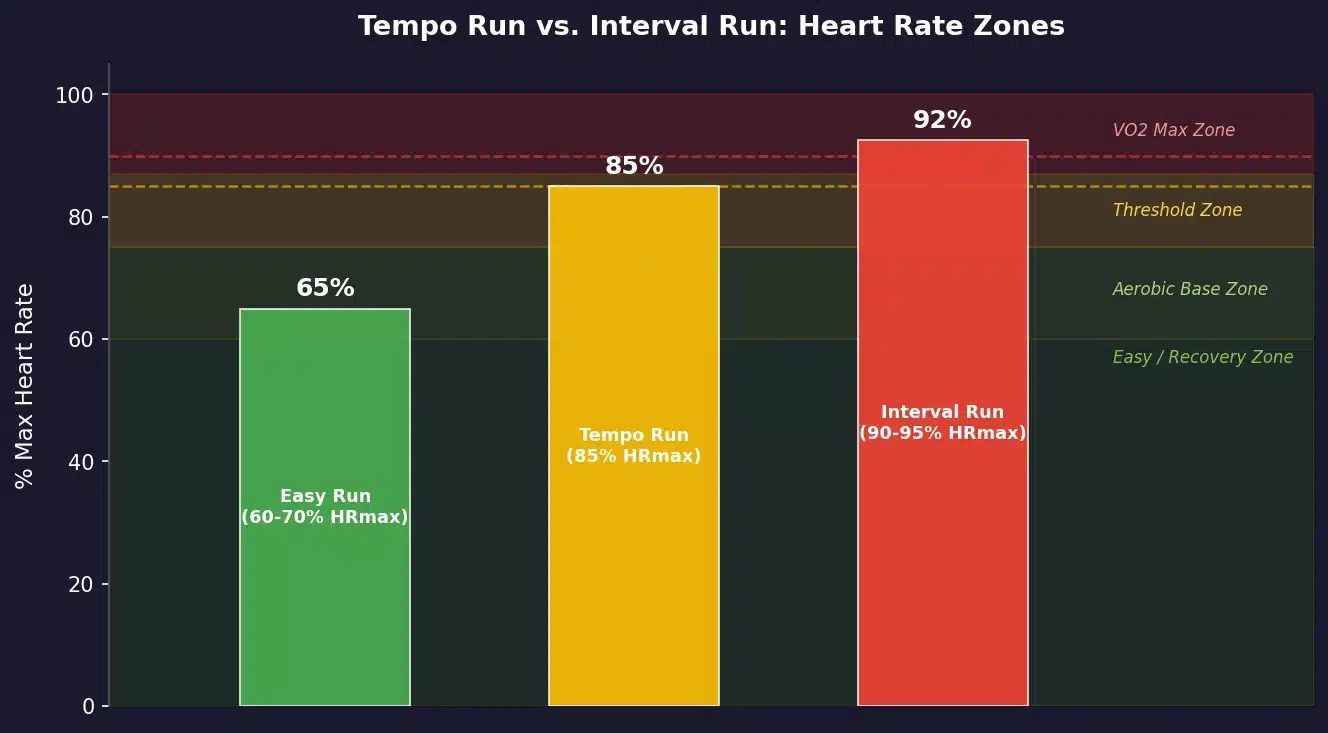
A tempo run keeps you below the point where lactate accumulates rapidly, training your body to sustain that pace longer.
An interval run pushes above that point deliberately, forcing your cardiovascular system to work at near-maximum capacity.
If you’re unsure which effort level you’re at, calculating your lactate threshold gives you the exact pace that separates tempo work from interval work for your current fitness.
Neither workout is superior.
They train different systems and both are necessary for well-rounded endurance fitness.
How Is a Garmin Tempo Zone Different from Threshold Training?
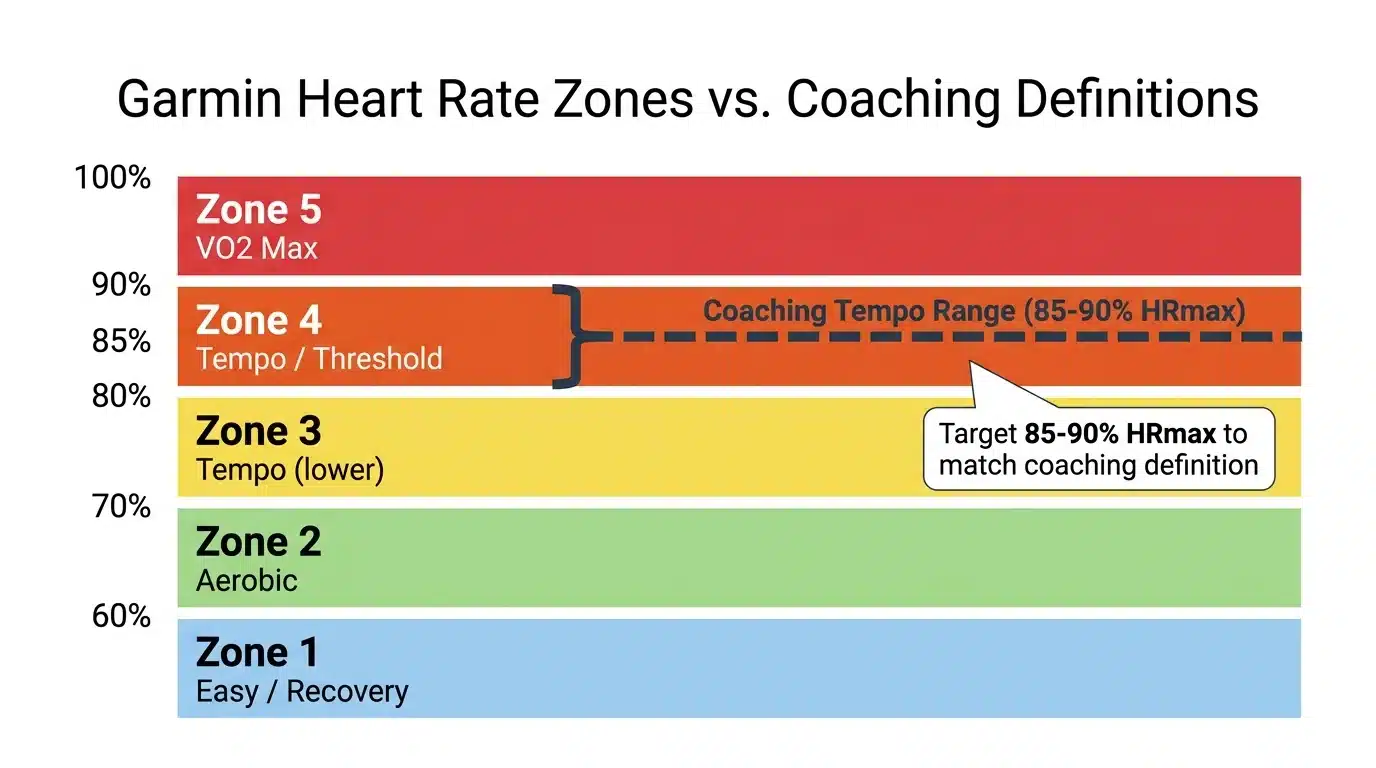
Garmin’s Zone 4 covers 80 to 90% of maximum heart rate and is labeled either “Tempo” or “Threshold” depending on device and firmware version.
That labeling does not align precisely with how coaches use the same words.
When coaches say “tempo run,” they mean running at approximately 85% HRmax.
That intensity falls in the upper half of Garmin’s Zone 4.
The lower half of Zone 4 (80 to 83% HRmax) sits below true lactate threshold intensity for most trained runners.
Running in that lower range builds aerobic capacity but delivers a weaker threshold training stimulus than a properly paced tempo run.
When your Garmin assigns a “Tempo” or “Threshold” workout, target 85 to 90% of your maximum heart rate to match the coaching definition of threshold intensity.
On devices that have completed a VO2 max assessment or lactate threshold test, Garmin recalibrates zones around your individual threshold rather than generic percentages.
Those personalized zones are more accurate.
Runners using default zone settings, which covers most users, should use heart rate percentage as the reference point rather than zone label alone.
What Are Tempo Intervals and When Do They Work Better Than Either?
Tempo intervals split a tempo run into segments with short rest periods in between.
Instead of 4 continuous miles at threshold pace, a tempo interval workout might be:
2 mi warm-up, 3 x 2 miles at threshold pace with 3 to 4 minutes rest, 1 mi cool-down
The target pace stays the same as a standard tempo run: still threshold, not VO2 max intensity.
What changes is total volume: by breaking the effort into segments, you can accumulate 50 to 80 minutes at threshold pace in a single session instead of the 20 to 40 minutes you could hold continuously.
A 2023 review found that lactate-guided threshold interval training allows runners to achieve high absolute training speeds while maintaining a relatively low metabolic load, which enables a greater weekly volume of threshold work compared to VO2-max intensity intervals without accumulating the same fatigue.
That’s the mechanical advantage: more time at the exact pace that raises your lactate threshold, without the recovery debt that comes from interval intensity.
Tempo intervals are also more psychologically manageable than a 40-minute continuous tempo run.
Focusing on one 2-mile segment at a time is a different mental task than committing to an unbroken 4-mile effort at threshold pace.
Use tempo intervals when you’ve built enough threshold base through standard tempo runs to handle the increased volume, typically after 4 to 6 weeks of consistent weekly tempo work.
Common tempo interval formats:
- 2 x 3 miles at threshold pace with 3 to 4 min rest: emphasizes sustained threshold work with a mental break midway
- 3 x 2 miles at threshold pace with 3 min rest: slightly faster than the 2×3 format because segments are shorter
- 3 miles, 2 miles, 3 miles at threshold pace with 3 to 5 min rest: ladder format that builds throughout the workout
How Often Should You Do Tempo Runs vs. Intervals Each Week?
Most runners can handle one quality workout per week safely, with a second added only after the first is consistently strong.
When you run two quality days per week, the structure matters as much as the workouts themselves.
A well-structured week might look like this:
- Tuesday: Interval run (VO2 max intensity)
- Thursday or Saturday: Tempo run or tempo intervals (threshold)
- All other days: Easy running (conversational pace, 60 to 70% HRmax)
Separating the two quality sessions by at least 48 hours gives your nervous system time to recover from the interval session before the threshold work.
If you’re adding a second quality day for the first time, run the tempo workout first for 2 to 3 weeks, because the lower fatigue load gives you a more accurate baseline for how your body tolerates two hard days before you layer in intervals.
Total quality work, intervals plus tempo, should represent no more than 15 to 20% of your weekly mileage.
The rest should be genuinely easy.
Which Should You Prioritize for Your Race Goal?
Your primary race distance should drive which workout gets more emphasis in your training cycle.
For 5K and 10K racing, interval work at VO2 max pace produces a stronger return because VO2 max is a larger limiting factor at shorter distances.
For half marathon and marathon racing, lactate threshold is the more critical variable.
The pace you can sustain for 1 to 4-plus hours is constrained more by your threshold than your maximum oxygen uptake.
That said, neither workout disappears from your plan regardless of race distance.
A marathon runner still benefits from occasional interval sessions to maintain top-end speed.
A 5K runner still needs threshold work to build the aerobic base that supports repeated interval sessions.
Make threshold training the foundation of your quality training if your goal race is half marathon or longer, and prioritize VO2 max intervals if your goal race is 10K or shorter, with threshold work as the secondary quality day.
The exact ratio shifts throughout a training cycle, with more threshold work early in the build and more interval work as the race approaches.
Tempo intervals sit in the middle of the spectrum: they’re threshold work at higher volume, making them one of the most efficient tools in a runner’s training week regardless of goal distance.
Citations
Helgerud J, et al. “Aerobic high-intensity intervals improve VO2max more than moderate training.” Med Sci Sports Exerc. 2007 Apr;39(4):665-71. PMID 17414804.
Casado A, Foster C, Bakken M, Tjelta LI. “Does Lactate-Guided Threshold Interval Training within a High-Volume Low-Intensity Approach Represent the ‘Next Step’ in the Evolution of Distance Running Training?” Int J Environ Res Public Health. 2023 Feb 21;20(5):3782. PMID 36900796.
Faude O, Kindermann W, Meyer T. “Lactate threshold concepts: how valid are they?” Sports Med. 2009;39(6):469-90. PMID 17901124.




5 Responses
Excellent stuff. I have run 3-Half Marathons, the last by default as I was attempting a full marathon and various things got in my way. My new motto is: keep it simple. I not only understood this article and how to adapt it in many ways, it also proves progress is really that simple. Thank you.
Glad the article was helpful, Becky. Yes, progress in a sense is very simple. Consistent and solid training, nothing fancy, but just week after week of good workouts, will almost always produce great results. Good luck at your next half!
Is Lactate Threshold directly related to heart rate? The reason I ask is that I’m only 33 years old, but when I do these tempo intervals, my heart rate gets up in the low 150s and I feel like that’s about all I’ve got, but a lot of friends my age run the same run with me, and their HRs are in the high 170s! I’m confused. Am I just not pushing myself hard enough? Is it a lactate issue?
Great question, Sam.
Heart Rate and Lactate Threshold are linked, but not directly as there are a few other factors that determine your lactate threshold. Here are a few possible explanations to your issue.
(1) You have a lower than average max heart rate. Max heart rate is individual and can vary quite a bit based on a number of fitness and genetic factors. You just might be on the low end. This is the most plausible answer.
(2) Lactate is a bi-product of energy production. Typically the higher your HR is, the higher the demand for oxygen and energy. However, you may be particularly inefficient at clearing lactate, which would mean even a slight amount of lactate build-up will cause you to slow down. On the other hand, elite runners can clear lactate very efficiently, which allows them to run at a very high heart rate while still producing little lactic acid.
I hope that gives you some guidance.
Great article!
I’ve been running by time/pace, rather than by distance/pace. Furthermore, I’m trying to learn to run by feel, rather than by Garmin.
Can the “run by feel” be married with the “run by time” for the Intervals Training?