

You finish a tempo run feeling like your legs belong to someone else.
The pace that felt controlled suddenly became impossible, and you had to slow down whether you wanted to or not.
That tipping point has a name: your lactate threshold.
Lactate threshold is one of the most referenced concepts in distance running, and one of the most misunderstood. For decades, coaches told runners that lactic acid was a toxic waste product that had to be “flushed out” after hard efforts.
Research from George Brooks at UC Berkeley overturned that story. Lactate is actually a fuel your body produces and recycles during exercise, and the real question has nothing to do with waste removal.
The question is whether your clearance rate can keep pace with your production rate.
That boundary between “manageable” and “accumulating” is your lactate threshold, and it may be the most trainable performance factor in distance running.
Here’s what you’ll learn:
- What lactate threshold actually means and why the lactic acid story was wrong
- What happens inside your muscles when you cross the threshold
- The difference between LT1 and LT2 and how each one shapes your training zones
- Why lactate threshold predicts race performance better than VO2 max for most runners
- How to estimate your threshold without a lab
- The 4 training methods that push your threshold pace faster
- Exactly what pace and heart rate to target in threshold sessions
What Is Lactate Threshold?
Lactate threshold is the exercise intensity at which lactate begins accumulating in your blood faster than your body can clear it.
A comprehensive review in Sports Medicine found that lactate threshold is the single best predictor of endurance performance across distances from 5K to the marathon, outperforming VO2 max in applied predictive value.
Every time you run, your muscles break down glucose for fuel.
A natural byproduct of that process is lactate. Your body produces it constantly, even at rest at roughly 0.5 to 1.0 mmol/L in blood.
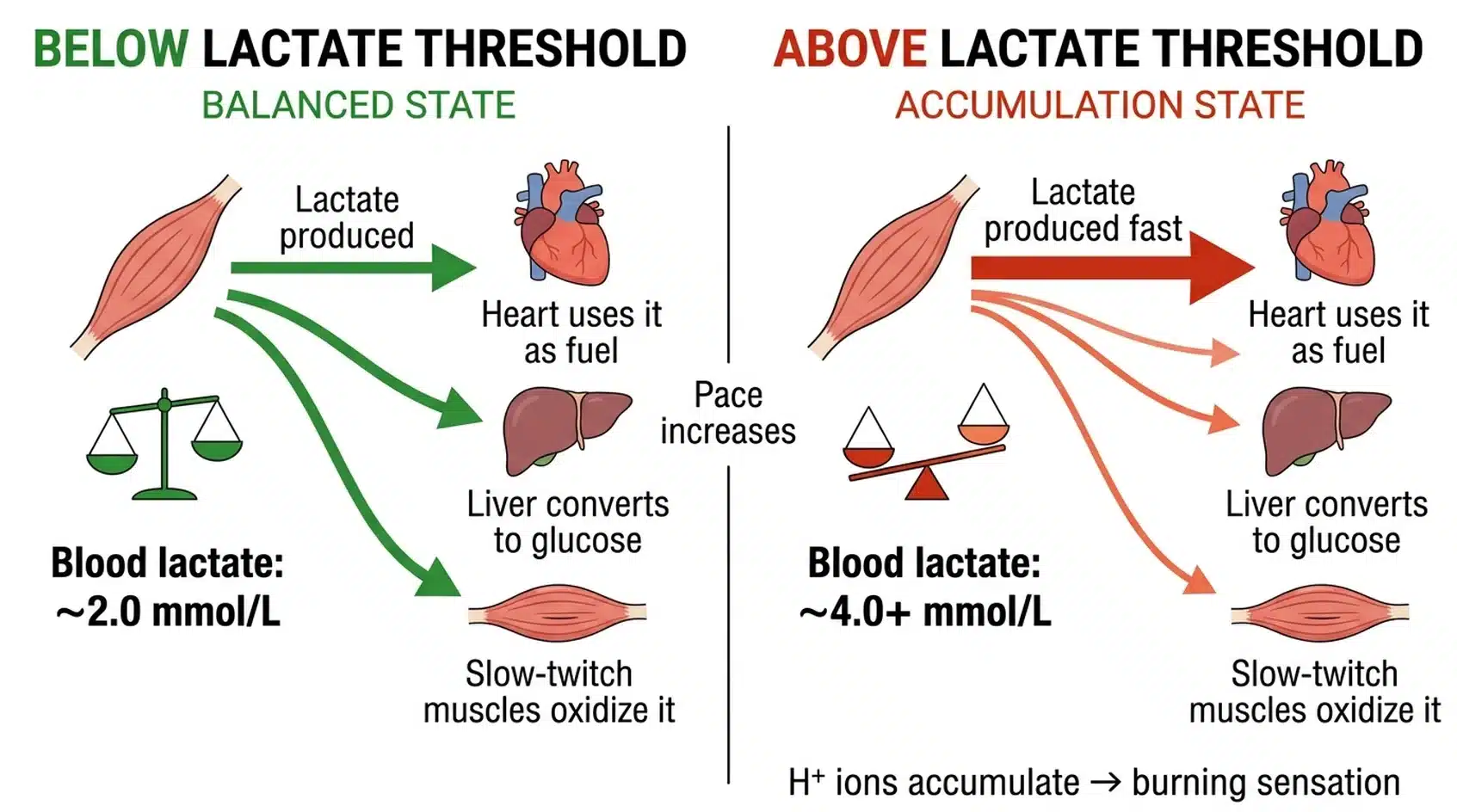
At easy paces, your body clears lactate as fast as it produces it. Your liver converts some back into glucose through gluconeogenesis, your heart uses it directly as fuel, and neighboring slow-twitch muscle fibers oxidize it for energy.
As you run faster, lactate production rises. At some point, production outpaces clearance, and lactate starts accumulating in your blood.
Lactate threshold marks the fastest pace you can sustain before lactate accumulation begins rising exponentially. It typically corresponds to an effort you could hold for roughly 45 to 60 minutes in a race.
The old term “anaerobic threshold” implied your muscles ran out of oxygen at this point. Updated physiological research has confirmed that the threshold is a rate-of-clearance problem, not an oxygen supply problem.
Your body is still using oxygen at threshold intensity. It just can’t recycle lactate as fast as your working muscles are generating it.
What Happens in Your Body at Lactate Threshold?
Below your lactate threshold, your body runs a balanced recycling loop.
Lactate produced by fast-twitch muscle fibers gets shuttled to slow-twitch fibers, the heart, and the liver, where it converts back into usable energy.
Updated lactate shuttle research has demonstrated that 70 to 80 percent of the lactate your muscles produce during exercise gets oxidized as fuel. It’s not discarded as waste.
A 2023 review of lactate metabolic clearance confirmed that blood lactate rises when lactate production rate exceeds disposal rate, and that your physiological capacity for clearance is the primary driver of where your threshold sits.

When you push past your threshold pace, 3 things happen in rapid succession.
First, your body recruits more fast-twitch muscle fibers to meet the demand. These fibers are powerful but generate lactate at a much higher rate than slow-twitch fibers.
Second, your fuel mix shifts. Below threshold, your muscles rely heavily on fat oxidation. Above threshold, carbohydrate becomes the dominant fuel source, and carbohydrate metabolism generates more lactate per unit of energy produced.
Third, blood flow gets redirected away from organs that help clear lactate. Your liver and kidneys normally convert lactate back into glucose, but as exercise intensity rises, more blood routes to working muscles, reducing clearance capacity.
The combined effect is rapid accumulation of lactate and hydrogen ions in the blood. Those hydrogen ions lower your muscle pH, interfere with calcium signaling needed for contraction, and create the burning sensation you feel in your legs in the final kilometers of a hard race.
What Is the Difference Between LT1 and LT2?
When coaches and articles refer to “lactate threshold,” they’re usually talking about one of 2 distinct physiological boundaries.
Understanding both changes how you structure every training week.
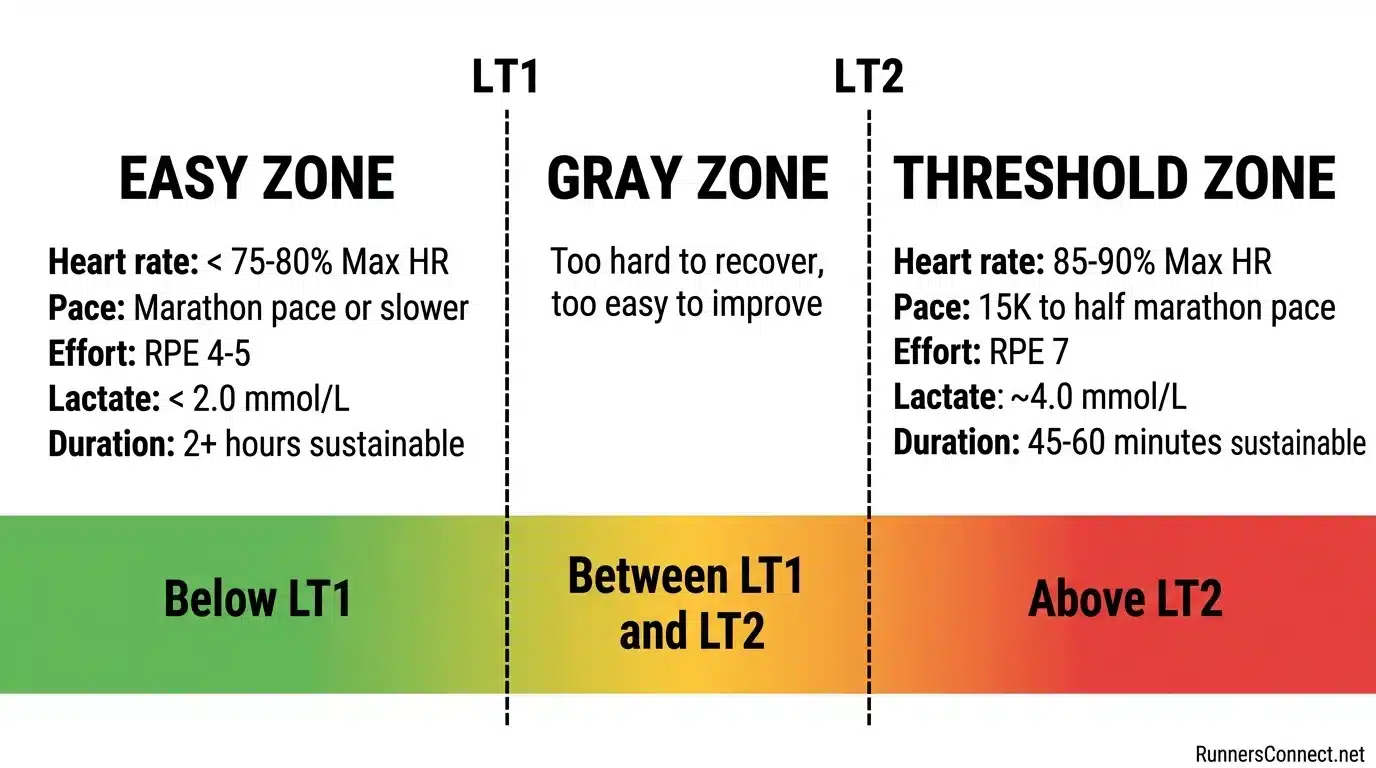
LT1 (aerobic threshold) is the intensity at which lactate first begins to rise above resting levels. Below LT1, blood lactate stays flat at roughly 1.5 to 2.0 mmol/L. Above it, lactate starts a slow, steady climb.
For most trained runners, LT1 falls around 75 to 80 percent of maximum heart rate. That’s the upper boundary of your true easy-run zone.
LT2 (lactate threshold) is the intensity where lactate accumulation accelerates sharply. This is the point most runners mean when they say “lactate threshold.”
Research published in Frontiers in Physiology found that LT2 corresponds closely to the maximal lactate steady state: the highest intensity you can sustain without a continual rise in blood lactate over time. For trained runners, LT2 typically occurs around 85 to 90 percent of maximum heart rate, corresponding to a pace you could hold for roughly 45 to 60 minutes in a race.
The gap between LT1 and LT2 is where tempo runs, cruise intervals, and most threshold-specific training lives. Widening that gap is one of the fastest ways to improve your distance running.
Runners who skip easy days often hover between LT1 and LT2 on what should be recovery runs. That intensity is too hard to recover from and too easy to generate a training stimulus. Coaches call it the gray zone, and spending too much time there is one of the most common mistakes in recreational runner training.
RunnersConnect Bonus
Download our Heart Rate Calculator to find out what your individual heart rate zones are.
Why Does Lactate Threshold Matter More Than VO2 Max?
VO2 max gets the headlines, but lactate threshold has a stronger relationship with race performance for most recreational and intermediate runners.
Joyner and Coyle’s landmark review established that 3 factors drive endurance performance: VO2 max, lactate threshold, and running economy. Of those 3, lactate threshold determines how much of your VO2 max you can actually sustain during a race.
An elite marathoner with a VO2 max of 75 mL/kg/min might race at 85 percent of that ceiling. A recreational runner with a VO2 max of 50 can still run a strong half marathon if their lactate threshold is high enough to let them sustain a large fraction of that capacity for 90 minutes.
VO2 max has a genetic ceiling that most runners approach within a few years of consistent training.
Lactate threshold keeps responding to training stimulus for much longer.
A runner who has hit their VO2 max ceiling can still shave minutes off race times by pushing their lactate threshold pace faster through targeted tempo and threshold work.
For distances from 5K through the marathon, performance is ultimately limited not by how much oxygen you can take in, but by how long you can sustain a high percentage of that capacity without crossing into unsustainable lactate accumulation. That’s the threshold question, and it’s the one that keeps improving with training.
How Do You Find Your Lactate Threshold?
A lab test with blood draws during an incremental treadmill protocol gives the most precise measurement. Most runners don’t need that level of precision to train effectively.
There are 3 reliable field estimates.
30-minute time trial: Run as hard as you can sustain for 30 minutes on a flat course. Check your average heart rate over the final 20 minutes. That number approximates your LT2 heart rate, and your average pace during that effort gives a working estimate of threshold pace.
Recent race result: Your 10-mile or half marathon pace closely approximates LT2 pace for most trained runners. Your 10K pace sits slightly above LT2. This is the fastest field estimate to use if you have a recent result from either distance.
Step test: Run 5-minute segments at progressively faster paces, checking heart rate at the end of each. The intensity at which heart rate stops rising predictably and starts spiking is near your LT2. The full 3-method field testing protocol, including the talk-test variation that works on any route, is covered in our lactate threshold testing guide.
Whichever method you use, retest every 8 to 12 weeks. Your threshold shifts as your fitness changes, and training at an outdated threshold pace means you’re either leaving stimulus on the table or pushing too hard to sustain the adaptation.
How Do You Improve Your Lactate Threshold?
Lactate threshold responds to training that forces your body to produce and clear lactate at higher rates.
The key is working at or just below your current threshold intensity long enough to drive adaptation without crossing into territory you can’t recover from.
A 2024 narrative review in the Montenegrin Journal of Sports Science examined 9 categories of evidence on lactate threshold training for distance runners. Consistent threshold-intensity work produces measurable shifts in the pace at which lactate begins to accumulate. 4 workout types drive the most of that adaptation.
Tempo Runs
A tempo run is a sustained effort at your current LT2 pace for 20 to 40 minutes.
The continuous nature teaches your body to clear lactate at a high rate without rest intervals. Start with 20 minutes at threshold pace and build toward 40 minutes over a training cycle. Run the effort on a flat route where you can maintain even pacing.
Target pace: your 15K to half marathon race pace, or roughly 25 to 30 seconds per mile (15 to 18 seconds per km) slower than 10K pace.
Cruise Intervals
Cruise intervals break the threshold effort into shorter 5- to 10-minute segments with 60 to 90 seconds of easy jogging between them.
The pace stays at LT2, but the brief recoveries let you accumulate more total time at threshold intensity within a single session. A typical workout: 4 to 6 repeats of 6 minutes at threshold pace with 90 seconds of recovery jog. The total threshold time in a cruise interval session often exceeds what a continuous tempo run can achieve, especially for runners newer to this intensity.
Easy Running Below LT1
Easy-pace running below LT1 builds the aerobic infrastructure that supports threshold performance.
It increases capillary density in your muscles, grows mitochondrial volume, and improves your body’s ability to oxidize fat at moderate intensities.
A study of 48 well-trained endurance athletes found that a polarized training approach, with roughly 80 percent of training below LT1 and 20 percent at or above LT2, produced the greatest improvements in key endurance variables compared to threshold-only, high-intensity, or high-volume approaches.
That 80 percent of easy running is not filler. It builds the clearance machinery that makes your hard sessions productive.
Long Runs With a Threshold Finish
Long runs at easy to moderate pace improve your body’s capacity to use fat as fuel, sparing glycogen and reducing the rate of lactate production at any given pace.
They also increase blood plasma volume, which improves oxygen delivery and lactate transport. Adding 10 to 20 minutes of running at or near LT1 pace in the final portion of a long run teaches your body to clear lactate under fatigue. This is one of the most effective session types for marathon-specific threshold development.
What Pace and Heart Rate Is Your Lactate Threshold?
Your lactate threshold pace is individual, but race equivalents give a reliable starting estimate for most runners.
LT2 pace corresponds to the pace you could sustain for 50 to 60 minutes of all-out racing. For competitive runners, that’s close to 15K or half marathon pace. For most runners training 3 to 5 hours per week, LT2 pace sits closer to 10-mile race pace.
In heart rate terms, LT2 typically falls at 85 to 90 percent of your maximum heart rate for trained runners.
On a perceived exertion scale of 1 to 10, threshold effort sits at about 7. You can speak in short phrases but can’t hold a conversation.
| Metric | LT1 (Aerobic Threshold) | LT2 (Lactate Threshold) |
|---|---|---|
| Heart rate (% of max) | 75 to 80% | 85 to 90% |
| Race pace equivalent | Marathon pace or slower | 15K to half marathon pace |
| Perceived exertion (1-10) | 4 to 5 | 7 |
| Talk test | Full sentences, comfortable | Short phrases only |
| Blood lactate (mmol/L) | ~2.0 | ~4.0 |
| Sustainable duration | 2+ hours | 45 to 60 minutes |
Train at your current threshold, not the threshold you want to have. Running 15 seconds per mile (9 seconds per km) faster than your actual LT2 turns a threshold session into an interval session with a different physiological target.
As your fitness improves over a training cycle, your threshold pace shifts. That’s the entire point of threshold training. A pace that once sat right at LT2 will eventually fall below it, and your tempo runs will naturally get faster as your body adapts.
Frequently Asked Questions
Is lactate threshold the same as anaerobic threshold?
The terms are often used interchangeably, but they refer to slightly different concepts. Anaerobic threshold originally implied that muscles ran out of oxygen at that intensity.
Lactate threshold is more precise: it describes the pace at which lactate accumulation exceeds clearance rate. Modern exercise physiologists prefer lactate threshold because oxygen availability isn’t actually the limiting factor at that intensity.
Can I improve my lactate threshold at any age?
Yes. Lactate threshold responds to training across all age groups. A 2019 review in the Journal of Aging and Physical Activity found that masters runners who included consistent threshold-intensity work improved their LT2 pace despite age-related declines in VO2 max. The clearance machinery that drives threshold improvements continues adapting to stimulus well into your 50s and 60s.
How long does it take to see threshold improvements?
Most runners see measurable threshold pace improvements within 6 to 8 weeks of consistent threshold work.
A 2021 study in the International Journal of Sports Physiology and Performance found that recreational runners who added 2 threshold sessions per week saw LT2 pace improve by an average of 3.2 percent over an 8-week training block. Full adaptation across a season of training produces larger gains.
Should I use heart rate or pace to guide threshold workouts?
Pace is more reliable on flat, consistent conditions. Heart rate is more useful on hilly terrain or in heat where pace becomes a less accurate guide to internal effort.
The best approach is to use both: set a pace target based on your time trial or race result, then check that your heart rate lands in the 85 to 90 percent range. If heart rate is significantly higher than expected, ease back. The conditions or fatigue are pushing the session above threshold.
What is the difference between a tempo run and a threshold run?
In practice, coaches use both terms to describe the same intensity: sustained running at LT2 pace. Some coaches reserve “tempo” for runs lasting 20 to 40 minutes and “threshold” for shorter cruise intervals, but the target physiological intensity is the same. The key is targeting the right pace, not the label.
Lactate threshold is the fastest pace you can sustain before lactate accumulates faster than your body can clear it, typically corresponding to 15K or half marathon race effort.
Lactate is a fuel source your body produces and recycles during exercise, not a waste product that causes fatigue. George Brooks’ lactate shuttle research at UC Berkeley overturned the old lactic acid story.
2 distinct thresholds matter for training: LT1 (aerobic threshold, around 75 to 80% max HR) marks the upper limit of true easy running, while LT2 (around 85 to 90% max HR) marks the boundary of sustainable hard effort where most threshold training lives.
Lactate threshold is more predictive of distance running performance than VO2 max for most runners, and it remains trainable long after you reach your VO2 max ceiling.
Tempo runs, cruise intervals, easy mileage below LT1, and long runs with threshold finishes are the 4 primary training methods that push your threshold pace faster.
Retest your threshold every 8 to 12 weeks and adjust your training paces accordingly. Training at an outdated threshold pace either leaves stimulus on the table or pushes you too hard to recover.




6 Responses
So what length of time is best for half marathon training?
I have read that 20 minutes slightly faster than LT or 30-40 minutes slightly slower is best.
There really is no “best” way. each type of tempo targets a different system and it’s individualized (what I can handle is going to be different than what you can handle). Plus, you can do half marathon specific workouts too.
“By running just below your lactate threshold you can begin to decrease (or improve, depending on how you look at it) the pace at which you begin to produce too much lactic acid for your body to manage.”
I think I know what you mean but can you please clarify what you mean?
“just below” in terms of speed (MPH) or time per distance?
Are you advising running at a faster pace than the lactate threshold (to induce the production of lactate and get body to produce lactate)? Like if your lactate threshold is 10:00, running a 9:30 mile pace for as long as you physically can until you’re forced to slow down and the attempt to do so will build the strength,etc to finish the entire workout at that pace?
Or are you saying to run as fast as you can without producing the lactic response to pace yourself so that you can try to push body as much as you can WITHOUT producing lactate for as LONG as possible? (say 10:02 pace and then as you get stronger, you push to 10:00 and then reduce it each time so that you are avoiding the lactate response for as long as you can?
Also the pace as measured by a mile pace is also tricky. The lactate response will eventually trigger at some point if you run for long enough distance regardless of pace, so that can also get a bit confusing.
If I sprint 95%-100% of what my body can possibly run, after about 1/4th of a mile my body will start to “hit a wall”. If I have a slower pace I will still hit a wall, but can sustain longer distances. So if I train for a mile run or 10k the pace would be very different and I will still be a bit confused.
I have the same question as Mike.
The confusion is the word ‘below’.
If my lactic threshold is 10 mins, what pace is ‘below’ my threshold?
9.45 mins or 10.15 mins ?
Mike and RC:
Convert min/mi to mph, then the “above” and “below” may make more sense. For example, 10:00/mi converts to 6.00 miles per hour (mph); so, assuming a vertical scale with zero mph at the bottom and 100 mph at the top, “above” would mean faster (say, 6.31 mph, or 9:31/mi) and “below” would mean slower (say, 5.71 mph, or 10:30/mi).