Run for an hour beside a training partner on a warm morning, and one of you can finish having sweated twice as much as the other.
One drinking rule can’t fit both of you, which is why your own sweat rate is the most useful hydration number you can know.
The average runner loses a little over 1 liter of sweat per hour, and a 1-hour run with a bathroom scale tells you where you sit compared with that average.
In this article, you’ll learn:
- The average sweat loss per hour for runners, for men and for women
- How to calculate your own sweat rate with a scale and a water bottle
- Why one runner can sweat 40% more than another on the same run
- How much sweat you lose in a marathon, and how much body weight you can lose before your running slows
- How much sodium leaves in your sweat each hour
- Why finishing a race heavier than you started is a warning sign, and how to turn your sweat rate into a drinking plan
What Is the Average Sweat Rate for Runners?
Runners usually lose between 0.5 and 2 liters of sweat per hour, and the average endurance athlete loses about 1.3 liters (43 fl oz).
An analysis of 1,303 athletes found that endurance athletes sweat an average of 1.28 liters per hour during training, more than soccer and basketball players.

That average hides a wide spread between individual runners.
A 2022 study of 119 runners measured total sweat losses from as little as 0.2 liters to as much as 5.0 liters across a single day of running.
The same study worked out how much each runner would have to drink to avoid losing 2% of their body weight, and the answer ran from 0 to 1.4 liters per hour.
That means 2 runners on the same route can need completely different drinking plans, so any plan you copy from another runner starts from the wrong number.
Here are the sweat numbers this article uses, in one place.
| Group | Sweat rate or drinking rate | Per hour in fl oz |
|---|---|---|
| Endurance athletes, average sweat rate | 1.28 L per hour | 43 fl oz |
| Male runners, average sweat rate | 1.3 L per hour | 44 fl oz |
| Female runners, average sweat rate | 0.9 L per hour | 30 fl oz |
| Drinking needed to stay under 2% weight loss | 0 to 1.4 L per hour | 0 to 47 fl oz |
| Elite marathon winners, actual drinking rate | 0.55 L per hour | 19 fl oz |
How Do You Calculate Your Sweat Rate?
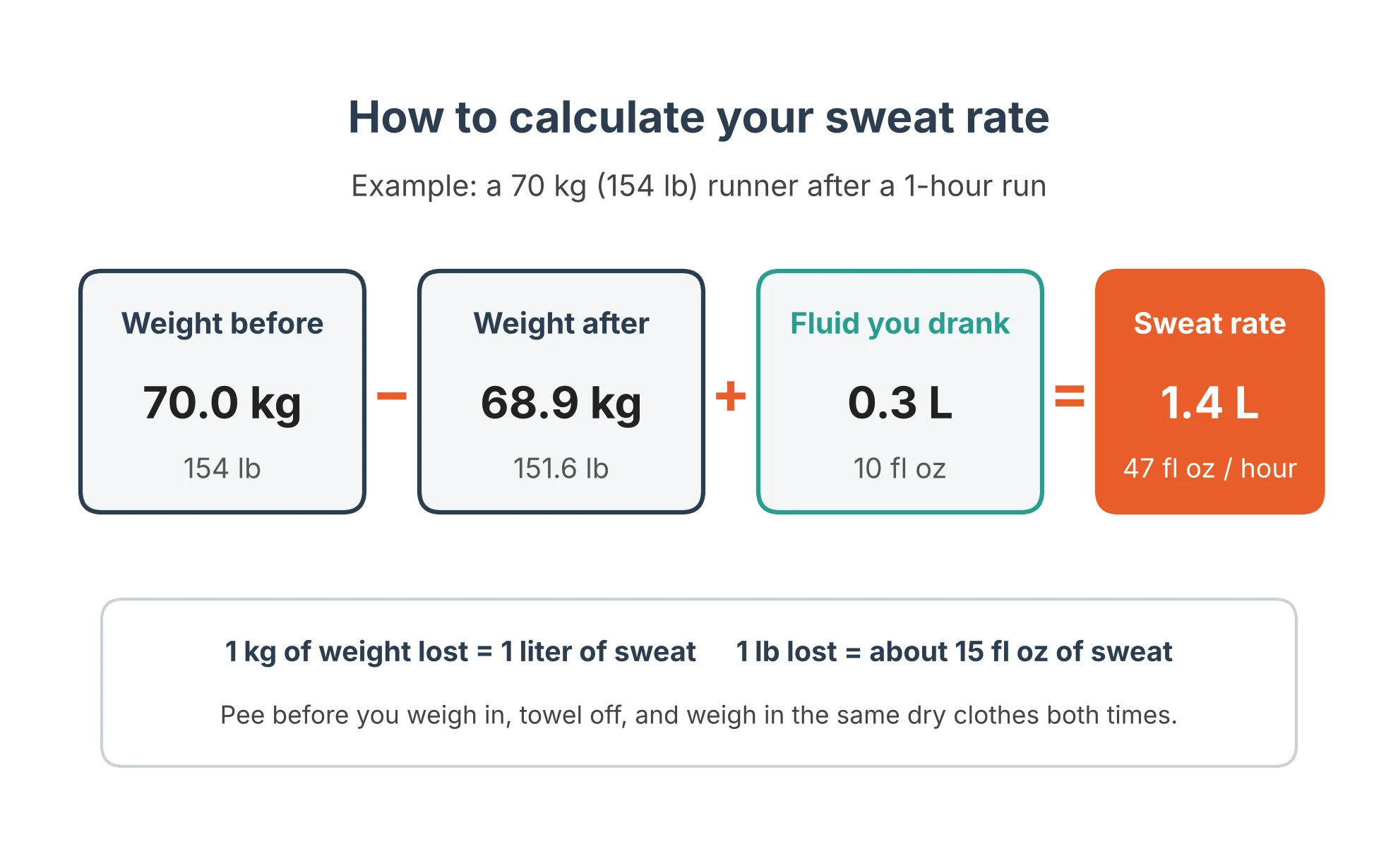
You calculate your sweat rate by weighing yourself before and after a 1-hour run and adding back whatever you drank.
Every kilogram of weight you lose during the run is 1 liter of sweat, and every pound is about 15 fl oz (0.45 liters).
A 2017 review of sweat testing methods named body weight change the simplest and most accurate way to measure whole-body sweat rate, as long as you account for urine and for sweat soaked into your clothes.
- Pee first. Empty your bladder, then weigh yourself naked or in dry running shorts.
- Run for 60 minutes. Use the pace and conditions you want to plan for, such as race pace on a warm morning.
- Track what you drink. Weigh or measure your bottle before and after so you know exactly how much went in, and try to avoid peeing during the run.
- Towel off and weigh again. Dry your skin and hair, take off any sweat-soaked clothing, and weigh yourself in the same outfit as before.
- Do the math. Subtract your post-run weight from your pre-run weight, convert to liters or fl oz, and add the fluid you drank.
As an example, a 70 kg (154 lb) runner who weighs 68.9 kg after the run and drank 0.3 liters lost 1.1 liters as weight loss plus 0.3 liters from the bottle, for a sweat rate of 1.4 liters per hour.
In pounds, the same runner lost 2.4 lb, which is about 37 fl oz, and drank 10 fl oz, so the sweat rate is about 47 fl oz per hour.
Repeat the test in hot and cool weather and at easy and race pace, because each combination gives you a different sweat rate.
RunnersConnect Bonus
Download your FREE Sweat Rate Calculator now.
If you are unsure about how to calculate how much water to consume, and electrolytes to use, this will give you your exact needs.
Why Do Some Runners Sweat More Than Others?
Your muscles turn roughly three-quarters of the energy they burn into heat, and you sweat to get rid of it, so anything that raises your heat production or slows how fast heat leaves your skin raises your sweat rate.
- Pace: Faster running produces more heat per minute, so your sweat rate at race pace is higher than at easy pace.
- Body size: A heavier runner produces more heat at the same pace and usually sweats more in total.
- Weather: Hot air and high humidity slow evaporation from your skin, and your sweat glands respond by producing more sweat to keep cooling you.
- Sex: Men sweat more than women on average, mostly because of larger body size.
- Heat training and fitness: Training in the heat makes you start sweating sooner and sweat more once you start.
A 2021 study of 166 runners in Thailand measured whole-body sweat rates during self-paced runs of 30 to 100 minutes.
The 102 men sweated an average of 1.3 liters per hour. The 64 women sweated an average of 0.9 liters per hour.
That means a male runner on an average day loses about 40% more sweat each hour than a female runner, which adds up to about 1.6 liters over a 4-hour marathon.
Fitness and heat training raise your sweat rate. A 2015 review of heat acclimation lists improved sweating among the main adaptations to training in the heat, along with lower body temperature and better fluid balance.
A sweat rate you measured in spring will be too low for a summer race once you’ve trained through a few weeks of heat, so test again.
How Much Sweat Do You Lose During a Marathon?
Most of the water a runner loses during a marathon leaves as sweat, and at 1 liter per hour a 4-hour finisher sweats out about 4 liters (135 fl oz).
For a 70 kg (154 lb) runner, 4 liters of sweat with nothing to drink would be 5.7% of body weight, or about 8.8 lb.
Elite marathon winners finish with bigger deficits than that.
A study of elite marathon winners found they drank about 0.55 liters per hour and finished an estimated 8.8% lighter than they started.
The study tracked 10 elite men across 13 major city marathons with an average finish time of 2:06:31, and the winner of the 2009 Dubai Marathon was measured at 9.8% lighter after the race.
Those runners spent a total of about 25 seconds drinking during each race.
That means the fastest marathoners in the world drink a modest amount when they feel thirsty and replace only part of their sweat losses during a race.
How Much Body Weight Can You Lose Before Your Running Suffers?
Losing 2% of your body weight to sweat is the line most hydration guidelines draw, and the 2022 runner study used that same 2% cut-off to define significant dehydration.
The same study found that 31 of 35 runners who ran for less than 60 minutes didn’t need to drink anything to stay under that line.
On runs longer than 60 minutes, 65 of 111 runners had to replace more than half of their sweat to stay under 2%.
Studies that let athletes drink to thirst show a smaller effect from a 2% loss than the guideline suggests.
A meta-analysis of time-trial studies found that losing up to 4% of body weight didn’t lower power output in time trials, while drinking less than thirst asked for cut power output by 5.2%.
Those trials used trained cyclists racing time trials in warm, humid conditions, so the finding applies to running with some caution.
That means a loss of 2% to 3% by the end of a long race is normal, and the bigger mistake is ignoring your thirst on the way there.
How Much Sodium Do You Lose in Sweat?
Sweat carries sodium out with the water, and endurance athletes lose more of it per hour than most other athletes.
The same 2019 analysis of 1,303 athletes measured sodium losses of 51.7 millimoles per hour in endurance athletes, compared with 34.6 millimoles per hour in soccer players.
That’s about 1,190 mg of sodium per hour, or close to 4,800 mg over a 4-hour marathon.
That’s roughly the amount of sodium in half a teaspoon of salt every hour.
If you finish long runs with a white, gritty crust on your cap or shirt, you’re losing more sodium than average and should lean toward saltier sports drinks.
The electrolytes runners need on a long run come from sports drinks, gels with added sodium, or salt tablets, and the right choice depends on how much fluid you plan to drink.
Can Drinking Too Much Be More Dangerous Than Sweating Too Much?
Drinking more than you sweat is the hydration mistake that puts runners in the medical tent, because the extra water dilutes the sodium in your blood.
That condition is called exercise-associated hyponatremia, and it causes nausea, headache and confusion that can progress to seizures.
A study of 488 Boston Marathon finishers found that 13% had low blood sodium at the finish line, and 0.6% had critically low levels.
Runners who gained weight during the race had about 4 times the odds of hyponatremia.
Runners slower than 4 hours had about 7 times the odds of runners who finished in under 3:30.
A 5-hour marathoner passes the same aid stations as a 3-hour runner while sweating less per hour at that pace, so a drink-at-every-stop plan puts the 5-hour runner furthest above their sweat rate.
Weight gain is the clearest sign that you drank more than you sweated, which is why the 2015 international consensus statement on hyponatremia recommends drinking to thirst during exercise.
Read more about the dangers of overhydration if you’ve been following a drink-every-mile plan.
How Should You Use Your Sweat Rate to Plan Your Drinking?
Your sweat rate is the upper limit for how much you drink per hour, and you should never plan to drink more than it.
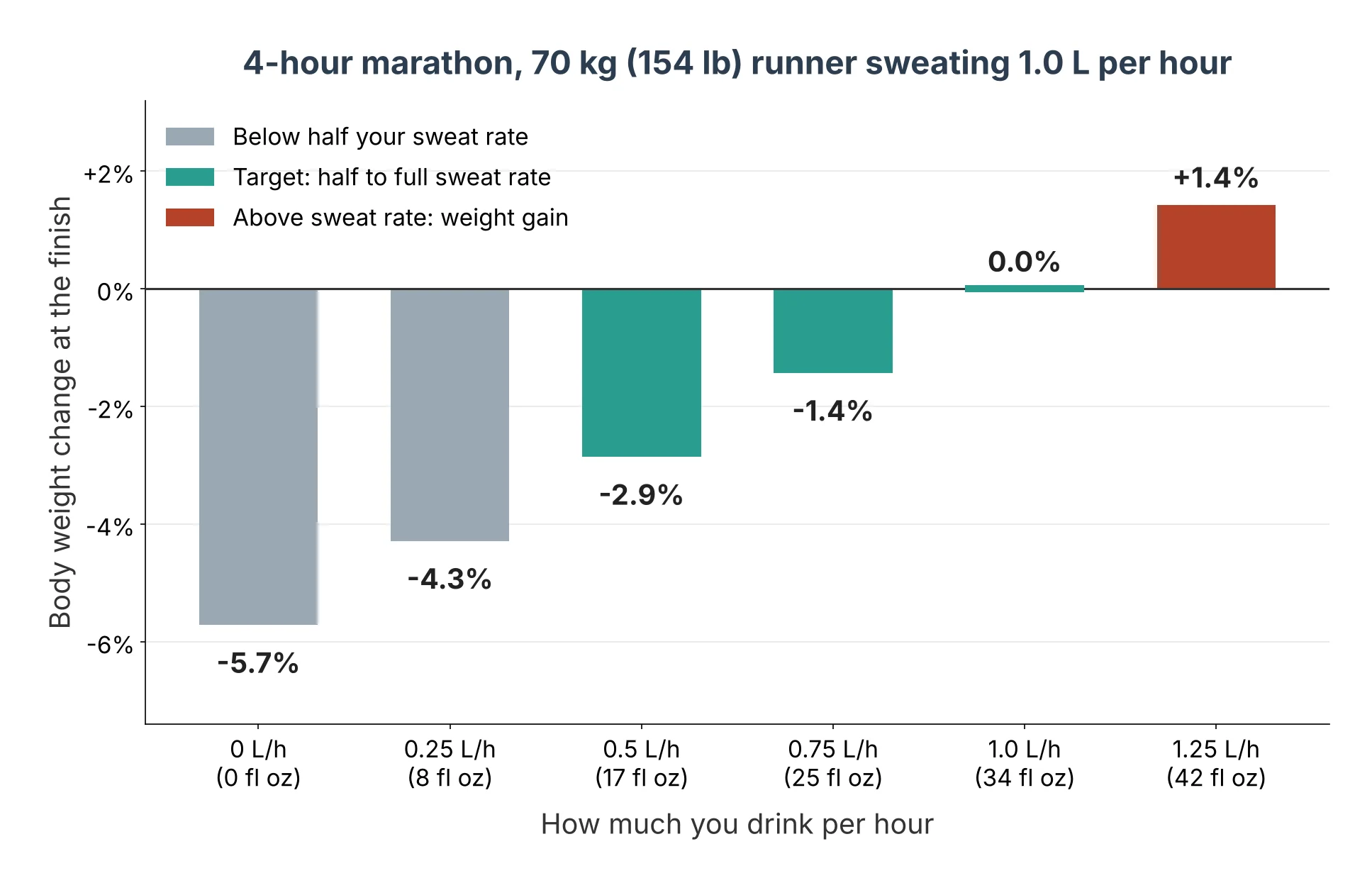
For runs longer than 60 minutes, plan to drink between half your sweat rate and your full sweat rate, and let thirst decide where you land in that range.
A runner with a sweat rate of 1.0 liter per hour would drink between 0.5 and 1.0 liters per hour, which is 17 to 34 fl oz.
Never drink more per hour than your measured sweat rate, because finishing heavier than you started is the strongest warning sign for hyponatremia.
The chart shows what different drinking rates do to that runner’s body weight over a 4-hour marathon.
Here is how the plan changes with race distance.
| Race or run length | How much to drink during | What to focus on |
|---|---|---|
| Under 60 minutes (5K, 10K) | Usually nothing | Start the run well hydrated |
| 60 to 150 minutes (half marathon) | Drink to thirst, never above your sweat rate | Practice taking sips at aid-station spacing |
| Over 150 minutes (marathon) | Half your sweat rate up to your full sweat rate | Sodium from drinks, gels or tablets |
| Any long run in heat | Toward the top of your range | Retest your sweat rate in summer conditions |