

If you eat plenty of beans, oats, vegetables, eggs and dairy, it’s easy to assume your vegetarian diet has your training covered.
For the most part it does, but cutting out meat changes 4 parts of a runner’s diet.
They are how much you eat, how much fiber is in your stomach when you run, how much protein you get and how much iron you absorb.
Each of those has a simple fix, and most of the fixes come down to what you eat and when.
Here’s what you’ll learn about eating as a vegetarian runner:
- Why vegetarian runners often eat less than their training burns
- When to cut back on fiber before a run or race
- How much protein you need, and whether you have to combine proteins at every meal
- The food and drink habits that change how much iron you absorb
Do Vegetarian Runners Eat Enough Calories to Fuel Their Training?
Eating too little is a common problem for runners on any diet, and on a vegetarian diet you can undereat while feeling full after every meal.
Lacto-ovo vegetarians eat eggs and dairy but no meat or fish.
A 2019 study of recreational runners found that more than half of the lacto-ovo vegetarians ate less energy than the general recommendation for adults.
More than half of the runners who ate meat fell short too.
The vegetarian version of the problem comes from how filling plant foods are.
Beans, lentils, whole grains and vegetables carry a lot of fiber and water for the calories they provide.
A 2026 review of 48 studies found that eating more fiber from oats and rye made people feel fuller after a meal.
It had less effect on how much they ate later in the day.
That means fullness is a poor guide to whether a fiber-heavy vegetarian diet has given you enough calories for a high-mileage week.
If you feel full all day but tired on your easy runs, add calorie-dense vegetarian foods before you add more vegetables.
Nut butters, cheese, eggs, olive oil, avocado, whole milk and dried fruit add calories without adding much volume to your plate.
To see how many calories your training burns, use the calculator below to estimate your needs on running days and rest days.
RunnersConnect Bonus
Download your Calorie Calculator for Runners. This calculator will tell you the exact amount of calories you burn each day so you can better target your nutrition needs.
When Should Vegetarian Runners Cut Back on Fiber?
Keep the meal before a long run, workout or race low in fiber, and save your high-fiber meals for after the run.
Fiber-rich foods take longer to digest than low-fiber foods.
So a bean burrito or a bowl of bran cereal eaten before a run can still be in your gut when you start running.
A 1992 survey of 55 triathletes after a half Ironman found that every athlete with intestinal cramps had eaten fiber-rich food before the race, compared with only 10% of those without cramps.

Runners have picked up on this, and a 2020 survey of 388 runners found that 23% avoid high-fiber foods before a race.
For a vegetarian runner the swap takes more planning, because beans, lentils, whole grains and raw vegetables are the base of most meals.
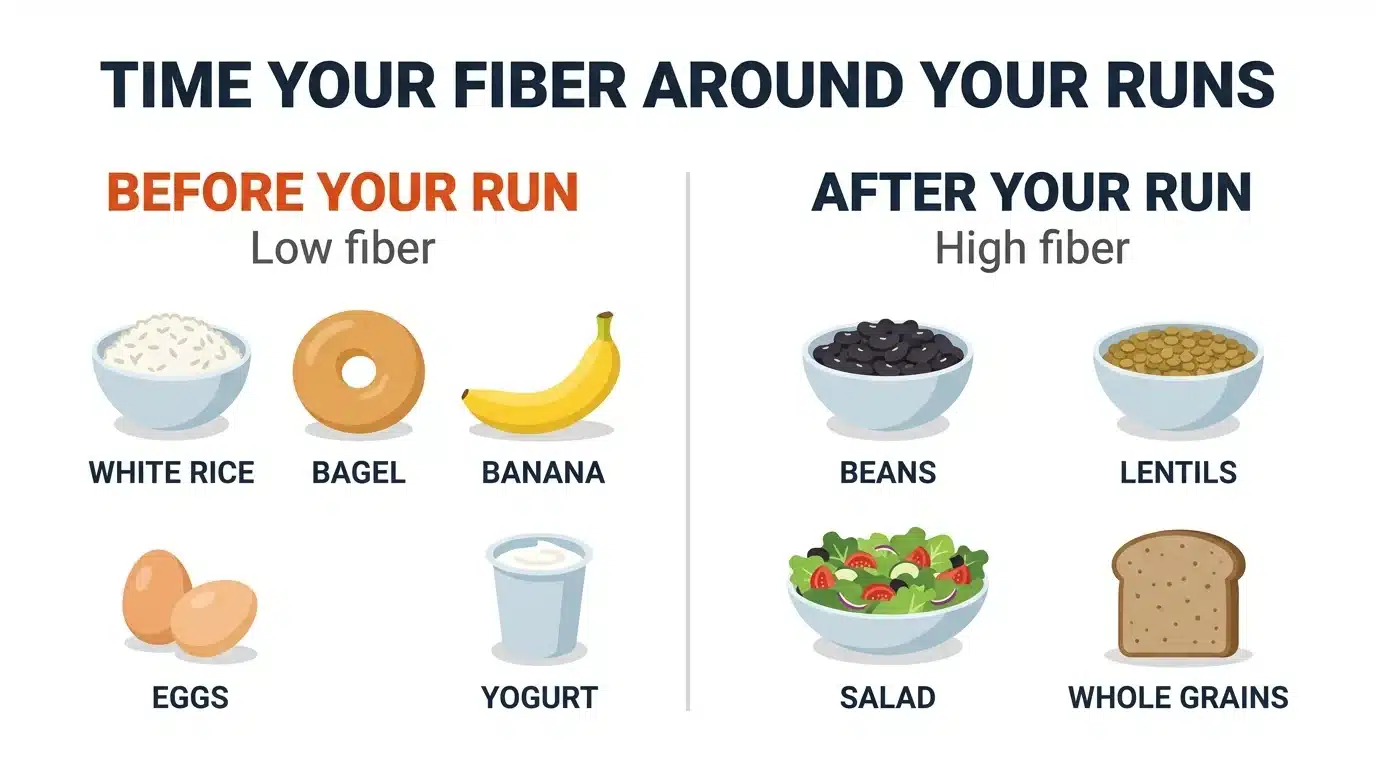
Before a long run, workout or race, eat foods with little fiber.
White rice, a bagel or white toast, a ripe banana, eggs and yogurt all work well.
Then eat the beans, lentils and big salads at the meals after your run and on easy days.
If your stomach still acts up on race day, cut back on fiber for the whole day before the race as well.
How Much Protein Do Vegetarian Runners Need?
Endurance runners need about twice the standard adult recommendation of 0.8 grams of protein per kilogram of body weight (0.36 g per lb).
A 2023 study of 15 endurance athletes found that after a 20 km (12.4 mile) run, the average athlete needed 1.6 grams of protein per kilogram (0.73 g per lb) a day to maximize protein building.
To cover almost every runner, the researchers recommended about 1.85 grams per kilogram (0.84 g per lb).
But the lacto-ovo vegetarian runners in that 2019 study of recreational runners averaged only 1.34 grams per kilogram (0.61 g per lb).
That means a 150 lb (68 kg) runner eating like them gets about 91 grams of protein a day.
That’s at least 18 grams short of the 109 grams the average athlete needed, and about 35 grams short of the recommended 126 grams.
So aim for 1.6 to 1.8 grams per kilogram (0.73 to 0.82 g per lb) a day.
For that runner, 3 eggs and a cup of Greek yogurt a day would close most of the gap.
Do You Need to Combine Proteins at Every Meal?
Eating a mix of protein foods across the day gives you all the amino acids you need.
Your body needs 9 essential amino acids from food, and most plant proteins are low in at least one of them, such as lysine in grains.
A 1994 review of plant protein in human nutrition concluded that mixtures of plant proteins can provide a complete and well-balanced supply of amino acids.
Those amino acids add up across all your meals, so beans at lunch and rice at dinner count toward the same daily total.
Eggs, milk, yogurt, cheese and soy each contain all 9 essential amino acids.
That makes protein easier to cover if you eat eggs and dairy than if you’re vegan.
Are Vegetarian Protein Foods as Good as Meat for Muscle Repair?
Eggs and lentils can build muscle protein about as well as meat, as long as each meal has enough protein.
A 2026 study of 65 young adults who lifted weights fed them eggs, egg whites, lentils, pork or salmon after a lower-body strength workout.
Each meal gave 0.25 grams of protein per kilogram of body weight (0.11 g per lb), and muscle protein building rose by a similar amount with every food.
The study tested a strength workout rather than a run, but it suggests that, at the same dose, eggs and lentils raise muscle protein building about as much as meat.
For a 150 lb (68 kg) runner, that’s about 17 grams of protein at each meal.
2 eggs on toast, a cup of Greek yogurt or a bowl of lentil soup topped with cheese gets you close to that amount.
How Can Vegetarian Runners Absorb More Iron?
Iron takes the most planning on a vegetarian diet, because plants supply only the form of iron that is harder to absorb than the iron in meat.
A 2018 analysis of 24 studies found that vegetarian adults had ferritin levels about 30 µg/L lower than meat eaters, with a larger gap in men.
Ferritin is the protein that stores iron, and low stores leave less iron for building the hemoglobin that carries oxygen to your muscles.
The US National Institutes of Health advises vegetarians to get 1.8 times the standard iron intake.
That works out to about 14 mg a day for men and 32 mg a day for women aged 19 to 50.
The habits below change how much of the iron in your food you absorb.
Should You Eat Vitamin C With Iron-Rich Foods?
Add a vitamin C food to your iron-rich meals, such as tomatoes, peppers, strawberries or a glass of orange juice.
Researchers testing iron absorption from bread meals found that 30 mg of vitamin C cancelled out the iron-blocking effect of the phytate in bran.
They estimated that at least 50 mg of vitamin C would be needed to offset a large dose of tannic acid, a compound similar to the polyphenols in tea.
A 4 oz (120 ml) glass of orange juice has more than 50 mg of vitamin C.
When Should You Drink Tea or Coffee?
Drink your tea at least an hour after an iron-rich meal instead of with it.
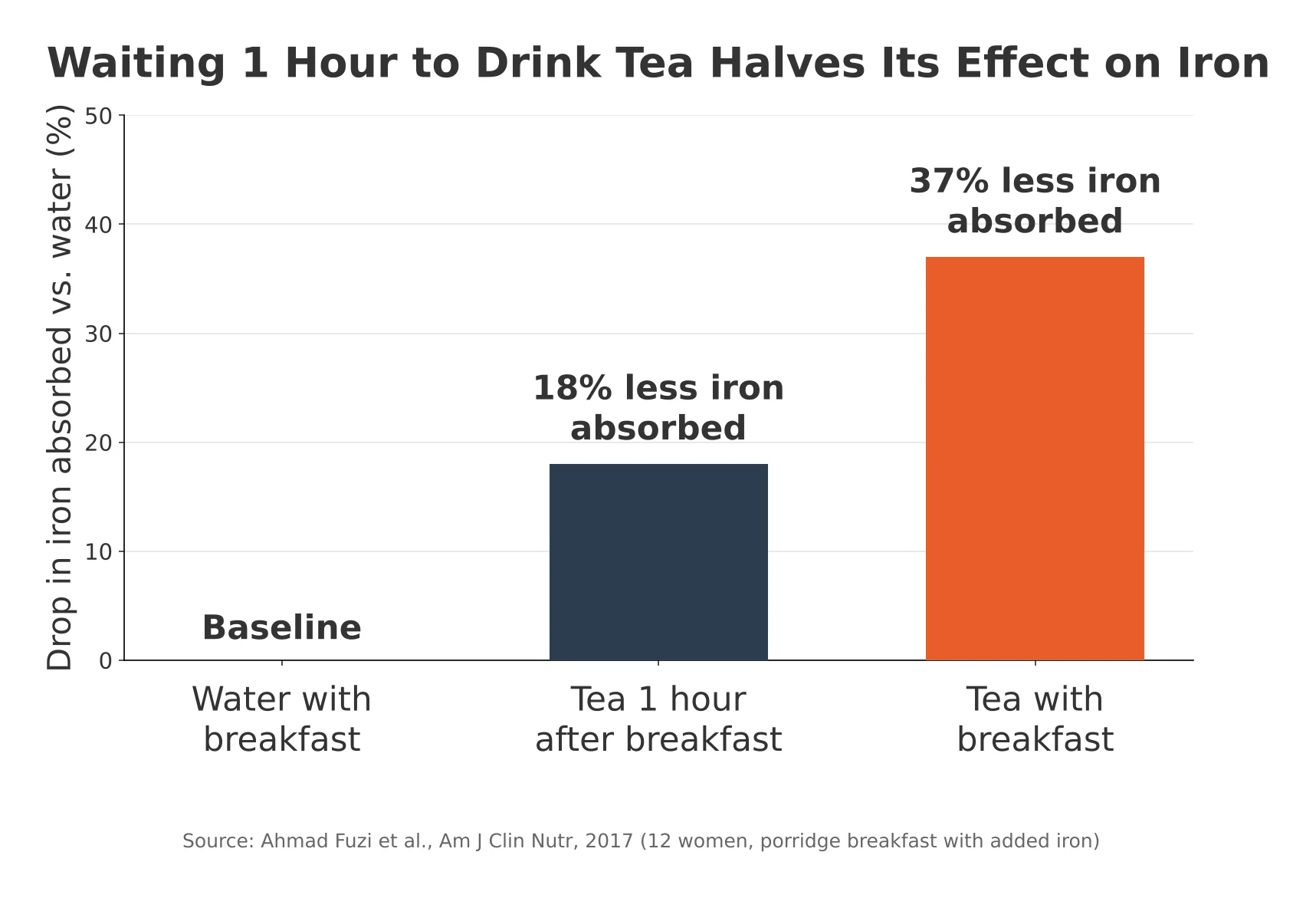
A 2017 study of 12 women found that tea served with a porridge breakfast cut iron absorption by 37% compared with water.
When they drank the tea 1 hour after the same breakfast, it cut absorption by only 18%.
The study only tested tea, but coffee also contains polyphenols, so giving your coffee the same gap is a sensible rule.
Does Running in the Morning Help You Absorb More Iron?
The meal you eat soon after a morning run is a good place for your most iron-rich food.
A 2019 study of 16 runners with ferritin below 50 µg/L absorbed more iron from breakfast 30 minutes after a 90-minute morning run than on a rest day.
They also absorbed more at that breakfast than at dinner later the same day.
That happened even though hepcidin, a hormone that blocks iron absorption, rose in the 3 hours after the run.
That means breakfast after a morning run is a better time for your most iron-rich food than dinner.
Does Dairy Block Iron Absorption?
You can keep milk with your meals.
A 2004 study of 14 women found that a glass of milk with each of 3 daily meals did not lower iron absorption across a 4-day diet.
If your ferritin is already low, our guide to iron deficiency in runners covers the signs to watch for and when a supplement makes sense.
RunnersConnect Bonus
No measuring, weighing, counting calories or macros. Use our simple guide to build healthy plant based meals to support your running and longevity!
Which Diet Changes Matter Most for Vegetarian Runners?
Here’s a recap of the 4 priorities and what to do about each one.
| Priority | Why vegetarian runners fall short | What to do |
|---|---|---|
| Calories | Fiber-rich foods fill you up before you’ve eaten enough | Add nut butters, cheese, eggs, olive oil and dried fruit |
| Fiber timing | Fiber-rich meals before a run raise the risk of intestinal cramps | Eat foods with little fiber in the meal before long runs, workouts and races |
| Protein | Lacto-ovo vegetarian runners averaged 1.34 g per kg (0.61 g per lb), short of what endurance runners need | Eat 1.6 to 1.8 g per kg (0.73 to 0.82 g per lb) a day from eggs, dairy, soy and lentils |
| Iron | Vegetarians average about 30 µg/L less ferritin than meat eaters, and plant iron is harder to absorb | Add vitamin C, drink tea an hour after iron-rich meals, and eat iron-rich food after morning runs |
For vitamin B12 and creatine, the other 2 nutrients that come mostly from animal foods, read our guide for vegan and vegetarian runners.


4 Responses
Great article. Thanks!
I’ve been vegan for a couple of years now. The one thing I would like to warn “new vegetarians” about is to avoid replacing meat with a ton of cheesy substitutes and creamy dressings. While as a vegan I don’t eat dairy when I took the first step by going vegetarian I started ordering black bean burgers with cheese and ranch dressing with my salad. I started gaining weight like crazy. Not good!
It’s a shame I didn’t know you when I first went to the dark side, or should I say “green side” as it took me a while to hone my diet.
Marty! Great comment! You are not alone with this discovery! Many people go vegetarian assuming it is automatically healthier, but there is a lot of processed vegetarian/vegan junk food out there. Not that cheese and ranch are necessarily junk food, but we often increase the amount of those foods to replace the “meat” of the meal. I am glad you feel like you have figured your diet out!
Have you felt your running improve since you have become vegan?
Thanks Abby! This is great information, and I’ve shared it with my fellow vegetarian runners.
Thanks for passing on the article Tracie! I am glad you found it helpful!