

The biggest mistake I see runners make is doing the same strength routine all year, or dropping it all together once training for the race is over.
But the weeks between races are the only time of year you can strength train to actually get stronger.
Once your next training block starts, the job of strength training shifts to holding on to what you built.
And because strength fades slowly, the strength you build in November can still be in your legs for a spring marathon.
So how much strength training should you do between races, and how little can you get away with once race training starts?
To give an evidence-based answer, let’s look at the research-backed practical advice on…
- Why heavy lifting 3 times a week for 8 weeks made runners 5% more efficient, and why you can only fit that in between races
- How one strength session a week kept almost all the strength people had built, 12 weeks later
- Why your aerobic fitness drops 7% in 12 days off while your strength holds for about a month
- The 3 strength training modes for your running year: build, maintain and taper
Why Can You Only Build Strength Between Races?
Getting stronger takes heavy lifting 2 to 3 times a week, with a little more weight added every week or two.
A 2008 study had well-trained runners add heavy half squats to their normal running, 4 sets of 4 reps, 3 times a week for 8 weeks.
Heavy half squats 3 times a week for 8 weeks increased runners’ maximum squat by 33% and improved their running economy by 5%, with no change in body weight.

Running economy is how much oxygen you use to run at a given pace.
That means the runners in the study used 5% less energy at the same pace, and they lasted 21% longer when running to exhaustion at a hard, fixed pace.
Three heavy sessions a week also leave your legs sore and tired.
During a marathon training block, that fatigue carries into your long runs and key workouts, so most runners cut back on lifting once race training starts.
In the weeks between goal races, your mileage is lower and your workouts are easier, so your legs have room to recover from heavy sessions.
The 6 to 8 weeks after your race are the one stretch of the year where you can lift 2 to 3 times a week and add weight every week.
How Long Does Strength Last After You Stop Lifting?
You might be wondering then if doing strength work now will have any benefit to your race in the spring.
And the answer may surprise you because strength fades much more slowly than most runners expect.
A 2001 review of studies on people who stopped training found that strength holds for up to 4 weeks with no strength training at all.
Researchers have even tested how little training it takes to keep strength for longer than that.
A 2024 study had young women who were new to training lift weights and do bike intervals twice a week for 12 weeks.
For the next 12 weeks, one group trained once a week, one group trained once every 2 weeks, and one group stopped completely.
One strength session a week, lifting the same weight, kept nearly all the strength built over 12 weeks of training, with leg press strength down just 1% another 12 weeks later.
The group that stopped lost 15% of their leg press strength over the same 12 weeks.
Even the group that trained once every 2 weeks kept about 96% of the strength they had gained.
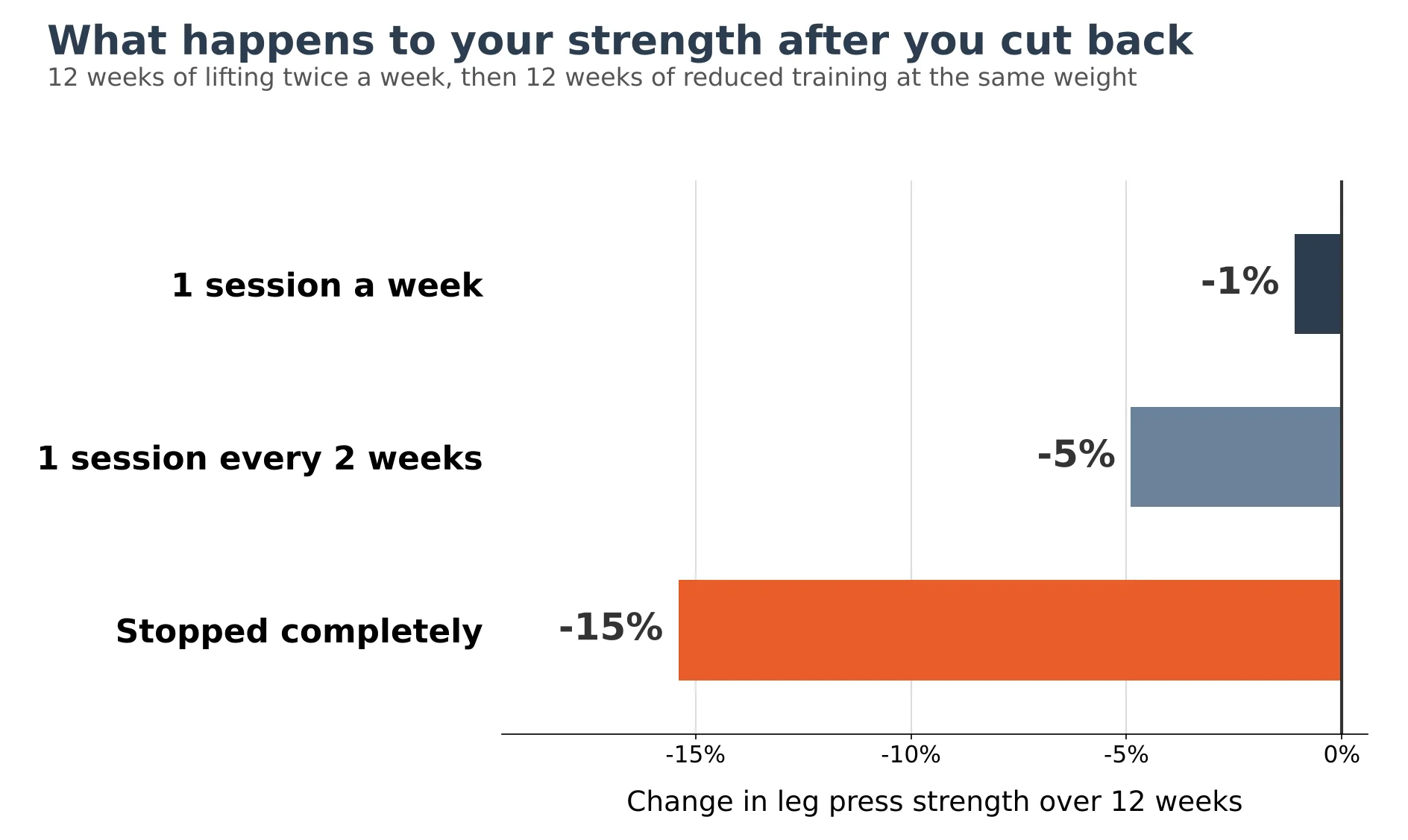
That means one strength session a week is enough to hold the strength you built between races through at least 12 weeks of race training.
The once-a-week group lifted the same weight they finished their training with, so keep your weights heavy and cut the number of sessions.
Why Does Your Aerobic Fitness Fade Faster Than Your Strength?
Your aerobic fitness works the other way around, fading within days of stopping.
A 2024 review of studies on endurance athletes who stopped training found that VO2max dropped 7% after 12 days off.
VO2max is the most oxygen your body can use during hard running.
Blood volume dropped 9% after 2 to 4 weeks off, and less blood means less oxygen delivered to your muscles at every pace.
That means 2 weeks off over the holidays costs your aerobic fitness far more than it costs your strength.
The good news is that the running fitness you lose over a short break also comes back quickly.
Coaches consistently see runners regain it within a few weeks of normal training.
So when your motivation is low between races, put your training into strength, because it takes weeks to build and fades slowly.
How Should You Strength Train Through the Rest of Your Year?
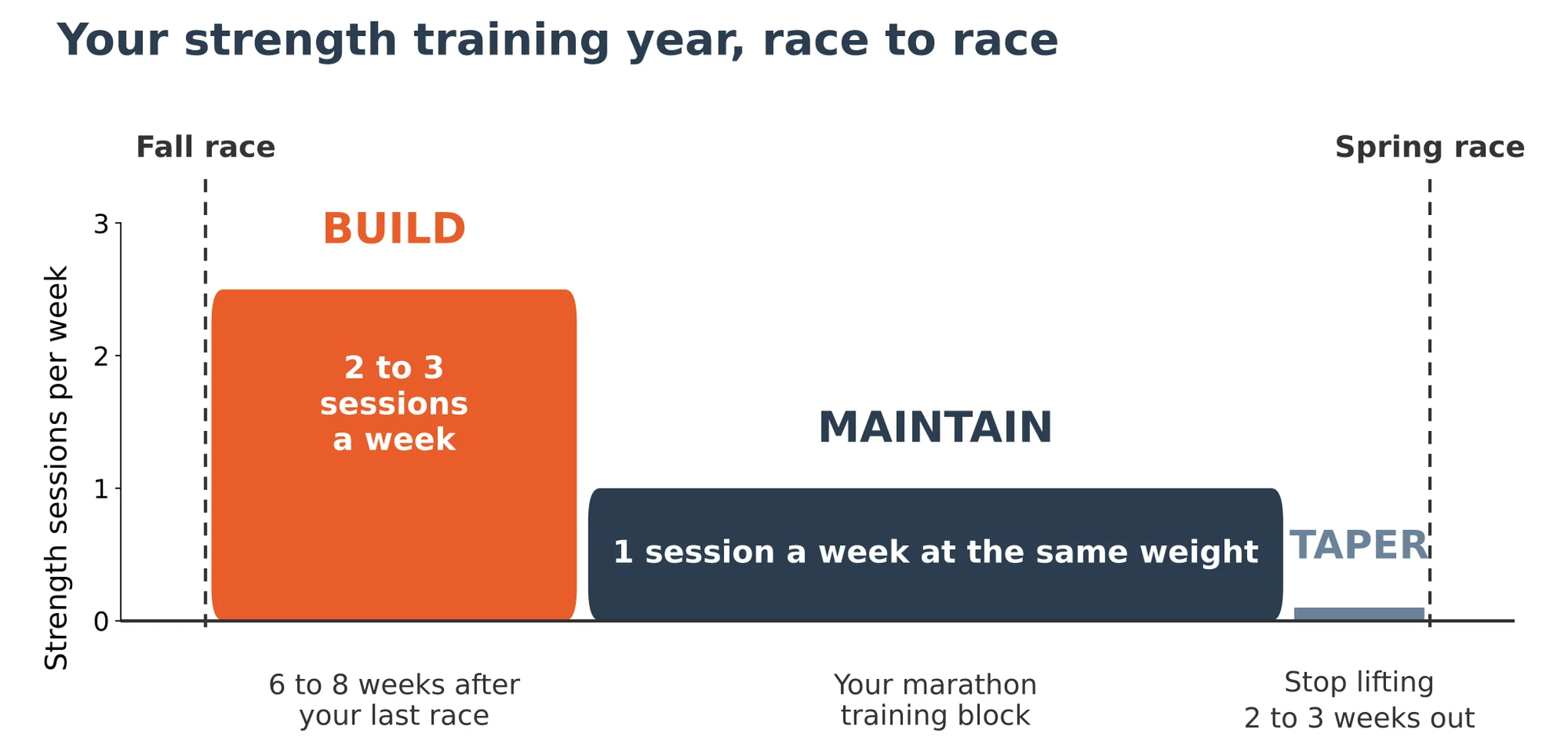
Your strength training should change with your race calendar, moving through 3 modes: build, maintain and taper.
How Much Should You Strength Train Between Races?
Between races, lift 2 to 3 times a week for 6 to 8 weeks.
Keep the reps low and the weight heavy, and add a little weight every week or two so your muscles keep adapting.
This is the mode that takes the most planning, because each week has to add weight without wrecking your running.
The 6 Week Strength Bootcamp is the done-for-you version of this block.
It gives you a daily schedule of strength workouts and runs, customized to your fitness level, age and training history, with no gym needed.
It costs $69, you can start anytime, and you get a full refund if you’re not happy after the first week.
It works best when your next race is at least 10 to 12 weeks away, which is where most runners are right after a fall marathon.
If you would rather spend this window building volume, the 6 Week Mileage Bootcamp builds your weekly mileage with a custom running schedule and still includes personalized strength workouts.
How Often Should You Strength Train During a Marathon Training Block?
Once race training starts, drop to one strength session a week.
Keep lifting the same weight you finished your between-race block with, the way the once-a-week group in the 2024 study did.
When Should You Stop Strength Training Before a Race?
Stop lifting 2 to 3 weeks before race day so your legs are fresh.
Your strength will hold through the taper, since strength lasts up to 4 weeks with no lifting at all.
Start Your Strength Training Block in the Weeks After Your Race
The weeks after your race are the only time of year you can strength train for gains.
Lift heavy 2 to 3 times a week for 6 to 8 weeks, and add weight every week or two.
Once race training starts, drop to one session a week at the same weight.
Stop lifting 2 to 3 weeks before race day, and the strength you built will still be there on the start line.
| Strength mode | When | Sessions per week | What to do |
|---|---|---|---|
| Build | The 6 to 8 weeks between races | 2 to 3 | Lift heavy and add weight every week or two. |
| Maintain | Your race training block | 1 | Lift the same weight you finished your between-race block with. |
| Taper | The last 2 to 3 weeks before your race | 0 | Stop lifting. Strength holds for up to 4 weeks. |