

You’ve been told to add hill sprints to your training and to find a “steep hill,” and you’re now standing at the bottom of the rise at the end of your street wondering if it counts.
Hill gradient is the number that settles it, and once you know what a 6% or a 10% grade looks like, you can check any hill with your watch or a map.
Short, all-out hill sprints are also a low-impact way for a distance runner to start speed work, because the slope lowers both your top speed and the impact force when your foot lands.
In this article, you’ll learn:
- What a hill’s gradient means and how a percent grade converts to degrees
- How steep a 6%, 10%, 20% or 40% hill is in real life
- How to find the gradient of any hill near you
- What hill sprints do for a distance runner’s speed and running economy
- Why sprinting uphill is easier on your hamstrings and joints than sprinting on the flat
- Which gradient to use, and a week-by-week plan for your first hill sprints
What Does a Hill’s Gradient Mean?
A hill’s gradient, also called its grade, is how much height you gain for every unit of distance you travel forward, written as a percentage.
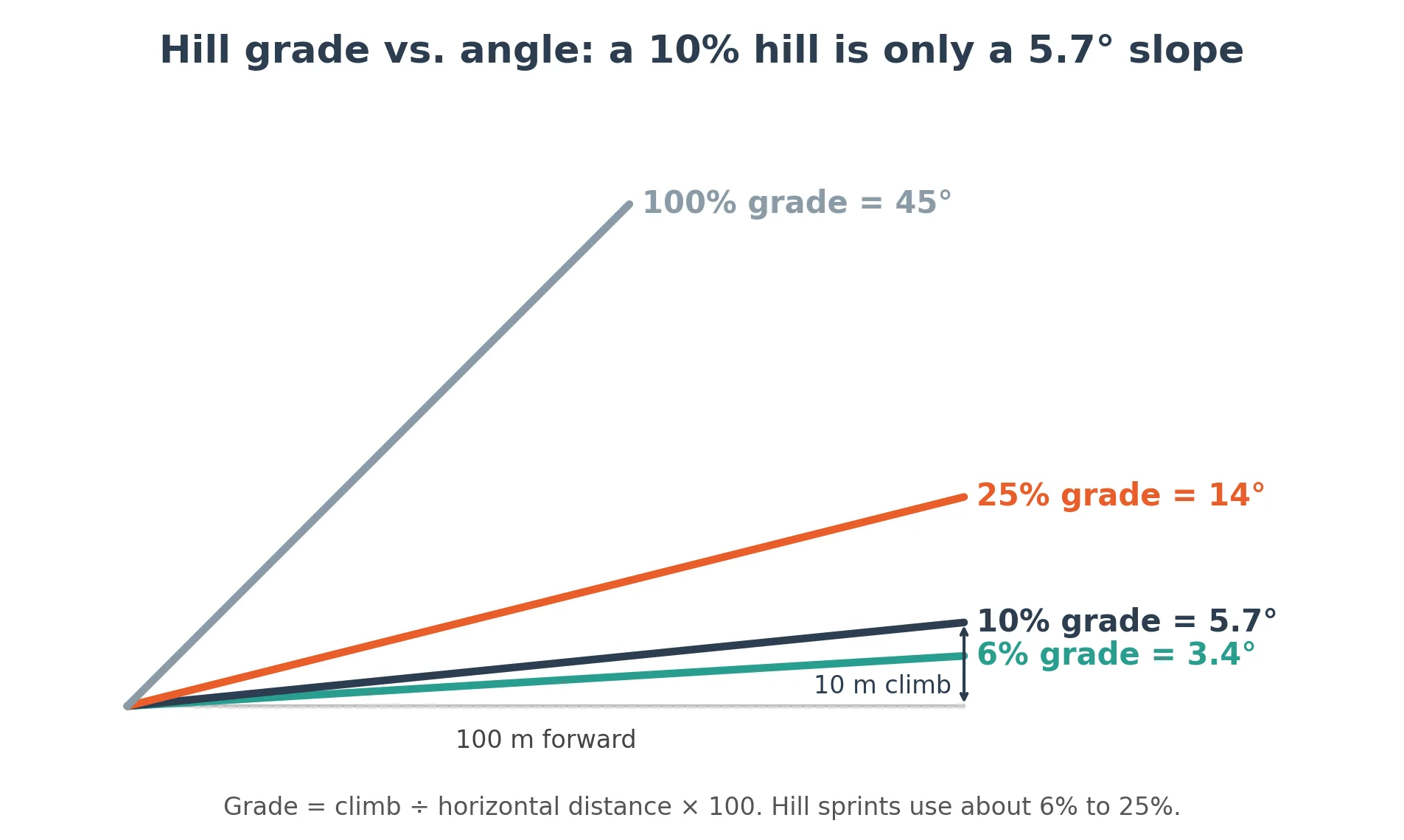
On a 10% grade you climb 10 meters for every 100 meters of horizontal distance, which is the same as 10 feet for every 100 feet.
Grade and angle are two different scales, and mixing them up makes a hill sound steeper than it is when you read about it.
A 100% grade means you climb as far as you travel forward, and that slope is only a 45-degree angle.
A 10% hill is a 5.7-degree slope, so a hill that looks gentle to the eye is often steep enough for hill sprints.
The table converts the grades you’ll see on GPS watches, treadmills and road signs into degrees and real climb.
| Grade | Angle | Climb per 100 m (or 100 ft) | What it means for a runner |
|---|---|---|---|
| 2% | 1.1° | 2 m (2 ft) | A slight rise you’d barely notice on an easy run |
| 6% | 3.4° | 6 m (6 ft) | The low end for hill sprints and a good first hill |
| 10% | 5.7° | 10 m (10 ft) | A steep road hill and the middle of the hill sprint range |
| 15% | 8.5° | 15 m (15 ft) | A common maximum treadmill incline |
| 25% | 14.0° | 25 m (25 ft) | The top of the useful hill sprint range |
| 35% | 19.3° | 35 m (35 ft) | The world’s steepest street |
| 100% | 45.0° | 100 m (100 ft) | A climb you’d scramble up with your hands |
How Steep Is a 6%, 10%, 20% or 40% Hill?
A 6% to 8% hill is a steady road climb that you can run up at easy pace without changing your stride much.
At 10% your stride shortens on its own during easy runs, and holding your usual easy pace pushes your heart rate up.
A 20% grade is steep enough that walking up it is hard work, and you’ll mostly find it on short residential streets, trails and ski slopes.
Anything at 35% or above is a record-book slope.
Baldwin Street in Dunedin, New Zealand holds the title of the world’s steepest street with a gradient of 34.8%, so a “40% grade hill” is steeper than any public road.
Gradient also changes how much energy each stride takes. A 2002 study of uphill and downhill running measured the energy cost of running on slopes from flat to 45% in 10 runners.
Running on a 45% slope cost 18.93 joules per kilogram per meter, more than 5 times the 3.40 joules per kilogram per meter the runners used on flat ground.
The equation from that study puts a 10% grade at about 65% more energy per meter than flat running, and a 20% grade at about 2.5 times the flat cost.
Each meter of a 10% hill costs about two-thirds more energy than a meter on the flat, so your legs have to produce more force on every stride at the same effort.
How Do You Find the Gradient of a Hill?
The fastest way to find a hill’s gradient is to run up it with a GPS watch. Strava also lists the average grade of every segment.
To work it out yourself, divide the climb by the horizontal distance and multiply by 100.
- Find the climb. Subtract the elevation at the bottom of the hill from the elevation at the top, using a mapping app, your watch, or a cycling route planner.
- Find the distance. Measure the length of the hill on the same map.
- Divide and multiply. A hill that climbs 8 meters over 100 meters has an 8% grade, and a hill that climbs 15 feet over 200 feet has a 7.5% grade.
Phone level apps usually give you an angle in degrees, so convert it with the table above. A 3-degree slope is about a 5% grade, and a 6-degree slope is about a 10.5% grade.
Average grade can hide a steep section. As an example, a 300 m hill listed at 5% may have a 50 m stretch at 9%, and that steep 50 m is the part you want for 8-second sprints.
A treadmill shows its incline as a grade too, so you can learn what a 6% or 10% slope feels like before you find one outside.
A 1996 treadmill study of 9 trained runners found that a 1% incline matched the energy cost of running on a flat road, because a treadmill has no air resistance to push through.
Set the treadmill to a 1% incline to match running on a flat road, because the belt removes the air resistance you’d face outside.
RunnersConnect Bonus
Download your FREE Treadmill Guide for Runners.
The guide contains 4 treadmill specific workouts guaranteed to keep you sane and fit! You’ll learn about the In-N-Out workout, how to “run like an Egyptian” and get my favorite “green eggs and ham” workout.
What Do Hill Sprints Do for a Distance Runner?
Hill sprints make your leg muscles produce more force on every stride than flat running at the same effort, which is why runners use them as a running-specific form of strength training.
Running uphill also recruits more of your leg muscle. A study using MRI scans found women running hard uphill used 73% of their leg muscle volume, compared with 67% during the same hard effort on the flat.
The vastus muscles on the front of the thigh were 23% more active uphill, and the soleus in the calf was 14% more active.
That extra force carries over to your running economy, the amount of oxygen you use to hold a given pace.
Research has shown that 6 weeks of uphill interval training improved 5 km time trial performance by 2.0%, and the hardest uphill intervals improved running economy by 2.4%.

For a runner with a 25:00 5K, a 2.0% improvement is about 30 seconds.
Steeper hills gave the biggest gains in a 2025 trial of 40 young middle-distance runners, which compared 8 weeks of uphill training on 2.5%, 5.1% and 7.6% gradients with a control group.
The 7.6% group improved its 30 m sprint speed, 800 m time trial and strength endurance compared with the control group, and the 5.1% group improved only its 800 m time.
Those runners were 16 to 20 years old, but the result fits the advice for adults too: a hill of about 7% to 8% trains your legs more than a 2% or 3% rise on a normal road route.
For more on the speed and power side of this workout, see how explosive hill sprints build sprint speed once you’re past the beginner stage.
Are Hill Sprints Safer Than Sprinting on Flat Ground?
Sprinting uphill lowers two of the loads that cause the most trouble for distance runners who start speed work, which are the impact of each landing and how hard your hamstrings work.
A study of uphill running found the impact force peak at landing disappeared at a 9-degree slope, while the push-off force rose 75%.
A 9-degree slope is a 15.8% grade, and the runners in that study ran at 3 meters per second, which is 8:56/mi (5:33/km), so the drop in impact was measured at an easy running pace.
Your hamstrings also do less work. A comparison of fast running on a 30% treadmill incline and on the flat found lower hamstring activity uphill, along with higher activity in the calves, quadriceps and glutes.
A case study that recorded a hamstring strain as it happened placed the injury in the late swing phase.
That’s the moment the hamstring is stretched as it slows the leg before the foot lands.
That runner was on a 15% treadmill incline at 5.36 meters per second, about 5:00/mi (3:07/km), so a slope lowers the load on your hamstrings without removing the risk of a strain.
That’s why you warm up fully and sprint at about 95% of your maximum effort instead of an all-out 100%.
The trade-off is extra work for your calves and Achilles tendons, and that’s the reason to start with 1 or 2 sprints and add them slowly.
On the way up, stay tall through your hips and pump your arms hard while your stride shortens with the slope.
Those are the same cues that help when running uphill on any run.
How Steep Should Your Hill Be for Hill Sprints?
A 6% to 8% grade is the right hill for your first hill sprints, and you can move to 10% after 2 to 3 months of regular sessions.
Hill sprints for distance runners use gradients between about 6% and 25%, and the gradient you pick depends on how long you’ve been doing them.
- 6% to 8%: Steep enough to slow your top speed and reduce landing impact, and gentle enough that your stride still looks like running. Start here.
- 10% to 15%: More force on every stride and more work for your calves. Move here after 2 to 3 months of sessions on a 6% to 8% hill.
- Above 20%: Your stride turns into a short, choppy climb, which builds strength but trains you less for running fast on the flat.
Pick a hill between 6% and 8% for your first hill sprints, with at least 50 m of steady slope and a smooth surface.
Your hill also needs to be long enough. At 5 to 6 meters per second, 4:28 to 5:22/mi (2:47 to 3:20/km), an 8-second sprint covers 40 to 50 m, so you need at least 50 m of steady slope without a flat section or a sharp bend.
Choose a smooth paved road, path or firm grass surface, because loose gravel and wet grass make you slip during the hardest part of each push-off.
How Should a Beginner Start Hill Sprints?
Start with 2 sprints of 8 seconds on a 6% to 8% hill, twice a week, and add 1 or 2 sprints a week until you reach 10 per session.
Your first 2 sprints will feel too easy.
If you’ve never done maximal sprinting, your calves, Achilles tendons and hamstrings need a few weeks to adapt to the force. Soreness from adding too many sprints too soon shows up 1 to 2 days later.
- Warm up first. Run 1 to 2 miles (1.6 to 3.2 km) at easy pace on flat ground, then do a few dynamic drills such as leg swings and walking lunges.
- Sprint for 8 seconds. Run up the hill at about 95% of your maximum effort, staying tall and driving your arms.
- Walk back down. Recover fully between sprints, which takes 2 to 3 minutes, so every sprint covers about the same distance.
- Stop while the sprints are still fast. End the session when a sprint covers less ground than the first one, even if you haven’t hit your planned number.
- Cool down. Finish with 10 to 15 minutes of easy running.
Add the hill sprints to the end of an easy run, or do them as a short session of their own on an easy day.
Keep at least 1 easy day between hill sprints and your next hard workout.
Once you can do 10 sprints of 8 seconds twice a week, stretch each sprint to 10 seconds. About a month later, move to a 10% hill, and a month after that stretch each sprint to 12 seconds.
Add only 1 or 2 sprints each week, and stop any session as soon as your sprints slow down.
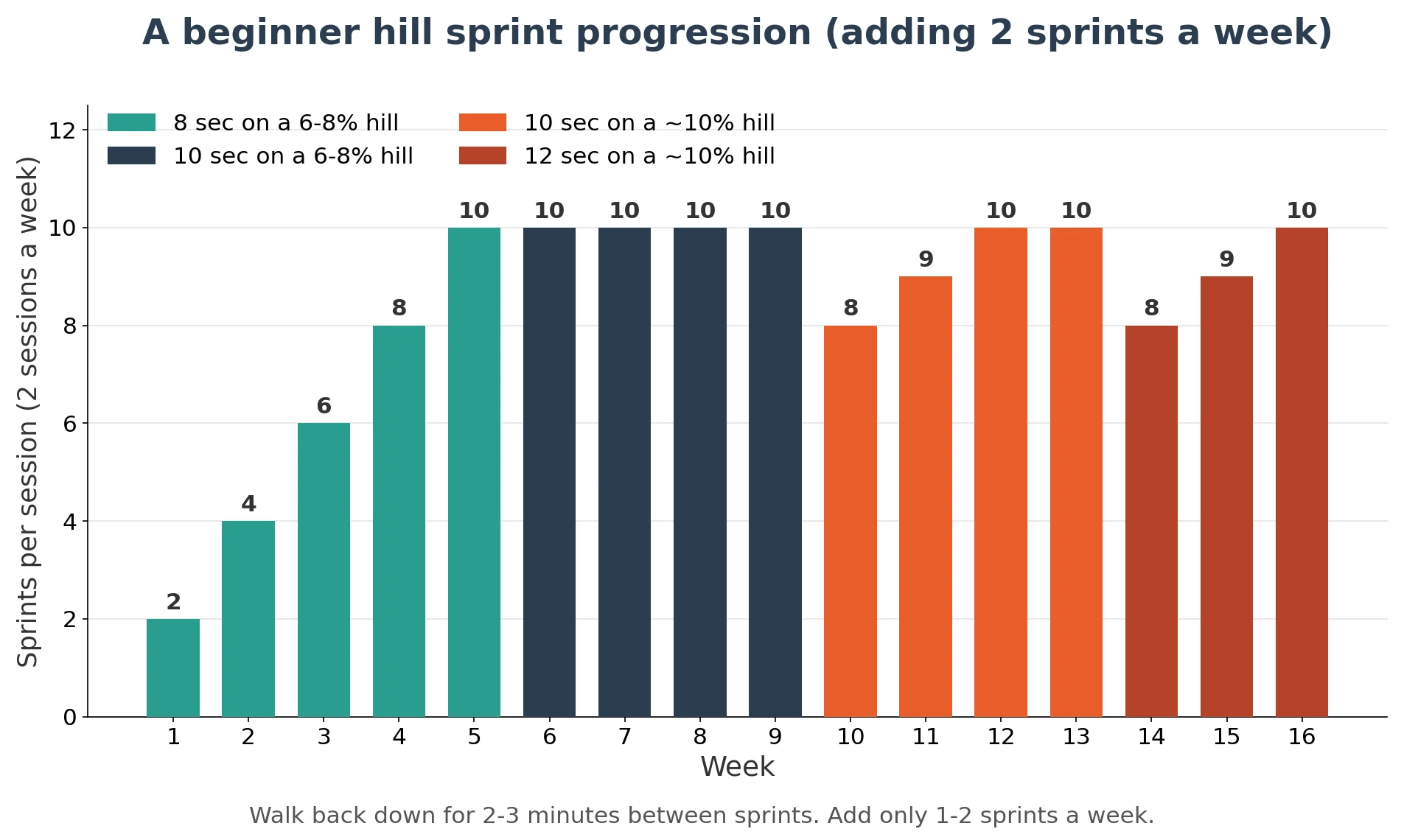
Here is the full progression in one table.
| Weeks | Sprints per session | Sprint length | Hill gradient | Sessions per week |
|---|---|---|---|---|
| 1 | 2 | 8 seconds | 6% to 8% | 2 |
| 2 to 9 | Add 1 to 2 a week, up to 10 | 8 seconds | 6% to 8% | 2 |
| Next 4 weeks | 10 | 10 seconds | 6% to 8% | 2 |
| Next 4 weeks | 8 to 10 | 10 seconds | About 10% | 2 |
| After that | 8 to 10 | 12 seconds | About 10% | 2 |