

Double threshold training means running two threshold interval sessions on the same day, one in the morning and one in the afternoon, usually twice a week.
Jakob Ingebrigtsen and the Norwegian method made it the most talked-about workout structure in distance running, and it has been linked to the wave of fast times over the past few years.
The pitch is that splitting your threshold work into 2 sessions lets you run more total minutes at threshold than you could in 1 session, with less fatigue afterward.
The problem is that the runners I coach have full-time jobs and maybe 60 minutes a day to train, so two 90-minute windows separated by 6 hours of eating and napping aren’t realistic.
The good news is that you can get the main benefit of double threshold training from workouts you probably already know, run as a single session.
In this article, you’ll learn:
- What a double threshold day looks like for elite runners, with the sessions they run
- Why splitting threshold work into smaller blocks lowers heart rate and lactate for the same total work
- 5 double threshold style workouts you can run in one session
- A 12-week progression for building up to them
What Is Double Threshold Training?
Double threshold training is two separate threshold interval sessions run on the same day, typically with 4 to 6 hours of recovery between them.
Threshold is the fastest pace you can hold before lactate starts to build up quickly in your blood, which falls between 10k and half marathon race pace for a typical non-elite runner.
Norwegian coaches control that intensity with a finger-prick blood lactate test every 1 to 3 repetitions, instead of holding a set pace on the watch.
A 2023 review of the Norwegian model found that world-class runners using it complete 3 to 4 lactate-guided threshold sessions and 1 VO2max session each week, holding blood lactate between 2 and 4.5 mmol/L, inside 150 to 180 km (93 to 112 miles) of weekly running.

That means the double threshold days take up about 2 days of the week, and most of the remaining running is done at an easy pace.
The review’s explanation is that keeping lactate in the threshold zone causes less fatigue than VO2max intervals at 5k pace or faster, so the athletes recover in time to repeat these sessions several times a week.
RunnersConnect Bonus
Download our Heart Rate Calculator to find out what your individual heart rate zones are.
What Does a Double Threshold Day Look Like?
On a typical elite double threshold day, the morning session uses reps of 6 minutes or 2 km, and the afternoon session uses reps of 400 m to 1,000 m.
- Morning: 5 x 6 minutes or 5 x 2 km at the lower end of threshold, around 2 to 3 mmol/L, with about 60 seconds of recovery between reps.
- Afternoon: 10 x 1,000 m or 20 to 25 x 400 m at the upper end of threshold, around 3 to 4 mmol/L, with 30 to 60 seconds of recovery.
Every rep in both sessions is run slower than 5k race pace, which is why elite runners can repeat a day like this twice a week and still recover in time for their next hard day.
Those sessions sit on top of 100+ miles (160+ km) per week and years of accumulated volume, and the athletes schedule naps and meals so they recover between the 2 workouts.
Take away that support structure and the same 2 sessions produce a lot more fatigue than they do for a full-time athlete.
Why Does Splitting Threshold Work Into 2 Sessions Help?
The benefit of double threshold training comes from breaking a large block of threshold work into 2 or more segments, with recovery between them.
When you run 6 continuous miles at threshold pace, your heart rate drifts upward and lactate builds faster than your body clears it, so the last 2 miles take more effort for the same pace.
Splitting that work lets each block start at the heart rate you had before the first one, which keeps more of your running at the intensity that improves your lactate threshold.
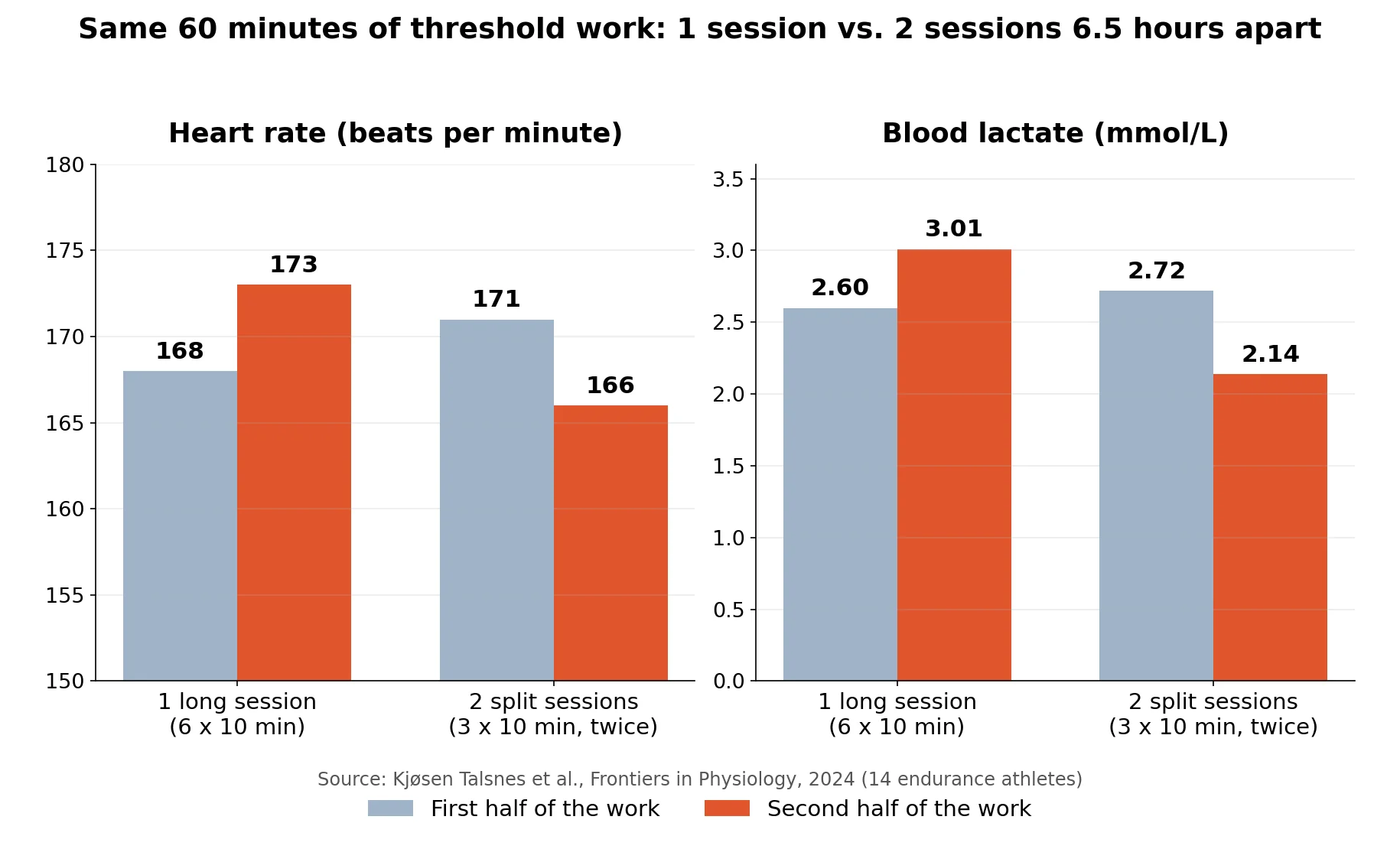
A 2024 crossover trial had endurance athletes run the same 60 minutes of threshold intervals either as 1 session or as 2 sessions 6.5 hours apart. Heart rate and blood lactate rose in the second half of the single session and dropped in the second half of the split day.
An hour after finishing, the athletes’ resting heart rate was 65 beats per minute after the single session and 61 beats per minute after the split sessions.
They also rated the single session as harder, 7 out of 10 against 6 out of 10, and reported more fatigue and muscle soreness the next morning.
That means the same amount of threshold work caused less fatigue when it was broken up, which leaves more room to repeat it later in the week.
Should Everyday Runners Try Double Threshold Days?
For a runner training 30 to 50 miles (48 to 80 km) per week, a second threshold session on the same day adds more fatigue than fitness.
The second session suffers because there isn’t enough time to recover between efforts, and the fatigue from two hard sessions in one day carries into the next 48 hours of training.
The easy mileage underneath the elite program matters as much as the threshold days themselves.
A study of 85 elite and world-class distance runners found that the total distance they ran at an easy pace was one of the strongest predictors of their race performances over their first 7 years of training, along with tempo runs and short intervals.
That means copying the elite hard days without their easy volume leaves out the part of the training that best predicted how fast those runners became.
The pattern I see most often is runners lasting 2 to 3 weeks of double threshold before something breaks down, either from the fatigue accumulation or from trying to cram recovery into a schedule that doesn’t have room for it.
Masters runners over 40 need even more recovery time between hard efforts, so the fatigue from double days catches up with them within fewer weeks.
The barrier is logistical, and the mechanism behind double threshold works when you build the same structure into a single workout.
How Can You Get Double Threshold Benefits in One Workout?
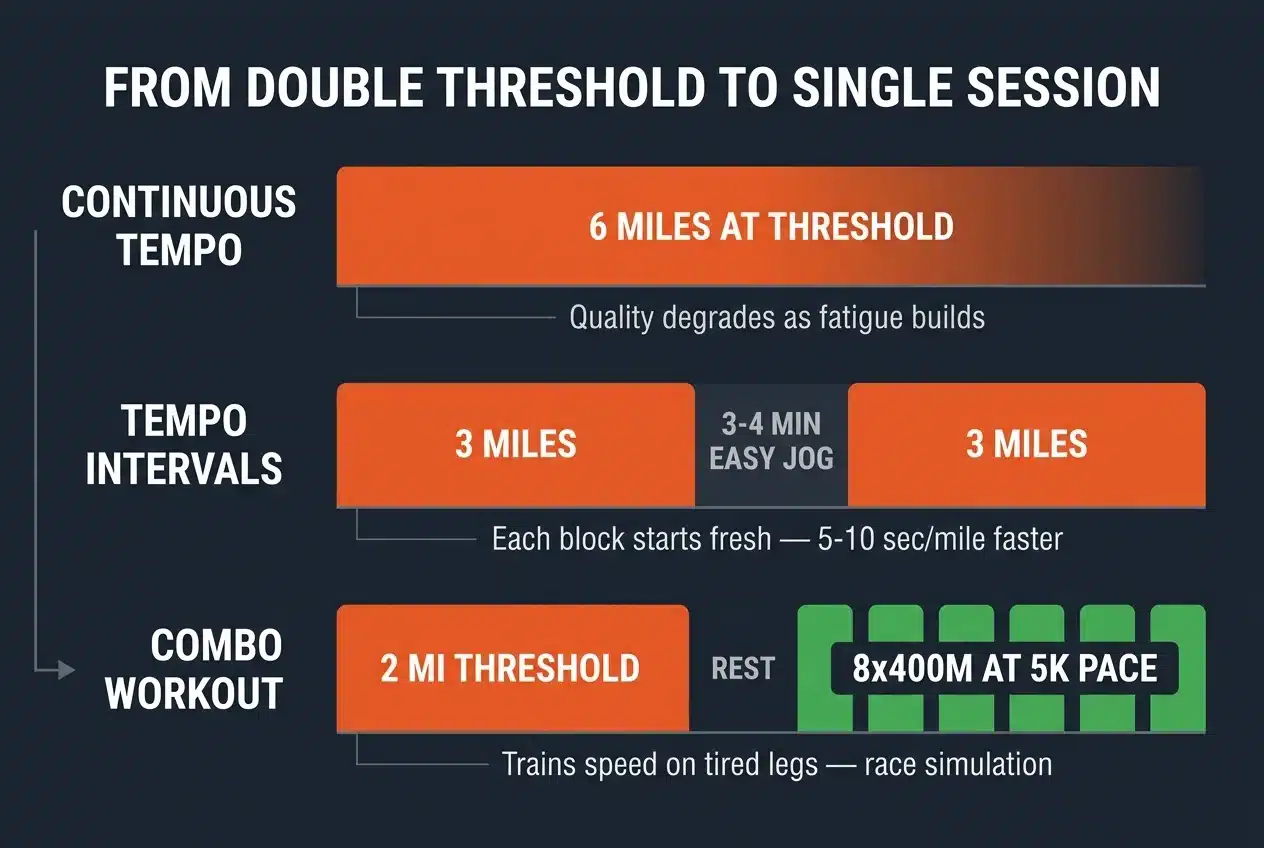
Tempo intervals and combo workouts split your threshold work into fresher blocks the same way a double threshold day does, with minutes of recovery instead of hours.
What Are Tempo Intervals?
If you’ve ever broken a tempo run into 2 or 3 segments with a few minutes of easy jogging between them, you’ve already run a version of double threshold training.
Instead of 6 continuous miles at threshold pace, you run 2 x 3 miles or 3 x 2 miles at the same intensity, with 3 to 4 minutes of easy jogging between blocks.
Your heart rate drops during each jog and some of the lactate clears, so each block starts from a fresher point than the last mile of a continuous tempo.
The runners I coach typically run 5 to 10 seconds per mile (3 to 6 seconds per km) faster in tempo intervals than they can sustain during a continuous tempo of the same total distance.
That means more of your total minutes are spent at true threshold pace, instead of fading below it in the last third of a continuous run.
These 3 tempo interval workouts are the closest single-session versions of a double threshold day:
- 2 x 3 miles (2 x 4.8 km) at threshold with 3 to 4 minutes of easy jogging: the closest parallel to a morning and afternoon session, with a mental and physical break at halfway.
- 3 x 2 miles (3 x 3.2 km) at threshold with 3 minutes of easy jogging: you can hold a quicker pace on 2-mile blocks than on 3-mile blocks, which suits a sharper threshold session.
- 3 miles, 2 miles, 3 miles at threshold with 3 minutes of easy jogging: the shorter middle block gives you a mental reset before a strong final effort.
What Are Combo Workouts?
Combo workouts add something a double threshold day doesn’t train, which is the ability to run fast on tired legs.
You run 2 to 3 miles at threshold pace, take a short rest, then switch to shorter intervals at 5k pace or faster, so the speed work starts when your legs are already fatigued from the threshold block.
That matches the last 2 to 3 miles of a half marathon or marathon, where you have to hold pace or kick with an hour or more of running already in your legs.
- Threshold sandwich: 2 miles (3.2 km) at threshold, 2 minutes rest, 8 x 400 m at 5k pace with 90 seconds of jogging, 2 minutes rest, then 2 more miles at threshold.
- Front-loaded combo: 3 to 5 miles (4.8 to 8 km) at threshold, 3 minutes rest, then 4 to 6 x 1 minute at 5k pace with 1 minute of rest.
If you’re struggling in any part of a combo workout, slow the target pace to something you can hold, because finishing the full structure 5 to 10 seconds per mile (3 to 6 seconds per km) slower does more for you than stopping halfway through the speed portion.
How Do You Build Up to Double Threshold Workouts?
Progress from continuous tempo runs to tempo intervals first, and add combo workouts only after the interval format feels routine.
If you already run continuous tempos of 3 to 5 miles (4.8 to 8 km), you have the base you need, and the first step is adding a rest break.
Weeks 1 to 4: How Do You Turn a Tempo Run Into Tempo Intervals?
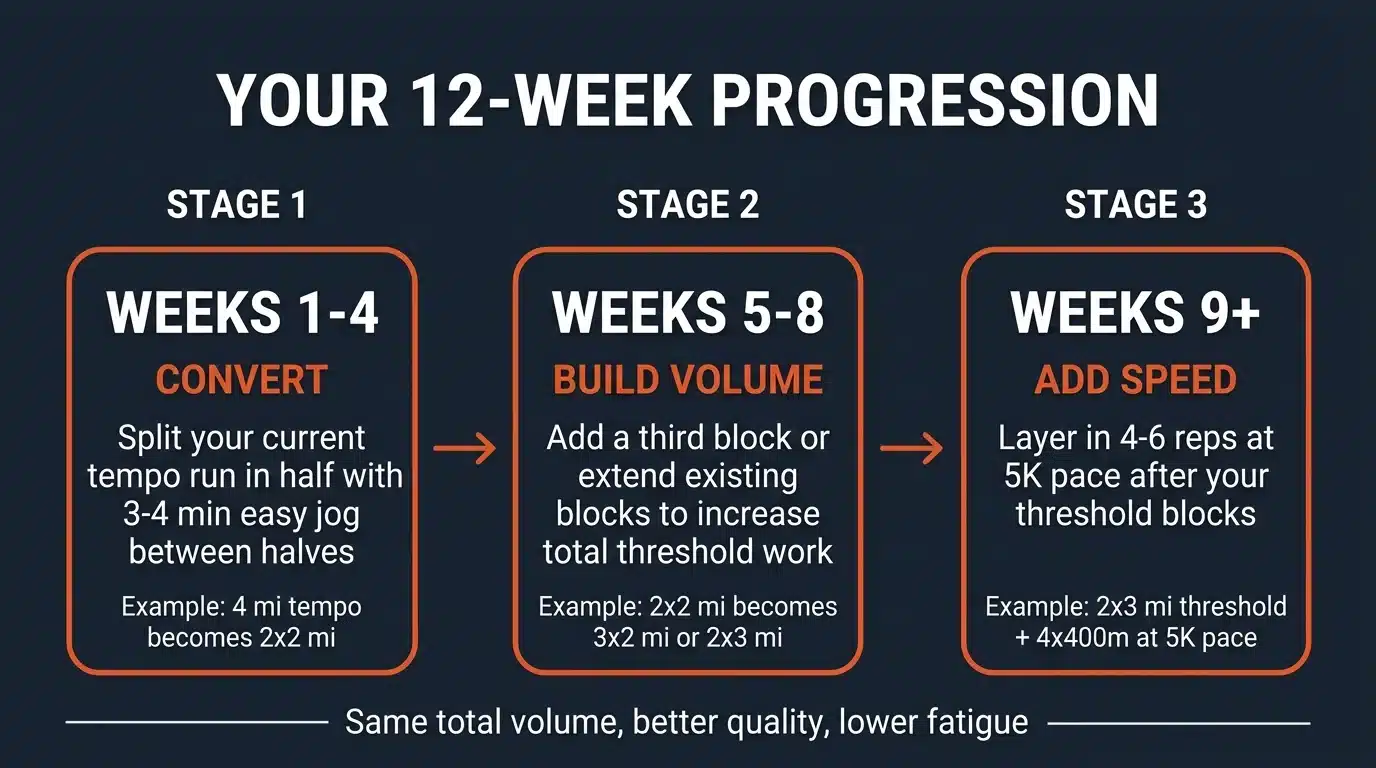
Take the tempo distance you run now and split it in half, with 3 to 4 minutes of easy jogging between the 2 blocks.
As an example, a 4-mile tempo becomes 2 x 2 miles (2 x 3.2 km) at the same pace with 3 minutes of easy jogging between sets, so your total threshold volume stays the same.
Weeks 5 to 8: How Much Threshold Volume Should You Add?
Once the interval format feels manageable, add a third block or lengthen the ones you have, moving from 2 x 2 miles to 3 x 2 miles and then to 2 x 3 miles over about a month.
The interval format lets you increase total threshold volume without the proportional increase in fatigue that a continuous tempo of the same total distance would create.
Weeks 9 and Beyond: When Should You Add Speed Work?
After 8 weeks of tempo intervals, add 4 x 400 m at 5k pace with 90 seconds of recovery after your threshold blocks, which introduces the speed work without overloading your legs.
Runners who jump straight to combo workouts without that base usually run the threshold portion too hard and have nothing left for the speed work.
Here’s a quick reference for each workout format and when to use it.
| Workout | Structure | Best used when |
|---|---|---|
| Elite double threshold day | AM 5 x 6 min, PM 10 x 1,000 m at threshold | You run 100+ miles (160+ km) per week with a flexible schedule |
| 2 x 3 miles | 2 x 3 mi (4.8 km) at threshold, 3 to 4 min jog | You’re converting a continuous tempo for the first time |
| 3 x 2 miles | 3 x 2 mi (3.2 km) at threshold, 3 min jog | You want to run threshold a few seconds per mile faster |
| 3-2-3 miles | 3 mi, 2 mi, 3 mi at threshold, 3 min jog | You’re building to higher threshold volume |
| Threshold sandwich | 2 mi threshold, 8 x 400 m at 5k pace, 2 mi threshold | You’re in a half marathon or marathon block |
| Front-loaded combo | 3 to 5 mi threshold, 4 to 6 x 1 min at 5k pace | You’re adding speed work after week 9 |