

Your mileage has been dropping for 2 weeks when a friend invites you on one last 18-miler.
Or you missed Sunday’s long run and made it up on Wednesday.
The extra miles feel like the responsible choice, a way to protect the fitness you spent 4 months building.
Strava data from more than 158,000 marathoners links weeks like that to slower races.
Runners whose mileage fell every week for the final 3 weeks were linked to a median finish 5 minutes 32 seconds faster than runners who barely tapered.
About 2 in 3 marathoners let their mileage rise again partway through the taper, and they finished slower than runners who kept cutting.
So, in this article you’re going to learn the research-backed practical advice on the marathon taper mistake that can add up to 8 minutes to your finish time:
- What a disciplined taper is worth at your finish time, from 3:00 to 5:00
- Why 69% of marathoners run a “relaxed” taper, and the 3 habits that create one
- Why a rest-only taper produced no gain in trained runners, while a high-intensity taper increased their time to exhaustion by 22%
- How much to cut each week, and why a 30% cut and an 80% cut both failed in the same trial
- What your last workout should look like, including the one I ran 4 days before my best marathon
Where Do the 5 to 8 Minutes Come From?
A disciplined marathon taper is linked to a finish roughly 2.4% to 3.2% faster, which works out to 5 to 8 minutes for a 3:30 to 4:30 marathoner.
A 2021 analysis of 158,000 marathoners’ Strava logs found that a strict 3-week taper was linked to a median finish 5 minutes 32 seconds faster, or 2.6% of finish time, than a minimal taper.

The runners trained for marathons between 2014 and 2017 and averaged about 3.5 runs a week, so they were everyday marathoners fitting training around the rest of their lives.
The minimal taper the researchers measured against was itself a relaxed taper: a single week of reduced mileage that didn’t fall in the final week before the race.
That means the shortest relaxed taper gives up the full benefit, while a relaxed taper of normal length gives up about 1 to 1.5 minutes of it.
Women gained more than men.
With a strict 3-week taper, men gained a median 2.38% of finish time and women gained 3.19%.
For a 4:00 marathoner, a strict 3-week taper was linked to a benefit of 5 minutes 43 seconds for a man and 7 minutes 39 seconds for a woman.
| Marathon finish time | Men (2.38% benefit) | Women (3.19% benefit) |
|---|---|---|
| 3:00 | 4 min 17 s | 5 min 45 s |
| 3:30 | 5 min 00 s | 6 min 42 s |
| 4:00 | 5 min 43 s | 7 min 39 s |
| 4:30 | 6 min 26 s | 8 min 37 s |
| 5:00 | 7 min 08 s | 9 min 34 s |
Runners whose mileage climbed back up partway through the taper gained less of that time, even when their taper lasted just as long.
What Is a Relaxed Taper, and Why Do Most Runners Run One?
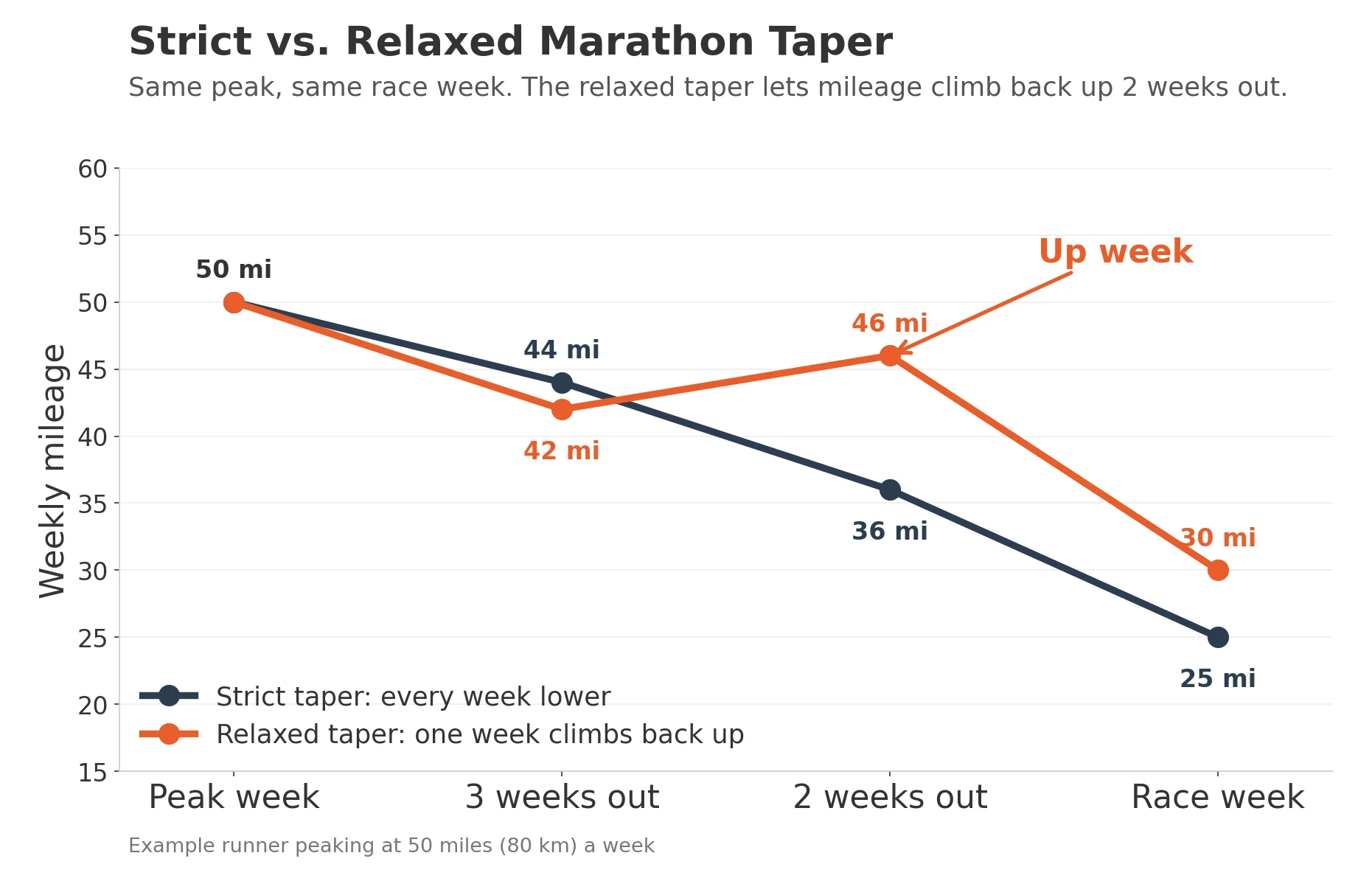
A relaxed taper is any taper where a week of lower mileage is followed by a week of higher mileage before race day.
The 2021 analysis split every runner’s final 4 weeks into down weeks, where total distance dropped, and up weeks, where it rose.
A strict taper puts its down weeks back to back, right up to the race, so mileage never climbs once the cut begins.
A relaxed taper has at least one up week that falls between the start of the cut and the start line.
As an example, a runner whose final 4 weeks go 50, 42, 46 and 30 miles (80, 68, 74 and 48 km) has run a relaxed taper.
Race week is still the lightest week, so the plan looks normal on paper.
About 69% of the runners in the data ran a relaxed taper.
Only about 31% kept every week lower than the one before.
In practice, the up week usually comes from one of 3 habits:
- The make-up run. A cold, a work trip or bad weather wipes out a long run, and the runner adds it back the following week to stay on plan.
- The confidence week. After 2 weeks of reduced mileage the legs feel heavy, so the runner squeezes in one more big week to prove the fitness is still there.
- The tune-up race. A half marathon 3 weeks out, plus a warm-up, cool-down and the usual weekend miles, pushes that week above the week before it.
Each habit adds training back at the point where your legs should be recovering from peak training.
Once your mileage starts coming down, no later week of the taper should be bigger than the one before it.
RunnersConnect Bonus
Download your FREE Marathon Nutrition During Your Taper Guide.
The guide contains a plan of exactly what you should be eating in the 5 days to 3 hours before your race. We give specific food recommendations to make sure you are ready on race day.
How Much Does a Relaxed Taper Cost You?
A relaxed taper was linked to finishing about 1 to 1.5 minutes slower than a strict taper of the same length.
The 2021 analysis compared every taper type after controlling for each runner’s sex and 10K training pace, so faster runners couldn’t skew the comparison.
A relaxed 2-week taper was linked to finishing 2.3 minutes faster than the minimal taper.
A strict 2-week taper was linked to finishing 3.7 minutes faster, and a strict 3-week taper to finishing 4.2 minutes faster.
That means 2 weeks of reduced mileage were linked to about 1.4 more minutes of benefit when they came back to back, right before the race.
Men and women both gained less from a relaxed 2-week taper than from a strict one.
Men on a relaxed 2-week taper gained a median 1.29% of their finish time, and men on a strict 2-week taper gained 2.14%.
Women on a relaxed 2-week taper gained 2.19%, and women on a strict 2-week taper gained 3.12%.
A strict taper adds no workouts and was linked to finishing about 1.4 minutes faster than a relaxed 2-week taper.
The study observed what runners chose to do, so it can’t prove the order of their weeks caused the difference in finish times.
Runners with strict tapers also had higher peak mileage than runners with relaxed tapers, which could mean more experienced marathoners are more likely to taper this way.
The researchers only counted each runner’s fastest marathon of the year, which could make every taper look a little better than it would across all of a runner’s races.
The second way a taper goes wrong shows up in controlled trials on trained runners, where the taper removed the hard running.
Why Does Turning the Taper Into Rest Backfire?
A taper that becomes rest produced no performance gain in trained runners and began to reverse some of their training adaptations.
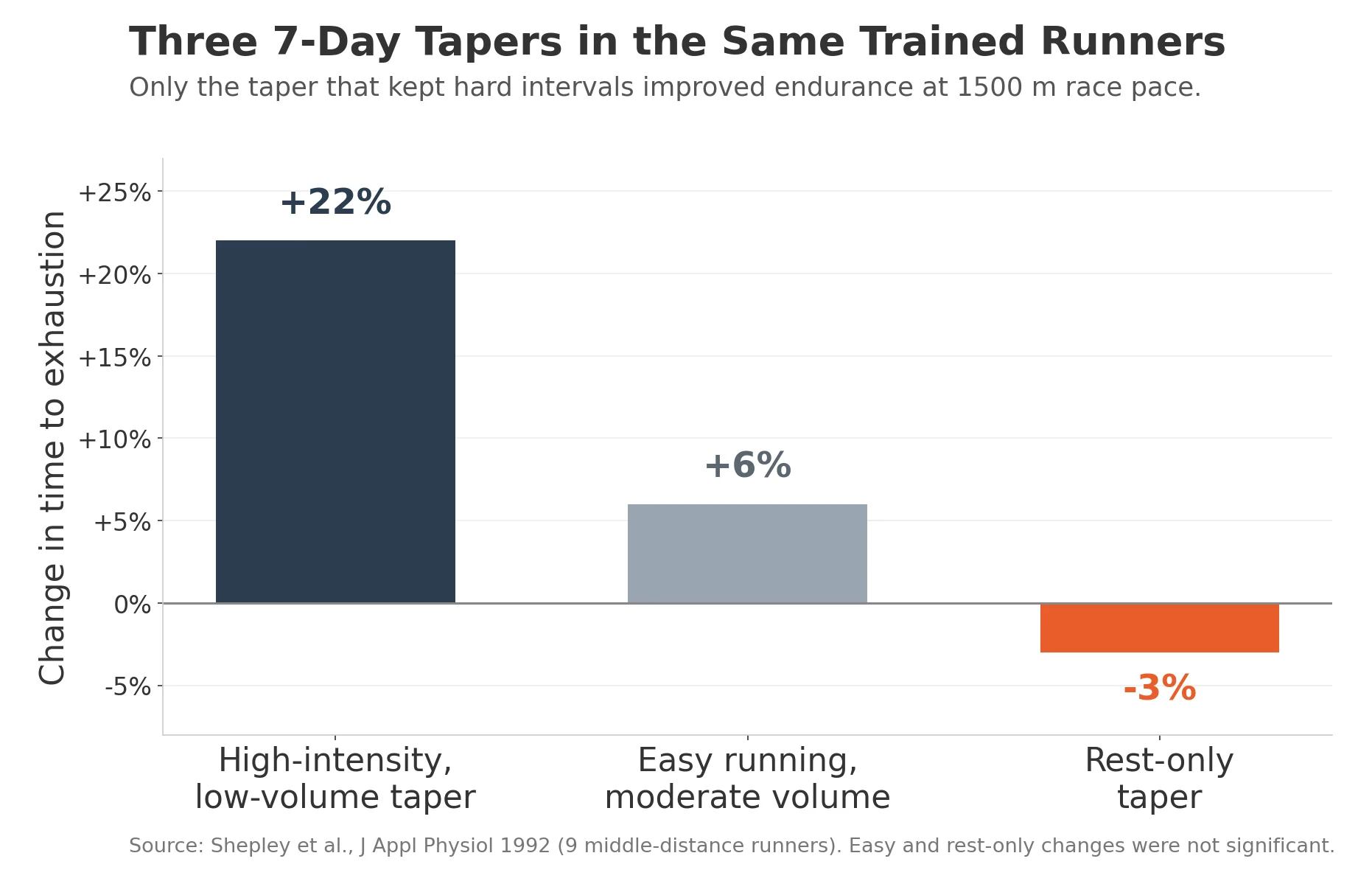
A study of highly trained middle-distance runners found that a 7-day taper built on short, hard intervals increased time to exhaustion at race pace by 22%, while a rest-only taper produced no improvement.
The same 9 runners tried all 3 tapers.
Their test was a run to exhaustion at 1500 m race pace, repeated before and after each taper, with 4 weeks of normal training between tapers.
The third option, a taper of moderate mileage run entirely at easy intensity, improved time to exhaustion by 6%, which the researchers couldn’t separate from normal day-to-day variation.
VO2max didn’t change after any of the 3 tapers.
The differences showed up in the muscle and the blood.
After the high-intensity taper, citrate synthase rose, which is an enzyme researchers use to measure how much aerobic capacity your muscle fibers have.
Total blood volume rose too, which means more blood to carry oxygen to working muscle at race pace.
After the rest-only taper, citrate synthase and total blood volume both fell.
That means a week of rest started to reverse the gains in aerobic enzymes and blood volume that months of training had built.
Muscle glycogen rose after both the rest-only and high-intensity tapers, and leg strength rose after all 3 tapers.
That means a rest taper can leave your legs feeling good without improving your race.
Keep the pace of your key sessions in the taper and cut how long they last.
As an example, a 10-mile (16 km) tempo at marathon pace in peak training becomes a 4- to 6-mile (6 to 10 km) tempo at the same pace.
A session of 6 x 1 mile at marathon pace becomes 3 x 1 mile at the same pace, with the rest of the week kept easy.
How Much Should You Cut Your Mileage Each Week?
In a controlled trial, cutting training by 50% beat both a 30% cut and an 80% cut.
A 2003 trial in trained cyclists found that a 1-week taper cutting training by 50% improved 20 km time trial performance by 5.4%, while cutting 30% or 80% produced no improvement.
Every group kept its intervals at about 85% of VO2max.
The likely explanation is that a 30% cut left too much training fatigue in place.
An 80% cut removed so much training that the cyclists gained nothing, much like the rest-only runners in the previous section.
A 2007 meta-analysis of 27 taper studies found a similar middle range across several endurance sports.
The best results came from a 2-week taper that cut total volume by 41% to 60%, with training intensity and the number of sessions per week left unchanged.
For a marathoner tapering over 3 weeks, I apply that 41% to 60% cut to race week and reach it in 3 steady steps down from your peak week:
- 3 weeks out: 85% to 90% of peak mileage
- 2 weeks out: 70% to 75% of peak mileage
- Race week: 40% to 60% of peak mileage for the days before the race
Marathoners with 3 weeks of cuts did better than those with 2 in the 2021 analysis, so this plan starts with a small first step 3 weeks out.
Front-load race week by running most of its miles early and only 2 to 5 miles (3 to 8 km) a day on the last 2 days before the race.
Your race week should total 40% to 60% of your peak mileage, reached through steady cuts that start 3 weeks out.
Should Your Last Taper Workouts Get Faster?
Keep your final workouts at goal marathon pace.
The case for speeding them up comes from studies of 1500 m runners, and even those studies disagree with each other about whether a faster final session helps.
The faster version comes from a 2021 study of highly trained 1500 m runners who cut volume by 60% and ran their last intervals at 110% of race pace.
Those runners improved their 1500 m time trial by 5.2 seconds, and the researchers recommended the faster final session for 1500 m racing.
A comparison taper with a 30% cut and intervals at race pace improved their time by 3.2 seconds, a gain too small to separate from normal variation.
A 2019 study of trained 1500 m runners found that a final interval session at race pace improved 1500 m time by 10.1 seconds, compared with 4.2 seconds for a final session at 115% of race pace.
The 115% results varied widely between runners, and the researchers recommended the race-pace version and warned that the faster session should be used with caution.
For a marathoner, 110% of 1500 m race pace is roughly 800 m race pace, and that speed hasn’t been part of the marathon-specific phase of your training.
I regularly see runners add short, fast repeats in the last 2 weeks and come away with sore legs and no added sharpness.
I followed the goal-pace approach in my own 2-week taper before the 2007 Olympic Trials Marathon.
The first week was 96 miles (154 km) with one marathon-specific workout, split into a morning progression run and an afternoon 7K at marathon pace.
My last workout came 4 days before the race: 5K on the track at goal marathon pace, about 5:03 per mile (3:08 per km).
I ran 2:14:56 and finished 7th, a 32-second personal best on a harder course than my previous best.
Run your last workout about 4 days before the race, at goal marathon pace and no faster, and keep it short enough that it feels easy.
What Does a Strict Marathon Taper Look Like on Paper?
For a runner who peaked at 50 miles (80 km) a week, a strict taper drops mileage every week for 3 weeks and keeps some marathon-pace work in each.
| Week | Weekly mileage | Long run | Marathon-pace work |
|---|---|---|---|
| 3 weeks out | 43 to 45 mi (69 to 72 km) | 16 to 17 mi (26 to 27 km) | Final 3 to 4 mi (5 to 6 km) of the long run |
| 2 weeks out | 35 to 38 mi (56 to 61 km) | 10 to 12 mi (16 to 19 km), all easy | 3 to 4 mi (5 to 6 km) tempo, about 10 days out |
| Race week | 20 to 30 mi (32 to 48 km) before race day | None | 2 mi or 5K (3 to 5 km), 4 days out |
Every other run stays easy.
The runner also keeps the same number of runs per week as in peak training, since the 2007 meta-analysis found the best results with frequency unchanged.
The week-by-week taper schedule covers each day of those 3 weeks in more detail, including race-week shakeouts and strides.
These 3 rules keep the taper strict when a missed run or a race gets in the way:
- A missed run stays missed. If a cold or a work trip means you miss a long run 2 weeks out, drop it from the plan instead of adding it to the following week.
- Your peak block already proved your fitness. Heavy legs in the second week of a taper are common, so skip the extra week of miles meant to reassure you.
- Tune-up races go before the taper starts. Race your last half marathon 4 or more weeks out, or count the race, warm-up and cool-down inside a week that still comes in lower than the week before.
Before your taper starts, write down the 3 weekly totals and make sure each one is lower than the week before it.