
Most runners assume their easy pace should be creeping faster every month, and they read a slower easy run as fitness slipping away.
In practice, what I see with well-trained athletes runs closer to the opposite.
Their easy paces hold steady for years, and they often get slower the deeper an athlete goes into specific training for a race.
Whether your easy pace should be improving depends almost entirely on where you are in your running life and where you sit in your current training cycle.
So let’s look at when a faster easy pace is a real fitness signal, when a slower one is expected, and when it deserves your attention.
Yes, Your Easy Pace Should Get Quicker While You’re Still Building
If you are still building, steadily adding mileage with a touch of speed here and there, your easy days should drift faster over time.
That improvement is real, and it is one of the cleanest signals you get that your aerobic system is developing.
Easy running increases capillary density and builds mitochondria, the structures inside your muscle cells that produce energy using oxygen.
As those adaptations accumulate, you use less oxygen to hold the same speed.
The same comfortable effort then produces a slightly quicker pace on your watch.
A 2020 meta-analysis in Sports Medicine found that steady continuous running lowered the oxygen cost of running in everyday runners more than interval training did.
The strongest results came from programs lasting eight weeks or longer.
The runners I watch this happen to most predictably are the ones adding mileage patiently and keeping their easy days genuinely easy.
Compare your easy runs on the same route from four weeks ago against today at the same perceived effort.
A drift of 15 to 30 seconds per mile (9 to 18 seconds per kilometer) over four weeks at the same effort means your aerobic system has developed.
That drift is also one of the signals I look at when deciding whether an athlete is ready to increase their training paces.
Why Your Easy Pace Stops Improving Once You’re Well Trained
Once you have been training seriously for years, the speed of your easy days largely stops tracking your fitness.
The athletes I coach who run the fastest races often run their easy days no quicker than they did three seasons ago.
New fitness in a well-trained runner shows up at the top end of your range, at threshold pace, at race pace, and in your ability to repeat hard sessions.
Your easy days sit far below that end of the range, so they barely move.
My own training is a decent illustration of this.
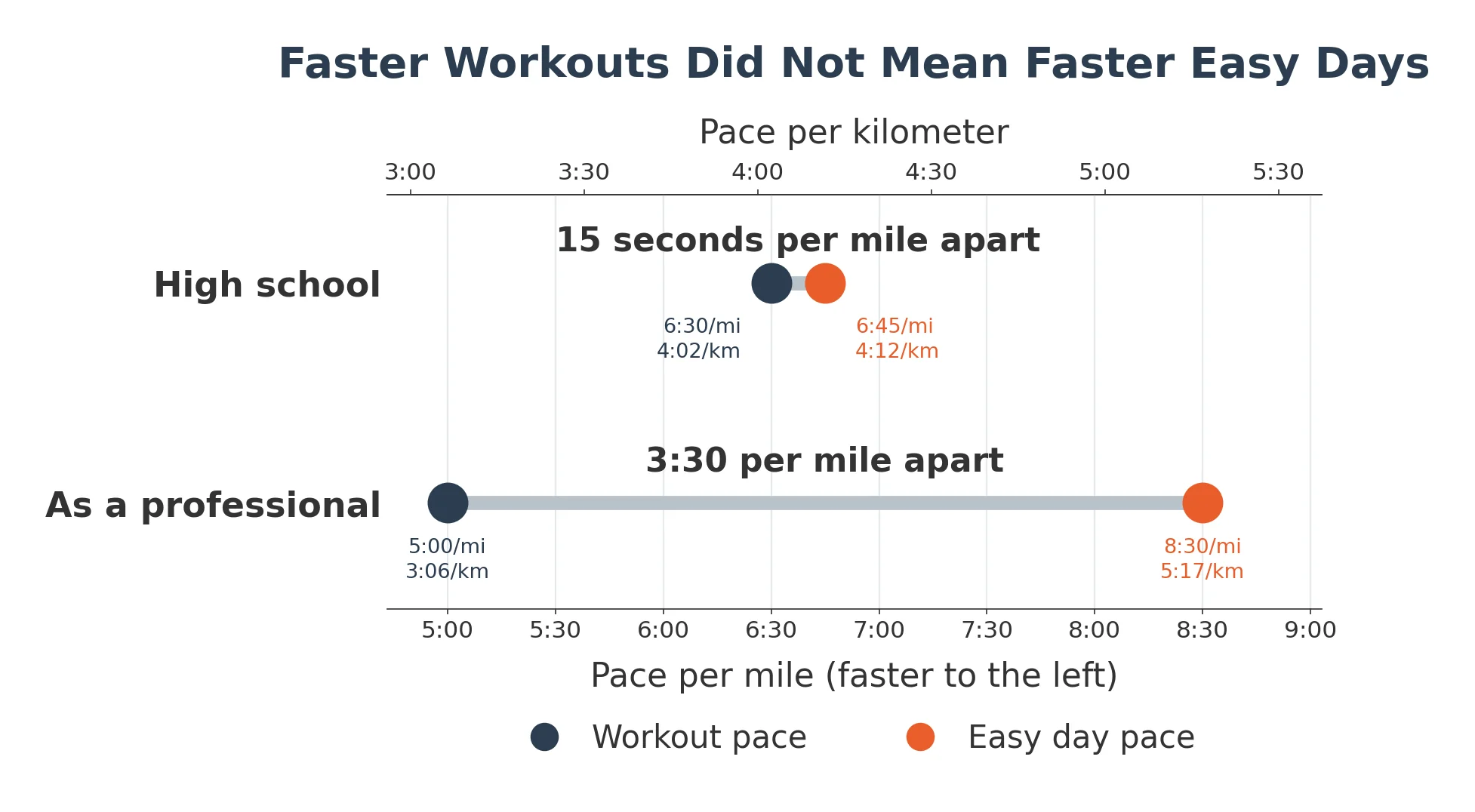
In high school I raced my easy days at around 6:45 per mile (4:12 per kilometer) and ran my workouts at about 6:30 per mile (4:02 per kilometer).
Ten years later as a professional, I ran many workouts at 5:00 per mile (3:06 per kilometer) or faster.
My easy days had dropped to 8:30 per mile (5:17 per kilometer) or slower.
I got dramatically faster over that decade, and my easy pace moved in the other direction.
I coach a lot of sub-three-hour marathoners, some of them down closer to 2:30.
Plenty of them run 9-minute miles (5:36 per kilometer) the day after a key session.
That is well over two minutes per mile (75 seconds per kilometer) slower than their marathon race pace.
It doesn’t rattle them one bit.
Stop grading your fitness on your easy pace once you have several years of consistent training behind you.
Track the paces you hold in your workouts and how well you recover from them.
What’s Actually Slowing You Down Deep in a Training Block
A slower easy run in the middle of a hard training cycle almost always reflects accumulated fatigue rather than lost fitness.
Repeated long runs and key workouts leave you with some combination of glycogen depletion, muscle damage, and residual fatigue that hasn’t fully resolved.
Glycogen is the carbohydrate your muscles store for fuel, and one night of eating and sleeping doesn’t fully replace it after a hard session.
When you carry that load, the same effort feels harder and your heart rate sits higher.
The same easy effort then produces a slower pace.
A review of muscle damage and running economy reported that damaging downhill running worsened running economy by 3 to 7 percent, and the impairment lasted around four days.

Researchers studying runners with lowered muscle glycogen also recorded higher perceived effort at the same running speeds.
The pattern I see most often is a runner six weeks into a marathon build, hitting every workout, and quietly panicking.
Their easy runs have slowed by 30 seconds per mile (19 seconds per kilometer) and they assume they are losing fitness.
That heaviness is the cumulative training load a peak block is built to create.
Your aerobic system isn’t getting worse.
Your legs are carrying the bill for the work you have been doing.
Look at your training log for the previous seven days before you draw any conclusion about a slow easy run.
When the slowdown follows a long run or a hard workout, treat it as expected and hold your effort steady.
The Only Job Your Easy Run Has the Day After a Workout
On the days after your long runs and key sessions, an easy run has one job: maintain or build volume without interfering with your recovery from those key runs.
Your hard sessions break the muscle down on purpose so it rebuilds stronger.
Easy running the next day moves oxygen-rich blood through your legs and helps repair the micro-tears a workout creates.
Push the pace on that run and you add fresh damage to legs that are supposed to be healing.
The purpose of an easy run has nothing to do with pace, and the speed at which you complete it has no bearing on how well it works.
You cannot run too slowly on a recovery day, only too fast.
The runners who handle big training blocks best are the ones who let those days be as slow as their legs want them to be.
The ones who struggle are checking mile splits against last month’s easy runs and nudging the pace up to match.
Run the day after a workout by breath and feel, and take the pace field off your watch screen if you need to.
You should be able to hold a full conversation for the entire run.
Let Your Key Workouts Carry Your Confidence
Judge a training block by your key sessions and by how much of that work you can absorb as the weeks go on.
Those are the runs designed to tell you something real about your fitness.
Workouts hold pace, distance, and recovery constant, so a change in what you can hold means something.
Easy runs swing with sleep, heat, life stress, and whatever you did the day before, so a single one tells you very little.
What I tell my athletes is to look at three things across the arc of a training block.
- Whether your workout paces hold at the same or lower effort. Hitting the same interval splits while your breathing stays more controlled means your fitness has moved, even if nothing on your watch looks faster.
- Whether you can handle more total work in a session. Adding a rep, extending a tempo, or holding pace through the final interval is progress that easy runs will never show you.
- Whether you bounce back faster between hard days. Needing one easy day instead of two after a key session is one of the clearest fitness signals I get from an athlete.
Sports Medicine published a review of functional overreaching, a state where a heavy stretch of training temporarily lowers performance before it recovers.
Some athletes then climb past where they started.
Pull up your last six weeks of workouts before you make any judgment about your fitness.
When a Slower Easy Pace Is Worth Investigating
Your easy days become a real signal when your key workouts start slipping alongside them.
Rule out the obvious explanations first, starting with the weather.
A study of 1.79 million marathon finishers identified air temperature as the most influential environmental factor on running speed.
The fastest performances clustered between roughly 39 and 50 degrees Fahrenheit (4 to 10 degrees Celsius).
Once you have ruled out heat, illness, and a rough stretch of sleep, these are the signals I take seriously.
- Workout paces sliding across several weeks. One flat session happens to everyone, and a three-week downward trend at the same effort is the flag.
- Morning resting heart rate 5 to 10 beats above your normal for three days or more. Measure it before you get out of bed, and compare it against your own baseline.
- Recovery stretching out. Needing three days to feel normal after a session you used to absorb in one is a load problem.
- Easy runs that feel hard rather than slow. Effort is the number that matters here, and a run that feels like work at any pace is the warning.
When two or more of those show up together, cut your weekly volume by roughly a third for five to seven days and drop the intensity to easy running only.
Reassess at the end of that week before you change anything else in your plan.
Start by Looking at Your Last Three Workouts
Whether your easy pace should be getting faster comes down to where you are in your running life.
Newer runners building mileage will watch it improve as their aerobic system develops.
Well-trained runners deep in a hard block will often see it hold flat or slow down.
Both of those are normal.
Pull up your last three key workouts and look at what you were able to hold and how quickly you recovered afterward.
Start there, and let your easy days be as slow as your legs need them to be this week.