

Most runners will never win a race or stand on a podium afterward.
Yet they still train for months and line up at race after race.
So what does racing mean when you know you’re not going to win?
To give a useful answer, let’s look at the research on why everyday runners race, plus what two veteran marathoners from the middle and back of the pack say about it.
In this article, you’ll learn:
- The difference between running a race and racing it
- Who you’re competing against when a win is off the table
- How chasing the runners around you can make you faster, and how to set race goals that go beyond the clock
What Does Racing Mean in Running?
In running, racing means covering a set distance as fast as you can on that day, measured against the clock, the runners around you or your own previous best.
That’s different from running a race, where you enter the event but don’t try to run at your limit.
Danielle Cemprola, who had run more than 50 marathons in 9 years when she shared her view, draws the line the same way.
“I tend to distinguish between ‘running a race’ and ‘racing,'” she says.
“If I’m running a race, I’m just participating. Maybe doing it at an easy pace with a friend, or giving it a medium effort and taking pictures along the way.
If I’m racing, I’m going for a PR (personal record) or a really hard effort.”
That means whether you’re racing depends on the effort you choose to give that day, wherever you end up in the results.
You’re racing any time you run a set distance at the hardest effort you can hold that day, whether you finish first or 5,000th.
Who Are You Racing If You’re Not Trying to Win?
For most runners, the main opponent on race day is their own previous best.
A 2019 study of 166 recreational runners who finished the Athens Classic Marathon found that achieving personal goals and staying healthy were their strongest reasons for running, while competing with other runners ranked among the weakest.

Nellie Acevedo, a self-described “unapologetic back of the packer,” races exactly that way.
“I feel as if I am racing myself and I am not concerned with the people around me for more than camaraderie,” she says.
“For me, I love to race against my last PR and I’m never concerned with placements.”
A goal you pick for yourself can change how hard you run, even when no one else knows about it.
An analysis of 9,789,093 marathon finishing times found that finishes bunch up just before round numbers like 4 hours.
The researchers traced that bunching to runners planning around the round number and adjusting their effort near the finish line to get under it.
That means a goal like breaking 4 hours or beating last year’s time is enough to make you run the final miles harder.
If your PRs are years behind you, an age-graded score lets you race your younger self on fair terms.
It adjusts your finish time for your age and sex, so you can compare this year’s race with the ones you ran a decade ago.
RunnersConnect Bonus
Download your FREE Age Grading Performance Calculator now.
It makes it easy to calculate your age graded performance to compare yourself against those young guns or your former self.
Does Racing the Runners Around You Make You Faster?
Having someone to race against can make you faster than covering the same distance alone.
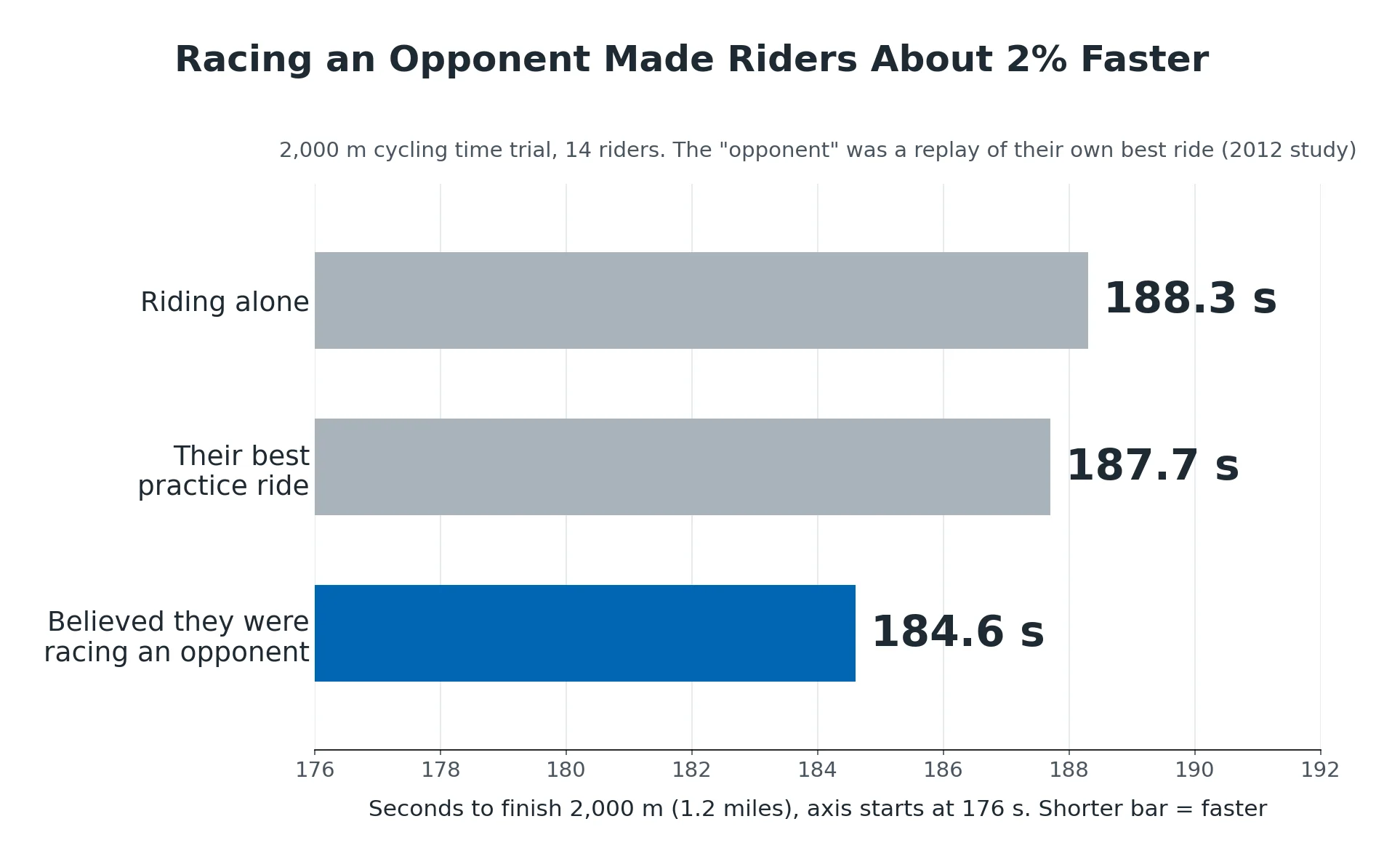
A 2012 study of 14 people riding a 2,000 m (1.2 mile) cycling time trial found they finished in 184.6 seconds when they believed they were racing an opponent, compared with 188.3 seconds riding alone.
The “opponent” on the screen was a replay of each rider’s own best ride.
The riders matched that pace over the first half, then held more power from the halfway point to the finish.
That means the riders had about 2% more speed in reserve than their solo efforts showed, and a rival was enough to get them to use it.
That study used cyclists, but the runners on your pace in a road race can play the same role, turning into a mini-race inside the larger one.
To put this to work, pick a runner or small group moving slightly faster than you in the second half of the race and try to stay with them.
Can Racing Be Fun If You’re Not Chasing a PR?
The people you race with can be as big a draw as the race itself.
A 2022 review of 11 studies covering 18,203 parkrun participants found that improving fitness and social interaction were the main reasons people took part in the free, weekly timed 5 km (3.1 mile) runs.
Acevedo describes the back of the pack the same way.
“We are [the back of the pack] a special, amazing and kind group. We take care of each other, we never run past or step over each other in the name of a PR and we lift each other up the entire way.
I’ve made many friends on the course. Sometimes it is all you need to get a second or third wind.”
A fun goal can still produce a fast race.
Cemprola once ran a local half marathon with one of her closest friends, and their only goal was to have fun.
The new course turned out to be much hillier than the one she had run before, and the day was hot and humid.
Instead of letting the race turn sour, the two of them focused on high-fiving as many costumed kids as they could.
“We ended up finishing about 4 minutes faster than I expected!” she says.
She has also met two people she calls her best lifelong friends while running a marathon.
Runner, coach and avid racer Tony Pallotta shares more about what racing means to him in this video.
How Do You Set Race Goals That Go Beyond Your Finish Time?
Setting more than one goal for a race lets you count it as a success even when the clock doesn’t cooperate.
Cemprola sets an A, B and C goal for every race she plans to run hard.
“Setting multiple goals helps me to stay motivated without the devastating feeling of abject failure if I don’t PR,” she says.
“I don’t ever want to be so disappointed after a race that I lose the desire to run. That’s not why I do it.”
Here’s one way to build your own set of race goals:
- Your A goal is the finish time you’d run if training went well and the weather cooperates.
- Your B goal is a target you can still hit on a hot, windy or hilly day, such as running the second half as fast as the first.
- Your C goal has nothing to do with the clock, like finishing strong, helping a friend through their first race or enjoying a course you’ve never run.
A race with an A, B and C goal gives you three ways to succeed instead of one.
Writing a short review after each race shows you which goal you hit and what to change next time.
RunnersConnect Bonus
Download your free Race Report And Evaluation Form
This post-race checklist will help you identify the things that most affect your performance on race day, both positively and negatively, so you improve at your next big race.
Where Else Can You Line Up With Olympians?
Running is one of the few sports where an everyday athlete can start on the same line as the best in the world.
A high school receiver won’t catch a pass from an NFL quarterback during a game, but a back-of-the-pack runner might share a course with an Olympic medalist.
Acevedo found that out at the Shape Women’s Half Marathon in New York’s Central Park, where the 13.1 mile (21.1 km) course runs two loops.
Deena Kastor, who won the bronze medal in the marathon at the 2004 Olympics in Athens, was in the field.
“She started about 30 minutes ahead of me and then lapped me on my first loop,” Acevedo says.
“All the runners cheered for her like crazy! It was awesome!”
Cemprola once shared part of a race with Jeff Galloway, who is best known for the run-walk method.
“[I ran with Jeff] for a little while at a race once and he was very friendly and talkative, but also was sticking to his strict run/walk schedule,” she says.
She stayed with him “for a few minutes just to chat,” then went on her way, adding, “Of course, I’m pretty sure he passed me later.”
Most big races put you on the same course and under the same clock as the fastest runners in the field.
What Are the Different Ways to Race?
Here’s a quick look at who or what you can race against, and how to use each one at your next race.
| Way to race | What you’re measured against | What to try at your next race |
|---|---|---|
| Against the clock | A finish time goal | Set an A goal based on your recent training |
| Against yourself | Your last PR or your age-graded score | Compare your result with your best age-graded performance |
| Against other runners | The runners on your pace | Stay with a runner slightly faster than you in the second half |
| With other runners | The experience you share | Set a C goal that has nothing to do with your time |



2 Responses
As a member of the “mid-packers” club, thanks so much for the words of encouragement!
Welcome and enjoy the racing!