

Shin splints are one of the most common injuries for runners who are new to the sport or who build their mileage quickly.
The classic advice for preventing them is to grab a resistance band and strengthen the muscle on the front of your shin.
But your shin is more than that one muscle.
It’s a bone, the tibia, surrounded by muscles that help it handle the force of every stride, and research shows the bone and the calf muscles behind it are where runners with shin pain come up short.
So, how do you strengthen your shins, and which exercises protect them best?
To give an evidence-based answer, let’s look at the research on:
- Which shin and calf muscles test weaker in runners with shin splints
- How your shin bone gets stronger, and why runners who played other sports start with a stronger one
- Why resistance band shin exercises on their own won’t keep you healthy
- A 5-exercise shin strengthening routine you can do 2 to 3 times a week
Which Muscles Do You Strengthen When You Strengthen Your Shins?
Strengthening your shins means training the muscles that attach to your shin bone, and most of them sit behind it in your calf.
The tibialis anterior on the front of your shin lifts your toes.
Behind the bone, your soleus and gastrocnemius make up the calf, and smaller muscles like the flexor hallucis longus run down to your foot.
Each time your foot lands, these muscles tighten to steady the shin bone and limit how much it bends.
A 2021 study comparing 20 long-distance runners with shin splints to 20 healthy runners found that the legs with shin splints managed an average of 33 single-leg heel raises before tiring, compared with 75 in the healthy runners.

The runners with shin splints were also weaker in 4 muscles around the shin.
Their soleus produced 64% of their body weight in force, compared with 73% in the healthy runners.
Their tibialis anterior produced 34% of their body weight in force, compared with 42%.
The researchers measured runners who were already hurt, so the study can’t say whether the weakness came before the pain.
But it does show which muscles a shin strengthening routine needs to cover: the calves first, plus the muscle on the front of the shin.
RunnersConnect Insider Bonus
Download our Shin Splint Prevention Guide inside your Insider Members area.
It’s a PDF with the four best exercises to help you prevent shin splints.
How Do You Strengthen Your Shin Bones?
Your shin bone gets stronger the same way a muscle does, by adapting to the loads you put on it.
When running bends the tibia with each stride, the bone responds over the following weeks by laying down new bone and getting thicker.
Stress fractures, and many cases of shin splints, show up when the load climbs faster than the bone can adapt, which is why they’re most common in runners who are new or who add mileage quickly.
Some loads build bone faster than others.
A 2021 review on bone stress injuries in runners explains that bone adapts best to a small number of fast, hard loads coming from different directions, the kind you get from jumping and changing direction.
Running is the opposite: thousands of similar loads in the same direction.
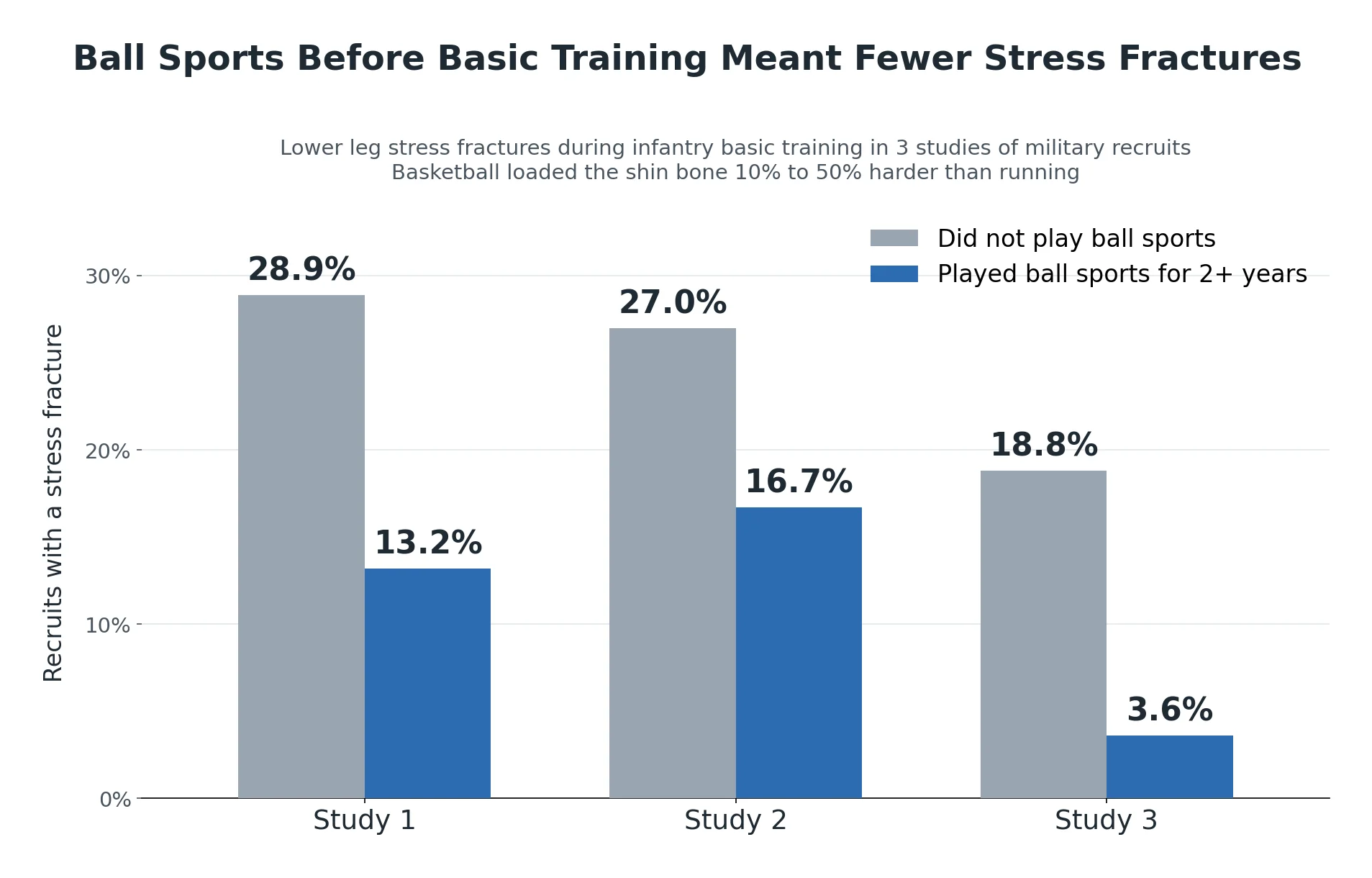
3 studies of military recruits found that recruits who had played ball sports like basketball for at least 2 years before basic training had about half as many stress fractures, 13.2% compared with 28.9% in the first study.
Running before basic training didn’t change the stress fracture rate.
When the researchers measured strain on the shin bone directly, basketball loaded the tibia 10% to 50% harder than running did.
The same pattern shows up in runners.
A 2022 study of female college cross-country runners found that the runners who had also played soccer or basketball when they were younger had a lower shin bone that could take 19.5% more force before breaking than the runners who had only run.
That means a small dose of hopping and jumping is the most direct way to strengthen your shin bones, and it works best alongside mileage that you build gradually.
Does Calf Strength Protect Your Shin Bone?
Runners with bigger calf muscles also have stronger shin bones, because the bone grows in response to the pull of the muscles around it.
A 2009 study of 39 competitive female distance runners found that runners with a history of stress fractures had shin bones with 9% to 10% lower bending strength and 7% to 8% smaller calf muscles than runners who had never had one.
Once the researchers accounted for calf size, the difference in bone strength disappeared.
That means the runners with weaker shin bones had exactly the bone strength you’d expect for their smaller calves.
Your shin bone is only as strong as the calf muscles that load it, so building your calves is one of the best ways to build your shins.
Calf endurance matters too.
When your calves tire late in a run, they steady the shin bone less with each stride, which is why the runners with shin splints in the 2021 study stood out most on the heel raise test.
Do Resistance Band Shin Exercises Prevent Shin Splints?
Resistance band exercises work the tibialis anterior on the front of your shin, which is a small part of the muscle around your shin bone.
The muscle does test weaker in runners with shin splints, so it’s worth training.
But its main job is to lift your toes, and your calves do far more of the work of steadying the tibia when your foot lands.
A 2024 trial of 325 new runners tested the lower leg approach directly.
Runners who did a foot and ankle exercise program before each run had no fewer overuse injuries than runners who only stretched.
The runners who did a hip and core exercise program had 39% fewer overuse injuries in an average week.
That means a few sets of toe raises or band work on the front of your shin are fine, but they shouldn’t be the whole routine.
Spend most of your time on your calves, your hips and a small amount of hopping.
What Is the Best Shin Strengthening Routine for Runners?
The best shin strengthening routine covers your calves, the front of your shin, your hips and your shin bone.
Do these 5 exercises 2 to 3 times a week, ideally on easy days or after a short run.
Straight-Leg Eccentric Calf Raises
Stand on a step on one leg, rise onto your toes using both legs, then lower yourself slowly on one leg until your heel drops below the step.
Work up to 25 repetitions on each leg, and add weight with a backpack once they become easy.
Bent-Knee Eccentric Calf Raises
Do the same movement with your knee bent, which shifts the work to your soleus, the deeper calf muscle that tested weaker in runners with shin splints.
Heel Walks
Walk forward on your heels with your toes pulled up toward your shins to train the tibialis anterior.
A minute of heel walking covers the front of your shin, so there’s no need for a long list of band exercises.
Side-Lying Hip Abduction
Lie on your side with your bottom knee bent, then lift your top leg up and slightly behind you with your toes pointing forward.
This works your gluteus medius, the hip muscle that keeps your pelvis level and your knee from drifting inward when you land.
Small Hops
Bounce on the balls of your feet with quick, small hops, keeping your knees soft and your ground contact short.
Start with a few short sets on a forgiving surface, rest between sets, and add more only if your shins feel fine the next day.
Skip the hops if your shins already hurt, and add them back once you can run without pain.
Should You Do Shin Exercises If Your Shins Already Hurt?
The calf, heel walk and hip exercises are safe to keep doing with mild shin splints, as long as they don’t make the pain worse.
Hopping puts the most load on your shin bone, so leave it out until the pain has settled.
If the pain sits in one small spot on the bone, hurts when you press on it, or gets worse with every run, see a doctor or physical therapist to rule out a stress fracture.
This guide to telling shin splints from a stress fracture walks through the warning signs.
If you need to cut back your running while your shins heal, pool running lets you keep your fitness without the impact.
Cross Training While Injured and During Recovery
Aqua jogging is a form of deep water running that closely mimics the actual running movement. Your feet don’t actually touch the bottom of the pool, so it is zero impact and safe for almost any type of injury. In my experience, the only time to avoid aqua jogging is when you have a hip flexor injury, which can be aggravated by the increased resistance of the water as you bring your leg up. Because aqua jogging closely mimics natural running form, it provides a neuromuscular workout that, in addition to aerobic benefits, helps keep the running specific muscles active. The same can’t be said for biking and swimming. The only downside to aqua jogging is that you need a pool that is deep enough to run in without touching the bottom. If you’re lucky enough to have access to a pool of this size, aqua jogging should be your first cross training choice.Aqua Jogging Workouts For Runners
If you're interested in aqua jogging to rehab your injury, then the absolute best way is to use one of my favorite programs, Fluid Running.
Medium Effort Workouts
Hard Workouts
Shin Strengthening at a Glance
This table shows what each exercise trains and why it matters for your shins.
| What you train | Exercise | Why it matters |
|---|---|---|
| Calves (gastrocnemius) | Straight-leg eccentric calf raises | Calf strength and endurance steady the tibia on landing |
| Calves (soleus) | Bent-knee eccentric calf raises | Soleus force was 64% vs. 73% of body weight in legs with shin splints |
| Front of the shin | Heel walks | Tibialis anterior tested weaker, but it’s a small muscle |
| Hips | Side-lying hip abduction | Hip and core work cut overuse injuries 39% in new runners |
| Shin bone | Small hops | Fast, varied loads build bone more than running alone |



7 Responses
Just got shin splints while learning to run. This site helps. Thanks.
Has anyone tried the king brand or mendmeshop products for shin splints? I’m currently taping them before I go for a run but I’m still in pain. Someone in my running club recommended king brand but I wanted to see if anyone here could give me some advice. Haven’t tried the stretches yet but I’ll consider it. Thanks. Here is the stuff my friend told me about.
Find a physical therapist that does a Graston release. You can do it on your own after a few sessions. It will break up the scar tissue from shin splints. The exercises above are great, but if you have suffered for a while, you have scar tissue that needs to be addressed before you will recover fully.
Can’t say enough about tape when it comes to shin splints…seriously. The difference is huge!
The above exercises are the exact same introductory exercises for shin splints my physio prescribed.
Form is imperative.
Later on a theraband is used to increase resistance.
Agreed! Thanks for sharing your thoughts!
This article explains so much! I have has shin splints for over 15 years and they are gone! I have been doing barre which definitely strengthens your calf muscles and hip abductors. Now completely pain free from shin splints! My flexibility has improved so much and my body feels amazing! I am living proof of this article.