

You’re 2 laps from the end of a hard track workout, your thighs are burning, and your legs feel like they’re running through wet sand.
Most runners were taught that lactic acid causes that burn, makes you slow down and leaves you sore the next morning.
The research on lactic acid and running since the early 2000s has corrected most of that story, and the corrected version changes how you cool down and how you train.
Here’s what you’ll learn about lactic acid in running:
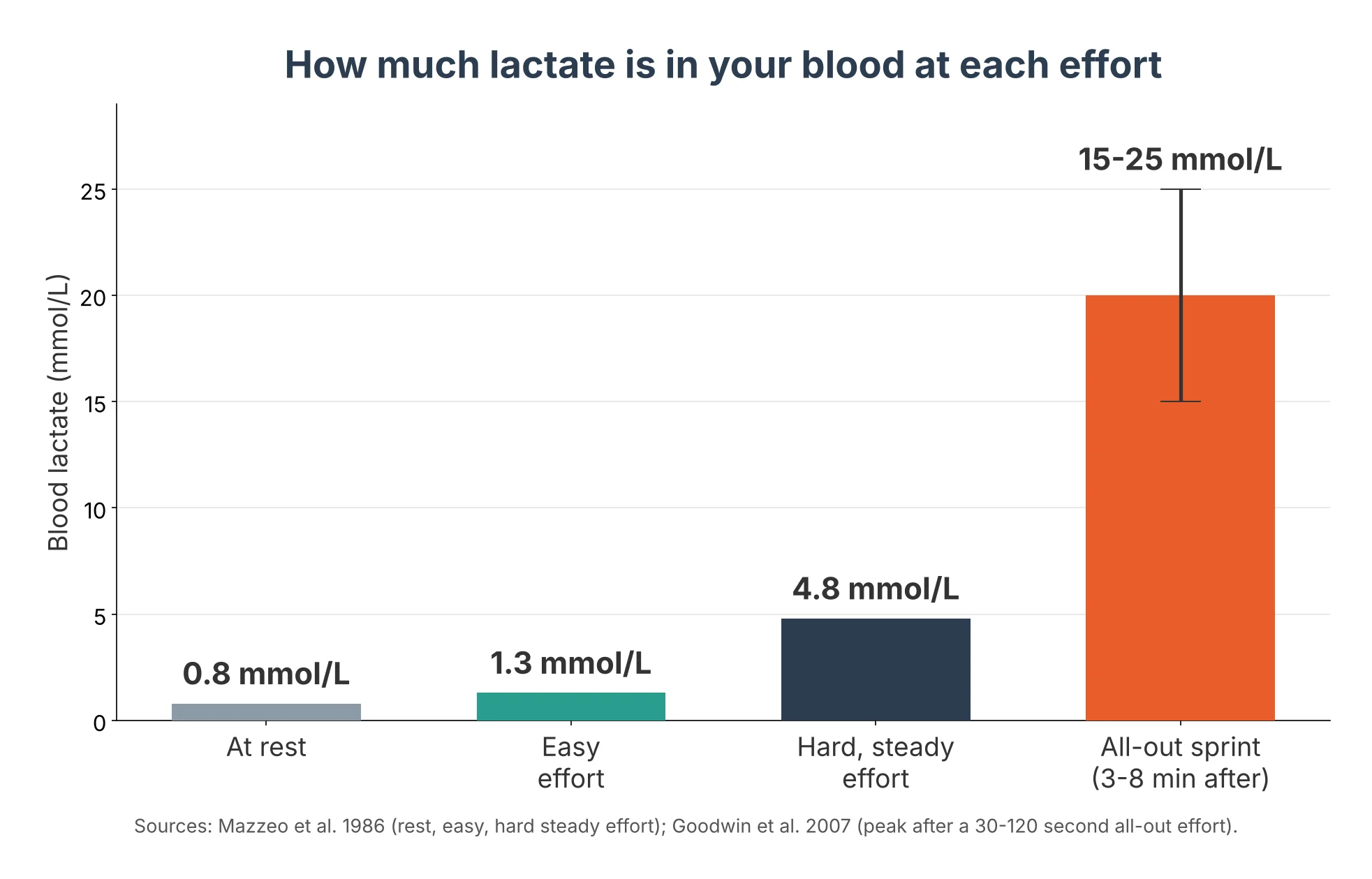
- Your muscles make lactate at every pace, and blood levels climb from about 0.8 mmol/L at rest to 15 to 25 mmol/L after an all-out sprint.
- The burn comes from lactate, acid and ATP acting together on nerve endings in the muscle.
- Lactate peaks within minutes of a hard effort, while next-day soreness follows the muscle damage caused by downhill running.
- You clear blood lactate fastest by jogging at close to threshold effort after a hard session.
- In one trial, 5 weeks of short intervals raised muscle buffering capacity by 25%.
What Is Lactic Acid When You Run?
When you run, your muscles break down glucose and glycogen for energy, and they produce lactate at every pace while they do it.
“Lactic acid” is the old name for 2 separate products of hard running: lactate, and hydrogen ions that come mainly from breaking down ATP for energy.
A 2018 review of lactate metabolism describes lactate as a major energy source and the main raw material your liver uses to make new glucose.
Your blood always contains some lactate, and the amount rises with your pace.
A 1986 tracer study measured blood lactate at about 0.8 mmol/L at rest, about 1.3 mmol/L at an easy effort and about 4.8 mmol/L at a hard, sustained effort.
An all-out effort lasting 30 to 120 seconds pushes it much higher.
A guide to blood lactate testing reports peak values of about 15 to 25 mmol/L, measured 3 to 8 minutes after the effort ends.
That means if you finish a 200m or 400m race flat out, your blood lactate climbs to roughly 20 to 30 times your resting level.
After an all-out 200m or 400m, blood lactate peaks 3 to 8 minutes after you stop, at 15 to 25 mmol/L.
What Does Lactic Acid Feel Like When You Run?
At moderate levels, lactic acid buildup feels like heavy, tiring legs, and at the levels reached in hard intervals it turns into an ache and a hot, burning sensation.
Researchers have measured this directly.
A 2014 infusion study found that lactate, acid or ATP injected into muscle on its own caused no sensation at all, but the 3 together produced fatigue at moderate-exercise levels and ache at hard-exercise levels.

The 10 volunteers received the injections in a small hand muscle.
ATP is the molecule your muscles use for energy, and the doses matched the levels found in resting and exercising muscle.
The mix found in muscle during moderate endurance exercise, 5 mmol/L of lactate with a small drop in pH, produced clear feelings of fatigue.
The mix found during vigorous exercise, 10 mmol/L of lactate with a larger drop in pH, produced stronger fatigue plus some ache.
The researchers suggested that 2 types of sensory nerves are involved, one that picks up low levels of these chemicals and signals fatigue, and one that picks up high levels and signals ache and heat.
That means the heavy-legs feeling in the middle of a tempo run and the burning in the last 200 meters of an interval are 2 different signals from the same 3 chemicals.
Why Does Lactic Acid Hurt, and Does It Slow You Down?
Lactic acid hurts because nerve endings in your muscle respond to the combination of lactate, hydrogen ions and ATP that builds up as your pace climbs.
Lactate is the part of that mix that takes the blame for the acid.
A 2004 biochemistry review argued that the hydrogen ions come from breaking down ATP, and that making lactate uses up hydrogen ions, which slows the drop in muscle pH.
At an easy pace, your mitochondria use those hydrogen ions as fast as they appear, so acid doesn’t accumulate.
Once your pace rises above what your aerobic system can supply, hydrogen ions pile up faster than your mitochondria can use them, and your muscles make more lactate to slow the acidity.
The acid also has a smaller direct effect on muscle force than the classic lactic acid explanation assumed.
A 2002 review of muscle fatigue concluded that acidity has little direct effect on muscle force at normal body temperature, and pointed to inorganic phosphate as a major cause of fatigue.
Inorganic phosphate builds up when your muscles break down creatine phosphate during hard efforts.
Creatine phosphate is the fast energy reserve your muscles draw on when your pace jumps.
The burn in your legs is a pace signal from lactate, acid and ATP, while inorganic phosphate is a major cause of the loss of force late in a sprint.
Does Lactic Acid Make You Sore After Running?
Lactic acid doesn’t cause the soreness you feel a day or 2 after a hard run, because blood lactate peaks 3 to 8 minutes after an all-out effort while soreness shows up 1 to 3 days later.
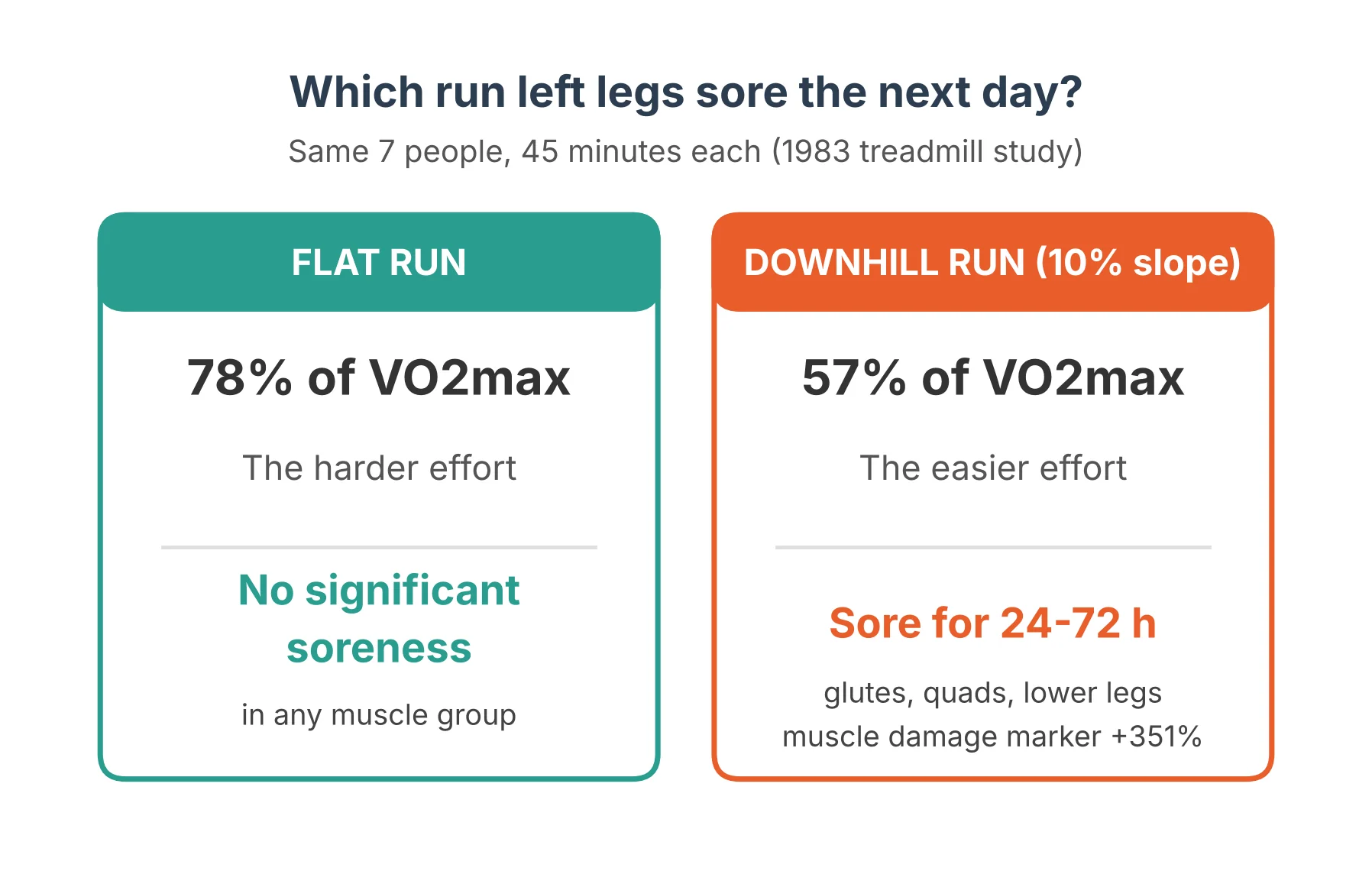
A 1983 treadmill study had 7 people run 45 minutes on the flat at 78% of VO2max and, on another day, 45 minutes down a 10% slope at only 57% of VO2max.
The flat run, at the higher 78% effort, caused no significant soreness in any muscle group.
The downhill run was the easier effort, yet it caused soreness in the glutes, quads and lower legs at 24 to 72 hours.
A blood marker of muscle damage also rose 351% at 24 hours after the downhill run.
That points to next-day soreness coming from muscle fibers being damaged while they lengthen under load, which happens most when you run downhill.
Plan an extra easy day after a downhill race or a hilly long run, since downhill running caused 3 days of soreness at a lower effort than a flat run.
If your legs ache 2 days after a race, read up on delayed onset muscle soreness and how to tell it apart from an injury.
How Do You Get Rid of Lactic Acid After a Run?
The fastest way to get rid of lactic acid after a hard run is to keep moving at a steady jog.
Your working muscles burn lactate as fuel, so a cooldown gives them a reason to keep using it.
That same 1986 tracer study found that during exercise your body burned about 87% of the lactate it cleared, compared with about 49% at rest.
A 2010 recovery study found that after hard 5-minute repeats, active recovery at 80% to 100% of lactate threshold cleared blood lactate fastest, and standing still cleared it slowest.
The 10 men in that study ran 5-minute repeats at 90% of VO2max, which raised their blood lactate from 1.0 to 3.9 mmol/L.
They then recovered either by exercising at a range of intensities up to their lactate threshold or by standing still.
That means your cooldown clears lactate fastest when it’s a steady, controlled jog close to threshold effort.
Here is how to use that after a workout or race:
- Jog 10 to 15 minutes at an effort you could hold for well over an hour, a little slower than your tempo pace.
- Start within a couple of minutes of finishing your last hard rep, since lactate peaks 3 to 8 minutes after an all-out effort.
- Keep jogging between hard reps during interval sessions, which lets your legs start clearing lactate before the next rep.
To find the heart rate that matches threshold effort for your cooldowns and tempo runs, use the calculator below.
RunnersConnect Bonus
Download our Heart Rate Calculator to find out what your individual heart rate zones are.
How Can You Train Your Body to Handle Lactic Acid Better?
You can’t stop lactic acid buildup when you race hard, but training lowers how much lactate you produce at a given workload and raises how much acid your muscles can absorb.
Does aerobic training lower your lactate levels?
Steady aerobic training teaches your muscles to produce less lactate at the same workload and to take up more of what they make.
In a 9-week cycling study, 9 men trained 5 days a week, and afterward their arterial lactate at the same workload was 41% lower than before.
Their legs also took up and burned more lactate when they exercised at the same relative effort.
That means steady aerobic work lets you hold a given effort with less lactate in your blood.
Threshold runs are the workouts that train your body to burn lactate as fuel while you hold a hard pace.
Do short intervals improve your tolerance to the burn?
Short, fast intervals raise your muscle buffering capacity, which is how much acid your muscle can absorb before its pH drops.
A 5-week interval trial found that 2-minute intervals above lactate threshold raised muscle buffering capacity by 25%, while steady training just below threshold raised it by only 2%.
Both groups did the same total amount of training, and both improved VO2peak by 12% to 14% and lactate threshold by 7% to 10%.
That means steady training and intervals both raised lactate threshold, but only the intervals improved how much acid the women’s muscles could handle.
The 16 women in the trial cycled 6 to 10 repeats of 2 minutes with 1 minute of rest, 3 times a week.
The running version for a 5K or 10K runner is 6 to 10 x 2 minutes at roughly 3K to 5K race effort with 1-minute jogs.
One session a week fits alongside your easy mileage and a weekly threshold run.
Lactic Acid and Running: What the Research Shows
Here’s a quick reference for the most common lactic acid beliefs and what the studies in this article found.
| Common belief | What the research shows | What to do |
|---|---|---|
| Lactic acid is a waste product | Lactate is fuel, and your body burns about 87% of the lactate it clears during exercise | Keep moving after hard efforts so your muscles keep burning it |
| Lactate makes your muscles acidic | Hydrogen ions come mainly from ATP breakdown, and making lactate slows the pH drop | Build your aerobic base so less acid builds up at race pace |
| Lactic acid causes the burn | Lactate, acid and ATP together trigger fatigue and pain nerves, and none does it alone | Treat the burn as a pace signal |
| Lactic acid stops your legs | Acid has little direct effect on force at body temperature, and inorganic phosphate is a major cause of fatigue | Pace evenly and avoid early surges |
| Lactic acid makes you sore the next day | Lactate peaks 3 to 8 minutes after a sprint, and downhill running causes soreness at a lower effort | Plan extra recovery days after downhill courses |
| You need to flush lactic acid out | An active cooldown near threshold effort clears lactate fastest | Jog 10 to 15 minutes after hard sessions |



3 Responses
is lactic acid good for runners?
The answer to that question is not a simple yes or no. Lactate can be used as an energy source and is reconverted back into energy through the Cori cycle. However, if there is too much lactate produced the resulting excess hydrogen ion will impair muscle performance and slow you down.
The terminology used for aerobic- anaerobic respiration isn’t as sharp as we would like to see. Most of the workouts, for instance a 1500m. runner, can be based on a large amount of high quality aerobic training. Once you got that level, you would need less ‘anaerobic fatique’ training and a few races to be on your PB-level.