
The six weeks after a fall marathon, right through the holidays and into January, are when I see the most runners lose their consistency.
The race that gave every run a purpose is over, the mornings get cold and dark, and the calendar fills up with everything except running.
Most runners try to fix this on their own, with more willpower or a new training plan.
But the research on exercise habits keeps pointing to a training variable most plans never mention: who you run with.
So how much does running with other people actually change your training, and how do you use it without wrecking your easy days?
To give an evidence-based answer, let’s look at the research-backed practical advice on…
- Why every extra mile your friends run adds about a third of a mile to your own run that same day
- How people who signed up for a program with friends were nearly three times as likely to keep their results six months later
- Why a partner more than doubled how long people kept going on a hard effort, even when the partner was only on a screen
- When running with a group makes your easy runs too hard, and who to run with on each type of run
Does Running With Other People Actually Make You Run More?
How much you run goes up and down with how much the runners around you run.
A 2017 study tracked the daily runs of about 1.1 million runners who followed each other on a fitness-tracking network over five years.
Friends who live in the same city run more on the same nice days, so the researchers used the weather to separate real influence from coincidence.
When good weather got a runner in one city out for a longer run, their friends in other cities ran more too, even though their own weather hadn’t changed.
Research has shown that every extra kilometer your friends run adds about 0.3 kilometers to your own run that same day.

That works out to about a third of a mile added to your run for every extra mile your friends log.
Less active runners influenced more active runners, and the reverse didn’t hold.
That means you don’t need a faster or fitter training partner to benefit, because a friend who runs less than you still pulls your running up when they get out the door.
The same link works against you after fall race season, because when the runners around you stop logging runs, your own running loses the push their runs were giving it.
Why Is It Easier to Quit When You Train Alone?
When you train alone, the only person who notices a skipped run is you.
Researchers have tested what happens when people start with someone else.
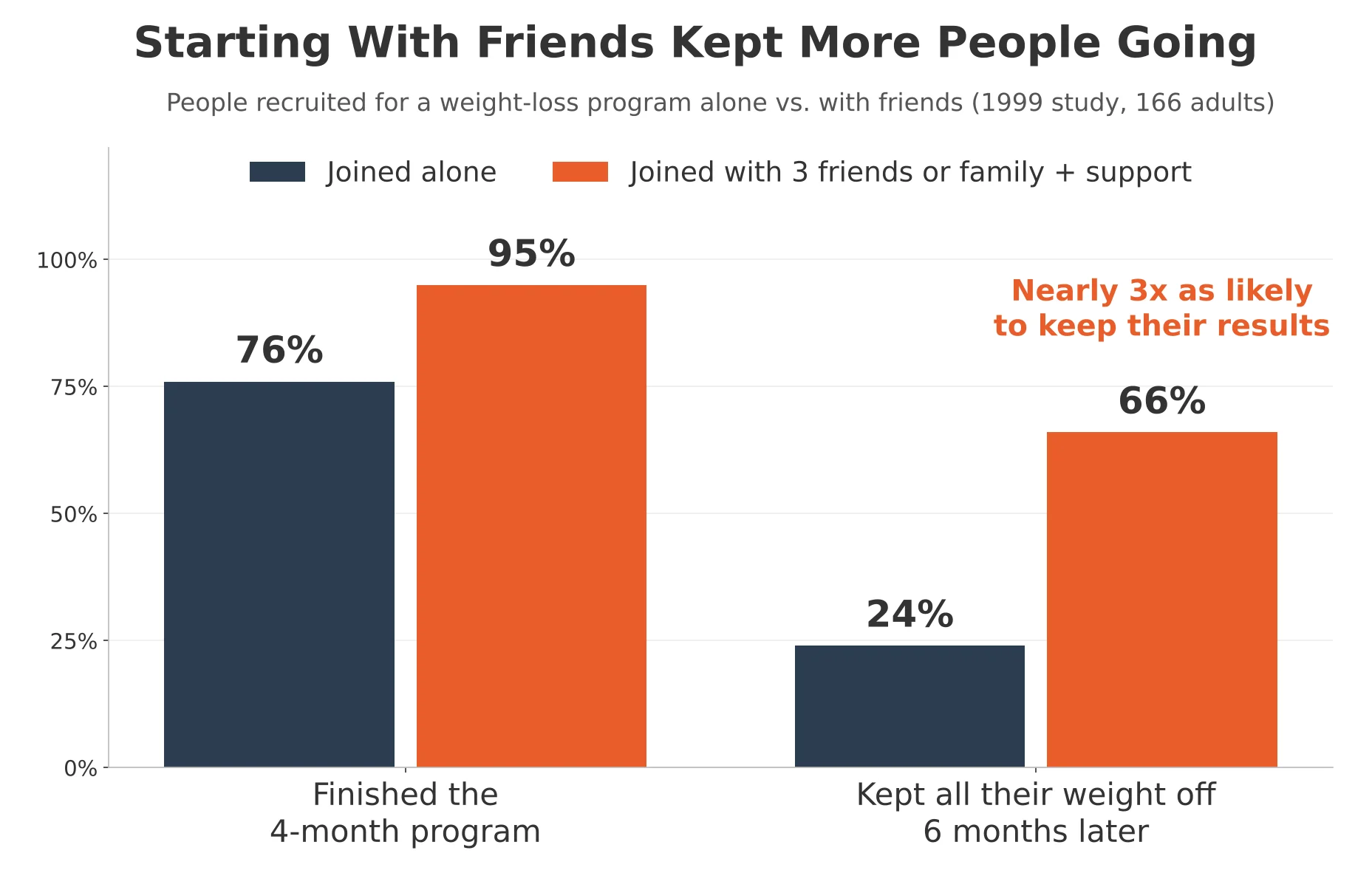
A 1999 study recruited people for a 4-month weight-loss program, either on their own or together with three friends or family members.
People who joined with friends and got support finished the program 95% of the time and 66% kept all their weight off six months later, compared with 76% and 24% of people who joined alone.
That means the people who signed up with friends were nearly three times as likely to hold on to what they had built.
It was a weight-loss program, but the habit being tested is the same one your winter training depends on: showing up week after week when no race is forcing you to.
Simply putting people in a group doesn’t produce the same effect.
A 2026 review of 71 studies compared group exercise programs with individual ones.
The group programs came out only slightly ahead on how much people exercised, by too little to rule out chance.
The people who joined with friends had someone who noticed when they missed a week.
Showing up to group training with a crowd of strangers often doesn’t give you that.
The runners who keep you consistent are the ones who know your plan and expect you to show up.
So pick one or two runners this month and tell them which days you plan to run.
If nobody near you runs at your times, sharing your weekly plan and your logged runs with a friend who checks them does part of the same job.
Does a Training Partner Help You Finish Hard Runs?
A training partner keeps you going longer on a hard run, even though it won’t make you faster on the day.
A 2012 study had 11 non-elite runners race a series of 5K time trials, some alone and some with a second runner in front of, behind, or beside them.
Their finish times, heart rates, and effort ratings were the same in every trial.
So company won’t lift your pace on a single all-out effort.
A partner helps with how long you keep going.
Researchers at Michigan State had young women ride a stationary bike at a moderate effort for as long as they could, on six separate days, either alone or with a partner.
The partner was only on a video screen and was set up to be stronger than each rider.
Exercising with a partner more than doubled how long people kept going, from 10.6 minutes alone to 21.9 minutes when the team’s score depended on both of them.
Riders who simply exercised alongside the partner, with no shared score, lasted 19.8 minutes.
That means most of the effect comes from having someone there, and a little more comes from knowing your effort counts for them too.
The partner doesn’t have to stand next to you, so a friend on a video call can fill part of the same role.
Schedule the run you are most likely to skip or cut short, usually the long run or the hard workout, with a partner who is a little stronger than you.
If your schedules never line up, agree to run the same workout on the same day and send each other your splits.
Can Running With a Group Make Your Easy Runs Too Hard?
The same pull that gets you out the door on a cold morning also speeds you up.
In the 2017 study of 1.1 million runners, pace spread between friends the same way distance did.
When friends ran faster, the runners connected to them ran faster too, by about a third of their friends’ change in speed.
That helps on a workout day and hurts on an easy day.
Easy runs are meant to be run at a conversational effort, because their job is to build your aerobic fitness without adding fatigue you carry into your next workout.
In practice, group runs often settle at the pace of the strongest few runners, and a run you planned as easy turns into a moderate effort you never meant to do.
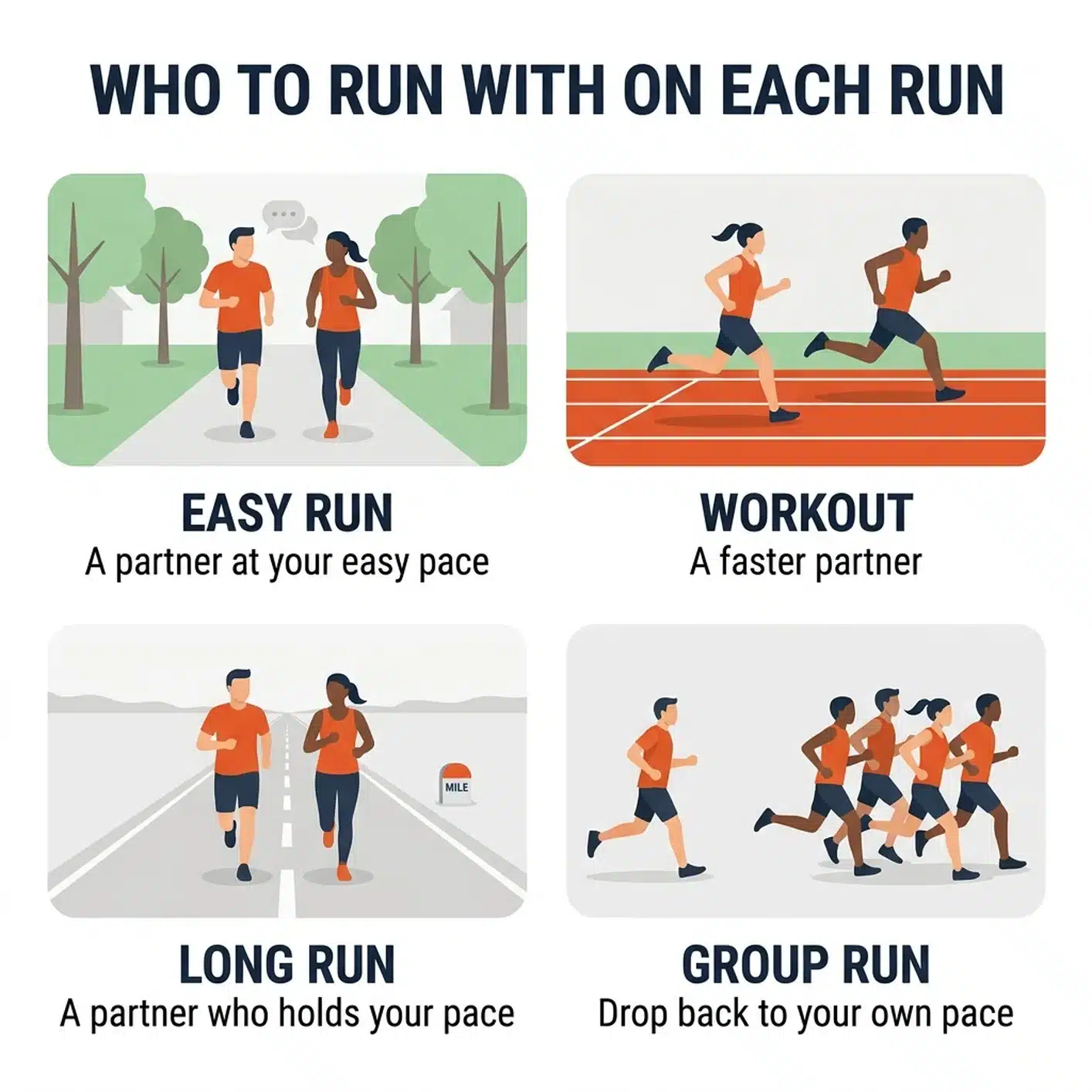
So match the partner to the run:
- Easy runs: run with someone whose easy pace matches yours, and slow down any time you can’t speak in full sentences.
- Workouts: save your faster partners for these days, because a faster pace is the point of a workout.
- Long runs: run with a partner who will stay at your planned long-run pace for the whole distance, even if they could go faster.
- Group runs that only go one speed: treat them as a moderate run in your week, or start with the group and drop back to your own pace.
Where Can You Run With Other Runners for a Whole Weekend?
A running retreat gives you a few days where every run, easy or long, comes with partners at your pace and coaches who know your plan.
RunnersConnect is running two small-group retreats in 2027, and both are open to every pace and every race distance.
- Flagstaff, Arizona, July 14 to 18: trails at about 7,000 feet where many elite distance runners live and train, plus a run along the rim of the Grand Canyon.
- The Algarve, Portugal, September 23 to 26: cliff-top trails, quiet roads, and beach routes on the southern coast, in September running weather.
Daily runs range from 3 to 20 miles and are set by each runner’s goal race.
The 2019 group ranged from 5:30 marathoners to 19-minute 5K runners, so I can guarantee you will have someone to run with and make new friends the entire weekend.
Most first-timers come for the trails and the coaching and come back for the people.
Ken Brown’s takeaway was that “we are not alone in this often solitary sport.”
Cynthia Morris called it one of the neatest experiences she has ever had and wrote, “I will cherish the new ‘friends’ I made.”
Kara Schmidt has told everyone it was “oddly strenuous, yet relaxing.”
A trip on the calendar for July or September also gives your winter runs, and the partners you run them with, something to build toward.
The daily schedule, lodging, and pricing for both trips are on the 2027 running retreats page.
Put One Run a Week on Someone Else’s Calendar This Winter
The weeks between your fall race and January are when consistency slips, and running alone makes it easier to let it slip.
The fix is small: pick one or two runners and tell them which days you plan to run.
Put your long run or your hardest workout on a shared calendar with a partner who is a little stronger than you.
Keep your easy runs with someone at your easy pace, and slow down any time you can’t talk in full sentences.
Start with one shared run this week, then add a second once the first one sticks.
| What you want help with | Who to run with | What the research found |
|---|---|---|
| Finishing long runs and hard workouts | A partner a little stronger than you | Exercising with a partner more than doubled how long people kept going, from 10.6 to 21.9 minutes. |
| Showing up on days you would skip | One or two runners who know your plan | People who joined a program with friends were nearly three times as likely to keep their results six months later. |
| Running more total miles | Friends who log their runs where you can see them | Every extra mile your friends run adds about a third of a mile to your own run that day. |
| Keeping easy runs easy | A partner who runs your easy pace | Pace spreads between friends, so a faster group pulls your easy runs faster. |