

Walk into a running store and there’s a good chance someone will look at your arch, film your ankles on a treadmill and tell you your foot type.
A high arch gets you a cushioned shoe, a normal arch gets you a stability shoe and a flat foot gets you a motion control shoe.
The system is simple and sounds logical, so it’s easy to assume it was built on injury research.
But when the US military tested it on more than 7,000 recruits, matching shoes to arch height made no difference to how often they got hurt.
That doesn’t mean your feet don’t matter, because one group of runners does seem to benefit from a more supportive shoe.
In this article, you’ll learn what the research says about foot type and running shoes, including:
- The 3 foot types and the type of running shoe each one is usually sold
- How to find your foot type at home
- Whether overpronation raises your injury risk
- What to use instead of arch height when you choose your next pair
What Are the Different Foot Types for Running Shoes?
Running shoes are usually matched to 1 of 3 foot types, based on how high your arch is and how far it drops when you land.
That drop is called pronation, and it’s a normal part of how your foot absorbs the impact of landing.
Supination is the opposite movement, where your foot rolls outward and stiffens so you can push off.
The traditional shoe chart sorts runners into these groups:
- High arch (supinated foot): your arch drops very little, so you’re sold a soft, cushioned shoe to absorb more of the impact.
- Normal arch (neutral foot): your arch drops a moderate amount, so you’re sold a shoe with a moderate amount of support.
- Flat foot (pronated foot): your arch drops a lot, so you’re sold a motion control shoe with firmer foam under the inside of your foot to limit that drop.

Every category in that chart rests on the same idea: the right shoe holds your foot near a neutral position, and a neutral foot is less likely to get injured.
That idea is exactly what researchers have tested.
How Do You Find Your Foot Type?
The quickest way to check your foot type at home is the wet test.
Wet the bottom of your foot, stand on a piece of paper or cardboard with your normal weight on it and look at the print you leave behind.
- If the print shows almost your whole foot, you have a low arch or flat foot.
- If there’s a clear curve along the inside edge of the print, you have a normal arch.
- If your heel and forefoot are joined by only a thin strip, or not joined at all, you have a high arch.
Researchers in 1987 turned the footprint into a measurement called the arch index, which compares the area of the middle third of the print with the area of the whole print.
Physical therapists and podiatrists often use the Foot Posture Index instead, which scores 6 features of your foot while you stand, including the angle of your heel and the shape of your arch.
Research has shown that a standing foot type score explained 64% of the differences in how people’s feet sat while standing, but only 41% of the differences in how their feet sat mid-step while walking.

That means the test you do standing still tells you only part of what your foot does when you run.
RunnersConnect Bonus
Download your FREE Injury Assessment and Prediction Video now.
A good injury prevention program starts with assessing where you’re weak and where you might be tight or inhibited. In the video I’ll demonstrate the six mobility tests you need to perform to assess what you need to begin working on.
Does Matching Running Shoes to Your Arch Type Prevent Injuries?
Choosing shoes by arch height did not lower injury rates when the military tested it.
The US Army, Air Force and Marine Corps each ran the same experiment in basic training, with 7,203 recruits in total.
After a footprint test, one group of recruits got a motion control, stability or cushioned shoe matched to their arch, and the other group all got the same stability shoe.
A 2014 analysis of the 3 military trials found that recruits wearing shoes matched to their arch height had an injury rate just 3% lower than recruits who all wore the same stability shoe, a difference small enough to be chance.
A 2022 review of 12 running shoe trials concluded that prescribing shoes based on foot posture probably makes little or no difference to how many injuries runners get.
That means the chart on the shoe store wall isn’t a reliable way to protect yourself from injury.
One trial found that the most supportive shoe led to the most missed training.
In that 2011 trial, 81 women training for a half marathon were sorted by foot type and randomly given a neutral, stability or motion control shoe for 13 weeks.
The women in motion control shoes missed a combined 79 days of training because of pain, while the women in stability shoes missed a combined 51 days.
The motion control shoe also caused more pain in runners with both neutral and pronated feet, which led the researchers to call prescribing shoes by foot type “overly simplistic and potentially injurious.”
It’s one of the reasons a gait analysis at a running store may not point you to the right shoe.
Is Overpronation Bad for Runners?
For most runners, a foot that rolls in more than average doesn’t raise injury risk.
A 2014 study followed 927 new runners for a year after giving them all the same neutral running shoe, with every run tracked by GPS.
The runners with pronated feet had 0.37 fewer injuries for every 1,000 km (620 miles) of running than the runners with neutral feet.
That means a moderately flat foot in a neutral shoe was not a problem for these beginners.
The picture changes for a few specific injuries.
A 2014 review of 21 studies found strong evidence that a pronated foot is a risk factor for shin splints and limited evidence that it’s a risk factor for runner’s knee.
In both cases the added risk was small, and foot posture wasn’t linked to foot, ankle or bone stress injuries at all.
Runners with clearly pronated feet are also the one group where a supportive shoe has helped.
One trial gave 372 everyday runners either the standard or the motion control version of the same running shoe and followed them for 6 months.
A 2016 trial found that runners with pronated feet who wore motion control shoes had about one third the injury risk of runners with pronated feet in a standard version of the same shoe.
The motion control shoe made no difference for runners with neutral or high-arched feet.
So if your feet are clearly flat and you’ve struggled with shin splints, a stability or motion control shoe is worth trying.
If your feet are neutral or only mildly flat, you have no reason to buy one.
Does Barefoot or Minimalist Running Lower Injury Risk?
Switching to minimalist shoes doesn’t lower your injury risk either.
The barefoot running trend that followed the 2009 book Born to Run promised stronger feet and fewer injuries by letting your foot move with less cushioning and support.
A 2026 trial put that promise to the test with 140 everyday runners who landed on their heels.
One group switched to minimalist shoes, one learned to run more softly with a quicker step rate and one did a stretching program.
Over the following year, the runners in minimalist shoes got injured as often as the runners who only stretched.
The runners who changed their technique didn’t get injured less often either, although their injuries showed up more in the foot and less in the hip.
That same 2022 review of running shoe trials found that cushioned and minimalist shoes may make little or no difference to how many runners get injured.
Neither minimalist shoes nor a softer running technique lowered injury rates in everyday runners.
If you like the feel of minimalist shoes, follow a gradual transition plan so your feet and calves have time to adapt to the extra work.
How Should You Choose a Running Shoe for Your Feet?
Comfort is a better guide to your next running shoe than your arch.
A 2015 review proposed that runners pick out shoes that let their legs move the way they already prefer to move, and that comfort is how you recognize those shoes.
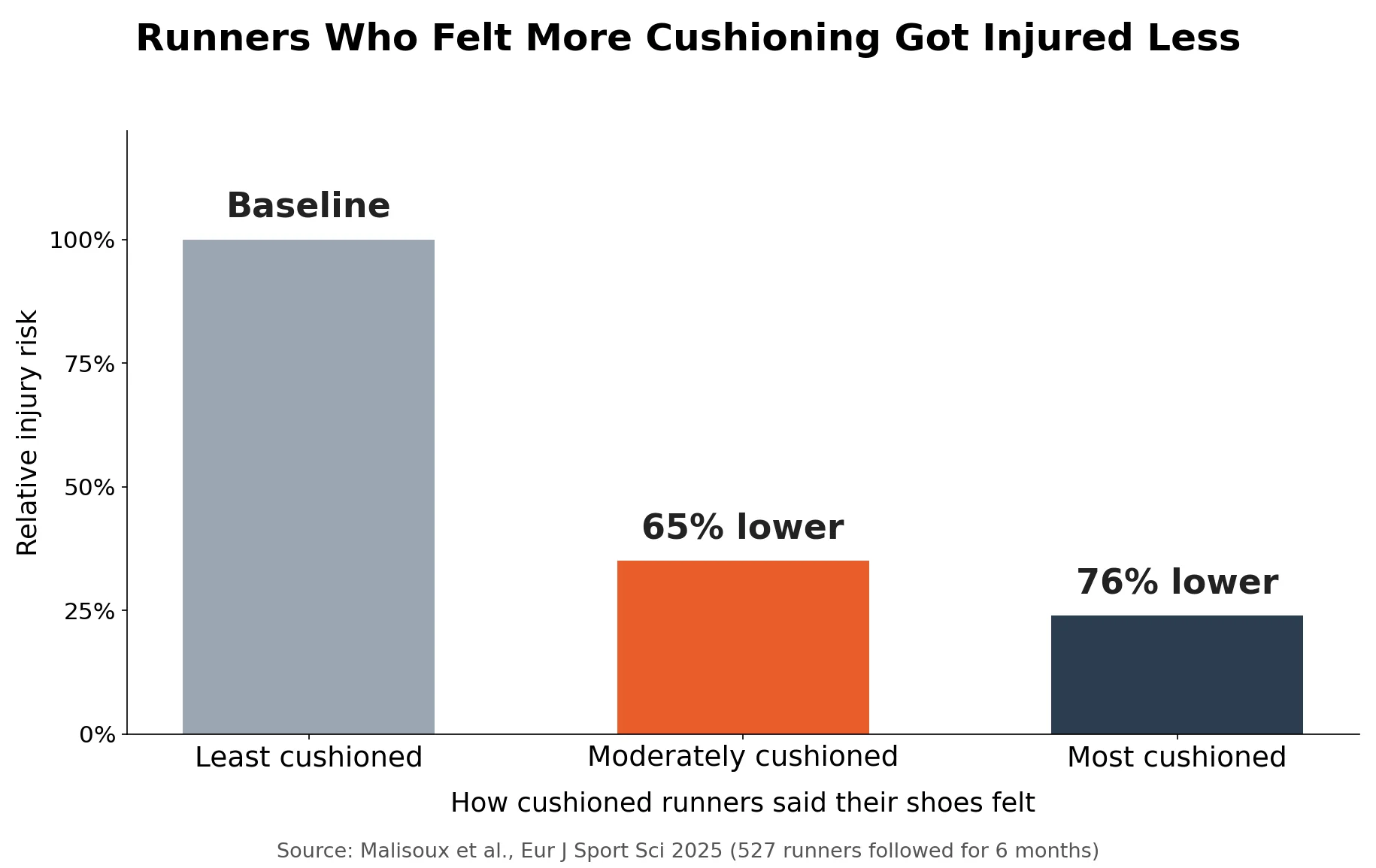
A 2025 study of 527 everyday runners tested that idea over 6 months.
The runners who rated their shoes as having moderate cushioning had 65% lower injury risk than the runners who rated their shoes as the least cushioned.
The runners who rated their shoes as having high cushioning had 76% lower injury risk, and the runners who liked their shoes the most overall also got injured less.
The shoe that feels best on your run is a better pick than the shoe your footprint points to.
Use these steps the next time you buy running shoes:
- Run in every pair you try. Jog on a treadmill or outside the store, since standing in a shoe tells you little about how it feels at your running pace.
- Buy the pair that feels most comfortable. How cushioned and comfortable a shoe felt to runners was linked with fewer injuries, while their arch height was not.
- Save stability shoes for clearly flat feet. Consider one if your feet are pronated and you’ve had shin splints, since that’s where the research points to a benefit.
- Keep what’s working. If your current shoe is comfortable and you aren’t getting hurt, there’s no reason to switch categories because of a foot type test.
How you lace your shoes also changes how they fit your foot.
RunnersConnect Bonus
Download your FREE lacing techniques guide.
You know how to read the wear of shoes, but are you lacing your shoes wrong? Download our Running Shoe Lacing guide for free and get a quick reminder, specific how-to and resources for videos on the best way to lace your running shoes.
What Should You Remember About Foot Type and Running Shoes?
Use this table to compare the traditional shoe for each foot type with what the research found.
| Foot type | Traditional shoe | What the research shows |
|---|---|---|
| High arch | Cushioned | Motion control made no difference, so choose by comfort |
| Normal arch | Stability | Motion control made no difference, so choose by comfort |
| Flat or pronated foot | Motion control | Moderate pronation didn’t raise injury risk in a neutral shoe, but clearly pronated feet are linked with shin splints and had fewer injuries in motion control shoes |
| Any foot type | Shoe matched to your footprint | Injury rates were no lower than giving everyone the same stability shoe |




7 Responses
I run in Nike Lunarglide+ 4. By far the most comfortable shoes I have run and since buying them problems with my left knee have gone. However, I do have a recurrence of problems with my left achilles.
Having said that, in the period I have worn the shoes I have lost considerable weight which may have eased the pressure on my knee in any case, while the achilles issue occurred when I wore neutral shoes.
I’m beginning to get the impression that injuries are more about the volume of my running and the type of training I do (overdoing hills).
I agree with Gavin’s comment about volume of running and type of training having to do more with injuries than shoes do. I started running on a regular basis 2 years ago. The first year I got a bad case of plantar fasciitus in the fall after doing a lot of speedwork during the summer. Since then I have worked on getting a better base and have rotated shoes with different types of support (nuetral, stability, minimalist). My favorite are mild stability, but I feel that my feet and ankles do well by getting work with all the different effects and I haven’t had any problems for a year and a half. If a shoe doesn’t feel right, I just don’t use it as much (or at all). Listen to your body.
I work at a large running specialty store that does an “ankle down” gait analysis and have conducted many such analyses myself. Anyone in our stores nationwide has had extensive ongoing training to carefully judge what is typically enough over-pronation for a certain shoe category. It is taught that pronation is our body’s natural cushioning system, but how much is too much (typically)? I’ve seen elite (often female) marathoners with heavy over-pronation at the ankle, but the rest of their body is aligned properly so that other joints aren’t strained. However, this is rarely the case. Over-pronation at the ankle often causes adduction at the knees and hips and strains the joints. With the average runner, those that tell us they have knee or shin pain are often over-pronators currently running in a neutral shoe and need help from their shoe to align their legs and hips (at least until they are stronger and no longer need it).
Also, unlike what you implied in the article, we put very few people in a motion control shoe. In fact, I would say that from the analysis we conclude less than 1% need a motion control shoe. Most are recommended a stability, a few “neutrability,” and rigid foot types a neutral.
Furthermore, our shoe recommendation and judgement on over-pronation is based on what the shoe will do when you run in it. We always offer to re-record your gait before you buy the shoe. If you over-pronate too much for a certain shoe so that the shoe tilts onto the medial edge, the shoe will have a poor break-down pattern and increase your risk of injury. If the shoe stands straight up, the shoe will most likely break down more evenly and help to align the rest of your body.
Just want to know if anyone here know anything about saucony guide 5 running shoes I run my first marathon in this shoes my time was 4 hours 18?I have to buy new shoes for the comrades what shoes would you say be good for 89km race my feet is not flat on the ground when I put it done there is abit of a gap under my feet?
I’d also post this to the member forum, Tobias: http://discuss.runnersconnect.net/. You’ll get much better answers there
I get a 404 error on Jeff G’s link. Maybe that could be updated?
My experience: I’m still fairly new, but do like the minimalist approach. I did overtrain (too fast, too much) while wearing a traditional neutral shoe. In 2016, I switched to minimalist wear & slowed up a bit (to be exact: I gave alot more thought to the pace of each workout and didn’t continue to try to always run my fastest time for a given workout). Now, I have a slight irritation in my right Achilles, so I’m resting, doing strength training, and looking to fine-tune my stride. I’ve also been working on cadence (moving up from 82 to 88 strides per minute as measured with the same-side foot). I’m going to pay careful attention to my body and see if we can’t resolve this last “kink”
I have done some barefoot running (about 60 miles total since I began about 2 months ago). I like that as well, but my feet get dried out & I find the need to moisturize to prevent skin cracking (and have had to bandage up a couple of cracks when I didn’t do enough of that). Trails are nice for barefoot running. Asphalt is OK. Concrete seems fine. The latter two are only bad when they have gravel or pebbles on top. Then one gingerly steps over all of this.
That’s my two cents. Hope it helps. JH
Interesting article. As someone with low arches and 35 years of running/racing experience – and a range of injuries to go with it – it seems to me that women’s pronation pattern (or at least mine) differs somewhat. I land on the midfoot outside of my foot, but roll quickly in. My injuries tend to be tendinitis of the iliopsoas or around the knee. I once had metatarsal stress fracture, but (knock wood) no plantar fasciitis or notable Achilles tendinitis. My first official running injury, c. 1980, was iliotibial band syndrome, when I wore the Saucony Jazz. The sports medicine doc suggested arch supports. I’ve worn motion control and stability shoes, played around with orthotics. I’ve been in Mizunos for the last decade and seemed to have found a pretty good balance with the Wave Catalyst and my custom orthotic. I recently added the Wave Rider to rotate in training. However, I’m now facing a little of the old iliopsoas tendinitis… so there’s no perfect solution.