You step out the door for a January run and the first half mile feels harsh. Your legs are fine, but the ground feels harder than it did in October, and your shoes feel like a firmer, less forgiving version of the pair you love.
That is not your imagination. Cold weather changes the foam in your running shoes, and it changes how that foam protects your foot.
The midsole of almost every running shoe is built from foam that gets stiffer as it cools. Drop the temperature toward freezing and the same shoe delivers noticeably less give underfoot.
Here is what you’ll learn about running shoes in cold weather:
- Whether your shoes get stiffer once the temperature drops
- What runners mean when they search for “cold padding”
- How much your own foot warms the shoe during a run
- Whether stiffer winter foam raises your injury risk
- How newer foams like PEBA and TPU handle the cold compared with standard EVA
- What to do about it on your coldest training days
Do running shoes get stiffer in cold weather?
Running shoes do get stiffer in the cold, and the reason sits in the midsole.
The insole and midsole of most running shoes are made from ethylene-vinyl acetate, or EVA, a foam that balances cushioning against energy return.
Like most materials, EVA softens when it warms and firms up when it cools. The question that matters is how much it firms up at the temperatures you train in.
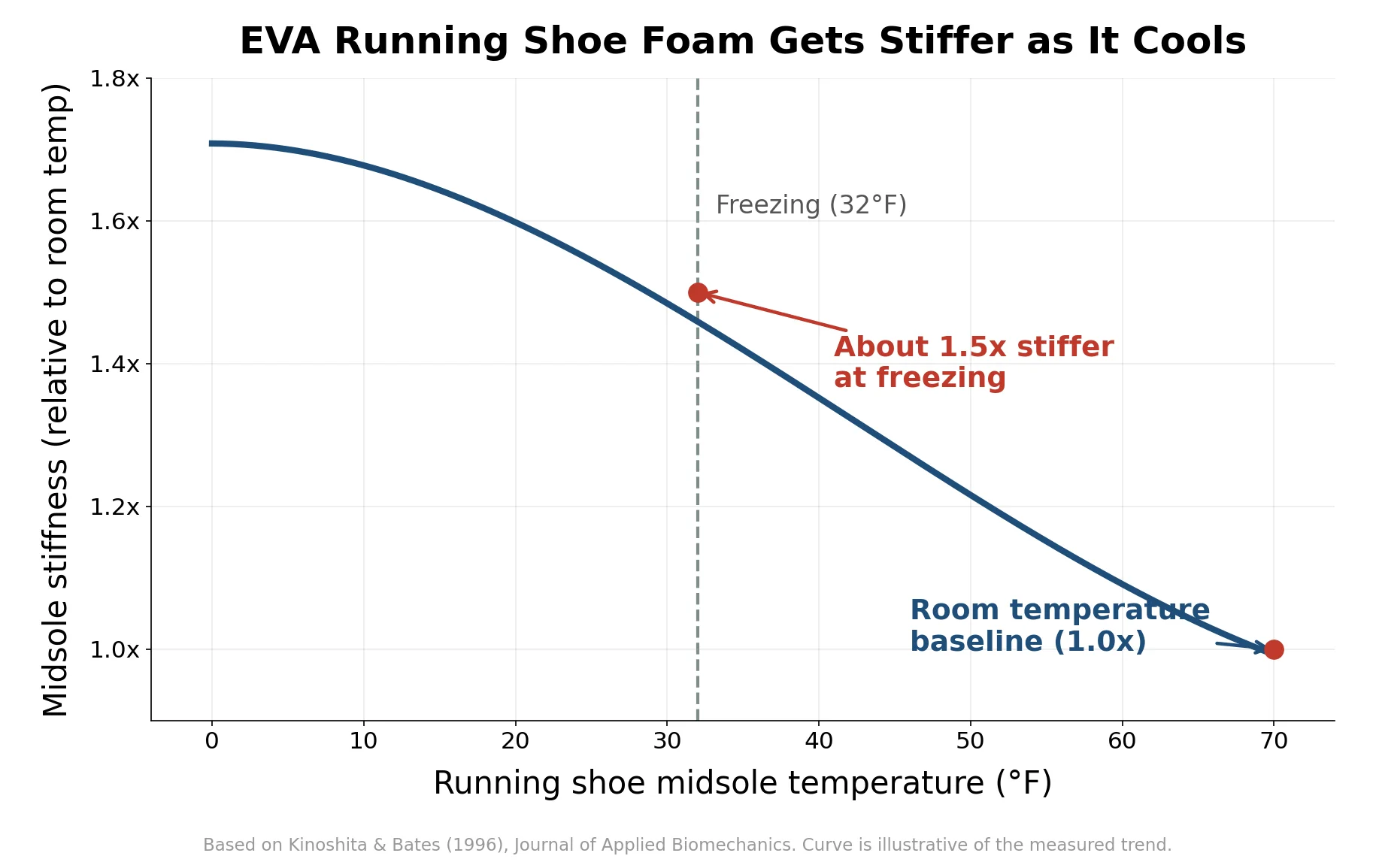
A 1996 study found that midsole stiffness rose to about 1.5 times its room-temperature value once the shoe’s foam cooled to around freezing.

That study, run at the University of Osaka and the University of Oregon, tested midsoles of different firmness levels on a mechanical impact rig across a range of temperatures.
Every foam followed the same pattern. Colder foam was stiffer foam, with the biggest jump as the midsole approached freezing.
What is “cold padding” in a running shoe?
Cold padding is not an official shoe feature or a material you can buy. It is the phrase runners reach for when the cushioning in a familiar shoe suddenly feels firm on a cold morning.
What you are feeling is the padding in the midsole and insole responding to temperature.
The foam has not changed thickness or worn out. It has cooled, and cooled foam compresses less under the same load.
Cold padding is familiar cushioning stiffened by the cold, and it softens again as the shoe warms.
So when a shoe feels like it has less padding in winter, the cushioning material is still all there. It is behaving as a stiffer version of itself until it warms back up.
How much does your foot warm the shoe during a run?
Your foot and the impact of each stride heat the midsole from the inside, which offsets part of the cold.
The same 1996 research tracked midsole temperature with a sensor while 2 runners trained in different weather across a full year.
The shoe warmed by about 14°F in the first 10 to 15 minutes of running, then held steady near that level for the rest of the session.
That warming happens no matter the weather, so your shoe never stays as cold as the air around it.
The firmest, least cushioned part of a cold run is the opening 10 to 15 minutes, before your foot has heated the foam.
Ease into cold runs and treat the first mile as an extension of your warm-up, because your shoes are at their stiffest before they have had a chance to heat up.
Does stiffer foam in the cold raise your injury risk?
Stiffer foam changes how impact spreads across your foot, and that is the part worth watching.
When the midsole is firmer, it compresses less on impact than a warm midsole would, so less of the foam presses back against your foot.
A 2010 computer model of a cold midsole showed that the reduced foam compression raised peak plantar pressure, the force concentrated on the part of your foot in contact with the shoe.
The total impact force does not change. The same force is concentrated on a smaller patch of your foot than in a warm shoe, which raises the pressure at that patch.
Running in stiff, cold shoes concentrates force on your foot the way running on concrete instead of grass does, because concrete gives your foot less to sink into than grass does.
No study has tied cold shoes directly to running injuries. Even so, more concentrated pressure is worth respecting if you already deal with foot problems or you are prone to injuries that hard ground aggravates.
RunnersConnect Bonus
Download your FREE lacing techniques guide.
You know how to read the wear of shoes, but are you lacing your shoes wrong? Download our Running Shoe Lacing guide for free and get a quick reminder, specific how-to and resources for videos on the best way to lace your running shoes.
Do PEBA and TPU foams handle cold better than EVA?
Newer midsole foams hold their properties across a wider temperature range than standard EVA, so they lose less of their cushioning in the cold.
Over the last decade, materials like TPU and PEBA have moved from race-day carbon-plated shoes into everyday trainers.
PEBA in particular stays springy across a broad span of temperatures, which means a PEBA midsole gives up less of its cushioning on a freezing morning than an EVA midsole does.
A 2024 trial of trained runners measured a lower energy cost in fresh PEBA shoes than in fresh EVA shoes at the same running speed.
That test measured performance at room temperature, not in the cold, so treat the winter edge of PEBA as a property of the material rather than a proven race-day number.
If your winter miles pile up and firm shoes bother you, a shoe built on PEBA or TPU foam is the more temperature-stable choice.
How should you manage running shoes in cold weather?
You cannot stop foam from stiffening in the cold, but a few habits keep it from catching you off guard.
Start your shoes warm, add extra warm-up time, and keep an eye on how old your winter pair is.
Store your shoes somewhere warm. Foam that starts a run at room temperature has a head start on the cold, so keep your shoes indoors rather than in a garage, a car trunk, or a cold entryway.
Give cold runs extra warm-up time. The opening 10 to 15 minutes are when the foam is stiffest, so build in easy running before any hard effort.
Watch how old your winter shoes are. Cold foam behaves a lot like worn foam, because EVA also stiffens as it ages and breaks down.
A tired pair in January combines age-related stiffness with cold stiffness, so this is a good time to check how many miles are on your shoes.
Pick a softer or more temperature-stable midsole if you run cold a lot. A softer EVA shoe changes less in the cold than a firm EVA shoe, and a PEBA or TPU shoe changes less than any EVA shoe.