
Your lactate threshold is the fastest pace you can hold for roughly an hour before your blood lactate starts climbing faster than your body can clear it.
Once you know that number, every workout on your calendar becomes sharper.
Tempo runs land at the right effort. Easy days stay truly easy.
Race pace stops being a guess.
The good news: you don’t need a lab or a blood sample to find it. Three home tests give you a usable estimate in under an hour.
Here’s what you’ll learn:
- What lactate threshold actually is, and why LT1 and LT2 are different
- Three field tests for your lactate threshold heart rate and pace
- Whether a lab test is worth the cost
- The heart rate zone your threshold sits in
- Workouts that push your threshold higher
- How often to retest so your training stays accurate
What Is Lactate Threshold, Exactly?
Lactate threshold is the running intensity at which lactate starts to accumulate in your blood faster than your muscles and liver can recycle it back into energy.
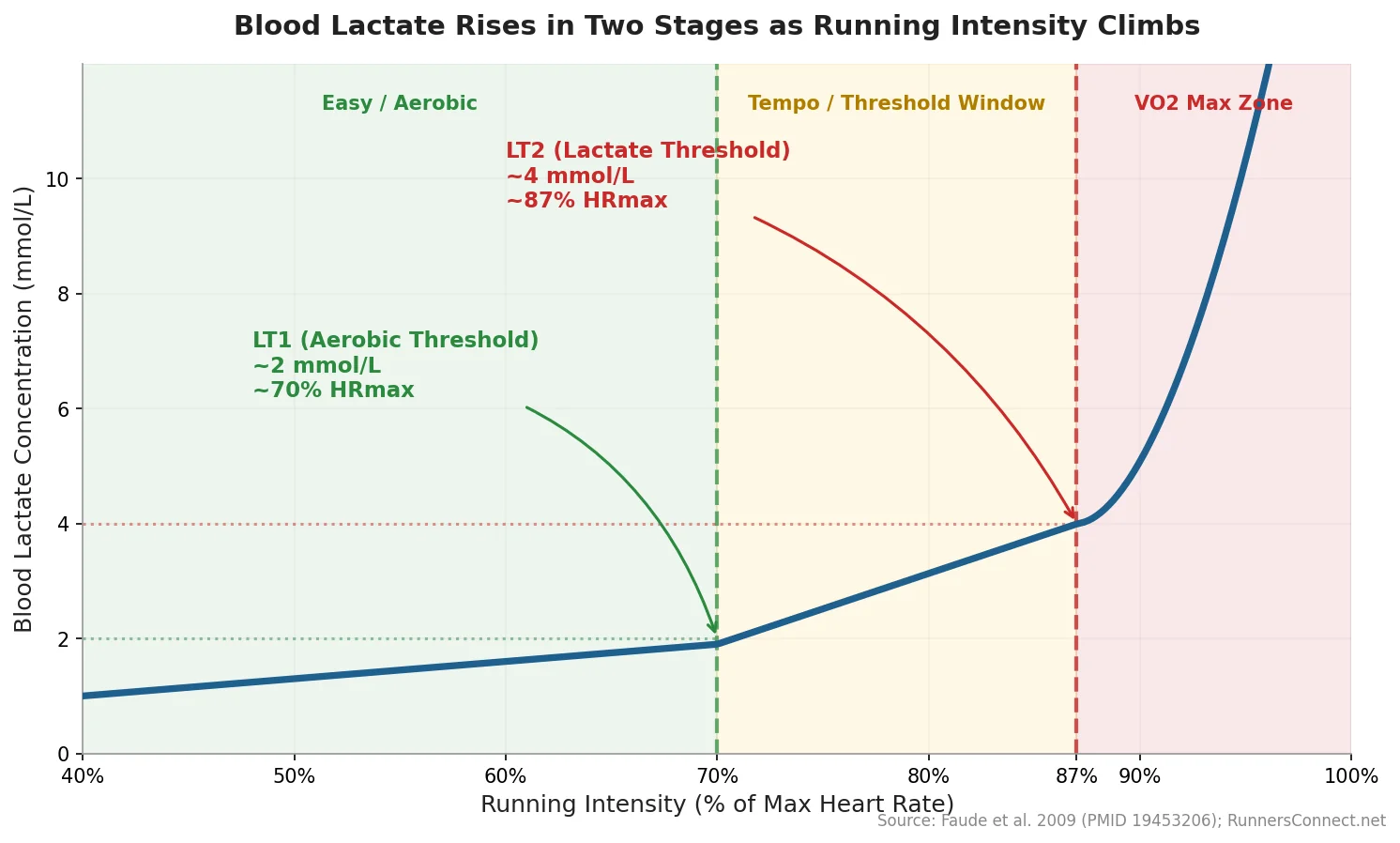
A 2009 review in Sports Medicine identified more than 25 named definitions of the lactate threshold, with most serious protocols settling on a blood lactate concentration near 4 mmol/L.

There are actually two thresholds, and mixing them up is where most runners go wrong.
LT1 (aerobic threshold) sits at the pace where blood lactate first rises above resting values, usually around 2 mmol/L. This is the upper edge of your easy running.
LT2 (anaerobic threshold) is the pace where lactate production outpaces clearance and the curve turns sharply upward, typically near 4 mmol/L. When coaches and watches say “lactate threshold,” this is the number they mean.
LT2 is the number you train, LT1 is the pace that protects your easy days, and the tests below target LT2.
How Do You Calculate Lactate Threshold Heart Rate at Home?
The most reliable home method is a 30-minute time trial with heart rate data.
The protocol was popularized by coach Joe Friel and has been used for two decades in cycling and running because it correlates well with lab-measured LTHR.
Equipment: a watch or chest strap that records heart rate, and a flat course (a track works well).
Protocol:
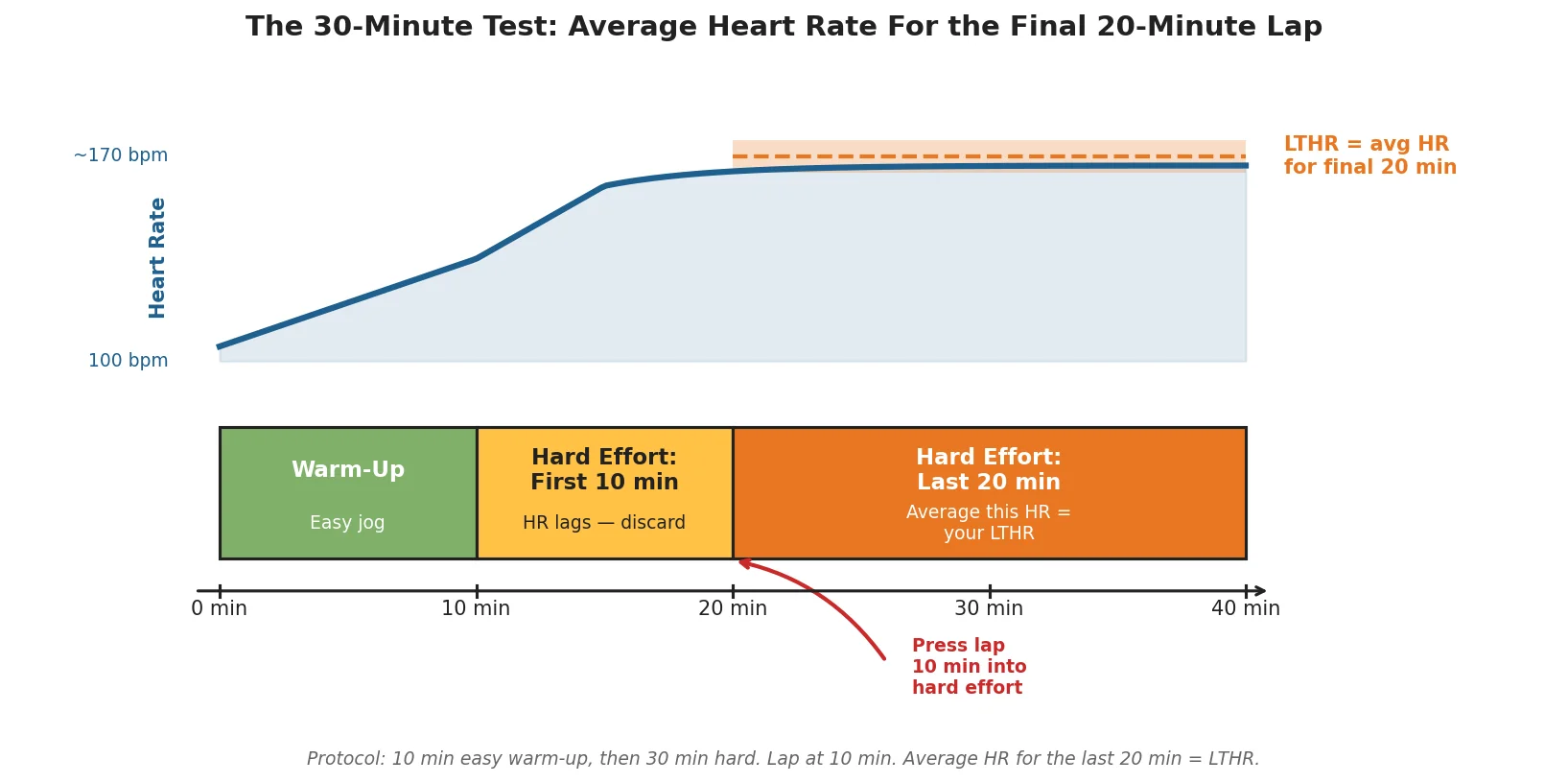
- Warm up easy for 10 to 15 minutes.
- Run hard for 30 minutes. Steady, race-like, not a sprint.
- Ten minutes into the 30-minute segment, press the lap button.
- Continue hard for the remaining 20 minutes.
- After the test, average your heart rate for that final 20-minute block.
That average heart rate is your lactate threshold heart rate (LTHR).
The first 10 minutes are thrown out on purpose. Heart rate lags behind effort in the opening minutes, so averaging the full 30 would underestimate your true LTHR.
Use a range of roughly 5 beats above and below your calculated LTHR when you prescribe workouts. Heart rate drifts with heat, caffeine, sleep, and hydration.
If your last 20-minute average is 164 bpm, your working LTHR range is 159 to 169 bpm for tempo efforts. Any single-beat target will feel impossible to hold on a hot day and too easy on a cool one.
How Do You Estimate Lactate Threshold Pace From a Recent Race?
If you’ve raced in the last 6 weeks, you can back out your lactate threshold pace without running another test.
Lactate threshold pace is the pace a fit runner can sustain for about 60 minutes. For most non-elite runners, that lines up almost exactly with 15k to half marathon race pace.
From a 5k: add 15 to 25 seconds per mile (9 to 15 seconds per km) to your 5k pace.
From a 10k: add 10 to 15 seconds per mile (6 to 9 seconds per km) to your 10k pace.
From a half marathon: your race pace is your lactate threshold pace, or within a handful of seconds of it.
From a marathon: subtract 20 to 30 seconds per mile (12 to 18 seconds per km) from your marathon pace.
A comprehensive review of endurance methodology confirms that race performances between 30 and 60 minutes correlate most tightly with laboratory-measured lactate threshold, which makes the 15k to half marathon window the sweet spot for pace estimation.
Pair this pace with the LTHR from the 30-minute test whenever you can. One number without the other leaves you guessing about effort on days when the weather shifts.
Can You Find Your Lactate Threshold by Feel?
If you don’t have a watch or a recent race, the talk test gives you a rough estimate in about 15 minutes.
Run at a pace where you can speak three to four clear words in a row before needing to breathe.
Two words is too hard, closer to 5k pace. A full sentence is too easy, closer to marathon pace.
Three to four words is the tempo sweet spot.
On a 1 to 10 effort scale, lactate threshold sits at RPE 7 to 8 of 10. You should feel you could hold the pace for another 20 minutes if someone put a medal at the end, but not an hour longer.
The talk test is less accurate than the 30-minute test, but it travels with you. Use it as a gut check during workouts even when you have a watch on.
Is a Lab Test Worth the Cost?
A lab lactate test gives you the gold-standard measurement for about $150 to $300 at most universities and sports medicine clinics.
The protocol is simple in practice.
You run on a treadmill at progressively faster stages, usually 3 to 5 minutes each.
At the end of every stage, a technician pricks your fingertip or earlobe and measures blood lactate concentration.
When the number crosses 4 mmol/L, that stage is your LT2. The pace and heart rate at that stage become your training targets.
The result is more precise than any home test, and it detects both thresholds in one session.
A lab test is worth it if you’re a data-driven runner preparing for a serious race, or if your home tests keep producing inconsistent results. For most runners, the 30-minute field test captures 90% of the value at 0% of the cost.
What Heart Rate Zone Is Lactate Threshold?
For most well-trained runners, lactate threshold falls between 85 and 92 percent of maximum heart rate.
That range is wider than it sounds. A fit 35-year-old with a 185 bpm max sits somewhere between 157 and 170 bpm at threshold.
The 13-beat spread is why the “220 minus age” shortcut leads runners astray.
The CDC age-based formula misses true max heart rate by 10 to 15 bpm in a large share of runners. Use it only as a rough upper bound until you’ve done the 30-minute test.
On most 5-zone heart rate systems, lactate threshold sits at the bottom of Zone 4.
Above threshold you’re in Zone 4 to 5, burning primarily glycogen. Below threshold you’re in Zone 2 to 3, burning a heavier share of fat.
Five beats above your LTHR turns a 40-minute tempo into a VO2 max interval, while five beats below turns it into a marathon-pace run.
RunnersConnect Bonus
Download our Heart Rate Calculator to find out what your individual heart rate zones are.
Which Workouts Raise Lactate Threshold?
Lactate threshold improves when you train at or slightly below it for extended durations.
Research on elite endurance athletes shows that a polarized distribution, with roughly 75 to 80 percent of weekly volume below LT1 and 15 to 20 percent at or above LT2, produces the largest threshold improvements.
Three workouts do the heavy lifting.
Classic tempo runs. 20 to 40 continuous minutes at LT2 pace or within 3 bpm of LTHR, book-ended by a 10-minute warm up and cool down.
Starting load is 20 minutes. Progress 5 minutes per week until you can hold 40.
Broken tempos (cruise intervals). 3 to 5 times 8 to 12 minutes at threshold, with 60 to 90 seconds of easy jogging between reps.
The short recovery keeps total threshold time high without letting heart rate fully drop. You can accumulate 40 to 50 minutes of threshold work this way even when a continuous tempo feels too hard.
Threshold intervals at 10k pace. 3 to 5 times 1 mile at 10k pace with 60 seconds rest, book-ended by a 2-mile warm up and cool down.
Faster than classic tempo, but the short recovery maintains the threshold stimulus. Our tempo intervals guide breaks down the full progression.
Build one threshold session into your week. Two only if you’re running 50 miles a week or more, spaced at least 72 hours apart.
| Workout | Pace target | Duration at threshold | Best for |
|---|---|---|---|
| Classic tempo | LT2 pace (HM pace) | 20-40 min continuous | Marathon, HM |
| Broken tempo (cruise) | LT2 pace | 40-50 min with short rest | HM, 10k |
| Threshold intervals | 10k pace | 30-40 min total work | 10k, 5k, mixed |
How Often Should You Retest Lactate Threshold?
Retest every 6 to 8 weeks while you’re in a build phase.
That cadence matches how quickly physiology adapts.
Any sooner and you’re measuring noise from heat, sleep, or hydration. Any later and your training zones drift out of sync with your real fitness.
Three signals tell you it’s time to retest before the 6-week mark is up:
- Tempo runs feel markedly easier at the same pace
- Your last race beat your expected time by 30 seconds per mile or more
- Heart rate during workouts runs 5-plus bpm lower at paces that used to feel hard
Retest on a cool morning, rested, at least 48 hours after your last hard workout. A test run the day after an interval session captures fatigue, not fitness.
Update your training zones the same day you retest. Running the next tempo at last month’s target heart rate wastes the adaptation you just earned.