
You signed up for a race and just checked the elevation profile.
There’s 1,800 feet of climbing on the course.
One problem: your neighborhood is completely flat.
This is one of the most common training mismatches in running: a hilly race on a flat-runner’s body.
The gap is smaller than it looks.
Between treadmill incline settings, stadium stairs, and a handful of tools for finding hidden hills in your area, you can build every physiological benefit hill training produces without living near a single incline.
So, in this article you’re going to learn the research-backed practical advice on simulating hill training when you live somewhere flat.
- How to find hills to run near you using free tools
- What treadmill incline setting actually replicates outdoor hills
- Which hill alternatives (stairs, bridges, parking garages) give the best training return
- Specific workouts flat runners can plug into their training this week
Why Does Hill Training Make You a Better Runner?
Hill training isn’t just preparation for hilly courses.
It changes how your muscles fire on flat terrain, too.
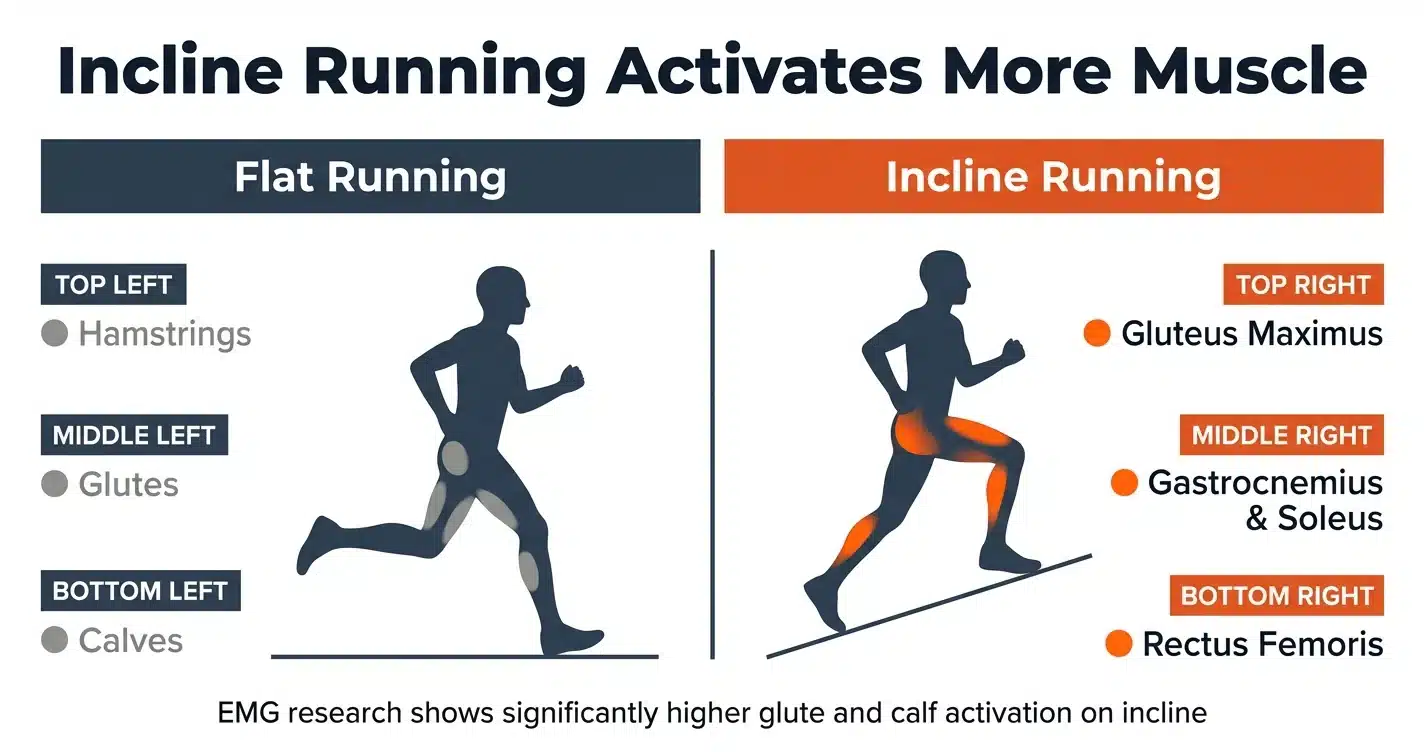
Research has shown that incline running significantly increases activation in the gluteus maximus, gastrocnemius, and soleus compared to flat running at the same pace.

That’s your power chain: the muscles that drive your push-off on every stride.
On flat ground, those muscles never get pushed hard enough to produce meaningful adaptation.
Running uphill forces your glutes to generate more force per stride and your calves to absorb greater load at foot contact.
Over weeks, those adaptations carry back to flat running as improved running economy.
You cover the same distance using less oxygen.
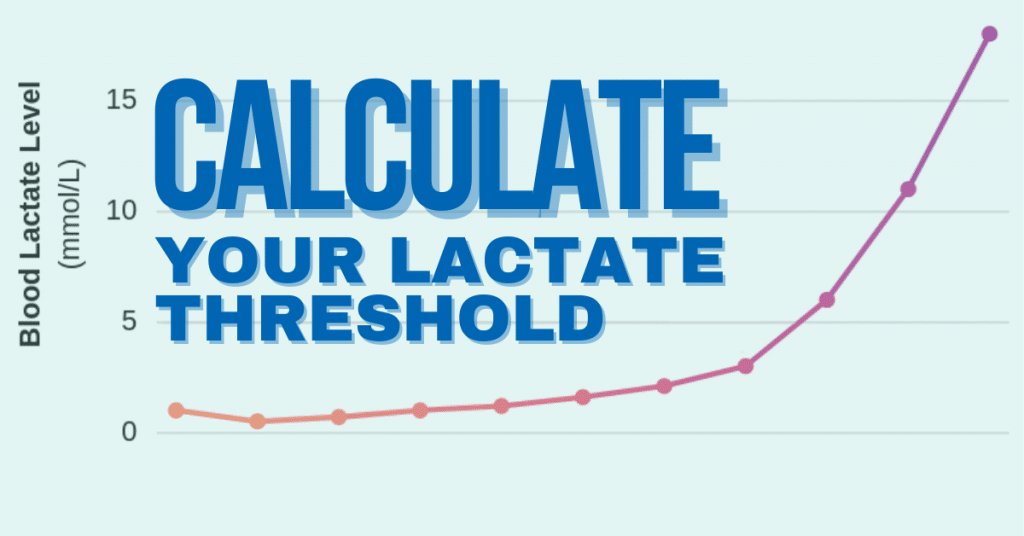
Hill training also raises your lactate threshold at a lower perceived effort than track intervals, which means you can accumulate quality training stress without the recovery toll of hard flat-ground workouts.
If you want to understand how hill training improves race performance on the physiological level, the research goes deeper than most runners expect.
How to Find Hills to Run Near You
Before you start simulating hills, it’s worth spending 10 minutes checking whether real hills are closer than you think.
Flat cities often have isolated elevation that doesn’t show up on a typical road map.
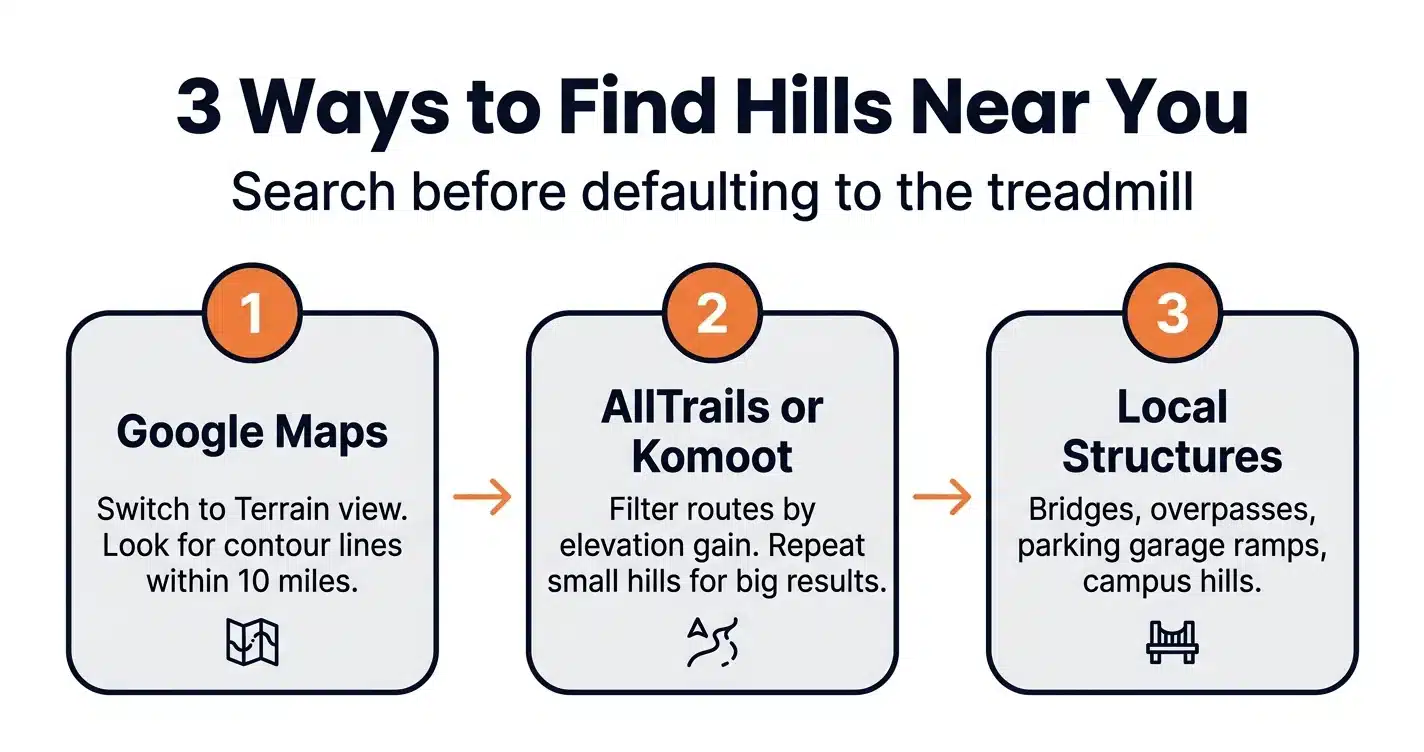
Google Maps terrain view.
Switch to the terrain layer on Google Maps and zoom out to a 5–10 mile radius from your home.
Look for contour lines.
Even a road crossing a subtle ridge can produce a 50-foot climb that shows up as a genuine training stimulus over repeated loops.
AllTrails and Komoot.
Both apps index elevation data for every trail and road in your area.
Filter AllTrails by “elevation gain” and sort ascending.
You’re looking for even small parks with a rolling section, not a mountain.
A 30-foot hill repeated 10 times becomes 300 feet of climbing in a single workout.
Local structures.
Highway overpasses, bridge approach roads, and campus hills often go unnoticed by runners who assume they need a trail to find elevation.
A bridge crossing a river can have 20–40 feet of rise on each approach.
Run across and back 6 times and you’ve done a legitimate hill session.
Parking garages.
A spiral parking garage is one of the most underrated hill training tools in a flat city.
Each ramp level gains roughly 10 feet of elevation, and most structures have 5–8 levels.
The concrete surface and consistent grade make them predictable for pacing repeats.
If you live within 10 miles of any of these structures, real hill alternatives exist. Search before defaulting to the treadmill.
Does Treadmill Incline Actually Replace Outdoor Hills?
For most runners, yes. The one caveat is grade setting.
Running on a flat treadmill is measurably easier than running outdoors at the same pace because the belt assists forward momentum and there’s no air resistance.
Research has shown that a 1% treadmill grade most accurately reflects the energetic cost of outdoor running at speeds between 2.92 and 5.0 m/s (roughly 7:00 to 10:00 min/mile pace).
That means every treadmill run should start with the incline set to at least 1% just to match outdoor flat running.
Once you push above 1%, you’re training the same musculature as outdoor hill work.
The treadmill’s belt can’t distinguish between simulated and real incline in terms of the load placed on your glutes, calves, and quads.
The key limitation is downhill training.
Treadmill incline only goes in one direction, so the eccentric load your quads absorb on downhills doesn’t get trained on the machine.
That eccentric quad stress is what causes most post-race soreness on hilly courses.
For proper hill running form on downhills, you’ll want to find even a modest slope to practice controlled descent.
What Incline Percentage Should You Use for Hill Training?
Different gradients train different physiological systems.
Matching the right incline to the right workout is what separates useful treadmill hill work from just feeling tired.
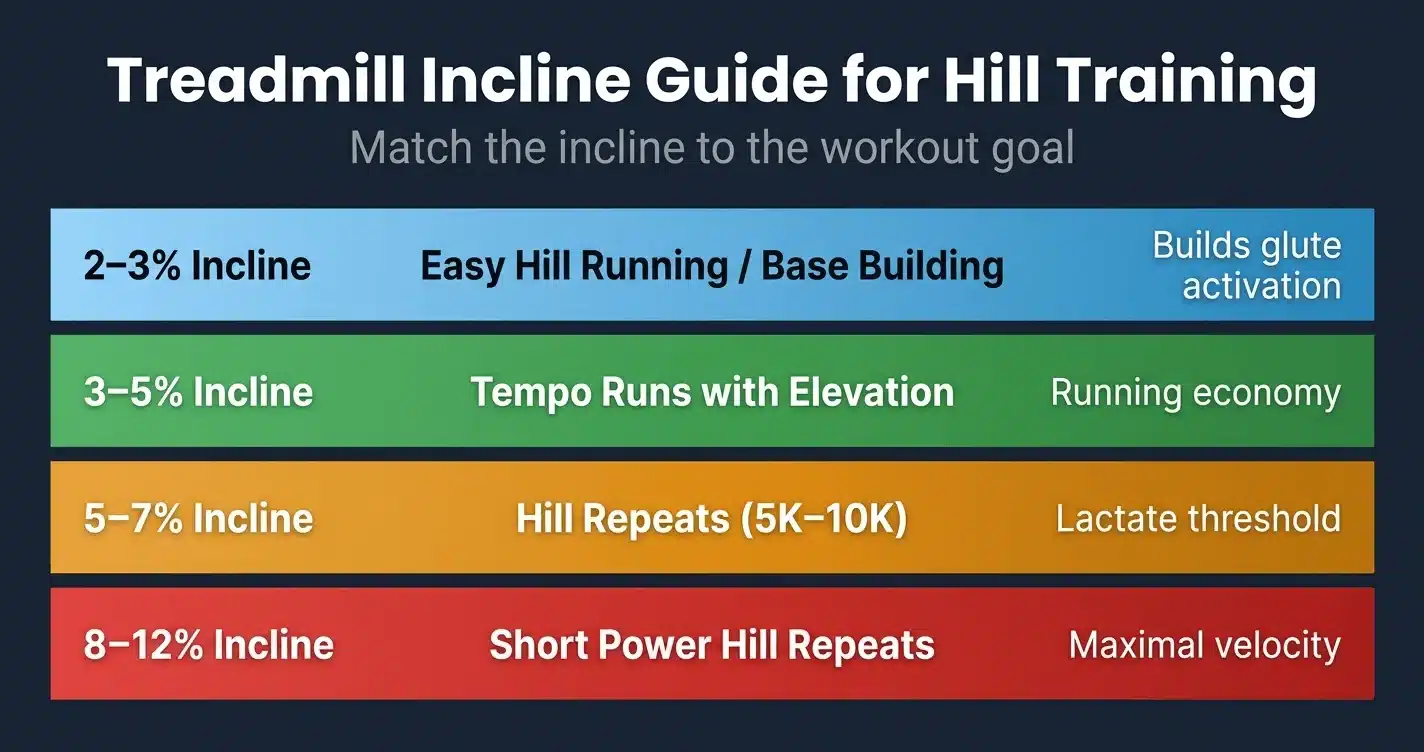
A randomized controlled trial found that steeper uphill training (7.6% grade and above) produced significantly greater improvements in maximal velocity, while moderate grades around 5% were more effective for longer-distance running economy.
Here’s how to translate that into treadmill settings:
| Workout Type | Incline Setting | Primary Benefit |
|---|---|---|
| Easy hill running / base building | 2–3% | Increased glute activation without excessive load |
| Tempo runs with elevation | 3–5% | Running economy, sustained power output |
| Hill repeats (5K-10K focus) | 5–7% | Lactate threshold, running economy |
| Short power hill repeats (1 mile focus) | 8–12% | Maximal velocity, neuromuscular power |
One key rule: reduce your pace as incline increases.
At 8% grade, most runners need to drop to 60–70% of their normal training pace to maintain good form and avoid overloading the Achilles tendon.
The effort level matters more than the speed on the display.
RunnersConnect Bonus
Download your FREE Treadmill Guide for Runners.
The guide contains 4 treadmill specific workouts guaranteed to keep you sane and fit! You’ll learn about the In-N-Out workout, how to “run like an Egyptian” and get my favorite “green eggs and ham” workout.
What Other Options Replace Hills When You Live Somewhere Flat?
Treadmills are the most accessible option, but they’re not the only one.
Several alternatives train the same muscle groups and produce comparable cardiovascular stress.
Stadium stairs.
Running stairs targets the same posterior chain as hill repeats: glutes, hamstrings, and calves, with the added demand of a steeper angle than most treadmills can reach.
Most stadium steps sit at a 25–35% grade, which is steeper than any treadmill setting.
Use a step-skipping pattern (taking 2 stairs at a time) to emphasize hip extension more directly.
Parking garage ramps.
Ramps allow continuous running rather than the step-by-step mechanics of stairs, which makes them better for replicating hill repeat intervals.
Run up the helical ramp, walk back down the inside stairwell for recovery, and repeat.
A 6-story garage gives roughly 60 feet of climbing per rep, equivalent to a moderate outdoor hill repeat.
Highway overpass repeats.
Find an overpass with a dedicated pedestrian walkway.
The approach road typically rises 15–25 feet over 100–200 meters, which creates a short but steep hill interval when repeated 8–12 times.
The grade tends to be steeper than it looks, especially toward the top of the approach.
Indoor stair climbing.
Office buildings and apartment complexes with 10+ floors give flat-city runners access to vertical climbing on days when weather or safety rules out outdoor options.
Running stairs continuously for 20 minutes produces a training stimulus comparable to a 30-minute outdoor hill session on most fitness measures.
How Do You Build Hill Workouts Without Hills?
The goal is to accumulate climbing, not simply to sweat more on an incline.
Structure matters as much as the surface you’re running on.
Workout 1: Treadmill hill repeats (lactate threshold focus).
Set the treadmill to 5–6% incline.
Run 3 minutes at a pace that feels like a 7 out of 10 effort: hard but sustainable.
Walk or jog at 1% for 2 minutes for recovery.
Repeat 6–8 times.
This session closely replicates the physiological demand of classic outdoor hill repeats and directly targets the metabolic pathways that matter most for race performance.
Research has shown that short incline intervals (30–60 seconds at steep grades) improved lactate threshold more than longer incline intervals — even when the longer group ran more than twice the total volume per session.
That means time on the hill matters less than intensity on the hill.
Short, hard efforts with full recovery produce more adaptation than grinding through long incline slogs at a moderate effort.
Workout 2: Stair or garage intervals (power focus).
Find your local stairs or parking garage ramp.
Sprint up at maximum effort for 20 seconds.
Walk back down for 90 seconds of recovery.
Repeat 10–12 times.
This session trains the neuromuscular power system that flat running never touches.
It’s the same system elite runners use to surge on race-course climbs.
Weekly integration.
One hill session per week is enough to generate meaningful adaptation for runners under 50 miles per week.
Replace one of your moderate-effort runs with a hill session, not an easy day or a long run.
Trying to add a hill session on top of a full training week without removing something is a recovery mistake most flat-terrain runners make when they first start hill work.
RunnersConnect Bonus
Download your FREE Treadmill Guide for Runners.
The guide contains 4 treadmill specific workouts guaranteed to keep you sane and fit! You’ll learn about the In-N-Out workout, how to “run like an Egyptian” and get my favorite “green eggs and ham” workout.
Replace one moderate-effort run with a hill session each week. Don’t add it on top of a full training schedule.
| Training Option | Grade / Effort | Best For | Key Limitation |
|---|---|---|---|
| Treadmill incline | Set to 5–12% depending on workout | Hill repeats, tempo, economy work | No downhill training |
| Stadium stairs | 25–35% (very steep) | Power, neuromuscular strength | Different mechanics than running |
| Parking garage ramps | 8–12% typical | Continuous running, intervals | Tight turns, traffic |
| Overpasses / bridges | 5–15% approach | Outdoor feel, recovery runs | Short distance per rep |
| Real hills (found via app) | Variable | Full training stimulus including downhill | May require travel |
The bottom line: flat terrain is a training constraint, not a training ceiling.
Every physiological benefit hill work produces is accessible through a combination of treadmill incline, local structures, and one strategic search of the terrain around you.
Stronger glutes, better running economy, higher lactate threshold: all of it available to flat-terrain runners.