You’re three weeks into 5K training and hitting a wall.
You run easy days too hard and hard days not hard enough, or you string together workouts without a clear purpose.
Then you read a training plan that lists “intervals” and “tempo run” without explaining what they actually do to your body or why one matters more than the other for your race goal.
5K training success depends on doing the right workouts at the right intensity.
Each workout type targets a specific physiological adaptation your body needs to run faster at 5K distance.
So, in this article you’re going to learn the research-backed practical advice on 5K workouts.
- Why interval training builds VO2max faster than steady running
- How tempo runs teach your body to sustain 5K race pace
- The role long runs play in 5K training (spoiler: it’s essential)
- Which workouts to prioritize if you’re short on time
- How to structure your weekly mix for injury prevention
- Objective measures of whether your 5K training is working
For a full training approach, check out our complete 5K training plan that puts all these workouts into a structured week-by-week program.
What Are the Best Workouts for Your 5K Training?
5K training success depends on targeting three distinct energy systems and physiological adaptations.
Your body uses three energy systems during a 5K effort.
The anaerobic system drives short, maximum-effort sprints.
The lactate threshold system sustains your fastest sustainable pace for 5–10 minutes.
The aerobic system builds your endurance foundation.
The most effective 5K workouts address each system with specific intensities and durations.
Interval workouts recruit the anaerobic system and expand VO2max (the maximum amount of oxygen your body can use during exercise).
Tempo runs strengthen your lactate threshold, the pace at which lactate accumulates in your blood and limits performance.
Long runs build aerobic capacity and the muscular endurance needed to maintain 5K pace even when fatigued.
Understanding what each workout does lets you train intentionally instead of just running hard whenever you feel like it.
How Do Interval Workouts Build 5K Speed?
Interval workouts are repeated high-intensity efforts separated by short recovery periods.
Your body is not used to the intensity required during intervals, so it triggers rapid adaptations: increased VO2max, improved lactate clearance, and greater running economy (getting more speed for the same effort).
A study of recreational runners found that 8 weeks of high-intensity interval training significantly improved VO2max, 1-km running time, and maximal aerobic speed.

The high-intensity stimulus is what drives VO2max growth.
Easy running alone cannot trigger this adaptation regardless of distance.
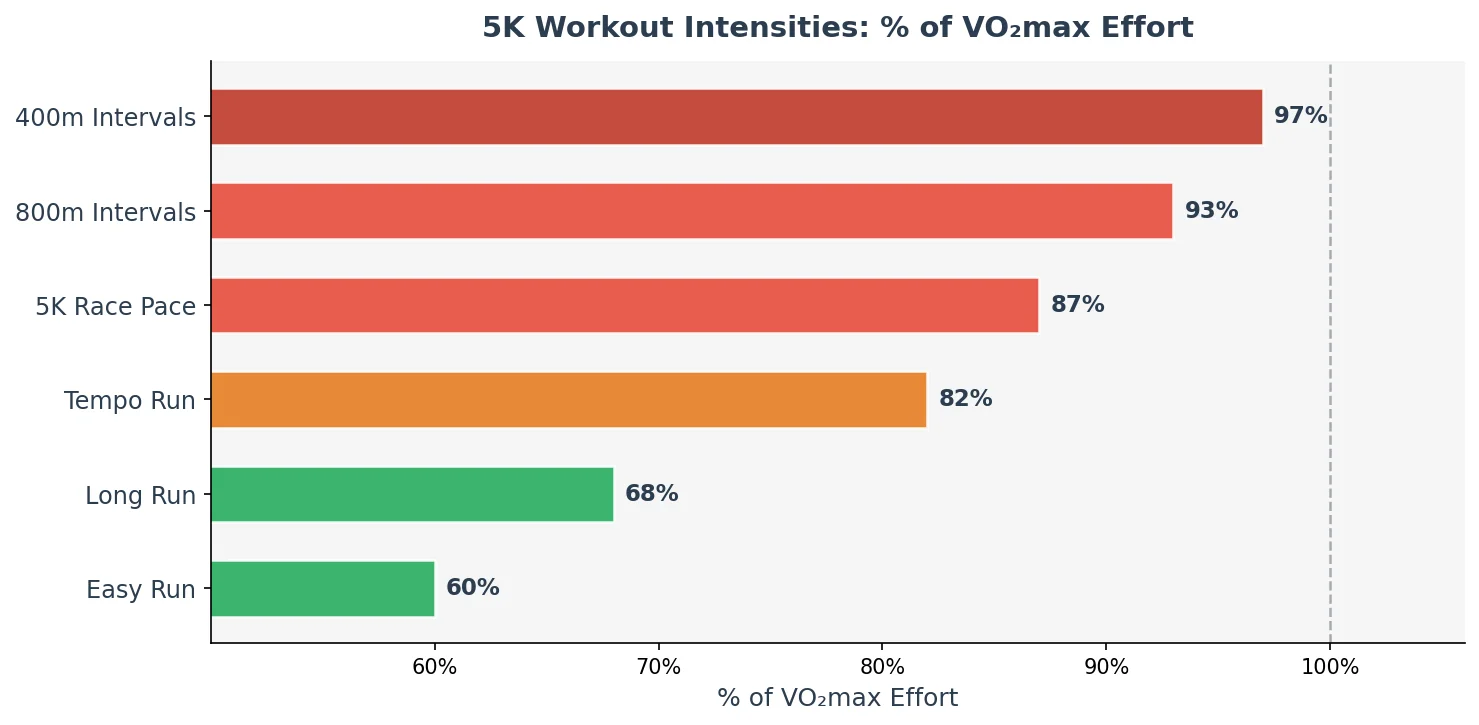
For 5K training, the most effective intervals are 400m repeats (one quarter-mile), 800m repeats (half-mile), and 2–3 minute repeats at 5K race pace or slightly faster.
400m repeats are run at roughly 95–100% of your VO2max effort.
That pace feels uncomfortably fast but stops short of an all-out sprint.
The recovery jog between repeats (typically 90–120 seconds) lets your heart rate drop but stays short enough that you never fully recover.
This teaches your body to clear lactate while still fatigued, a critical skill during a 5K race.
800m repeats sit at roughly 90–95% of VO2max effort, a pace you could sustain for about 3–4 minutes at full effort.
The longer duration of each interval (roughly 3–4 minutes) creates a stimulus that bridges interval work and tempo running.
2–3 minute repeats are closer to your lactate threshold than true VO2max work, but still demand high oxygen uptake.
These repeats suit recreational runners because the shorter rest period between repeats keeps the workout brutal without requiring the same track or careful pacing that 400m repeats demand.
Your 5K race pace sits at roughly 85–90% of VO2max effort, slower than the intensity of most interval sessions.
Workouts that train at faster paces teach your body to sustain that lower intensity with greater ease.
[text-block id=”68594″]
What Is a Tempo Run and Why Does It Matter?
A tempo run is sustained running at your lactate threshold pace, the speed at which lactate accumulates faster than your body can clear it.
This pace feels comfortably hard: you could speak 5–6 words before taking a breath, but not hold a full conversation.
Research has shown that after 6 weeks of endurance training, velocity at lactate threshold and average 5000-m running pace both increased significantly, confirming that raising lactate threshold directly improves 5K performance.
Lactate threshold matters because it’s closely linked to your 5K race pace.
If you raise your lactate threshold, you raise the pace you can sustain during a 5K race without accumulating dangerous amounts of lactate.
Tempo runs teach your muscles to work harder while clearing lactate more efficiently, a skill that translates directly to 5K racing.
For most 5K runners, tempo running pace is about 25–30 seconds per mile slower than your projected 5K race pace (in min:sec per mile).
If your goal is a 24-minute 5K (7:44 per mile), your tempo pace is roughly 8:10–8:15 per mile (5:05–5:07 per km).
A typical tempo run starts with 10 minutes of easy running, then runs 12–20 minutes at tempo pace, then cools down with 5–10 minutes of easy running.
Advanced runners might run longer tempos (up to 30 minutes) or stack multiple tempo efforts in the same session.
Tempo runs are more accessible than interval training for recreational runners because the pace is steady and easier to pace on roads without a track.
Do You Need Long Runs for 5K Training?
Many runners believe that 5K training means only speed work: intervals, tempo runs, and race-pace efforts.
That assumption misses a critical adaptation: your aerobic base.
Long runs develop your aerobic endurance, the foundational fitness that lets you recover between hard workouts, maintain pace late in a race, and build the muscular adaptations that benefit all other training.
Research has shown that endurance training increases capillary density in working muscles and improves peak oxygen uptake, both of which support faster race performance.
Your muscles adapt during both the hard workout and the recovery runs that follow.
Long runs at easy pace (65–75% of your max heart rate) build mitochondrial density, the cellular power plants that fuel aerobic performance.
They also strengthen connective tissue, which supports all your speed work.
For 5K training, a long run doesn’t need to be marathon-distance.
Most recreational 5K runners benefit from a weekly long run of 10–14 km (6–8.5 miles), run at a pace 60–90 seconds per mile slower than your 5K goal pace.
This distance is long enough to trigger aerobic adaptations without the injury risk or recovery demands of ultralong runs.
Long runs are the bedrock of 5K fitness: they enable recovery from speed work and build the muscular endurance that prevents you from slowing down in the final 800m of a 5K race.
How Should You Structure Your Weekly Workout Mix?
The best 5K training week balances hard workouts with adequate recovery and does not repeat the same stress twice in short succession.
Your muscles and central nervous system need 48 hours to recover from a true hard workout (intervals or tempo), so spacing them at least 2 days apart prevents overtraining and injury.
A typical 5K training week for a recreational runner includes: one interval or VO2max session, one tempo or threshold session, two to three easy runs, and one long run.
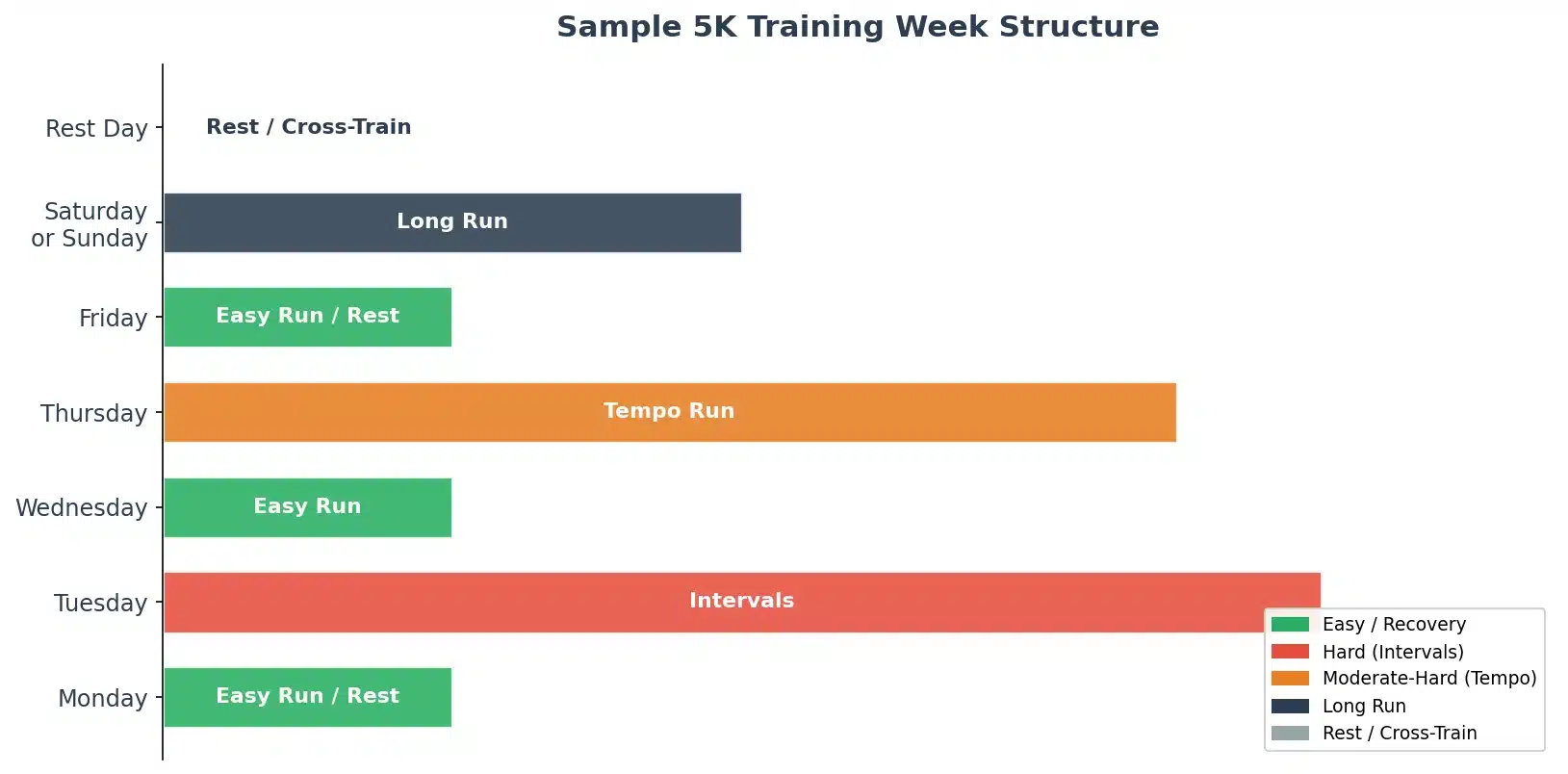
That structure totals 4–5 running days and respects the recovery principle.
Monday: Easy 5–8 km (3–5 miles), or rest day.
Tuesday: Interval workout (6 x 400m to 5 x 800m at VO2max intensity with equal rest).
Wednesday: Easy 5–8 km.
Thursday: Tempo run (10 min warm-up + 15–20 min at lactate threshold + 5–10 min cool-down).
Friday: Easy 5–8 km or rest day.
Saturday or Sunday: Long run (10–14 km at easy pace).
The remaining day: Rest, cross-training, or easy running.
Advanced runners looking to add variety can explore combining intervals and tempo runs in a single session — a technique that demands careful pacing and adequate recovery.
Two hard workouts per week is the minimum effective dose for 5K training.
Three hard sessions per week risks overtraining for most recreational runners.
How Do You Know Your 5K Workouts Are Actually Working?
Improvement is measurable if you track the right markers.
The simplest metric is pace at a given effort level: if your easy runs feel faster at the same perceived effort, your aerobic fitness has improved.
Time trial efforts reveal your current speed: run a timed mile or 2 km at race-simulation effort.
Repeat the same time trial every 4 weeks.
Drops in time signal real improvement.
Track your interval workout pace: if you’re hitting the same splits (time per lap) with less effort, your VO2max has likely expanded.
Most recreational runners see measurable improvements in 5K pace within 6–8 weeks of consistent training.
Early improvements (weeks 2–4) often reflect central nervous system adaptation (your brain getting better at recruiting muscle fibers) rather than physiological changes, but they signal that your training is working.
Your training paces are relative to your own fitness level.
Comparing your interval splits to another runner’s misses the point entirely.
The goal is improvement relative to your own baseline, not matching someone else’s workout splits.
[text-block id=”68594″]
The Bottom Line
5K training success comes from balancing three workout types that each serve a distinct purpose: intervals build VO2max, tempo runs raise lactate threshold, and long runs establish aerobic base.
The best weekly structure includes one interval session, one tempo session, easy runs for recovery, and one long run.
Recovery between hard efforts matters as much as the hard efforts themselves.
Consistent application of this structure over 8–12 weeks produces measurable gains in 5K race pace for nearly all recreational runners.