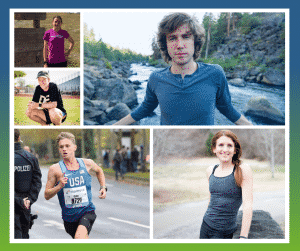

Over the last few years, about 240 runners from our coaching community in more than 20 countries came to our running retreats.
They came from different time zones, running backgrounds, climates and training cultures, but they shared a remarkable amount in common.
In fact, this is something I’ve noticed throughout my years of traveling the world and running in every new place I can find.
It’s what makes running one of the most tight-knit communities in endurance sports.
And, funny enough, despite everyone being from different background at our retreats I’ve found three things that almost everyone had in common…
Almost everyone thinks they will be the slowest one there.
I get 45 to 50 emails a year from runners worried they are too slow or too old for a retreat, and by the first run every one of them has found people at their pace.
Three out of four have the same form issues.
Of those roughly 240 runners, about 75% showed the same three problems during our video analysis: hip drop, crossover, and overstriding, and most of them needed the same 15-minute hip, glute and core routine.
Everyone runs faster with company.
At a voluntary hill session in Flagstaff, at 7,000 feet, I watched runners hit splits they cannot touch training alone at home.
Reflecting back on this as we put together our retreats for 2027 in Portugal and Flagstaff, it got me thinking about what lessons we can learn from runners across the globe.
So today I am going to dig into nine training lessons from nine countries and what we can take away from them!
Kenya — Give Your Week a Fixed Shape
In Iten, Kenya, Tuesday is track at Kamariny Stadium at 9 a.m., Thursday is fartlek, and Saturday is the long run of 20 miles or more, for everyone in town.
The town has roughly 4,000 year-round residents and hosts 18 training camps, and on a Thursday morning one visiting writer counted 50 runners doing the same fartlek together: one minute easy, two minutes hard, for about nine miles.
Everything in between is run at a jog so slow that the same writer had trouble running slow enough to stick with the group.
Nobody in Iten decides each morning what kind of run today will be.
That removes the daily negotiation that turns so many easy days into moderate ones.
Your lesson – having a structured training plan setup in advance makes it much easier to stay consistent.
Ethiopia — The Group Is the Training
Ethiopian runners treat a solo run as something you do for your health, and the group as the thing that makes you an athlete.
Michael Crawley learned that on his first morning in Addis Ababa, at about 7,700 feet, where he spent 15 months training with Ethiopian runners for his book Out of Thin Air.
He went for a run alone in the forest, and a group running single file pulled him in and told him that if you want to be transformed as an athlete, you run with the group.
When we interviewed him on our podcast, he described a group of high-level marathoners who ran on pavement once a week at most, because they believed asphalt killed your legs.
They met at 5:45 a.m., a different runner led each day, and the leader deliberately picked the most winding route through the forest he could find.
When Crawley asked his coach for a plan he could follow back home in Scotland, the first line of every session was the surface to run it on, before the distance or the pace.
Find one run a week with other people, put one soft-surface run on the schedule, and let a different person pick the route each time.
Japan — Make Someone Count on Your Run
Every January 2nd and 3rd, university teams run the Hakone Ekiden, a two-day relay from Tokyo to the mountains at Hakone and back, with ten runners per team covering about 135 miles.
The 2026 broadcast averaged a 29.4% television rating across both days, and 56 million people watched some part of it.
That is close to half the population of Japan tuning in to watch college students run a relay.
Japanese runners train and race as teams, from corporate squads to university programs, and in a relay nine other people are counting on your leg.
The depth of Japanese marathoning is hard to picture from the United States:at the 2021 Lake Biwa Marathon, 42 men broke 2:10 in a single race, when 21 American men had ever done it.
Sign up for a relay, or make your long run a standing appointment with someone who is counting on you to show up.
Norway — Hard Days Are Controlled, Not All-Out
Norwegian runners made double threshold training famous: two threshold sessions in one day, such as 4 to 6 x 5 minutes in the morning and again in the afternoon, with at least five hours between them.
Each rep is held just below the effort where lactate starts to pile up in the blood, and many Norwegian runners check their lactate mid-session with a finger-prick meter.
Neither session is a race, so the effort stays controlled and the runner can repeat it that afternoon and again two days later.
That is the opposite of how most everyday runners treat a tempo run, where the goal is to finish as fast as possible and the next hard day suffers for it.
Coaches consistently see everyday runners run their hard days too hard, so hold your tempo runs at an effort you could repeat tomorrow.
Spain and Portugal — Move the Run Instead of Cutting It
Summer heat in Spain and Portugal pushes training to early morning and evening, and the group run happens after dark.
In Valencia, 48% of runs logged on Strava in 2024 were matched with another runner, according to Strava’s 2024 Year in Sport report, one of the highest rates of any city it tracked.
Both countries also happen to have the fastest everyday marathoners in the world: across107.9 million race results from 1986 to 2018, Spain had the fastest average marathon time of any nation at 3:53:59, and Portugal was third at 3:59:31.
When the forecast says 90 degrees, move the run to the evening instead of cutting it short, and find the people who are already running at that hour.
The cliff paths, cross-country trails and beach routes are also the reason we picked the Algarve for our September 2027 Retreat (and don’t worry, the temps are perfect this time of year).
United Kingdom — Check Your Fitness Every Week for Free
parkrun started in 2004 with 13 runners in a London park, and it now happens at about 2,300 locations every Saturday morning, free, with a printed barcode as your entry.
On a typical Saturday in 2026, about 379,000 people finish one, and 214,000 of them are in the UK alone.
A free, timed 5K every week is a fitness check you can repeat all year without a race entry, and it is a group run with a start time you did not have to organize.
Run it as a tempo three weeks out of four, and race it on the fourth.
South Africa — Pick a Goal Years Out
The race South African runners build their year around is the Comrades Marathon, 89.98 kilometers, about 56 miles, between Pietermaritzburg and Durban.
In 2025, 18,208 people finished it.
Nobody arrives at a 56-mile start line on one 16-week plan, so the training is built in years, and the group is part of it: in Strava’s 2025 report, runners in South Africa and Colombia ran in groups more often than anyone else, on 18.5% of their runs.
The runners I talk to who are stuck in an injury cycle usually share one thing: they are patching themselves together for the next race, with no plan for what comes after it.
A goal race two or three years out gives every training block a reason to build on the last one, instead of starting over every 12 weeks.
Pick yours now, and find the group that is already training for it.
Indonesia — Beat the Heat by Beating the Sun
In Strava’s 2024 report, South Jakarta had the highest share of matched runs of any city Strava tracked, with 78% of runs logged alongside another runner.
In Strava’s 2025 report, Yogyakarta had the most early risers of any city, with 55.4% of all activities recorded between 4 and 7 a.m.
Jakarta is hot and humid every month of the year, so the run starts before the sun.
When it is hot, set a meeting time with other people, because that is what gets you out of bed at 4:30.
United States — Cover the Watch on Easy Days
About 52.3 million Americans ran in 2025, and 432,562 people finished a US marathon in 2024.
American running is also heavily measured: across all of Strava in 2024, 92% of marathoners logged their runs with a GPS watch.
Watching that pace is the most common way I see easy days turn into moderate ones, because a number on the wrist is harder to ignore than your breathing.
The Kenyan jog that a visiting writer could barely stay with would look embarrassing on a pace screen, and that is the point.
Run one easy day a week with the watch face covered, and judge the run by your breathing instead.
Where Runners From 20 Countries Meet
Every lesson above comes back to the same three things we see at the retreats: a fixed rhythm, a controlled effort, and other people.
That is the reason we run them, and it is the same training camp effect the pros chase when they travel for training stints.
For four or five days, your only jobs are the runs, the drills, the strength work, the stretching and the sleep, with a coach watching your form on video and a group to run every mile with.
If you’re interested in experiencing what a retreat is like, join us in 2027!
In July 2027 we will be in Flagstaff, running the trails at 7,000 feet and the rim of the Grand Canyon, with a 1-on-1 coaching session, a video form analysis, and lectures on training, nutrition and mental preparation for every attendee.
In September 2027 we will be on the cliffs of Algarve in Portugal, with the same coaching, guided runs on the coastal paths and cross-country trails, and a boat trip to the caves on the Saturday afternoon.
Borrow One Habit This Week
Pick one habit from this list and give it four weeks.
If you only pick one, take the one Kenya and Norway share: run your easy days slower than feels comfortable and your hard days at an effort you could repeat tomorrow.
Then find one run a week with other people, even if it is a free 5K on a Saturday morning.