
Stand in the sugar aisle and the labels all make the same promise: organic raw cane, golden coconut, medjool date sugar, and agave nectar lined up next to the plain white bag.
Runners ask me which one is the smart choice, usually hoping a natural label means they can stop worrying about sugar.
The honest answer is more useful than the marketing, because the differences between most sugars are small, and the choice that changes your running is a different one.
Here’s what you’ll learn:
- Whether natural sugars like coconut and cane are healthier than white sugar
- Why the fructose in a sweetener matters more than its name
- How much added sugar fits into a runner’s day
- Whether no-calorie sweeteners like Splenda are worth the swap
- Which sugar to reach for around your runs
Are Natural Sugars Healthier Than White Sugar?
Most natural sugars are close cousins of white sugar once they reach your bloodstream.
Cane sugar, beet sugar, and refined white sugar are all sucrose, which your gut splits into equal parts glucose and fructose.
Is Cane Sugar Better Than Beet or White Sugar?
White sugar can be made from either sugar cane or sugar beets, and the finished crystal is chemically identical from both plants.
Cane sugar that keeps a little of its molasses looks less processed, though the nutritional gap between it and beet or white sugar is too small to change anything in your diet.
Your body treats a teaspoon of organic raw cane sugar and a teaspoon of white sugar the same way.
What About Brown and Raw Sugars?
Brown and raw sugars, including turbinado and demerara, are white sugar with molasses left in or added back.
The molasses carries traces of minerals like calcium and iron, and it gives these sugars their color and flavor.
Those mineral amounts are so small that you would have to eat an unhealthy pile of sugar to get a meaningful dose, so the health benefit is effectively zero.
Are Coconut Sugar and Date Sugar Healthier?
Coconut sugar and date sugar are the two natural options with a real, if modest, difference.
Coconut sugar carries a small amount of fiber and a trace of a soluble fiber called inulin, which slows how fast the sugar hits your blood.
Analysis of coconut sugar reports a glycemic index around 35, compared with 58 to 82 for regular cane sugar.

A small trial in adults with type 2 diabetes found coconut sugar produced a lower blood glucose rise than cane sugar.
Date sugar is dried dates ground to a powder, so it keeps the fruit’s fiber and potassium and behaves more like a food than a refined sweetener.
Coconut and date sugar are the only natural sugars with a modest edge, and that edge comes from their fiber.
What Is Fructose, and Why Does It Matter More Than the Sugar’s Name?
Fructose is the sugar found naturally in fruit and in half of every table sugar molecule.
Your muscles cannot burn fructose directly, the way they burn glucose for fuel.
A review of fructose metabolism notes the liver stores up to 20 percent of a fructose load as glycogen and converts much of the rest, work your muscles never do.
When fructose arrives slowly, packaged inside whole fruit with fiber, your liver handles it easily.
When it arrives fast and in large amounts from sweetened drinks, your liver converts more of it into fat, the link researchers worry about.
That is why the fructose load of a sweetener tells you more than whether the label says natural.
Is Invert Sugar Different From Regular Sugar?
Invert sugar is table sugar that has already been split into its glucose and fructose halves, which keeps foods moist and smooth.
You will see it in syrups and soft baked goods, and your body treats it almost exactly like the sucrose it came from.
How Do Agave and High-Fructose Corn Syrup Compare?
Agave syrup gets sold as a low-glycemic choice because it barely raises blood sugar in the short term.
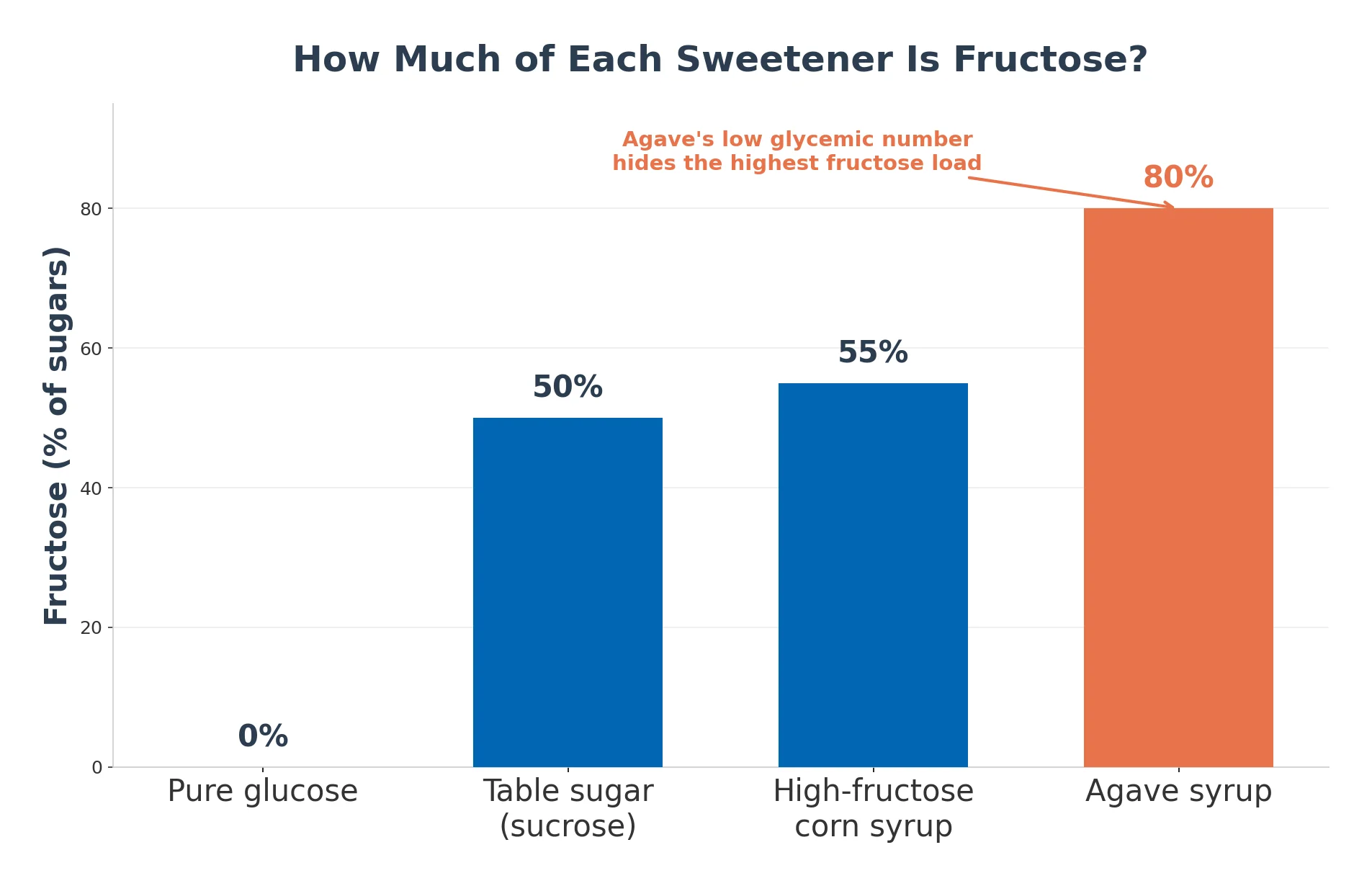
The reason is chemistry rather than health, because agave syrup runs 70 to 90 percent fructose, higher than table sugar or corn syrup.
High-fructose corn syrup sits close to regular sugar, at roughly 55 percent fructose against sucrose’s 50 percent.
A meta-analysis comparing the two found no meaningful difference between high-fructose corn syrup and regular sugar for weight or metabolic markers.
So corn syrup and cane sugar come out close to a wash, and agave’s low glycemic number hides a high fructose load.
How Much Added Sugar Can a Runner Have in a Day?
Added sugar is the sugar put into food and drinks, separate from the sugar built into whole foods like fruit and milk, or into your sports fuel.
The American Heart Association caps added sugar at about 25 grams a day for women and 36 grams a day for men.
That ceiling covers the sugar in your coffee, your cereal, and your evening treat, and it is easy to pass without noticing.
Most of that hidden sugar comes from drinks, so a single sweetened soda or bottled coffee can use up a full day’s allowance on its own.
The carbohydrate you take in during and right after a hard run counts as fuel, and it sits outside your daily added-sugar limit.
The everyday sugar you sprinkle and stir is where the type barely matters and the amount matters a lot.
Ready For More?
Then start our FREE Race Day Fueling email course!
You’ll learn how to calculate when you’ll bonk, how to hydrate, what foods to eat during your race, and more! From case studies to scientific research, we’ll help you learn how to best fuel for your next race.
Do No-Calorie Sweeteners Like Splenda Beat Sugar?
No-calorie sweeteners skip the sugar question by tasting sweet with essentially no carbohydrate.
Splenda is the brand name for sucralose, which starts as sugar and gets modified so your body cannot break it down for energy.
Sucralose is one of the most heavily reviewed additives on the market, and the FDA approved it in 1998 after examining more than 110 safety studies.
European regulators reached the same conclusion in a 2026 re-evaluation that reaffirmed sucralose is safe at normal intakes.
One recent finding is worth understanding rather than fearing, because a 2023 laboratory study reported that a trace byproduct of sucralose damaged DNA in isolated cells.
That study used cells in a dish rather than people, and no human research has shown harm at the amounts people normally consume.
On blood sugar, sucralose has little effect on its own, and a meta-analysis of sweetener drinks found no meaningful rise in glucose or insulin compared with water.
The gut is where the real debate sits, and the answer depends on how much you use.
A 2025 trial found that 30 days of daily sucralose raised glucose and insulin and shifted gut bacteria in healthy volunteers.
An occasional packet looks fine, while a diet built on artificially sweetened drinks all day is worth reconsidering, which is one more reason to train your gut around what you plan to race on.
Stevia and monk fruit are plant-derived no-calorie options that behave much like sucralose in your body, with a good track record of gut-friendly use.
None of these sweeteners are health foods, and none of them give your muscles anything to burn.
Which Sugar Should You Use Around Your Runs?
The sugar that matters for your running is the one you take in as fuel, and here plain, fast sugar wins.
During a hard effort your muscles want glucose they can absorb quickly, which is exactly what table sugar, sports drinks, and gels deliver.
Sports nutrition research supports 60 grams of carbohydrate per hour for runs over an hour, rising toward 90 grams for long ultra efforts.
A low-glycemic natural sugar is the wrong tool mid-run, when you want fuel that reaches your muscles fast rather than slowly.
For a run under an hour you may not need to swallow anything, since even rinsing a sweet drink and spitting it out can help a short, hard effort.
Away from training, the everyday choice comes down to using less intense sweetness rather than hunting for a magic sugar.
Your taste buds adjust within days, and knowing how much sugar you need around hard sessions matters far more than which bag sits in your pantry.
| Sweetener | What it is | Everyday vs white sugar | Runner use |
|---|---|---|---|
| White / cane / beet sugar | Pure sucrose | Baseline | Fast fuel during and around runs |
| Brown / raw / demerara | Sugar with molasses | No real difference | Same as white sugar |
| Coconut / date sugar | Sugar plus a little fiber | Slightly lower blood-sugar rise | Too slow to fuel a run |
| Agave | 70 to 90 percent fructose | Low glycemic, high fructose load | Poor fuel choice |
| Sucralose / stevia / monk fruit | No-calorie sweeteners | No sugar, sweet taste | No fuel value |
Use whatever sugar you like in moderation off the road, and save the fast, simple carbohydrate for the miles that need it.