You’ve heard coaches talk about cadence like a secret formula: find the magic number, hit it consistently, and you’ll run faster with fewer injuries.
The reality is more interesting.
Your running turnover, also called cadence or stride rate, is the number of times your feet strike the ground per minute, measured in steps per minute or spm.
Your optimal cadence isn’t something you inherit but something you optimize through understanding research, testing your body, and training it deliberately.
Cadence changes cascade through your whole running system, as higher cadence reduces joint forces, shifts muscle work patterns, and changes whether you stay healthy or end up injured.
There’s a catch: increasing cadence is a skill that takes weeks to rewire into your nervous system, and it won’t feel natural during that transition.
This article walks you through the research-backed answer to the most common question we hear about turnover, which is how to actually increase it safely and why you should bother.
In this article, you’ll learn:
- What running turnover actually is and why coaches care about it
- The research on cadence and injury prevention
- What cadence you should actually aim for and why 180 is a myth
- The science behind how higher cadence affects running economy
- Proven drills and methods to raise your cadence safely
- How long it takes for a new cadence to feel natural
What Is Running Turnover and Why Does It Matter?
Running turnover is the number of times your foot strikes the ground in one minute, measured in steps per minute.
Coaches obsess over cadence because it’s one of the few variables you can directly control that changes how your body absorbs force with every step.
Your body has two ways to cover distance: stride length and cadence.
Taller runners naturally take longer strides, while shorter runners take more frequent steps.
But almost every runner can shift their balance between these two, and that shift matters because shorter, quicker steps change the loading pattern through your joints.
When you take longer strides at slower cadence, you spend more time in contact with the ground before pushing off.
That contact time is your braking phase, your opportunity to slow down before the next stride.
The longer you brake, the more force your joints absorb.
Your knee, hip, and ankle have to handle bigger impacts, and repeated high loads over weeks of training stress tissues that aren’t adapted to it.
When you increase your cadence and take more frequent, slightly shorter steps, you reduce ground contact time.
Less contact time means less braking phase, which means lower peak forces through your joints.
This is why cadence is one of the most evidence-backed levers for reducing injury risk in runners.
What Cadence Should You Actually Aim For?
You’ve probably heard the number 180 steps per minute.
Coaches mention it constantly, and many running watches alert you if you dip below it.
It’s treated like the universal cadence target, and the number has research roots even though it oversimplifies what the data actually shows.
The 180 spm benchmark came from running coach Jack Daniels, who observed that elite distance runners naturally tended toward that rate.
His observation was accurate, but it also revealed enormous individual variation.
Some elite runners sustain 160 spm while others run 190 or higher.
That variation is real, and it correlates with height, leg length, running speed, fitness level, and terrain.
Research has shown that your body naturally selects a stride rate that minimizes the metabolic cost of running.
That preferred rate, sometimes called your optimal cadence, usually falls somewhere between 160 and 180 spm.
The word “optimal” carries more weight than it seems.
Cavanagh and Williams’ landmark 1982 study found that runners clustered around individual preferred rates, and when forced to deviate significantly from that preference, their oxygen consumption increased.
That means your cadence is partly an economy question.
Your body has a natural point where the mechanical cost of moving your legs meshes with the metabolic cost of supporting your body weight.
But it’s not the same natural point for everyone.
180 is a useful floor where research suggests many runners see injury-prevention benefits and economic efficiency.
But if you’re 5’2″ with short legs, aiming for 180 might be mechanically awkward.
If you’re 6’2″, 180 might feel artificially slow.
Your job is to find your natural cadence first, then test what happens when you shift it upward slightly.
A simple test works well: on your next easy run, just run naturally without thinking about cadence and feel the rhythm.
Count your steps for 15 seconds and multiply by 4 to get your natural, unforced cadence.
A few days later on another easy run, try deliberately increasing that by 5 to 10 percent and run at that faster rate for 5 minutes while noticing whether it feels mechanically fluid or forced and awkward.
If it’s fluid, you’ve found a cadence that’s slightly higher than your current preference but achievable.
If it’s awkward, you’ve overshot your natural range for now.
That feedback is how you map your cadence zone.
How Does Higher Cadence Reduce Your Injury Risk?
The injury-prevention case for higher cadence is one of the clearest pieces of evidence in running biomechanics research.
A 2011 study found that raising step rate by just 10% cut the impact shock on runners’ knees and hips significantly.

That’s from the Heiderscheit et al. 2011 study, one of the most cited papers on cadence and injury prevention.
The team took 37 female runners and had them increase their natural step rate by 10 percent.
The result: significant reductions in the forces and angles that load the knee and hip joint.
That joint loading matters because the shock intensity every time your foot hits the ground is called your vertical loading rate, and runners with high loading rates get injured more often.
Overstriding runners, meaning those with long strides and slow cadence, tend to land with their foot in front of their body’s center of mass, which creates a braking phase that multiplies impact.
Each impact reverberates up through your ankle, knee, hip, and lower back, and multiplied across 100 feet per mile, you accumulate damage that leads to chronic stress injuries.
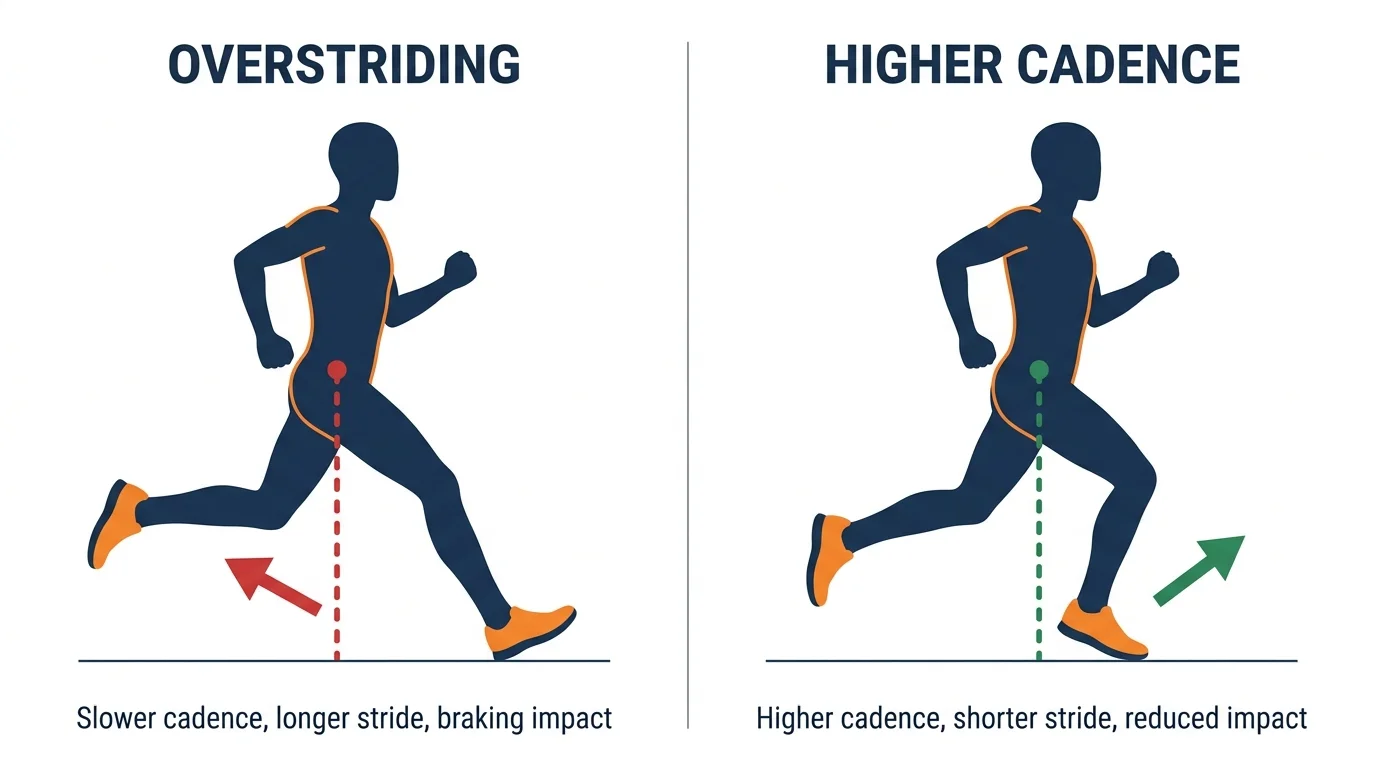
A 2014 systematic review found that overstriding and slower cadence are associated with higher rates of knee injuries, particularly patellofemoral pain.
When you increase cadence and shorten your stride, you compress ground contact time rather than eliminating it, because your foot lands underneath your body instead of in front of it.
That alignment change affects everything.
The mechanism is straightforward: less ground contact time, lower peak loads, fewer tissues stressed on every single step.
Over a training block of 40 miles per week, at 180 steps per mile, that’s 7,200 foot strikes.
If each one is 4 to 7 percent lower in peak load, the cumulative stress reduction is enormous.
Does Higher Cadence Hurt Your Running Economy?
Taking more steps per minute intuitively sounds like it should cost more energy: more muscle contractions, more metabolic cost, slower running.
The research tells a different story.
Running economy, your oxygen consumption at a given pace, is affected by cadence, but not in the simple “faster cadence equals harder work” way that intuition suggests.
A 2016 study found that roughly a third of participants improved efficiency with higher cadence, another third saw no change, and a smaller group showed minor declines.
The variation depends on how much biomechanical improvement they gain from the cadence change versus the metabolic cost of moving their legs faster.
The key distinction is between metabolic cost per stride versus metabolic cost per unit distance.
Higher cadence means more contractions per minute, but you’re also covering distance with shorter, more efficient strides that absorb less energy as wasted impact.
The net effect is individual, with runners coming out ahead economically in many cases, neutral in others, and rarely showing significant declines.
The injury-prevention benefit of higher cadence is usually so large that even if your economy dips slightly, your overall performance and health improve because you train consistently without injury layoffs.
The economy question becomes secondary when the alternative is a six-week injury recovery that costs you 15 percent of your training.
How to Raise Your Cadence Without Ruining Your Form
This is where cadence training breaks down: runners try to force the change all at once, and it wrecks their running form instantly.
Your body has spent thousands of miles training itself to move at a certain cadence.
That movement pattern is wired into your nervous system, and your muscles, tendons, and neuromuscular recruitment patterns are all optimized for that rate.
If you suddenly jump from 160 spm to 190 spm, you’ll fight your own body every step.
Your form will collapse, your stability will vanish, and you’ll feel completely uncoordinated.
A lot of runners quit at this point because it feels wrong, and it is wrong at that speed of change.
Increasing cadence is a skill: you teach your neuromuscular system to prefer it rather than forcing it.
Four evidence-backed methods actually work.
Gradual increases of 5 to 10 percent per week.
If your natural cadence is 170 spm, your Week 1 target is 179 spm, Week 2 is 188 spm, and Week 3 is 197 spm.
These aren’t massive jumps, and your body can adapt to small increments without fighting itself.
Start with this progression on your easy, recovery runs where you have the most stability and lowest speed demand.
Once comfortable at 179 spm for a full easy run, hold that for two to three weeks before adding the next 5 percent increase.
Slow progression wins because it lets your body rewire without panic.
Use a metronome or music at your target cadence.
Download a metronome app on your phone, set it to 180 spm or your chosen target rate, and run to the beat for 5 to 10 minutes early in an easy run.
This works because it gives your nervous system an external rhythm to lock onto, and after 10 minutes of consciously following the beat, your body often maintains that rhythm naturally for the next 20 minutes without the audio.
Over weeks, that conscious practice becomes automatic, and many runners find this faster than gradual speed-based progression because they’re training the motor pattern directly.
Match cadence to running effort.
Your cadence naturally increases when you run faster or uphill, which is free training.
On workout days with tempo runs or hill repeats, your cadence spikes naturally as your body learns to feel and sustain higher cadence under load.
This method integrates cadence training into your normal training stress without adding extra work.
Use form cues that support higher cadence.
Cadence is a result of movement patterns, not an isolated metric.
The cues that drive higher cadence without forced stiffness include a slight forward lean from your ankles rather than your waist, quicker knee drive rather than overreaching with your foot, and quieter footfalls that mean lighter contact and shorter ground contact time.
These cues point toward shorter strides and more frequent steps, and they’re not mechanical restraints but directions that your body naturally follows.
Use one cue at a time during practice runs, and once it feels embedded, add the next.
The cardinal rule: never sacrifice form for cadence number.
If you’re at 180 spm but your form is choppy, your knees are locked, or you’re shuffling with tiny, exhausting steps, that’s not success.
That’s form breakdown, which is counterproductive.
Scale back to 175 spm, dial in smooth, relaxed running, and then progress slower.
A cadence increase that breaks your movement pattern is counterproductive.
The goal is to increase cadence while maintaining relaxed, fluid running mechanics.
Making that change lasting takes progression and repetition through progressive drills and skill-building over time.
Our Improve Running Form course walks through the specific drills, strength work, and mental cues that actually rewire movement patterns over weeks of practice.
Drills That Actually Increase Your Turnover
Drills are the neuromuscular accelerator for cadence training.
They train your system to feel and produce higher cadence in isolation, so that when you run, the feeling is more familiar.
High-knees.
Run in place, driving your knees up to hip height, which forces a quick ground contact time and naturally higher cadence.
Start with 20 seconds on, 40 seconds recovery, repeated for 3 to 5 rounds, once per week before an easy run.
The burn you feel is your hip flexors and quads learning the recruitment pattern, and you can progress by extending duration to 30 seconds once 20 seconds feels controlled.
Butt-kicks.
Run in place, bringing your heels to your glutes with each stride, which compresses ground contact and increases cadence by necessity.
Butt-kicks are less intense than high-knees and can be sustained longer, so try 30 seconds for 4 rounds.
The feeling of extremely quick feet and minimal ground contact is exactly what you want to transfer to regular running.
Quick-step drill.
Identify a 50-meter stretch and run that distance focusing on rapid, light foot strikes while pretending you’re running over hot coals to minimize contact time.
Land softly and strike quickly without overthinking stride length, and your nervous system learns the sensation without the energy demand of actually running at that pace.
Do this drill 3 to 4 times per session with full recovery between reps, and progress by increasing the distance once the 50-meter feels controlled.
Single-leg bounds.
Push off with one leg and land on the other, which trains explosive power and forces quick turnover because bounds naturally happen at a rapid rate.
Start with 3 to 4 bounds per leg for 5 rounds, and do this twice per week early in your training week when fatigue is lowest since it’s muscularly demanding.
A sample weekly drill structure puts high-knees and quick-step on Monday at three rounds each for 10 to 15 minutes total, then butt-kicks and bounds on Thursday at three rounds each for 15 to 20 minutes total.
Neither session is intense enough to tire you out for other training, but both are frequent enough to rewire your motor pattern.
The common mistake is doing drills once and expecting transformation, but drills work because they’re repetitive practice.
Your nervous system needs repeated exposure to the cadence pattern for it to feel normal, and after 4 to 6 weeks of consistent twice-weekly drills, your body starts preferring the faster cadence.
After 12 weeks, it feels automatic.
How Long Does It Take to Adapt to a Higher Cadence?
Your brain and muscles are both skeptical of change, and cadence adaptation requires your nervous system to rewire the motor pattern it’s been practicing for years.
Weeks 1 to 2 feel awkward because your cadence feels forced, your legs feel heavy, and your mind monitors every step, which is normal as your neuromuscular system learns the new pattern.
Weeks 3 to 6, the pattern starts feeling more automatic and you still have to think about it, but not every step.
Weeks 8 to 12, the higher cadence starts feeling like your natural rhythm, and if you stop thinking about it, you often drift back to your old cadence but can slip back easily.
After 12 weeks of consistent practice, the new cadence feels automatic as your nervous system fully rewires the pattern.
This timeline assumes consistency: if you drill twice weekly and practice cadence awareness three times weekly, you hit the timeline, but if you practice sporadically, the timeline stretches to 16 to 20 weeks and dropout is common.
The key variable is frequency of practice, not absolute time.
Your nervous system needs regular exposure to the new pattern.
Once or twice per week is maintenance-level practice.
Three or four times weekly is the adaptation-accelerating sweet spot.
Daily exposure is excessive and usually means you’re overthinking it.
The most common pitfall is giving up in weeks 2 to 4, when the cadence still feels unnatural but other runners appear to have adapted easily, even though they’re just further along the same timeline.
Persist through the awkward phase and you’ll reach automatic by week 12, but stop practicing and you’ll reset to zero.