
It’s week 8 of marathon training in January, it’s dark by 5pm, and your goal-pace long run is happening on the treadmill whether you like it or not.
Every treadmill guide tells you to set the incline to 1% so the run matches outdoor effort. Almost none of them tell you where that number came from.
It came from a laboratory: 9 trained runners, 6 speeds, 5 treadmill grades, and one seafront promenade in Eastbourne, England, in 1996.
What that study found is more useful than the rule everyone repeats, and in one important way it’s the opposite of what most treadmill articles tell you.
So, in this article you’re going to learn:
- The primary source behind the 1% treadmill incline rule and what it actually tested
- The exact pace range where 1% is validated, and what to use above and below it
- Why the treadmill costs your body less energy than the road at the same speed
- The 2024 research that challenges the 1% recommendation
- How to structure treadmill workouts so the fitness shows up outdoors
Where Does the 1% Treadmill Incline Rule Come From?
The 1% figure traces to a single paper: Jones, A.M. and Doust, J.H., “A 1% treadmill grade most accurately reflects the energetic cost of outdoor running,” Journal of Sports Sciences, 1996, volume 14, issue 4, pages 321 to 327 (DOI 10.1080/02640419608727717, PMID 8887211).
The researchers took 9 trained male runners and had each of them run 6 minutes at six different speeds, on six separate days, under six conditions. Five of those conditions were treadmill runs at grades of 0%, 0%, 1%, 2% and 3%, and the sixth was a level road.
The six speeds were 2.92, 3.33, 3.75, 4.17, 4.58 and 5.0 metres per second, which is 10.5 to 18.0 km/h, or 9:11/mi (5:42/km) down to 5:22/mi (3:20/km). Oxygen consumption was measured by Douglas bag during the last 2 minutes of every run, with a duplicate collection each time to confirm the numbers were repeatable.
That protocol is why this study became the reference point. The runners wore the same shoes every session, the outdoor course was flat to within 0.2 m over 1.6 km, and outdoor runs were only performed when wind speed was under 2.0 m/s.
If you have ever wanted the citation for the 1% rule, it is Jones and Doust, Journal of Sports Sciences, 1996, and no other paper established the number.
Did the ACSM Create the 1% Incline Rule?
The recommendation is widely credited to the American College of Sports Medicine, and that attribution is wrong. The ACSM publishes metabolic equations that estimate the oxygen cost of treadmill running and include a term for grade, which is where the confusion starts, but the 1% figure itself was never an ACSM position stand.
Jones and Doust noted that earlier labs had already been using slight inclines to compensate for missing air resistance, with Heck and colleagues choosing 1.0% in 1985 and Tegtbur’s group choosing 2.0% in 1993. Neither of those groups published data supporting their choice, which is precisely the gap the 1996 study was designed to fill.
So when a treadmill manual or a coach cites “the ACSM 1% recommendation,” the number they are quoting still traces back to those 9 runners in Eastbourne.
What Did the 1% Incline Study Actually Find?
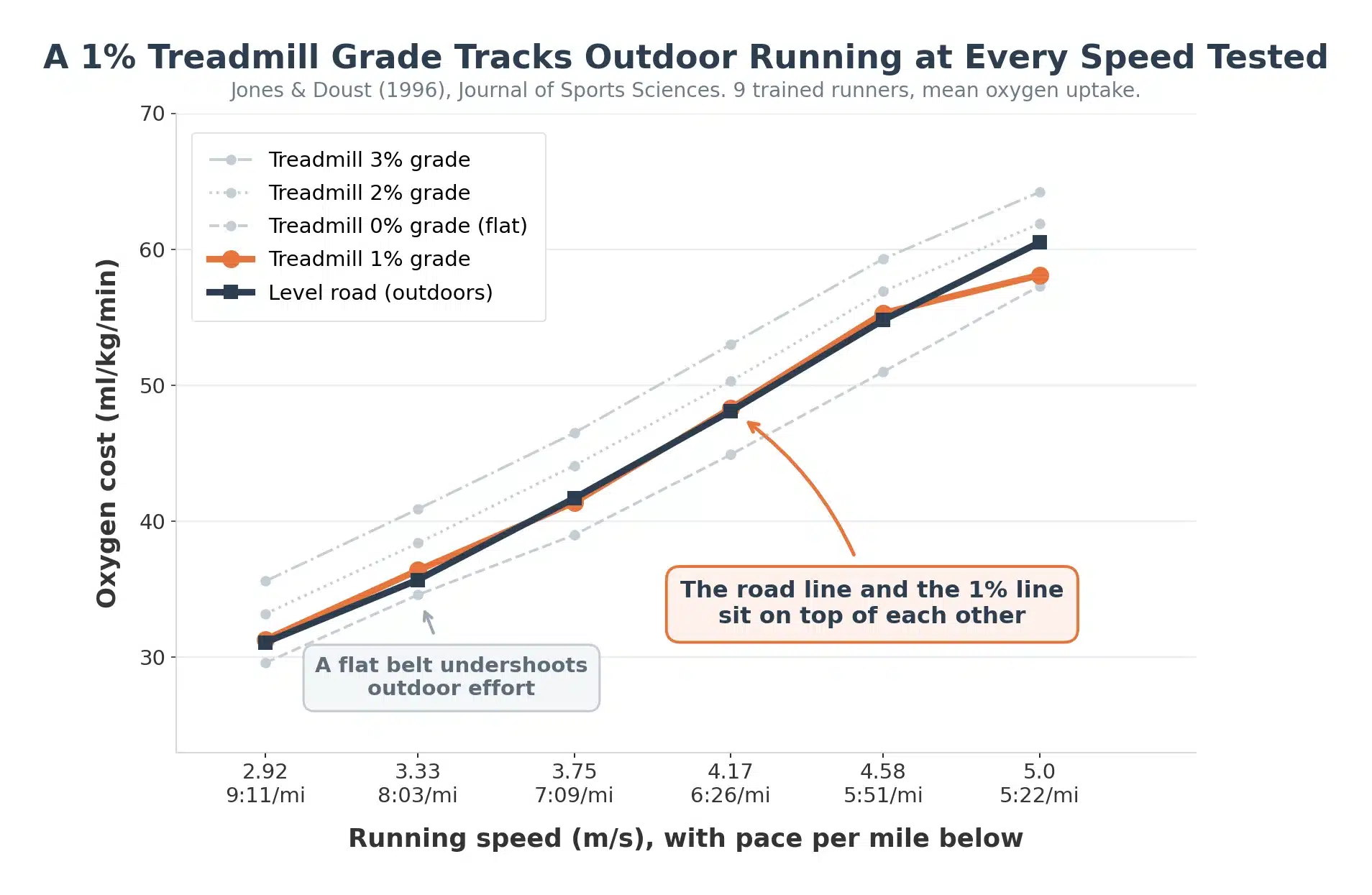
Oxygen uptake on the level road was not significantly different from oxygen uptake at 1% treadmill grade at any speed the researchers tested.
The 1996 trial found a 1% treadmill grade matched the oxygen cost of outdoor running across every speed from 9:11 per mile (5:42/km) to 5:22 per mile (3:20/km).

That range is the part most articles get backwards. The 1% grade held all the way up to 18 km/h, which is faster than 5k race pace for the overwhelming majority of runners.
Running flat, on the other hand, failed. At 3.75 m/s and above, treadmill running at 0% grade produced significantly lower oxygen uptake than the road, and 2% and 3% grades overshot it at the slower speeds.
| Speed tested | Pace per mile | Pace per km | Grade that matched the road |
|---|---|---|---|
| 2.92 m/s (10.5 km/h) | 9:11 | 5:42 | 0% or 1% |
| 3.33 m/s (12.0 km/h) | 8:03 | 5:00 | 0% or 1% |
| 3.75 m/s (13.5 km/h) | 7:09 | 4:27 | 1% only |
| 4.17 m/s (15.0 km/h) | 6:26 | 4:00 | 1% or 2% |
| 4.58 m/s (16.5 km/h) | 5:51 | 3:38 | 1% or 2% |
| 5.00 m/s (18.0 km/h) | 5:22 | 3:20 | 1% or 2% |
The authors went one step further and extrapolated beyond their data. They suggested that at speeds around 5 to 6 m/s, roughly 5:22/mi (3:20/km) to 4:28/mi (2:47/km), a 2% grade would probably fit better, and that at 2 to 3 m/s, roughly 13:25/mi (8:20/km) to 8:56/mi (5:33/km), 0.5% is the more appropriate setting.
So the rule has a floor and a ceiling, and almost every pace you train at sits comfortably between them.
RunnersConnect Bonus
Download your FREE Treadmill Guide for Runners.
The guide contains 4 treadmill specific workouts guaranteed to keep you sane and fit! You’ll learn about the In-N-Out workout, how to “run like an Egyptian” and get my favorite “green eggs and ham” workout.
Why Does Treadmill Running Cost Less Energy Than Running Outside?
On the road your body has to push a column of air out of the way, and on a treadmill it doesn’t. That single difference is the reason the treadmill feels easier than the road at an identical display pace.
Classic physiology work established that the force of air resistance rises with the square of running velocity, so doubling your speed quadruples the air you have to push through.
Jones and Doust measured how big that penalty is. Running flat indoors instead of on the road understated oxygen cost by about 1.5 ml/kg/min at 9:11/mi (5:42/km), rising to about 3 ml/kg/min at 5:22/mi (3:20/km).
In pace terms that gap is worth roughly 14 seconds per mile at easy pace and about 19 seconds per mile at 5:22/mi (3:20/km), using the velocity offsets the authors reported. Heart rate told the same story, running about 3 to 4 beats per minute higher on the level road than on the flat belt, and up to 8 beats higher at speed.
That is the entire case for adding incline. The grade buys back the work that still indoor air removes from the run.
What Incline Should You Set for Your Pace?
For nearly every run you do, the answer is 1%, and the study supports using it across a far wider pace range than most runners assume.
| Your pace | Incline | Why |
|---|---|---|
| Slower than 9:11/mi (5:42/km) | 0.5%, or flat if your belt won’t do halves | Below the tested range. The authors’ own extrapolation puts the best fit near 0.5%. |
| 9:11/mi to 5:22/mi (5:42 to 3:20/km) | 1% | The validated range. Oxygen cost matched the road at every speed in this band. |
| Faster than 5:22/mi (3:20/km) | 2% | Beyond the tested range. The authors projected 2% as the better fit at 5 to 6 m/s. |
Easy runs, steady runs, marathon-pace work, threshold repeats and most interval sessions all land inside that middle band. Set the machine to 1% and leave it there.
Raising the incline to 2% or 2.5% for tempo and interval work is a common recommendation that the research does not support, and it makes those sessions harder than the outdoor equivalent you’re trying to copy.
If your treadmill only moves in 1% steps, use 1% and stop worrying about the remainder. The difference between 0.5% and 1% at easy pace is smaller than the day-to-day variation in your own running economy.
When Does the 1% Rule Stop Working?
The rule is a laboratory average, and there are three situations where it stops being reliable.
The first is speed. Jones and Doust explicitly cautioned against extrapolating above 5.0 m/s, because the relationship between oxygen uptake and velocity becomes increasingly curved at higher speeds and their linear fit no longer holds.
The second is the machine itself. Belt friction, motor characteristics and grade calibration differ between treadmills, and a gym machine that has run 4,000 hours does not behave like a laboratory Woodway.
The third is the most interesting, because newer research has started to push back on the rule directly.
A 2024 study from ETH Zurich put 14 highly trained runners through 5-minute efforts at 14 km/h, which is about 6:54/mi (4:17/km), on a track and on a treadmill. Oxygen uptake came out 12.6% higher on the treadmill than on the track, and adding a 1% incline raised it a further 4.4%, pushing the treadmill further from the outdoor value.
That study used one treadmill model and a small sample, so 30 years of practice survives it. It does mean treadmills vary enough that the authors told every lab to test its own machine before assuming the correction applies.
Treat 1% as your default and your perceived effort as the tiebreaker, because a pace that feels harder on the belt than it does on the road means the belt is the more honest signal.
What Doesn’t Incline Fix?
Matching oxygen cost is not the same as matching the run. Incline corrects the energy books and leaves the mechanics of the stride largely alone.
A 2020 systematic review and meta-analysis concluded that treadmill and overground running are broadly comparable, with small but consistent differences including longer ground contact time on the belt.
The bigger loss is proprioceptive. Outdoor running asks your nervous system for thousands of small corrections per run, for camber, gravel, roots and puddles, and a moving belt asks for none of them.
Over a long winter block that shows up as a stride that has quietly narrowed its range. You keep your aerobic fitness and you lose some of the reflexive stability that makes outdoor running feel automatic.
The fix is exposure rather than incline. Hill running restores the neuromuscular demand the belt removes, so one hill session every 2 to 3 weeks during a treadmill-heavy block keeps that system honest.
How Do You Structure Treadmill Workouts So They Translate Outdoors?
Different workouts have different sensitivity to the treadmill, so treat them differently.
Easy runs. Run them on the belt without a second thought at 1%, and use the treadmill’s biggest advantage, which is that it will not let you drift faster than the pace you set.
Threshold and tempo. Keep the grade at 1% and shorten the blocks, turning a 20-minute outdoor tempo into 2 x 10 minutes with a short jog between, which holds your form together while you bank the pacing precision the belt gives you for free.
Intervals. Stay at 1% unless you’re running faster than 5:22/mi (3:20/km), and cap the reps at 3 to 5 minutes for VO2 max work.
Long runs. Cap the treadmill portion at 90 minutes and finish outdoors, because past that point your form drifts far enough that you’re rehearsing a stride you won’t use on race day.
Run one hard session outdoors every 2 to 3 weeks during a treadmill block, because that run is the only thing that tells you whether your indoor pacing is real.
Use that outdoor session as a calibration check. If goal pace feels easy out there, your treadmill has been flattering you, and if it feels brutal, your grade or your belt speed has been running hot.
RunnersConnect Bonus
Download your FREE Treadmill Guide for Runners.
The guide contains 4 treadmill specific workouts guaranteed to keep you sane and fit! You’ll learn about the In-N-Out workout, how to “run like an Egyptian” and get my favorite “green eggs and ham” workout.
Conclusion
The 1% rule is real, it comes from Jones and Doust in 1996, and it holds across a wider pace band than almost anyone gives it credit for. From 9:11/mi (5:42/km) to 5:22/mi (3:20/km), a 1% grade put oxygen cost on par with the road at every speed tested.
Set the belt to 1% and leave it. Drop to 0.5% if you’re running slower than 9:11/mi (5:42/km), go to 2% if you’re running faster than 5:22/mi (3:20/km), and ignore the advice to climb to 2.5% for tempo work.
Then accept that incline solves one problem and not the others. Get outdoors for one hard session every 2 to 3 weeks, run hills through the winter, and your January treadmill miles will show up in April exactly where you want them.